PUBLISHER: Mordor Intelligence | PRODUCT CODE: 2100637

PUBLISHER: Mordor Intelligence | PRODUCT CODE: 2100637
India Hospitality - Market Share Analysis, Industry Trends & Statistics, Growth Forecasts (2026 - 2031)
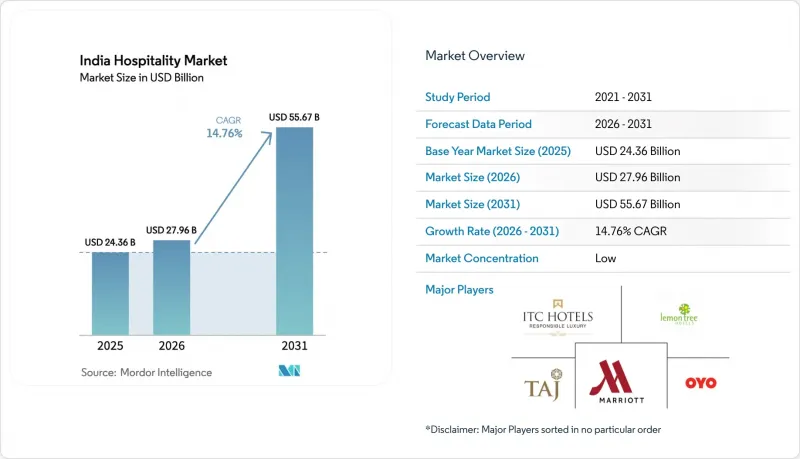
According to Mordor Intelligence, the India hospitality market size is projected to be USD 24.36 billion in 2025, USD 27.96 billion in 2026, and reach USD 55.67 billion by 2031, growing at a CAGR of 14.76% from 2026 to 2031.
This report is Segmented by Type (Chain Hotels, Independent Hotels, and Alternate Accommodations), Accommodation Class (Luxury, Mid & Upper-Mid-Scale, Budget & Economy and Others), Booking Channel (Direct Digital, Online Travel Agencies, Corporate/MICE, and Wholesale & Traditional Agents), and Geography (North, West, South, East, North-East India). Market Forecasts are Provided in Terms of Value (USD).
India Hospitality Market Trends and Insights
Rising Domestic Middle-Class Leisure Spend
Rising incomes among India's growing middle class are driving strong growth in domestic leisure travel. According to the India Tourism Data Compendium 2025, domestic tourism far exceeds inbound travel, with spending reaching around USD 185 billion in 2024. Younger travelers are increasingly opting for experience-led trips, including cultural, adventure, and wellness travel, boosting per-trip expenditure. Supportive government initiatives like improved connectivity and Dekho Apna Desh campaigns have made travel more accessible, making the middle class a key driver of India's tourism growth. Operators benefit from greater spend per trip and more frequent weekend getaways, trends that support occupancy and allow careful revenue management during peak seasons. The dispersion of demand beyond metros into Tier-1 and key Tier-2 cities strengthens local corridors, lifts room-night absorption, and encourages conversions of unbranded properties into organized flags. The India hospitality market, therefore, draws strength from domestic leisure resiliency, which limits volatility from corporate cycles and inbound shocks. These shifts support steady pricing power in urban and leisure clusters where branded supply is still building out.
Government Initiatives Supporting Market Growth
Tourism programs focused on circuits, destinations, and digital discovery continue to expand the investable landscape in the India hospitality market. The Ministry of Tourism has sanctioned projects under Swadesh Darshan 2.0 and PRASHAD to strengthen infrastructure at high-traffic religious and cultural sites, and it is rolling out connectivity projects that improve access to secondary destinations. The government's Incredible India initiatives and the digital platform have enhanced awareness and discovery, with large volumes of domestic visits recorded on official platforms in 2024 as part of sustained promotion of top destinations. Expansion in operational airports has improved airlift into multiple state capitals and leisure hubs, reinforcing traffic into both business and holiday markets. Budget allocations to tourism infrastructure in FY26 underscore a steady policy impetus that helps de-risk investment planning for operators and developers. Over time, these measures are expected to distribute demand more evenly across regions, reduce seasonality, and drive a healthier mix of trip purposes.
High GST on Premium Room Tariffs
The current GST structure imposes a higher tax on rooms above a certain tariff threshold, which reduces net yields for premium city hotels and upscale leisure resorts. This limits India's price competitiveness compared to some Southeast Asian destinations for high-value leisure and MICE travelers. Margin pressures also arise for operators when input costs and tax credits are restricted at lower tariff bands, affecting pricing flexibility for budget and mid-scale hotels. These challenges are particularly pronounced in top metros, where mid-tier average daily rates often approach or exceed the GST threshold. Operators must carefully balance occupancy and rate strategies to maintain demand while protecting profitability. In the near term, the market needs to design offerings that preserve rate integrity while ensuring value for guests managing higher trip expenses.
Other drivers and restraints analyzed in the detailed report include:
- Budget & Mid-Scale Chain Expansion
- Upgraded Pilgrimage Circuits Driving Spiritual & Wellness Tourism
- Transport Infrastructure Gaps in Tier-2/3 Airports & Rail
For complete list of drivers and restraints, kindly check the Table Of Contents.
Segment Analysis
Independent Hotels held 56.45% of the India hospitality market share in 2025, while Chain Hotels are projected to grow at a 16.76% CAGR through 2031 as asset-light models support wider, faster expansion. Operators are converting unbranded inventory into standardized flags that leverage loyalty, distribution technology, and brand quality audits to lift visibility and rate realization. The hospitality sector in India benefits from conversions that enhance hygiene and safety standards, which increases trust among family travelers and international visitors. Global chains are also positioning mid-scale brands in Tier-2 and Tier-3 cities to close the quality gap in corporate corridors and pilgrimage circuits. Organized brands continue to add management contracts that reduce upfront capital needs for developers while creating fee-based revenue streams for operators.
Independent operators still anchor local markets where entrepreneurial ownership and location advantages remain strong. Even so, brand affiliation is gaining traction because it can reduce marketing and distribution spends and help stabilize occupancy across seasons. With organized hotels representing a small portion of total rooms, conversion-led growth remains a durable theme for the hospitality industry in India. Digital reviews and meta-search comparisons also reward standardization, nudging independents to adopt brand systems to protect demand from OTA-driven price wars. As a result, Chain Hotels' share should rise as conversions accelerate and new management agreements add keys in strategically important nodes.
Complete Report Scope:
- By Type
- Chain Hotels
- Independent Hotels
- Alternate Accommodations (Serviced Apts, Branded Hostels)
- By Accommodation Class
- Luxury
- Mid & Upper-Mid-scale
- Budget & Economy
- Service Apartments
- By Booking Channel
- Direct Digital
- Online Travel Agencies (OTAs)
- Corporate / MICE
- Wholesale & Traditional Agents
- By Geographic Region
- North India
- West India
- South India
- East India
- North-East India
List of Companies Covered in this Report:
- Indian Hotels Co. Ltd. (Taj)
- Marriott International India
- OYO Hotels & Homes
- ITC Hotels
- Oberoi Hotels & Resorts
- Lemon Tree Hotels
- Accor India (Novotel, Ibis, Pullman)
- Hyatt Hotels India
- Hilton India
- Radisson Hotel Group India
- Wyndham Hotels & Resorts India
- Sarovar Hotels & Resorts
- Chalet Hotels
- Brigade Hospitality
- Royal Orchid Hotels
- Sterling Holiday Resorts
- Club Mahindra
- Treebo Hotels
- FabHotels
- Fortune Park Hotels
Additional Benefits:
- The market estimate (ME) sheet in Excel format
- 3 months of analyst support
TABLE OF CONTENTS
1 Introduction
- 1.1 Study Assumptions & Market Definition
- 1.2 Scope of the Study
2 Research Methodology
3 Executive Summary
4 Market Landscape
- 4.1 Market Overview
- 4.2 Market Drivers
- 4.2.1 Rising domestic middle-class leisure spend
- 4.2.2 Government initiatives supporting the market growth
- 4.2.3 Budget & mid-scale chain expansion
- 4.2.4 Upgraded pilgrimage circuits driving spiritual & wellness tourism
- 4.2.5 Hybrid-work long-stay demand in hill & beach towns
- 4.2.6 e-Visa expansion to 166 countries shortening booking lead-times
- 4.3 Market Restraints
- 4.3.1 High GST on premium room tariffs
- 4.3.2 Transport infrastructure gaps in Tier-2/3 airports & rail
- 4.3.3 Skilled-talent drain to gig economy & GCCs
- 4.3.4 Land-acquisition & CRZ compliance delays for resorts
- 4.4 Value / Supply-Chain Analysis
- 4.5 Regulatory Landscape
- 4.6 Technological Outlook
- 4.7 Porter's Five Forces
- 4.7.1 Threat of New Entrants
- 4.7.2 Bargaining Power of Buyers
- 4.7.3 Bargaining Power of Suppliers
- 4.7.4 Threat of Substitutes
- 4.7.5 Intensity of Competitive Rivalry
- 4.8 Investments & FDI Analysis
- 4.9 Multichannel Distribution Analysis
5 Market Size & Growth Forecasts (Value, USD)
- 5.1 By Type
- 5.1.1 Chain Hotels
- 5.1.2 Independent Hotels
- 5.1.3 Alternate Accommodations (Serviced Apts, Branded Hostels)
- 5.2 By Accommodation Class
- 5.2.1 Luxury
- 5.2.2 Mid & Upper-Mid-scale
- 5.2.3 Budget & Economy
- 5.2.4 Service Apartments
- 5.3 By Booking Channel
- 5.3.1 Direct Digital
- 5.3.2 Online Travel Agencies (OTAs)
- 5.3.3 Corporate / MICE
- 5.3.4 Wholesale & Traditional Agents
- 5.4 By Geographic Region
- 5.4.1 North India
- 5.4.2 West India
- 5.4.3 South India
- 5.4.4 East India
- 5.4.5 North-East India
6 Competitive Landscape
- 6.1 Market Concentration
- 6.2 Strategic Moves
- 6.3 Market Share Analysis
- 6.4 Company Profiles (includes Global level Overview, Market level overview, Core Segments, Financials as available, Strategic Information, Market Rank/Share for key companies, Products & Services, and Recent Developments)
- 6.4.1 Indian Hotels Co. Ltd. (Taj)
- 6.4.2 Marriott International India
- 6.4.3 OYO Hotels & Homes
- 6.4.4 ITC Hotels
- 6.4.5 Oberoi Hotels & Resorts
- 6.4.6 Lemon Tree Hotels
- 6.4.7 Accor India (Novotel, Ibis, Pullman)
- 6.4.8 Hyatt Hotels India
- 6.4.9 Hilton India
- 6.4.10 Radisson Hotel Group India
- 6.4.11 Wyndham Hotels & Resorts India
- 6.4.12 Sarovar Hotels & Resorts
- 6.4.13 Chalet Hotels
- 6.4.14 Brigade Hospitality
- 6.4.15 Royal Orchid Hotels
- 6.4.16 Sterling Holiday Resorts
- 6.4.17 Club Mahindra
- 6.4.18 Treebo Hotels
- 6.4.19 FabHotels
- 6.4.20 Fortune Park Hotels
7 Market Opportunities & Future Outlook
- 7.1 Ayurveda & Holistic Wellness Retreats in Tier-2 Hill/Coastal Destinations
- 7.2 Branded Hostels & Hybrid Co-living Spaces Along Heritage Circuits

