PUBLISHER: Mordor Intelligence | PRODUCT CODE: 2187392

PUBLISHER: Mordor Intelligence | PRODUCT CODE: 2187392
India Interior Design - Market Share Analysis, Industry Trends & Statistics, Growth Forecasts (2027 - 2032)
According to Mordor Intelligence, the India interior design market size is expected to increase from USD 35.48 billion in 2026 to USD 40.05 billion in 2027 and reach USD 72.04 billion by 2032, growing at a CAGR of 12.46% over 2027-2032.
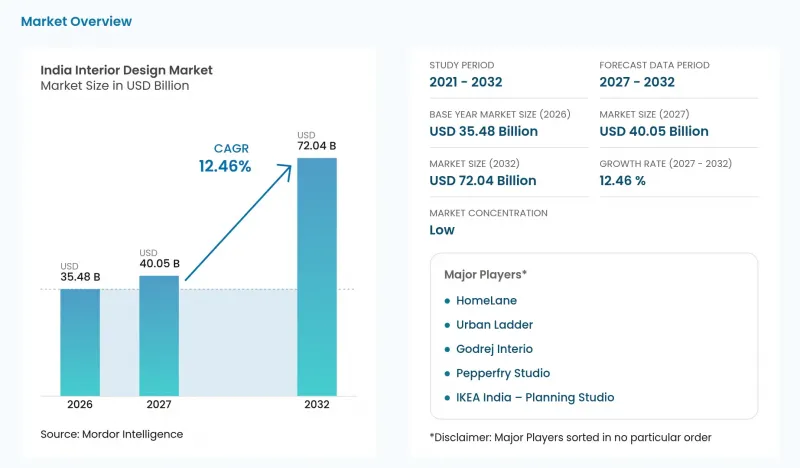
This report is segmented by End-User (Commercial and Residential), Service Type (New Construction and Renovation / Remodeling), Price Tier (Mid-Range, Economy, and Premium / Luxury), and Geography (North India, West India, South India, and East & North-East India). The market forecasts are provided in terms of value (USD), based on availability.
India Interior Design Market Trends and Insights
Rapid urbanization & rising disposable incomes
A large city population creates a broad potential customer base for interior services. UN DESA estimated that India had 589 million city residents in 2025 under its Degree of Urbanization methodology. Deloitte's 2026 assessment of India's interior services described consumers increasingly seeking predictability over design, cost, timelines and execution. For a household renovating its home, professional design can connect the proposed layout and finishes with responsibility for carrying out the work. The same assessment said this creates room for organized players to manage a larger share of the renovation journey, which favors providers that take responsibility for execution as well as design.
Government housing & infrastructure programs (PMAY, Smart Cities)
Government housing programs create a potential customer base for essential interiors, with the commercial opportunity tied to homes becoming usable. On October 16, 2026, the Ministry of Housing and Urban Affairs approved more than 193,000 additional PMAY-U 2.0 houses, bringing cumulative sanctions to 2.08 million for eligible urban families. For design providers, that pipeline favors service packages built around essential room functions rather than extensive customization. A limited scope can make professional assistance relevant to households whose immediate objective is basic occupancy. Demand realization depends on construction completion and subsequent household decisions to commission work. Aligning installation with housing handovers can help providers convert a portion of that construction pipeline into household-commissioned interiors.
Highly fragmented & price-competitive supply side
Organized home-interior providers can face an expensive conversion process before a new household commissions work. In 2026, a Livspace spokesperson said homeowners often defaulted to neighborhood carpenters or interior decorators because trying a new provider felt costly. An unnamed senior partner at a venture firm that evaluated the sector told ETtech that home-interior platforms faced high acquisition costs and little repeat business because customers mostly engaged once. Perceived switching costs can also make the initial sale harder to secure. Acquisition spending must therefore be recovered from a limited set of won commissions, constraining how much providers can spend to expand their residential customer base.
Other drivers and restraints analyzed in the detailed report include:
- Commercial real-estate boom in office, retail & hospitality
- Digital design visualization (VR/AI) accelerating customer acquisition
- Compliance cost of building / green regulations
For complete list of drivers and restraints, kindly check the Table Of Contents.
Segment Analysis
Commercial accounted for a 73.6% share of the India interior design market size in 2026, making it the largest segment. JLL recorded 37.9 million square feet of gross Indian office leasing in the first half of 2026, the second-highest first-half total after 2025. Second-quarter leasing fell to a nine-quarter low of 16.45 million square feet. The measure includes confirmed pre-commitments and excludes term renewals and deals under discussion. Confirmed pre-commitments let workplace designers develop occupier-specific briefs before installation, while the slower quarter makes commitment timing consequential for the flow of commissions.
Residential is the fastest-growing segment, with a forecast CAGR of 16.12% over 2027-2032. HomeLane serves homeowners with design and furnishing services for kitchens, bedrooms and living spaces. Its CEO reported roughly flat company-wide revenue in FY2026, so realizing the segment's forecast requires household adoption beyond any single provider's recent sales. An integrated room offer can bring furnishing choices and spatial design into one engagement, making professional assistance relevant to several functional parts of a home. Converting those room-level needs into a coordinated service brief gives the provider responsibility for how the selected elements work together.
Complete Report Scope:
- By End-User
- Residential
- Commercial
- By Service Type
- New Construction
- Renovation / Remodeling
- By Price Tier
- Economy
- Mid-Range
- Premium / Luxury
- By Geography
- North India
- West India
- South India
- East & North-East India
List of Companies Covered in this Report:
- Livspace
- HomeLane
- Asian Paints - Beautiful Homes Service
- Godrej Interio
- Pepperfry Studio
- DesignCafe
- Urban Ladder
- IKEA India - Planning Studio
- Morphogenesis
- Space Matrix
- Sleek Kitchens (Asian Paints)
- Furlenco Designs
- DWP Interics
- Gensler India
- Perkins & Will India
- Studio Lotus
- AECOM India
- HBA India
- Talati & Partners (TPA)
- K Raheja Design Group
Additional Benefits:
- The market estimate (ME) sheet in Excel format
- 3 months of analyst support
TABLE OF CONTENTS
1 INTRODUCTION
- 1.1 Study Assumptions and Market Definition
- 1.2 Scope of the Study
2 RESEARCH METHODOLOGY
3 EXECUTIVE SUMMARY
4 MARKET LANDSCAPE
- 4.1 Market Overview
- 4.2 Market Drivers
- 4.2.1 Rapid urbanization & rising disposable incomes
- 4.2.2 Government housing & infrastructure programs (PMAY, Smart Cities)
- 4.2.3 Commercial real-estate boom in office, retail & hospitality
- 4.2.4 Digital design visualization (VR/AI) accelerating customer acquisition
- 4.2.5 Specialized interiors for senior & assisted-living facilities
- 4.2.6 Tier-2/3 e-commerce turnkey packages for middle-income homes
- 4.3 Market Restraints
- 4.3.1 Highly fragmented & price-competitive supply side
- 4.3.2 Compliance cost of building / green regulations
- 4.3.3 Pandemic-induced project delays & cash-flow pressures
- 4.3.4 Shortage of accredited designers outside metros
- 4.4 Industry Value Chain Analysis
- 4.5 Regulatory Landscape
- 4.6 Technological Outlook
- 4.7 Porter's Five Forces Analysis
- 4.7.1 Threat of New Entrants
- 4.7.2 Bargaining Power of Suppliers
- 4.7.3 Bargaining Power of Buyers
- 4.7.4 Threat of Substitutes
- 4.7.5 Competitive Rivalry
5 MARKET SIZE AND GROWTH FORECASTS (VALUE)
- 5.1 By End-User
- 5.1.1 Residential
- 5.1.2 Commercial
- 5.2 By Service Type
- 5.2.1 New Construction
- 5.2.2 Renovation / Remodeling
- 5.3 By Price Tier
- 5.3.1 Economy
- 5.3.2 Mid-Range
- 5.3.3 Premium / Luxury
- 5.4 By Geography
- 5.4.1 North India
- 5.4.2 West India
- 5.4.3 South India
- 5.4.4 East & North-East India
6 COMPETITIVE LANDSCAPE
- 6.1 Market Concentration
- 6.2 Strategic Moves
- 6.3 Market Share Analysis
- 6.4 Company Profiles (includes Global level Overview, Market level overview, Core Segments, Financials as available, Strategic Information, Market Rank/Share for key companies, Products and Services, and Recent Developments)
- 6.4.1 Livspace
- 6.4.2 HomeLane
- 6.4.3 Asian Paints - Beautiful Homes Service
- 6.4.4 Godrej Interio
- 6.4.5 Pepperfry Studio
- 6.4.6 DesignCafe
- 6.4.7 Urban Ladder
- 6.4.8 IKEA India - Planning Studio
- 6.4.9 Morphogenesis
- 6.4.10 Space Matrix
- 6.4.11 Sleek Kitchens (Asian Paints)
- 6.4.12 Furlenco Designs
- 6.4.13 DWP Interics
- 6.4.14 Gensler India
- 6.4.15 Perkins & Will India
- 6.4.16 Studio Lotus
- 6.4.17 AECOM India
- 6.4.18 HBA India
- 6.4.19 Talati & Partners (TPA)
- 6.4.20 K Raheja Design Group
7 MARKET OPPORTUNITIES AND FUTURE OUTLOOK
- 7.1 White-Space and Unmet-Need Assessment

