PUBLISHER: Mordor Intelligence | PRODUCT CODE: 2124181

PUBLISHER: Mordor Intelligence | PRODUCT CODE: 2124181
GCC Interior Design - Market Share Analysis, Industry Trends & Statistics, Growth Forecasts (2026 - 2031)
According to Mordor Intelligence, the GCC interior design market size in 2026 is estimated at USD 14.79 billion, growing from 2025 value of USD 13.76 billion with 2031 projections showing USD 21.18 billion, growing at 7.46% CAGR over 2026-2031.
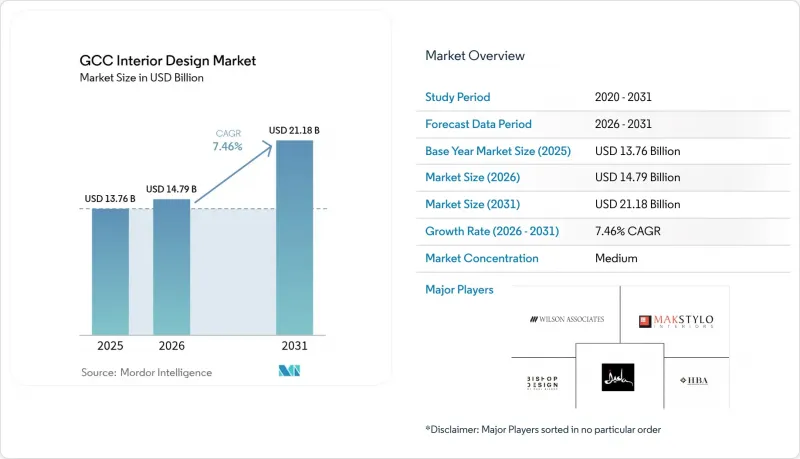
This report is Segmented by End-User (Residential, Commercial), Service Type (New Construction, Renovation/Remodeling), Price Tier (Economy, Mid-Range, Premium/Luxury), and Geography (Saudi Arabia, UAE, and More). The Market Forecasts are Provided in Terms of Value (USD).
GCC Interior Design Market Trends and Insights
Surging Residential Real-estate Investments
Riyadh-based ROSHN Group has committed SAR 350 billion (USD 93.3 billion) to master-planned communities that will eventually house more than 1.5 million residents, unleashing continuous demand for turnkey interiors across villas, apartments, and mixed-use amenities . Mixed-use formats require designers to orchestrate hospitality, retail, and office schemes alongside core housing units, elevating complexity and revenue potential in a single development. Luxury builders such as Dar Global are blending high-jewelry branding with interior packages at projects valued at SAR 880 million (USD 234 million), illustrating how design now anchors the marketing narrative rather than remaining an after-sales consideration. Off-plan sales in Dubai already exceed 60% of transactions, driving early-stage design engagement and long-run stickiness for specialist consultancies. Saudi Arabia's Architecture Characters Map program requires heritage-aligned interiors in public projects, creating niche opportunities for culturally informed suppliers. As a real-estate pre-sales fund working capital, interior firms gain earlier payment schedules, improving cash flow and lowering project-completion risk.
Expanding Hospitality & Tourism Pipeline
Roughly 600,000 hotel rooms are under development across the Gulf, representing a USD 110 billion fit-out backlog that spans guest rooms, branded residences and adjacent F&B venues. Saudi Arabia aims to host 100 million visitors by 2030, and projects such as NEOM's Trojena will introduce innovative ring-shaped hotels requiring bespoke interiors that integrate sustainability and luxury. UAE visitor spending is forecast to reach AED 228.5 billion (USD 62.26 billion) in 2025, prompting legacy properties to refurbish in order to remain competitive with next-generation assets. High-profile openings like Waldorf Astoria Residences Dubai underscore convergence between hospitality and high-end residential design, amplifying cross-segment competencies for leading studios. Qatar's Art Mill Museum and Design Doha biennale enlarge the cultural tourism footprint, driving demand for museum-grade interior specialists. Besides pure revenue, marquee hospitality interiors elevate a firm's portfolio branding, translating into pricing power in adjacent categories.
Dependence on Imported Furnishing Materials
Saudi Arabia's Vision 2030 pipeline exceeds USD 850 billion, straining global supply chains for premium fixtures, stone and specialty lighting while exposing budgets to freight spikes and currency swings. A Qatar pricing study found economic and regulatory forces drive 47.30% of cost volatility in construction materials, with logistics adding another 22%, numbers that cascade directly into interior fit-out risk margins. The GCC paints and coatings market is forecast to hit USD 4.5 billion by 2027, yet resin costs track petrochemical indexes, subjecting project P&Ls to oil-derived feedstock variability. Local manufacturers focus on bulk ceramic tiles and gypsum boards, leaving gaps in high-end decorative metals and acoustic solutions. Designers increasingly write contingency clauses into contracts or recommend material alternates, but client acceptance varies with brand positioning.
Other drivers and restraints analyzed in the detailed report include:
- Digitized Fit-Out Platforms (BIM/VR-based)
- Green-Building Incentives & ESG Mandates
- Cyclical Oil-Price Volatility
For complete list of drivers and restraints, kindly check the Table Of Contents.
Segment Analysis
In 2025, the residential segment generated 59.62% of the overall revenue of the GCC interior design market as government-backed housing schemes and developer-led luxury towers dominated handovers, illustrating the consumer pull that still anchors the GCC interior design market. Yet the commercial category is forecast to clock a 9.05% CAGR to 2031, eclipsing residential growth and reshaping the demand profile toward office, retail, and hospitality packages. Landmark projects such as Dubai's AED 10 billion (USD 2.72 billion) exhibition-center expansion add 180,000 sqm of leasable interiors, exemplifying scale advantages commercial specialists can harness. The GCC interior design market size for commercial jobs is therefore set to widen steadily, fueled by continued government diversification into finance, tourism, logistics, and events. Within commercial, the hospitality sub-set sees unprecedented order books as 600,000 new keys translate into standardized guest-room modules, back-of-house kitchens, and branded lobby concepts. Healthcare interiors offer an additional frontier; Bahrain's King Hamad American Mission Hospital integrates 14,000 sqm of greenery that calls for biophilic and infection-control design expertise, opening a lucrative vertical for specialized firms.
The residential arena maintains absolute volume leadership, yet its growth moderates because high base effects and tightening mortgage rules in some markets slow new-sale velocity. Nevertheless, retrofit cycles, especially in Dubai's first-generation freehold communities, sustain a healthy funnel of kitchen, bath, and smart-home replacements. Developers such as ROSHN increasingly integrate retail promenades within housing districts, blurring segmentation lines and allowing residential-focused studios to extend into adjacent commercial scopes. Premium villas surrounding Riyadh's World Expo 2030 site adopt curated interiors that blend global luxury cues with Saudi heritage motifs, demanding cross-cultural storytelling skills from design teams. Renovation work tied to post-handover warranty periods further stabilizes revenue for firms with maintenance divisions. Cumulatively, the GCC interior design market will continue to see end-user cross-pollination, reinforcing the need for diversified service portfolios.
Complete Report Scope:
- By End-User
- Residential
- Commercial
- By Service Type
- New Construction
- Renovation / Remodeling
- By Price Tier
- Economy
- Mid Range
- Premium / Luxury
- By Geography
- Saudi Arabia
- United Arab Emirates
- Qatar
- Kuwait
- Oman
- Bahrain
List of Companies Covered in this Report:
- Atkins (SNC-Lavalin)
- Aedas
- Arcadis
- CallisonRTKL
- Depa PLC
- Design Worldwide Partnership (dwp)
- Dewan Architects + Engineers
- Gensler
- Godwin Austen Johnson (GAJ)
- HBA (Hirsch Bedner Associates)
- HOK
- KEO International Consultants
- LW Design Group
- Perkins & Will
- P&T Architects & Engineers
- Shapoorji Pallonji Interiors
- SSH Design
- Summertown Interiors
- Wilson Associates
- Woods Bagot
Additional Benefits:
- The market estimate (ME) sheet in Excel format
- 3 months of analyst support
TABLE OF CONTENTS
1 Introduction
- 1.1 Study Assumptions & Market Definition
- 1.2 Scope of the Study
2 Research Methodology
3 Executive Summary
4 Market Landscape
- 4.1 Market Overview
- 4.2 Market Drivers
- 4.2.1 Surging Residential Real-estate Investments
- 4.2.2 Expanding Hospitality & Tourism Pipeline
- 4.2.3 Government-led Affordable-Housing Schemes
- 4.2.4 High Net-worth Migration to GCC
- 4.2.5 Digitized Fit-Out Platforms (BIM/VR-based)
- 4.2.6 Green-Building Incentives & ESG Mandates
- 4.3 Market Restraints
- 4.3.1 Dependence on Imported Furnishing Materials
- 4.3.2 Cyclical Oil-Price Volatility
- 4.3.3 Fragmented Regulatory Codes Across GCC
- 4.3.4 Talent Shortage in Specialized Trades
- 4.4 Value / Supply-Chain Analysis
- 4.5 Regulatory Landscape
- 4.6 Technological Outlook
- 4.7 Porter's Five Forces
- 4.7.1 Competitive Rivalry
- 4.7.2 Threat of New Entrants
- 4.7.3 Bargaining Power of Suppliers
- 4.7.4 Bargaining Power of Buyers
- 4.7.5 Threat of Substitutes
5 Market Size & Growth Forecasts (Value, USD Billion)
- 5.1 By End-User
- 5.1.1 Residential
- 5.1.2 Commercial
- 5.2 By Service Type
- 5.2.1 New Construction
- 5.2.2 Renovation / Remodeling
- 5.3 By Price Tier
- 5.3.1 Economy
- 5.3.2 Mid Range
- 5.3.3 Premium / Luxury
- 5.4 By Geography
- 5.4.1 Saudi Arabia
- 5.4.2 United Arab Emirates
- 5.4.3 Qatar
- 5.4.4 Kuwait
- 5.4.5 Oman
- 5.4.6 Bahrain
6 Competitive Landscape
- 6.1 Market Concentration
- 6.2 Strategic Moves
- 6.3 Market Share Analysis
- 6.4 Company Profiles (includes Global level Overview, Market level overview, Core Segments, Financials as available, Strategic Information, Market Rank/Share for key companies, Products & Services, and Recent Developments)
- 6.4.1 Atkins (SNC-Lavalin)
- 6.4.2 Aedas
- 6.4.3 Arcadis
- 6.4.4 CallisonRTKL
- 6.4.5 Depa PLC
- 6.4.6 Design Worldwide Partnership (dwp)
- 6.4.7 Dewan Architects + Engineers
- 6.4.8 Gensler
- 6.4.9 Godwin Austen Johnson (GAJ)
- 6.4.10 HBA (Hirsch Bedner Associates)
- 6.4.11 HOK
- 6.4.12 KEO International Consultants
- 6.4.13 LW Design Group
- 6.4.14 Perkins & Will
- 6.4.15 P&T Architects & Engineers
- 6.4.16 Shapoorji Pallonji Interiors
- 6.4.17 SSH Design
- 6.4.18 Summertown Interiors
- 6.4.19 Wilson Associates
- 6.4.20 Woods Bagot
7 Market Opportunities & Future Outlook
- 7.1 Net-Zero-Ready Fit-Out Solutions for Grade-A Offices
- 7.2 Senior-Living Interior Packages Tailored for GCC Demographics

