PUBLISHER: Mordor Intelligence | PRODUCT CODE: 2124468

PUBLISHER: Mordor Intelligence | PRODUCT CODE: 2124468
Asia Pacific Interior Design Software - Market Share Analysis, Industry Trends & Statistics, Growth Forecasts (2026 - 2031)
According to Mordor Intelligence, the Asia Pacific interior design software market size in 2026 is estimated at USD 1.7 billion, growing from 2025 value of USD 1.53 billion with 2031 projections showing USD 2.87 billion, growing at 11.08% CAGR over 2026-2031.
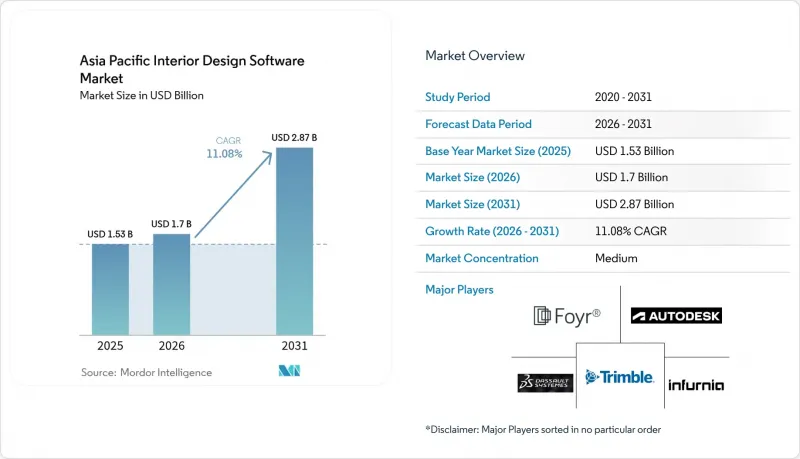
This report is Segmented by End-User Industries (Residential Sector, Non-Residential Sector), Deployment Mode (On-Premise, Cloud, Hybrid), Application Type (2D Design and Drafting, 3D Design and Rendering, and More), Platform (Desktop, Mobile, Web-Based), License Model (Perpetual One-Time License, and More), and Geography. The Market Forecasts are Provided in Terms of Value (USD).
Asia Pacific Interior Design Software Market Trends and Insights
Rising Demand for Visualization-Driven Home Renovation
Homeowners now insist on photoreal previews before committing capital to remodels. Japan recorded JPY 7.2 trillion (USD 48.6 billion) renovation outlays in 2024, with 68% of projects using digital visualization.Australian households followed suit as higher mortgage rates lengthened dwelling lifecycles. Software publishers responded by integrating material-pricing APIs with design canvases, allowing users to toggle finishes against live budgets. Platforms that unify visualization and purchasing are shortening decision cycles and gaining loyalty.
Government Smart-City and Housing Initiatives
Public digital-twin mandates spill into private practice. India's Smart Cities Mission deployed INR 48,000 crore (USD 5.8 billion) and normalized Building Information Modeling tools for municipal contractors. China's 290 pilot smart cities require cloud collaboration for cross-agency reviews. Thailand's Digital Economy Promotion Agency and Dassault Systemes are certifying 500 designers annually to support Eastern Economic Corridor projects.Such mandates set interoperability baselines and anchor long-run demand for compliant platforms.
Interoperability Issues Among Design Platforms
Disparate file structures require firms to invest in multiple tools and incur manual rework. The IFC 4.3 schema, finalized in 2024, still omits parametric furniture, so assets lose editability when moved between Revit, SketchUp, or Vectorworks. Japan's BIM mandate lacks a unified national template, resulting in regional variations that hinder coordination. Time lost to translation inflates costs and tempers adoption where projects rely on mixed vendor stacks.
Other drivers and restraints analyzed in the detailed report include:
- Surge in Cloud-Based Design Collaboration Adoption
- Integration of AI for Automated Space Planning
- High Subscription and Training Costs for SMEs
For complete list of drivers and restraints, kindly check the Table Of Contents.
Segment Analysis
The residential portion held 57.13% of 2025 revenue, reflecting early homeowner adoption of visualization for remodel budgeting. The Asia Pacific interior design software market size linked to non-residential clients is growing faster, with hospitality, retail, and co-working projects advancing at a 13.52% CAGR. Hotel builders in India used 3D walkthroughs for 62% of new rooms added in 2024. Japanese retailers repurposed physical stores as experiential showrooms, integrating VR configurators that lifted conversion by 18%.
Residential growth decelerates to 9.66% CAGR as penetration saturates tier-1 Chinese and Australian cities, though rural India and emerging Vietnamese metros remain greenfields. The Asia Pacific interior design software market is driving compliance in commercial real estate, with Singapore developers requiring BIM-ready submissions for projects exceeding SGD 50 million. Platforms able to align with building codes and procurement needs will dominate the expanding non-residential segment.
Cloud deployments captured a 62.52% share in 2025 and are growing at a 15.08% CAGR, outpacing the Asia Pacific interior design software market by four points. GPU shortages pushed on-premise card prices above USD 2,200, while India's import tariff added 28%. AWS render nodes now cost roughly USD 3 per hour, so a studio running 100 jobs a month spends USD 1,200 versus USD 18,000 annual amortization for local hardware.
Hybrid models are projected to rise at a 12.32% CAGR, where privacy laws require in-country storage, yet workloads must surge to the cloud during peaks. Autodesk's Flex license allows toggling between desktop and cloud renders in a single SKU, shielding users from upfront capital and compliance friction. Vendors lacking seamless hybrid workflows risk losing customers as they recalibrate their cost structures.
Complete Report Scope:
- By End-User Industries
- Residential Sector
- Non-Residential Sector
- By Deployment Mode
- On-Premise
- Cloud
- Hybrid
- By Application Type
- 2D Design And Drafting
- 3D Design And Rendering
- VR And AR Visualization
- Project Management And Collaboration
- By Platform
- Desktop
- Mobile
- Web-Based
- By License Model
- Perpetual One-Time License
- Subscription SaaS
- Freemium / Ad-Supported
- By Country
- China
- India
- Japan
- South Korea
- Australia
- Southeast Asia
- Rest of Asia Pacific
List of Companies Covered in this Report:
- Autodesk Inc.
- Dassault Systemes SE
- Trimble Inc.
- Chief Architect Inc.
- Graphisoft SE
- Vectorworks Inc.
- SketchUp (Trimble)
- Chaos Group (Epic Games)
- Foyr LLC
- Infurnia Technologies Pvt. Ltd.
- InnoPlanner Ltd.
- SmartDraw Software LLC
- RoomSketcher AS
- Planner 5D UAB
- Homestyler Ltd.
- Cedreo SAS
- Coohom (BoYi Technology)
- Live Home 3D (Belight Software Ltd.)
- Space Designer 3D (SAS Asynth)
- ECDESIGN Sweden AB
- Roomtodo OU
- EasternGraphics GmbH
- Sweet Home 3D (Eteks)
- Floorplanner BV
- AiHouse (Shenzhen Easyhome)
Additional Benefits:
- The market estimate (ME) sheet in Excel format
- 3 months of analyst support
TABLE OF CONTENTS
1 INTRODUCTION
- 1.1 Study Assumptions and Market Definition
- 1.2 Scope of the Study
2 RESEARCH METHODOLOGY
3 EXECUTIVE SUMMARY
4 MARKET LANDSCAPE
- 4.1 Market Overview
- 4.2 Market Drivers
- 4.2.1 Rising Demand For Visualization-Driven Home Renovation
- 4.2.2 Government Smart-City And Housing Initiatives
- 4.2.3 Surge In Cloud-Based Design Collaboration Adoption
- 4.2.4 Integration Of AI For Automated Space Planning
- 4.2.5 Expansion Of Virtual Furniture E-Commerce Partnerships
- 4.2.6 Hardware Tariff Pressures Accelerating Cloud Rendering Shift
- 4.3 Market Restraints
- 4.3.1 Interoperability Issues Among Design Platforms
- 4.3.2 High Subscription And Training Costs For SMEs
- 4.3.3 Shortage Of Skilled 3D And VR Designers
- 4.3.4 Data-Privacy And Cybersecurity Compliance Gaps
- 4.4 Industry Value Chain Analysis
- 4.5 Regulatory Landscape
- 4.6 Technological Outlook
- 4.7 Impact Of Macroeconomic Factors On The Market
- 4.8 Porter's Five Forces Analysis
- 4.8.1 Threat Of New Entrants
- 4.8.2 Bargaining Power Of Buyers
- 4.8.3 Bargaining Power Of Suppliers
- 4.8.4 Threat Of Substitutes
- 4.8.5 Intensity Of Competitive Rivalry
5 MARKET SIZE AND GROWTH FORECASTS (VALUE)
- 5.1 By End-User Industries
- 5.1.1 Residential Sector
- 5.1.2 Non-Residential Sector
- 5.2 By Deployment Mode
- 5.2.1 On-Premise
- 5.2.2 Cloud
- 5.2.3 Hybrid
- 5.3 By Application Type
- 5.3.1 2D Design And Drafting
- 5.3.2 3D Design And Rendering
- 5.3.3 VR And AR Visualization
- 5.3.4 Project Management And Collaboration
- 5.4 By Platform
- 5.4.1 Desktop
- 5.4.2 Mobile
- 5.4.3 Web-Based
- 5.5 By License Model
- 5.5.1 Perpetual One-Time License
- 5.5.2 Subscription SaaS
- 5.5.3 Freemium / Ad-Supported
- 5.6 By Country
- 5.6.1 China
- 5.6.2 India
- 5.6.3 Japan
- 5.6.4 South Korea
- 5.6.5 Australia
- 5.6.6 Southeast Asia
- 5.6.7 Rest of Asia Pacific
6 COMPETITIVE LANDSCAPE
- 6.1 Market Concentration
- 6.2 Strategic Moves
- 6.3 Market Share Analysis
- 6.4 Company Profiles (includes Global Level Overview, Market Level Overview, Core Segments, Financials As Available, Strategic Information, Market Rank/Share For Key Companies, Products And Services, And Recent Developments)
- 6.4.1 Autodesk Inc.
- 6.4.2 Dassault Systemes SE
- 6.4.3 Trimble Inc.
- 6.4.4 Chief Architect Inc.
- 6.4.5 Graphisoft SE
- 6.4.6 Vectorworks Inc.
- 6.4.7 SketchUp (Trimble)
- 6.4.8 Chaos Group (Epic Games)
- 6.4.9 Foyr LLC
- 6.4.10 Infurnia Technologies Pvt. Ltd.
- 6.4.11 InnoPlanner Ltd.
- 6.4.12 SmartDraw Software LLC
- 6.4.13 RoomSketcher AS
- 6.4.14 Planner 5D UAB
- 6.4.15 Homestyler Ltd.
- 6.4.16 Cedreo SAS
- 6.4.17 Coohom (BoYi Technology)
- 6.4.18 Live Home 3D (Belight Software Ltd.)
- 6.4.19 Space Designer 3D (SAS Asynth)
- 6.4.20 ECDESIGN Sweden AB
- 6.4.21 Roomtodo OU
- 6.4.22 EasternGraphics GmbH
- 6.4.23 Sweet Home 3D (Eteks)
- 6.4.24 Floorplanner BV
- 6.4.25 AiHouse (Shenzhen Easyhome)
7 MARKET OPPORTUNITIES AND FUTURE OUTLOOK
- 7.1 White-Space And Unmet-Need Assessment

