PUBLISHER: Mordor Intelligence | PRODUCT CODE: 2187642

PUBLISHER: Mordor Intelligence | PRODUCT CODE: 2187642
India MICE Tourism - Market Share Analysis, Industry Trends & Statistics, Growth Forecasts (2027 - 2032)
According to Mordor Intelligence, the India MICE tourism market size is expected to increase from USD 42.25 billion in 2026 to USD 47.29 billion in 2027 and reach USD 81.39 billion by 2032, growing at a CAGR of 11.47% over 2027-2032.
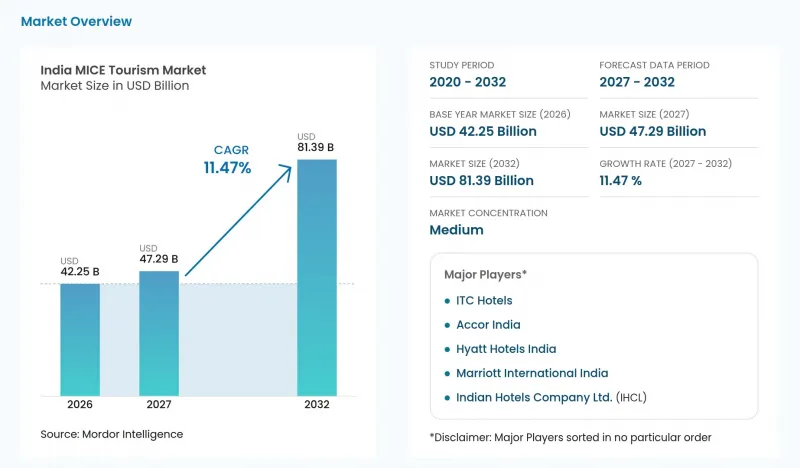
This report is segmented by Event (Meetings, Conferences, and more), Service Type (Venue Rental & F&B, Destination Management & Logistics, and more), End-User Industry (Corporates, Government & PSUs, and more), and Geography (North India, West India, and more). The market forecasts are provided in terms of value (USD), based on availability.
India MICE Tourism Market Trends and Insights
Surge in corporate travel spending
Corporate travel gives meeting suppliers a substantial customer base through which to sell organized group programs and their associated services. MakeMyTrip said gross bookings across its corporate travel platforms exceeded USD 1 billion in calendar 2025. In February 2026, Thomas Cook (India) and SOTC Travel reported that nearly 65% of surveyed Indian corporates expected travel volumes to rise over the following 12 months. Their report described a survey of 25 or more leading enterprises alongside internal booking and transactional data. Suppliers with established corporate relationships are better placed to convert that travel activity into MICE demand by offering group programs alongside business travel.
Government push via "Meet in India", G-20 legacy venues
Government departments and public sector undertakings give convention operators an institutional customer base for organized programs. In FY 2025-26, government departments organized around 135 events and public sector undertakings (PSUs) organized 75 at Bharat Mandapam in New Delhi. The Ministry of Tourism, Rajasthan's Department of Tourism and FICCI also organized the Meet in India Conclave in Jaipur on May 4, 2025. For a convention operator, departmental and PSU assignments can support scheduling across different institutional users. Associated service demand can extend to conference production, participant administration, and on-site execution as each institutional program takes shape. Existing venues can therefore generate supplier work through their institutional customer mix, independently of the pace of new hotel construction.
High indirect taxes (GST 18% on premium tariffs)
Premium hotel GST can constrain a residential event through both its invoice charge and the buyer's ability to use tax credits. Hotel accommodation above the prescribed per-unit, per-day value threshold attracts 18% GST in India. The Central Board of Indirect Taxes and Customs treats each state registration of a firm as a separate registered person and bars cross-utilization of credit between those registrations. For an organizer contracting accommodation across states, that separation makes the location of usable credits relevant to the final event cost. A tax-inclusive room quote therefore answers a different question from whether a particular buyer can use the associated credit. For premium residential programs, the relevant constraint is the potentially unrecovered accommodation tax across the delegate stay.
Other drivers and restraints analyzed in the detailed report include:
- Rapid hotel and convention-center pipeline
- E-visa & E-Conference Visa facilitation
- Air-route concentration & slot scarcity
For complete list of drivers and restraints, kindly check the Table Of Contents.
Segment Analysis
Meetings accounted for a 59.45% share of the India MICE tourism market size in 2026, making them the largest event segment. MICEtalk reported that smaller residential conferences typically involve 10 to 12 intimate meetings per month, often for leadership teams, training programs, brainstorming sessions and internal reviews. Their smaller format allows a hotel to serve several kinds of institutional work without depending on a single large convention booking. Flexible meeting spaces can support that variety, while lodging and dining turn an internal session into a residential program. This format can therefore support repeatable demand from several institutional uses, giving hotels an operating role between larger event bookings.
Incentives are forecast to be the fastest-growing event segment, with a CAGR of 12.6% over 2027-2032. In September 2026, IB Group rewarded its best-performing farmers and traders with a Goa trip under the Samriddhi initiative. The sponsor's purpose links travel to recognized performance, turning the Goa visit into an organized recognition program. Rewarding farmers and traders gives incentive travel an application beyond internal meetings and staff rewards, broadening the commercial relationships around which sponsors can commission group trips.
Complete Report Scope:
- By Event
- Meetings
- Incentives
- Conferences
- Exhibitions
- By Service Type
- Venue Rental & F&B
- Destination Management & Logistics
- Event Technology Enablement
- Creative & Production Services
- By End-User Industry
- Corporates
- Associations & Trade Bodies
- Government & PSUs
- Academic & Research
- By Geography
- North India
- West India
- South India
- East & North-East India
List of Companies Covered in this Report:
- Indian Hotels Company Ltd. (IHCL)
- Marriott International India
- Accor India
- Hyatt Hotels India
- ITC Hotels
- Oberoi Group
- Lemon Tree Hotels
- Radisson Hotel Group India
- Bharat Mandapam
- Jio World Convention Centre
- India International Convention & Expo Centre (IICC)
- BCD Meetings & Events India
- CWT India
- ATPI India
- Thomas Cook (India)
- EaseMyTrip MICE
- Cvent India
- Trawex
- MICEONLINE
- Praveg Ltd.
- Creative Travel MICE
Additional Benefits:
- The market estimate (ME) sheet in Excel format
- 3 months of analyst support
TABLE OF CONTENTS
1 INTRODUCTION
- 1.1 Study Assumptions and Market Definition
- 1.2 Scope of the Study
2 RESEARCH METHODOLOGY
3 EXECUTIVE SUMMARY
4 MARKET LANDSCAPE
- 4.1 Market Overview
- 4.2 Market Drivers
- 4.2.1 Surge in corporate travel spending
- 4.2.2 Government push via "Meet in India", G-20 legacy venues
- 4.2.3 Rapid hotel and convention-center pipeline
- 4.2.4 E-visa & E-Conference Visa facilitation
- 4.2.5 Rise of hybrid/tech-enabled event platforms (under-radar)
- 4.2.6 Bleisure & wellness add-ons boosting delegate spend (under-radar)
- 4.3 Market Restraints
- 4.3.1 High indirect taxes (GST 18% on premium tariffs)
- 4.3.2 Air-route concentration & slot scarcity
- 4.3.3 Security-perception shocks in select states
- 4.3.4 Fragmented vendor ecosystem limiting service quality (under-radar)
- 4.4 Industry Value Chain Analysis
- 4.5 Regulatory Landscape
- 4.6 Technological Outlook
- 4.7 Porter's Five Forces Analysis
- 4.7.1 Threat of New Entrants
- 4.7.2 Bargaining Power of Suppliers
- 4.7.3 Bargaining Power of Buyers
- 4.7.4 Threat of Substitutes
- 4.7.5 Competitive Rivalry
5 MARKET SIZE AND GROWTH FORECASTS (VALUE)
- 5.1 By Event
- 5.1.1 Meetings
- 5.1.2 Incentives
- 5.1.3 Conferences
- 5.1.4 Exhibitions
- 5.2 By Service Type
- 5.2.1 Venue Rental & F&B
- 5.2.2 Destination Management & Logistics
- 5.2.3 Event Technology Enablement
- 5.2.4 Creative & Production Services
- 5.3 By End-User Industry
- 5.3.1 Corporates
- 5.3.2 Associations & Trade Bodies
- 5.3.3 Government & PSUs
- 5.3.4 Academic & Research
- 5.4 By Geography
- 5.4.1 North India
- 5.4.2 West India
- 5.4.3 South India
- 5.4.4 East & North-East India
6 COMPETITIVE LANDSCAPE
- 6.1 Market Concentration
- 6.2 Strategic Moves
- 6.3 Market Share Analysis
- 6.4 Company Profiles (includes Global level Overview, Market level overview, Core Segments, Financials as available, Strategic Information, Market Rank/Share for key companies, Products and Services, and Recent Developments)
- 6.4.1 Indian Hotels Company Ltd. (IHCL)
- 6.4.2 Marriott International India
- 6.4.3 Accor India
- 6.4.4 Hyatt Hotels India
- 6.4.5 ITC Hotels
- 6.4.6 Oberoi Group
- 6.4.7 Lemon Tree Hotels
- 6.4.8 Radisson Hotel Group India
- 6.4.9 Bharat Mandapam
- 6.4.10 Jio World Convention Centre
- 6.4.11 India International Convention & Expo Centre (IICC)
- 6.4.12 BCD Meetings & Events India
- 6.4.13 CWT India
- 6.4.14 ATPI India
- 6.4.15 Thomas Cook (India)
- 6.4.16 EaseMyTrip MICE
- 6.4.17 Cvent India
- 6.4.18 Trawex
- 6.4.19 MICEONLINE
- 6.4.20 Praveg Ltd.
- 6.4.21 Creative Travel MICE
7 MARKET OPPORTUNITIES AND FUTURE OUTLOOK
- 7.1 White-Space and Unmet-Need Assessment

