PUBLISHER: Mordor Intelligence | PRODUCT CODE: 2187644

PUBLISHER: Mordor Intelligence | PRODUCT CODE: 2187644
Microcontroller (MCU) - Market Share Analysis, Industry Trends & Statistics, Growth Forecasts (2027 - 2032)
According to Mordor Intelligence, the microcontroller (MCU) market size is projected to expand from USD 38.34 billion in 2026 and USD 42.3 billion in 2027 to USD 67.63 billion by 2032, registering a CAGR of 9.84% between 2027 and 2032.
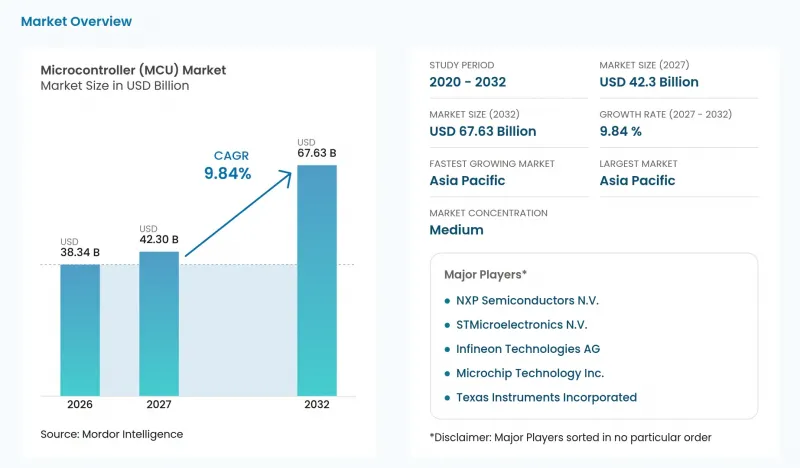
This report is segmented by Bit Class (32-bit and more), Core Architecture (ARM Cortex-M and more), On-Chip Memory Type (Embedded Flash and more), Application (Automotive and more), and Geography (Asia Pacific and more). The market forecasts are provided in terms of value (USD), based on availability.
Global Microcontroller (MCU) Market Trends and Insights
IoT Node Proliferation
Low-power metering and security requirements give MCU suppliers a route into expanding IoT applications. Vodafone Business's IoT connections increased from 205 million in FY25 to 244 million in FY26, which ended March 31, 2026, indicating expansion in its connected-service base. India had installed 72.4 million smart meters across national and state schemes by August 3, 2026. The Indian installation base makes meter design a concrete application through which suppliers can address connected-equipment demand. Renesas made its RA4C1 MCUs available in August 2025 for battery-powered, security-sensitive applications including gas, water, and industrial flow meters, smart locks, and thermostats. The commercial opening lies in MCU designs that match low-power control and security to the specific meter, rather than in connectivity alone.
Automotive Electrification and ADAS
Electric-vehicle scale makes coordinated powertrain control a material MCU opportunity across several vehicle classes. In 2025, more than 20 million electric light-duty vehicles were sold globally, and electric vehicles accounted for one in 4 cars sold. Bosch's microcontroller-based vehicle control unit can coordinate torque, thermal management, and charging in electrified powertrains. The unit can be used in electrified passenger cars, trucks, and off-highway vehicles, as well as combustion-engine applications. That cross-class applicability can let an MCU design inside the unit serve several vehicle categories as electrification expands.
Supply-chain Cyclicality
Inventory corrections can separate end-use demand from the orders that MCU suppliers actually receive. Microchip reported a 3.9% year-over-year decline in mixed-signal MCU sales in the 9 months ended December 31, 2025, primarily because many customers held high inventory and delayed or reduced orders. Sales nevertheless rose 10% year over year in the quarter ended December 31, 2025, as inventory cleared. For suppliers, that sequence shows how customer stock positions can interrupt orders even when the longer-term application opportunity persists. Inventory-delayed orders leave an MCU producer recovering production and engineering costs on an uncertain sales schedule.
Other drivers and restraints analyzed in the detailed report include:
- Smart-Home and Appliance MCU Integration
- Shift to RISC-V Open ISA
- ASP Erosion from Chinese Fabs
For complete list of drivers and restraints, kindly check the Table Of Contents.
Segment Analysis
32-bit MCUs accounted for a 57.06% share of the microcontroller (MCU) market size in 2026 and are the fastest-growing segment, with an 8.45% CAGR projected between 2027 and 2032. GigaDevice reported cumulative GD32 shipments above 2.5 billion units and more than 20,000 customers worldwide in its 2025 sustainability report, illustrating the commercial scale of this largest segment. GigaDevice's 2025 annual report described more than 700 GD32 products across 69 series, so one supplier offered a wide range of general-purpose 32-bit designs.
Device designers can match bit width to the complexity and economics of the control task. Microchip's fiscal 2026 annual report characterized 8-bit mixed-signal MCUs as cost-effective and easy to use across high-volume embedded-control applications. This gives simpler control functions a distinct economic rationale alongside the large general-purpose deployment base served by 32-bit platforms. For a supplier, a higher bit width can support a broader control design, while a smaller device can remain commercially appropriate where the application rewards simplicity and economical implementation across substantial production volumes.
ARM Cortex-M represented a 68.46% microcontroller (MCU) market share in 2026. In March 2026, ST reported that mass production had begun in China for initial models in its STM32H7 series. The series includes Cortex-M7 and Cortex-M4 devices, placing this production start within the largest segment. Local manufacturing gives Chinese equipment makers a sourcing choice within this Arm-based family, alongside the choice of core architecture.
RISC-V is the fastest-growing segment, with a 14.6% CAGR projected between 2027 and 2032. Cercis Semiconductor's M100 RISC-V auto-grade MCU entered mass production and vehicle use in China on December 18, 2025, for body-control functions. Great Wall Motor, which incubated Cercis, and Mand Optoelectronics helped define and refine the chip for applications including combination headlights, ambient lighting, and combination switches. Equipment-maker collaboration connects this production design's RISC-V core choice to a vehicle component built for defined control functions.
Complete Report Scope:
- By Bit Class
- 4-bit and below
- 8-bit
- 16-bit
- 32-bit
- By Core Architecture
- ARM Cortex-M
- RISC-V
- x86
- Proprietary / Others
- By On-Chip Memory Type
- Embedded Flash
- FRAM
- EEPROM/OTP
- SRAM-only (code-in-RAM)
- By Application
- Automotive
- Consumer Electronics and Home Appliances
- Industrial and Factory Automation
- Healthcare
- Aerospace and Defense
- Data-Com and Cloud Infrastructure
- Others
- By Geography
- North America
- United States
- Canada
- Mexico
- Europe
- Germany
- United Kingdom
- France
- Italy
- Rest of Europe
- Asia Pacific
- China
- Japan
- South Korea
- India
- Taiwan
- Rest of Asia Pacific
- South America
- Brazil
- Argentina
- Rest of South America
- Middle East and Africa
- GCC
- South Africa
- Rest of Middle East and Africa
- North America
Geography Analysis
Asia Pacific accounted for a 47.89% microcontroller (MCU) market share in 2026 and is the fastest-growing region, with a 10.6% CAGR projected between 2027 and 2032. Hua Hong Grace Semiconductor's foundry revenue from the Chinese mainland and Hong Kong rose 20% year over year in the second quarter of 2026, with increased MCU and other-chip demand among the stated drivers. NXP's Petaling Jaya facility in Malaysia assembles and tests a broad product portfolio that includes MCUs. In August 2026, NXP began an assembly-and-test expansion there for its broad portfolio, with a production ramp expected in the first quarter of 2028. NXP's planned backend expansion complements China's foundry-demand signal, so the regional supplier opportunity spans wafer fabrication and device finishing.
North America and Europe offer large vehicle-production bases, although output trends and local electronics activity create different openings for MCU suppliers. OICA's NAFTA grouping produced 15,573,367 motor vehicles in 2025, down 3% from 2024, while its Europe grouping produced 17,201,525, down 1% over the same period. Norwegian Industry reported particularly strong turnover growth in Norway's data and electronic equipment production from January through November 2025 compared with the same period in 2024. Norway's electronics activity lets MCU suppliers distinguish electronics-design opportunities from dependence on higher automotive output.
Brazil produced 2.64 million motor vehicles in 2025, up 3.5% from 2024, providing a South American manufacturing base for embedded-control suppliers. South Africa produced 618,077 vehicles in 2025, up 2.9% from 2024, creating a separate vehicle-production base within Middle East and Africa. In Colombia, residential electricity-meter producers and importers face premarket technical, metrological and administrative requirements, with a 12-month transition limited to meters produced or imported before the rule took effect in January 2026. In February 2025, ZINCO, a subsidiary of ZINELEC, inaugurated a smart electricity-meter production line in Fez, Morocco. Vehicle programs offer scale in Brazil and South Africa, while metering offers MCU suppliers a route through equipment manufacturers facing local production and compliance requirements.
- Infineon Technologies AG
- Microchip Technology Inc.
- NXP Semiconductors N.V.
- STMicroelectronics N.V.
- Texas Instruments Incorporated
- Renesas Electronics Corporation
- Silicon Laboratories Inc.
- Nordic Semiconductor ASA
- Espressif Systems (Shanghai) Co., Ltd.
- GigaDevice Semiconductor Inc.
- Nuvoton Technology Corporation
- Toshiba Electronic Devices and Storage Corporation
- Rohm Co., Ltd.
- onsemi Corporation
- Holtek Semiconductor Inc.
- Ambiq Micro, Inc.
- ASR Microelectronics Co., Ltd.
- Realtek Semiconductor Corp.
- Zilog, Inc.
- Analog Devices, Inc.
Additional Benefits:
- The market estimate (ME) sheet in Excel format
- 3 months of analyst support
TABLE OF CONTENTS
1 INTRODUCTION
- 1.1 Study Assumptions and Market Definition
- 1.2 Scope of the Study
2 RESEARCH METHODOLOGY
3 EXECUTIVE SUMMARY
4 MARKET LANDSCAPE
- 4.1 Market Overview
- 4.2 Market Drivers
- 4.2.1 IoT Node Proliferation
- 4.2.2 Automotive Electrification and ADAS
- 4.2.3 Smart-Home and Appliance MCU Integration
- 4.2.4 Shift to RISC-V Open ISA
- 4.2.5 Ultra-Low-Power Edge AI MCUs
- 4.2.6 Industrial Cybersecurity Mandates
- 4.3 Market Restraints
- 4.3.1 Supply-chain Cyclicality
- 4.3.2 ASP Erosion from Chinese Fabs
- 4.3.3 Rising NRE for sub-28 nm Embedded Flash
- 4.3.4 Talent Shortage in Mixed-Signal Design
- 4.4 Industry Value Chain Analysis
- 4.5 Regulatory Landscape
- 4.6 Technological Outlook
- 4.7 Porter's Five Forces Analysis
- 4.7.1 Threat of New Entrants
- 4.7.2 Bargaining Power of Suppliers
- 4.7.3 Bargaining Power of Buyers
- 4.7.4 Threat of Substitutes
- 4.7.5 Competitive Rivalry
5 MARKET SIZE AND GROWTH FORECASTS (VALUE)
- 5.1 By Bit Class
- 5.1.1 4-bit and below
- 5.1.2 8-bit
- 5.1.3 16-bit
- 5.1.4 32-bit
- 5.2 By Core Architecture
- 5.2.1 ARM Cortex-M
- 5.2.2 RISC-V
- 5.2.3 x86
- 5.2.4 Proprietary / Others
- 5.3 By On-Chip Memory Type
- 5.3.1 Embedded Flash
- 5.3.2 FRAM
- 5.3.3 EEPROM/OTP
- 5.3.4 SRAM-only (code-in-RAM)
- 5.4 By Application
- 5.4.1 Automotive
- 5.4.2 Consumer Electronics and Home Appliances
- 5.4.3 Industrial and Factory Automation
- 5.4.4 Healthcare
- 5.4.5 Aerospace and Defense
- 5.4.6 Data-Com and Cloud Infrastructure
- 5.4.7 Others
- 5.5 By Geography
- 5.5.1 North America
- 5.5.1.1 United States
- 5.5.1.2 Canada
- 5.5.1.3 Mexico
- 5.5.2 Europe
- 5.5.2.1 Germany
- 5.5.2.2 United Kingdom
- 5.5.2.3 France
- 5.5.2.4 Italy
- 5.5.2.5 Rest of Europe
- 5.5.3 Asia Pacific
- 5.5.3.1 China
- 5.5.3.2 Japan
- 5.5.3.3 South Korea
- 5.5.3.4 India
- 5.5.3.5 Taiwan
- 5.5.3.6 Rest of Asia Pacific
- 5.5.4 South America
- 5.5.4.1 Brazil
- 5.5.4.2 Argentina
- 5.5.4.3 Rest of South America
- 5.5.5 Middle East and Africa
- 5.5.5.1 GCC
- 5.5.5.2 South Africa
- 5.5.5.3 Rest of Middle East and Africa
- 5.5.1 North America
6 COMPETITIVE LANDSCAPE
- 6.1 Market Concentration
- 6.2 Strategic Moves
- 6.3 Market Share Analysis
- 6.4 Company Profiles (includes Global level Overview, Market level overview, Core Segments, Financials as available, Strategic Information, Market Rank/Share for key companies, Products and Services, and Recent Developments)
- 6.4.1 Infineon Technologies AG
- 6.4.2 Microchip Technology Inc.
- 6.4.3 NXP Semiconductors N.V.
- 6.4.4 STMicroelectronics N.V.
- 6.4.5 Texas Instruments Incorporated
- 6.4.6 Renesas Electronics Corporation
- 6.4.7 Silicon Laboratories Inc.
- 6.4.8 Nordic Semiconductor ASA
- 6.4.9 Espressif Systems (Shanghai) Co., Ltd.
- 6.4.10 GigaDevice Semiconductor Inc.
- 6.4.11 Nuvoton Technology Corporation
- 6.4.12 Toshiba Electronic Devices and Storage Corporation
- 6.4.13 Rohm Co., Ltd.
- 6.4.14 onsemi Corporation
- 6.4.15 Holtek Semiconductor Inc.
- 6.4.16 Ambiq Micro, Inc.
- 6.4.17 ASR Microelectronics Co., Ltd.
- 6.4.18 Realtek Semiconductor Corp.
- 6.4.19 Zilog, Inc.
- 6.4.20 Analog Devices, Inc.
7 MARKET OPPORTUNITIES AND FUTURE OUTLOOK
- 7.1 White-Space and Unmet-Need Assessment

