PUBLISHER: Mordor Intelligence | PRODUCT CODE: 2187708

PUBLISHER: Mordor Intelligence | PRODUCT CODE: 2187708
India Active Pharmaceutical Ingredients (API) - Market Share Analysis, Industry Trends & Statistics, Growth Forecasts (2027 - 2032)
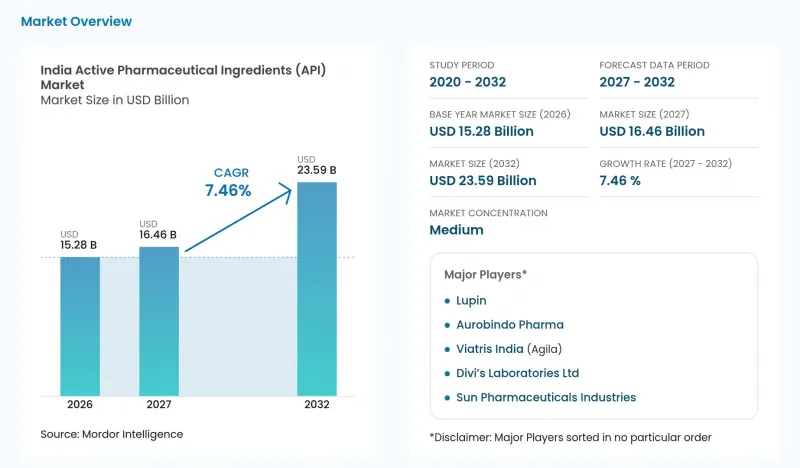
According to Mordor Intelligence, the India active pharmaceutical ingredients (API) market size is expected to increase from USD 15.28 billion in 2026 to USD 16.46 billion in 2027 and reach USD 23.59 billion by 2032, growing at a CAGR of 7.46% over 2027-2032.
This report is segmented by Business Model (Captive API and more), Synthesis Type (Synthetic API and more), Molecule Size (Small-Molecule and more), Potency (Low/Medium Potency API and more), Therapeutic Area (Cardiovascular and more), and End-User (Pharma & Biopharma Companies and more). The market forecasts are provided in terms of value (USD), based on availability.
India Active Pharmaceutical Ingredients (API) Market Trends and Insights
Government PLI & Bulk-Drug-Park push for self-reliance
Domestic production incentives can translate self-reliance policy into additional sourcing options for Indian formulation manufacturers. Production had commenced for 18 APIs among 41 products approved under the Bulk Drugs PLI scheme by March 2026. The broader scheme had created 56,800 metric tons per year of capacity for 28 critical key starting materials, drug intermediates and APIs by December 2025. Because precursor and API capacity address different manufacturing steps, this combination can improve the feasibility of domestic production across several routes. The immediate API opportunity therefore rests with covered molecules that have entered production, while upstream capacity can extend localization to additional stages of the manufacturing process.
Accelerated shift of US/EU orders to India post-Biosecure Act
The BIOSECURE Act provisions enacted on December 18, 2025, will restrict specified federal procurement and funding involving designated biotechnology companies after implementation. The prohibitions have not taken effect and start 60 or 90 days after Federal Acquisition Regulation revisions, depending on company category. For affected US customers, qualifying Indian alternatives to potentially covered suppliers in China could create API process-transfer work. European participation would depend on voluntary diversification beyond the law's US federal scope. ICH guidance normally places prospective API-process validation before downstream drug-product commercial distribution, while allowing specified concurrent-validation exceptions. This sequencing gives Indian CDMOs a potential service opportunity ahead of repeat API sales, even when supplier diversification begins before procurement restrictions take effect.
Volatile cost of China-sourced KSMs despite localization
A West Asia conflict-linked pharmaceutical input-cost shock reached India's API industry in March 2026. An Indian Drug Manufacturers Association committee chair reported that many China-based suppliers, as well as domestic suppliers, had raised raw-material prices. China had supplied about 73.7% by value of India's imports across 200 categories of APIs, bulk drugs and drug intermediates in FY2024-25. This exposure can complicate fixed-price API contracts when production depends on imported inputs. By September 2026, Lyfius Pharma Pvt. Ltd., an Aurobindo Pharma Ltd subsidiary, had established a fermentation-based Penicillin G KSM facility in Kakinada with installed capacity of 15,000 metric tons annually. Localization can therefore change exposure molecule by molecule, while contracts dependent on other imported intermediates retain the risk of repricing.
Other drivers and restraints analyzed in the detailed report include:
- Scale-up in oncology HPAPI blocks (Visakhapatnam, Hyderabad clusters)
- Growth of CRDMO exports serving Phase-I/II innovators
- Persistent compliance gaps at MSME API units (Schedule M)
For complete list of drivers and restraints, kindly check the Table Of Contents.
Segment Analysis
Captive APIs accounted for a 60.94% share of the India active pharmaceutical ingredients (API) market size in 2026. Aurobindo Pharma Ltd reported that 52% of its APIs were captively consumed in FY2024-25. Its API business serves internal needs and external clients, and the company reported 19,000 metric tons of installed API capacity. Aurobindo also linked backward integration and the operational agility of its India-based units to cost efficiencies. An internal formulation base can therefore anchor production planning, while external customers provide another route to commercialize the capabilities of an integrated API manufacturing operation.
Merchant / contract API is forecast to be the fastest-growing segment, with a CAGR of 9.15% over 2027-2032. Laurus Labs Ltd reported that higher CMO-linked API volumes and revenue scale-up from new contracts contributed to stronger utilization in FY2025-26. That creates a growth path through more intensive use of a manufacturing base as contracts bring product programs onto production assets. Higher utilization spreads fixed plant costs over more output, so contract growth can improve economics before producers build additional API capacity.
Synthetic APIs represented a 72.42% India active pharmaceutical ingredients (API) market share in 2026. Themis Medicare had 191 metric tons of annual synthetic API capacity at Vapi and 120 metric tons at its Artemis Biotech division in Hyderabad in Q1 FY27. Separately, Gujarat Themis Biosyn Ltd began commercial production at a multipurpose synthetic and fermentation-based API plant in Vapi, Gujarat, on May 6, 2025. The plant was established for production of both APIs and intermediates. A multipurpose plant combining synthetic and fermentation-based routes can accommodate several API programs at one site, so capacity need not depend on a single product.
Biotech APIs are forecast to be the fastest-growing segment, at a CAGR of 8.95% over 2027-2032. India-based Concord Biotech describes itself as among the leading global manufacturers of fermentation-based APIs. The company reported 42% year-over-year revenue growth for its company-wide API business in the quarter ended June 30, 2026. Aragen commissioned 2.50 kiloliters of Indian GMP biologics capacity in Q3 FY2026, reported as installed on March 31, 2026, on a platform serving clinical drug-substance and commercial biologics manufacturing. A fermentation specialist's expanding API business supports an established supply route, while Aragen's commissioned drug-substance services offer developers access to biologic manufacturing without building their own facilities.
Complete Report Scope:
- By Business Model
- Captive API
- Merchant / Contract API
- By Synthesis Type
- Synthetic API
- Biotech API
- By Molecule Size
- Small-Molecule
- Large-Molecule / Biologic
- By Potency
- High-Potency API
- Low/Medium Potency API
- By Therapeutic Area
- Oncology
- Cardiovascular
- Infectious Diseases
- Metabolic Disorders
- CNS & Neurology
- Respiratory
- Others
- By End-User
- Pharma & Biopharma Companies
- CDMOs / CMOs
- CROs & Academia
- Export-Oriented Formulators
- CRDMOs / CDMOs
List of Companies Covered in this Report:
- Divi's Laboratories Ltd
- Aurobindo Pharma
- Laurus Labs Ltd
- Dr Reddy's Laboratories Ltd
- Sun Pharmaceuticals Industries
- Viatris India (Agila)
- Teva API India
- Lupin
- Cipla
- Zydus Group
- Intas Pharmaceuticals
- Piramal Group
- Biocon Biologics
- Samsung Biologics India JV
- Syngene International
- Torrent Pharmaceuticals
- Granules India
- Alivus Life Sciences
- Hetero Drugs
- Alembic Pharmaceuticals
Additional Benefits:
- The market estimate (ME) sheet in Excel format
- 3 months of analyst support
TABLE OF CONTENTS
1 INTRODUCTION
- 1.1 Study Assumptions and Market Definition
- 1.2 Scope of the Study
2 RESEARCH METHODOLOGY
3 EXECUTIVE SUMMARY
4 MARKET LANDSCAPE
- 4.1 Market Overview
- 4.2 Market Drivers
- 4.2.1 Government PLI & Bulk-Drug-Park push for self-reliance
- 4.2.2 Accelerated shift of US/EU orders to India post-Biosecure Act
- 4.2.3 Scale-up in oncology HPAPI blocks (Visakhapatnam, Hyderabad clusters)
- 4.2.4 Growth of CRDMO exports serving Phase-I/II innovators
- 4.2.5 Green-chemistry route adoption to lower solvent import bill
- 4.2.6 AI-driven process-optimization to cut cycle-times
- 4.3 Market Restraints
- 4.3.1 Volatile cost of China-sourced KSMs despite localization
- 4.3.2 Persistent compliance gaps at MSME API units (Schedule M)
- 4.3.3 Talent crunch in large-molecule downstream & containment
- 4.3.4 Rising energy tariffs eroding margins in West-coast plants
- 4.4 Industry Value Chain Analysis
- 4.5 Regulatory Landscape
- 4.6 Technological Outlook
- 4.7 Porter's Five Forces Analysis
- 4.7.1 Threat of New Entrants
- 4.7.2 Bargaining Power of Suppliers
- 4.7.3 Bargaining Power of Buyers
- 4.7.4 Threat of Substitutes
- 4.7.5 Competitive Rivalry
5 MARKET SIZE AND GROWTH FORECASTS (VALUE)
- 5.1 By Business Model
- 5.1.1 Captive API
- 5.1.2 Merchant / Contract API
- 5.2 By Synthesis Type
- 5.2.1 Synthetic API
- 5.2.2 Biotech API
- 5.3 By Molecule Size
- 5.3.1 Small-Molecule
- 5.3.2 Large-Molecule / Biologic
- 5.4 By Potency
- 5.4.1 High-Potency API
- 5.4.2 Low/Medium Potency API
- 5.5 By Therapeutic Area
- 5.5.1 Oncology
- 5.5.2 Cardiovascular
- 5.5.3 Infectious Diseases
- 5.5.4 Metabolic Disorders
- 5.5.5 CNS & Neurology
- 5.5.6 Respiratory
- 5.5.7 Others
- 5.6 By End-User
- 5.6.1 Pharma & Biopharma Companies
- 5.6.2 CDMOs / CMOs
- 5.6.3 CROs & Academia
- 5.6.4 Export-Oriented Formulators
- 5.6.5 CRDMOs / CDMOs
6 COMPETITIVE LANDSCAPE
- 6.1 Market Concentration
- 6.2 Strategic Moves
- 6.3 Market Share Analysis
- 6.4 Company Profiles (includes Global level Overview, Market level overview, Core Segments, Financials as available, Strategic Information, Market Rank/Share for key companies, Products and Services, and Recent Developments)
- 6.4.1 Divi's Laboratories Ltd
- 6.4.2 Aurobindo Pharma Ltd
- 6.4.3 Laurus Labs Ltd
- 6.4.4 Dr Reddy's Laboratories Ltd
- 6.4.5 Sun Pharmaceutical Industries Ltd
- 6.4.6 Viatris India (Agila)
- 6.4.7 Teva API India
- 6.4.8 Lupin Ltd
- 6.4.9 Cipla Ltd
- 6.4.10 Cadila Pharmaceuticals
- 6.4.11 Intas Pharmaceuticals
- 6.4.12 Piramal Pharma Solutions
- 6.4.13 Biocon Biologics
- 6.4.14 Samsung Biologics India JV
- 6.4.15 Syngene International
- 6.4.16 Torrent Pharma
- 6.4.17 Granules India
- 6.4.18 Alivus Life Sciences
- 6.4.19 Hetero Drugs
- 6.4.20 Alembic Pharmaceuticals
7 MARKET OPPORTUNITIES AND FUTURE OUTLOOK
- 7.1 White-Space and Unmet-Need Assessment

