PUBLISHER: Mordor Intelligence | PRODUCT CODE: 2187718

PUBLISHER: Mordor Intelligence | PRODUCT CODE: 2187718
Vietnam Feed Additives - Market Share Analysis, Industry Trends & Statistics, Growth Forecasts (2027 - 2032)
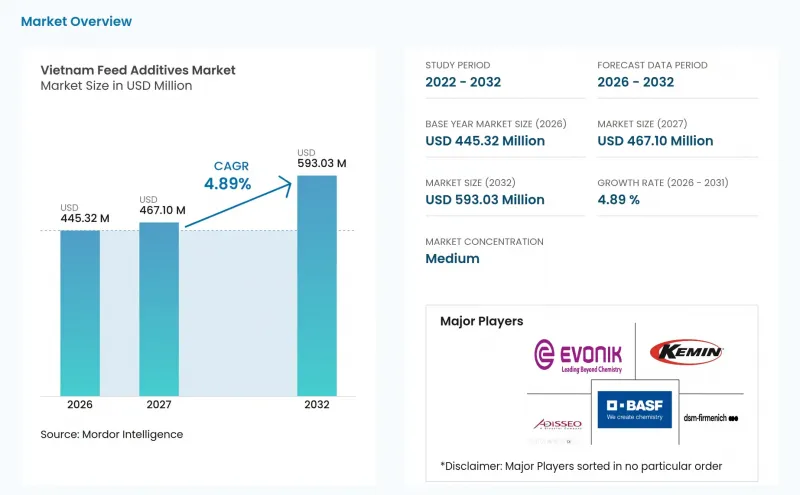
According to Mordor Intelligence, the Vietnam feed additives market was valued at USD 445.32 million in 2026 and is forecast to grow from USD 467.10 million in 2027 to USD 593.03 million by 2032, at a CAGR of 4.89% between 2027 and 2032.
Vietnam Feed Additives Market Trends and Insights
Reduction of Antibiotic Growth Promoters
Vietnam's phase-out of antibiotic growth promoters is encouraging demand for alternative feed additives that support gut health, feed efficiency, and livestock performance. Under Vietnam's Law on Animal Husbandry, the use of antibiotics in animal feed for growth promotion is prohibited, while restrictions on prophylactic use have been progressively tightened. The transition reaching January 2026 increases the need for feed manufacturers to reformulate diets, particularly for swine and poultry production. Organic acids, probiotics, prebiotics, phytogenics, and selected enzymes can support digestive function and nutrient utilization, although their effectiveness varies by formulation and production conditions. As feed mills adjust formulations to comply with antibiotic restrictions and maintain animal performance, these additives can become recurring components of commercial feed rather than occasional supplements. This shift creates opportunities for suppliers offering evidence-backed alternatives, technical formulation support, and products suited to Vietnam's livestock production systems.
Expansion of Export-Oriented Aquaculture Feed
Vietnam's expanding seafood export industry is driving demand for feed additives that support aquatic animal health, feed efficiency, and production consistency. According to the Vietnam Association of Seafood Exporters and Producers (VASEP), Vietnam's seafood exports reached USD 11.3 billion in 2025, reflecting the importance of export-oriented aquaculture to the country's seafood industry. Export producers must maintain consistent product quality and meet buyer requirements for traceability and food safety, encouraging greater attention to feed management and disease prevention. Additives such as probiotics, organic acids, and immunostimulants can support gut health, feed utilization, and immune function, while mycotoxin binders help manage contamination risks in feed ingredients. As aquaculture producers seek to reduce production risks and maintain compliance with export-market requirements, functional feed additives are becoming increasingly important components of commercial feeding programs, supporting growth in Vietnam's feed additives market.
Precision Nutrition and Feed-Cost Optimization
The need to control feed costs while maintaining livestock productivity is supporting demand for precision nutrition and specialized feed additives in Vietnam. Feed manufacturers are increasingly optimizing formulations to improve nutrient utilization and reduce feed wastage as raw material prices and availability fluctuate. Amino acids help balance dietary protein, while enzymes improve the digestibility of nutrients in ingredients such as corn and soybean meal, allowing nutritionists to formulate diets more efficiently. Probiotics and other gut-health additives can further support digestive function and animal performance. In 2026, Novonesis Academy Vietnam highlighted enzyme technologies and gut-health solutions for livestock production, reflecting continued industry attention to improving feed efficiency through targeted nutrition strategies. As commercial farms and feed mills seek to maintain performance while managing production costs, demand for additives supported by clear efficacy evidence and technical formulation guidance is expected to strengthen Vietnam's feed additives market.
Other drivers and restraints analyzed in the detailed report include:
- Intensification of Poultry and Swine Production
- Imported Raw-Material Price and Supply Volatility
- Variable Compliance Capability Across Smallholder Farms
For complete list of drivers and restraints, kindly check the Table Of Contents.
Segment Analysis
Amino acids accounted for 23.8% of the Vietnam feed additives market share in 2026, making them the leading additive category. Their position is supported by widespread use in formulated poultry and swine feeds, where lysine and methionine help balance dietary protein and meet essential amino acid requirements. Feed manufacturers use these additives to optimize nutrient utilization and maintain animal growth performance while reducing reliance on higher levels of crude protein. Their established role in commercial feed formulations supports recurring demand from integrated livestock producers and large feed mills. However, dependence on imported amino acid supplies exposes the segment to international price fluctuations and procurement risks. Acidifiers, enzymes, probiotics, vitamins, minerals, and mycotoxin binders also contribute to the market by supporting digestive health, nutrient digestibility, and feed quality across livestock and aquaculture production. These diverse applications reinforce the importance of specialized feed additives in Vietnam's commercial animal production systems.
Acidifiers are projected to be the fastest-growing additive category, expanding at a CAGR of 5.7% between 2027 and 2032. Growth is supported by demand for gut-health management solutions in poultry and swine production, particularly as restrictions on antibiotic use encourage feed manufacturers to adopt alternative approaches to maintaining animal performance. Organic acids can help manage gastrointestinal conditions, while acidifiers used in aquaculture feed and water management can support production conditions for shrimp and pangasius. Meanwhile, enzymes such as phytases and carbohydrases help improve nutrient utilization and enable feed manufacturers to formulate diets using alternative or lower-cost ingredients. In September 2025, TVOne Vietnam inaugurated a phytogenics feed-additive manufacturing facility in Phu Tho, with a reported annual capacity of 18,000 metric tons, illustrating domestic investment in specialized feed-additive production. As livestock and aquaculture producers increasingly prioritize feed efficiency and animal health, suppliers offering effective formulations, reliable supply, and technical support are positioned to benefit from rising demand for acidifiers and other functional additives.
Complete Report Scope:
- By Additive
- Acidifiers
- Fumaric Acid
- Lactic Acid
- Propionic Acid
- Other Acidifiers
- Amino Acids
- Lysine
- Methionine
- Threonine
- Tryptophan
- Other Amino Acids
- Antibiotics
- Bacitracin
- Penicillins
- Tetracyclines
- Tylosin
- Other Antibiotics
- Antioxidants
- Butylated Hydroxyanisole (BHA)
- Butylated Hydroxytoluene (BHT)
- Citric Acid
- Ethoxyquin
- Propyl Gallate
- Tocopherols
- Other Antioxidants
- Binders
- Natural Binders
- Synthetic Binders
- Enzymes
- Carbohydrases
- Phytases
- Other Enzymes
- Flavors & Sweeteners
- Flavors
- Sweeteners
- Minerals
- Macrominerals
- Microminerals
- Mycotoxin Detoxifiers
- Binders
- Biotransformers
- Phytogenics
- Essential Oil
- Herbs & Spices
- Other Phytogenics
- Pigments
- Carotenoids
- Curcumin & Spirulina
- Prebiotics
- Fructo Oligosaccharides
- Galacto Oligosaccharides
- Inulin
- Lactulose
- Mannan Oligosaccharides
- Xylo Oligosaccharides
- Other Prebiotics
- Probiotics
- Bifidobacteria
- Enterococcus
- Lactobacilli
- Pediococcus
- Streptococcus
- Other Probiotics
- Vitamins
- Vitamin A
- Vitamin B
- Vitamin C
- Vitamin E
- Other Vitamins
- Yeast
- Live Yeast
- Selenium Yeast
- Spent Yeast
- Torula Dried Yeast
- Whey Yeast
- Yeast Derivatives
- Acidifiers
- By Animal
- Aquaculture
- Fish
- Shrimp
- Other Aquaculture Species
- Poultry
- Broiler
- Layer
- Other Poultry Birds
- Ruminants
- Beef Cattle
- Dairy Cattle
- Other Ruminants
- Swine
- Other Animals
- Aquaculture
List of Companies Covered in this Report:
- DSM Nutritional Products Vietnam Ltd. (dsm-firmenich AG)
- Evonik Industries AG
- Adisseo France SAS
- BASF Vietnam Limited (BASF SE)
- Kemin Industries, Inc.
- Alltech, Inc.
- Nutreco N.V. (SHV Holdings N.V.)
- Novus International, Inc. (Mitsui & Co., Ltd.)
- CONG TY TNHH THƯƠNG MẠI DỊCH VỤ NONG SẢN VIET (VIET ACC CO., LTD.)
- Elanco Vietnam Company Limited (Elanco Animal Health Incorporated)
- Phibro Animal Health Corporation
- Zoetis Inc.
Additional Benefits:
- The market estimate (ME) sheet in Excel format
- 3 months of analyst support
TABLE OF CONTENTS
1 INTRODUCTION
- 1.1 Study Assumptions and Market Definition
- 1.2 Scope of the Study
- 1.3 Research Methodology
2 EXECUTIVE SUMMARY & KEY FINDINGS
3 REPORT OFFERS
4 KEY INDUSTRY TRENDS
- 4.1 Animal Headcount Analysis
- 4.1.1 Poultry
- 4.1.2 Ruminants
- 4.1.3 Swine
- 4.2 Feed Production Analysis
- 4.2.1 Aquaculture
- 4.2.2 Poultry
- 4.2.3 Ruminants
- 4.2.4 Swine
- 4.3 Regulatory Framework
- 4.3.1 Vietnam
- 4.4 Value Chain and Distribution Channel Analysis
- 4.5 Market Drivers
- 4.5.1 Reduction of Antibiotic Growth Promoters
- 4.5.2 Expansion of Export-Oriented Aquaculture Feed
- 4.5.3 Intensification of Poultry and Swine Production
- 4.5.4 Precision Nutrition and Feed-Cost Optimization
- 4.5.5 Mekong Delta Disease Pressure Accelerating Functional Additive Use
- 4.5.6 Vietnam-Specific Localization of Premix and Additive Supply
- 4.6 Market Restraints
- 4.6.1 Imported Raw-Material Price and Supply Volatility
- 4.6.2 Fragmented Distribution and Last-Mile Costs
- 4.6.3 Variable Compliance Capability Across Smallholder Farms
- 4.6.4 Inconsistent Evidence and ROI Measurement for Advanced Additives
5 MARKET SIZE AND GROWTH FORECASTS (VALUE AND VOLUME)
- 5.1 By Additive
- 5.1.1 Acidifiers
- 5.1.1.1 Fumaric Acid
- 5.1.1.2 Lactic Acid
- 5.1.1.3 Propionic Acid
- 5.1.1.4 Other Acidifiers
- 5.1.2 Amino Acids
- 5.1.2.1 Lysine
- 5.1.2.2 Methionine
- 5.1.2.3 Threonine
- 5.1.2.4 Tryptophan
- 5.1.2.5 Other Amino Acids
- 5.1.3 Antibiotics
- 5.1.3.1 Bacitracin
- 5.1.3.2 Penicillins
- 5.1.3.3 Tetracyclines
- 5.1.3.4 Tylosin
- 5.1.3.5 Other Antibiotics
- 5.1.4 Antioxidants
- 5.1.4.1 Butylated Hydroxyanisole (BHA)
- 5.1.4.2 Butylated Hydroxytoluene (BHT)
- 5.1.4.3 Citric Acid
- 5.1.4.4 Ethoxyquin
- 5.1.4.5 Propyl Gallate
- 5.1.4.6 Tocopherols
- 5.1.4.7 Other Antioxidants
- 5.1.5 Binders
- 5.1.5.1 Natural Binders
- 5.1.5.2 Synthetic Binders
- 5.1.6 Enzymes
- 5.1.6.1 Carbohydrases
- 5.1.6.2 Phytases
- 5.1.6.3 Other Enzymes
- 5.1.7 Flavors & Sweeteners
- 5.1.7.1 Flavors
- 5.1.7.2 Sweeteners
- 5.1.8 Minerals
- 5.1.8.1 Macrominerals
- 5.1.8.2 Microminerals
- 5.1.9 Mycotoxin Detoxifiers
- 5.1.9.1 Binders
- 5.1.9.2 Biotransformers
- 5.1.10 Phytogenics
- 5.1.10.1 Essential Oil
- 5.1.10.2 Herbs & Spices
- 5.1.10.3 Other Phytogenics
- 5.1.11 Pigments
- 5.1.11.1 Carotenoids
- 5.1.11.2 Curcumin & Spirulina
- 5.1.12 Prebiotics
- 5.1.12.1 Fructo Oligosaccharides
- 5.1.12.2 Galacto Oligosaccharides
- 5.1.12.3 Inulin
- 5.1.12.4 Lactulose
- 5.1.12.5 Mannan Oligosaccharides
- 5.1.12.6 Xylo Oligosaccharides
- 5.1.12.7 Other Prebiotics
- 5.1.13 Probiotics
- 5.1.13.1 Bifidobacteria
- 5.1.13.2 Enterococcus
- 5.1.13.3 Lactobacilli
- 5.1.13.4 Pediococcus
- 5.1.13.5 Streptococcus
- 5.1.13.6 Other Probiotics
- 5.1.14 Vitamins
- 5.1.14.1 Vitamin A
- 5.1.14.2 Vitamin B
- 5.1.14.3 Vitamin C
- 5.1.14.4 Vitamin E
- 5.1.14.5 Other Vitamins
- 5.1.15 Yeast
- 5.1.15.1 Live Yeast
- 5.1.15.2 Selenium Yeast
- 5.1.15.3 Spent Yeast
- 5.1.15.4 Torula Dried Yeast
- 5.1.15.5 Whey Yeast
- 5.1.15.6 Yeast Derivatives
- 5.1.1 Acidifiers
- 5.2 By Animal
- 5.2.1 Aquaculture
- 5.2.1.1 Fish
- 5.2.1.2 Shrimp
- 5.2.1.3 Other Aquaculture Species
- 5.2.2 Poultry
- 5.2.2.1 Broiler
- 5.2.2.2 Layer
- 5.2.2.3 Other Poultry Birds
- 5.2.3 Ruminants
- 5.2.3.1 Beef Cattle
- 5.2.3.2 Dairy Cattle
- 5.2.3.3 Other Ruminants
- 5.2.4 Swine
- 5.2.5 Other Animals
- 5.2.1 Aquaculture
6 COMPETITIVE LANDSCAPE
- 6.1 Key Strategic Moves
- 6.2 Market Share Analysis
- 6.3 Company Landscape
- 6.4 Company Profiles (includes Global Level Overview, Market Level Overview, Core Business Segments, Financials, Headcount, Key Information, Market Rank, Market Share, Products and Services, and Analysis of Recent Developments)
- 6.4.1 DSM Nutritional Products Vietnam Ltd. (dsm-firmenich AG)
- 6.4.2 Evonik Industries AG
- 6.4.3 Adisseo France SAS
- 6.4.4 BASF Vietnam Limited (BASF SE)
- 6.4.5 Kemin Industries, Inc.
- 6.4.6 Alltech, Inc.
- 6.4.7 Nutreco N.V. (SHV Holdings N.V.)
- 6.4.8 Novus International, Inc. (Mitsui & Co., Ltd.)
- 6.4.9 CONG TY TNHH THƯƠNG MẠI DỊCH VỤ NONG SẢN VIET (VIET ACC CO., LTD.)
- 6.4.10 Elanco Vietnam Company Limited (Elanco Animal Health Incorporated)
- 6.4.11 Phibro Animal Health Corporation
- 6.4.12 Zoetis Inc.
7 KEY STRATEGIC QUESTIONS FOR FEED ADDITIVE CEOS

