PUBLISHER: Mordor Intelligence | PRODUCT CODE: 1939161

PUBLISHER: Mordor Intelligence | PRODUCT CODE: 1939161
United States Feed Additives - Market Share Analysis, Industry Trends & Statistics, Growth Forecasts (2026 - 2031)
United States feed additives market size in 2026 is estimated at USD 7.55 billion, growing from 2025 value of USD 7.12 billion with 2031 projections showing USD 10.14 billion, growing at 6.07% CAGR over 2026-2031.
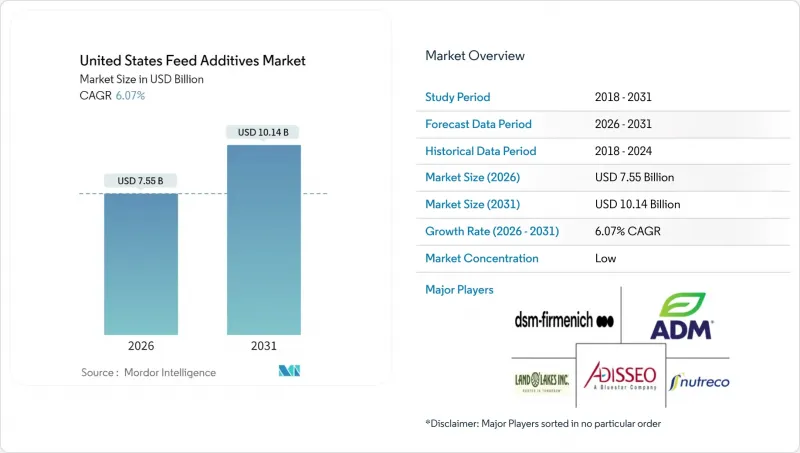
The growth profile is underpinned by steady protein demand, regulatory support for higher amino acid inclusion rates, and technology-enabled dosing that limits wastage while upholding animal performance. Functional additive blends targeting gut integrity, enzyme cocktails tailored for high-fiber co-products, and precision nutrition software continue to shift buyer preferences toward value-added solutions. Larger mills are expanding low-inclusion premix lines, giving formulators headroom to swap out conventional antibiotic growth promoters. Meanwhile, vertical integration by meat processors into feed manufacturing is shortening innovation cycles and accelerating the roll-out of custom premixes for contract growers. Price swings in corn-derived amino acid intermediates and extended FDA review timelines for novel ingredients remain the primary speed bumps for smaller suppliers.
United States Feed Additives Market Trends and Insights
Intensifying Demand for High-Protein Meat and Dairy
Per-capita protein intake continues to climb as households prioritize nutrient-dense diets, pushing beef consumption to 58.2 lb and poultry to 110 lb in 2025. Producers are upgrading feed formulations with methionine, lysine, and threonine to trim crude protein without compromising weight gain . Quick-service restaurant procurement standards amplify the shift toward consistent additive protocols that secure tenderness and yield. Tighter feed cost margins are steering nutritionists toward precision programs that couple amino acid supplementation with lower-protein basal diets. The net effect is sustained demand visibility for synthetic amino acids and complementary gut health inputs that protect feed efficiency in intensive systems. Lenders view additive adoption as a hedge against volatility in corn and soybean meal prices, further supporting capital allocation into advanced premixes.
Functional Additive Blends Replacing Antibiotic Growth Promoters
The FDA phase-out of medically important antibiotics has opened a pipeline for organic acid, essential oil, and probiotic combinations that replicate growth promotion without drug residues. Kemin's PROSIDIUM platform illustrates multi-mode pathogen control that safeguards daily weight gain in antibiotic-free barns . Early adopters have documented improved feed conversion and reduced mortality, prompting integrators to embed these blends in technical specification sheets. AAFCO registration of natural constituents accelerates commercialization compared with synthetic molecules, lowering regulatory costs. Competitive pressure is rising as premix companies race to patent synergistic ingredient ratios that broaden antimicrobial spectra. Distributors note that blend stability during pelleting and long-haul distribution is a decisive purchase criterion for large complexes.
Volatile Prices of Key Amino Acid Raw Materials
Methionine and lysine spot quotes swung by 25% during 2024 as Asia-based producers faced energy shortages and shipping bottlenecks. Domestic premix blenders passed a portion of these spikes to producers, prompting ration reformulation toward protein meals during peak prices. Smaller mills lacking futures hedging struggled with cash-flow hits, delaying orders for functional blends. Currency fluctuations against the yuan and euro added layers of unpredictability for U.S. importers. Major suppliers such as Adisseo instituted quarterly price resets for RHODIMET, signaling permanent volatility. The turbulence dampens near-term expansion plans for amino acid capacity, restraining the slope of the United States feed additives market growth curve.
Other drivers and restraints analyzed in the detailed report include:
- Expansion of Poultry Production for Quick-Service Restaurants
- Regulatory Allowance of Higher Amino Acid Inclusion Rates
- FDA Scrutiny on Novel Additive Approvals
For complete list of drivers and restraints, kindly check the Table Of Contents.
Segment Analysis
Amino acids held 20.45% of the United States feed additives market share in 2025, translating to a substantial portion of the United States feed additives market size for precision nutrition products. Demand centers on methionine and lysine packs that enable lower-protein formulations in broilers and swine. Profit-oriented integrators continue to shift spend toward encapsulated amino acids that enhance bioavailability through pelleting. Acidifiers, projected at a 6.91% CAGR to 2031, are consolidating momentum in antibiotic-free systems thanks to their dual role in pH modulation and pathogen suppression.
Enzyme adoption remains robust, particularly phytase upgrades that permit higher distillers' grains inclusion. Minerals see steady uptake as chelated formats win share from inorganic salts due to documented absorption advantages. Vitamins maintain broad penetration, with fat-soluble variants A, D, and E achieving premium positioning in free-range and welfare-certified programs. Phytogenic additives featuring essential oil blends are carving out a fast-growing niche among organic producers seeking natural growth promoters. Overall, additive diversity is expanding in tandem with data-driven feed formulation, reinforcing the value proposition of precision blends within the United States feed additives market.
The United States Feed Additives Market Report is Segmented by Additive Type (Acidifiers, Amino Acids, Antibiotics, Antioxidants, Binders, Enzymes, Flavors & Sweeteners, Minerals, Mycotoxin Detoxifiers, Phytogenics, Pigments, Prebiotics, Probiotics, and More) and by Animal (Aquaculture, Poultry, Ruminants, Swine, and More). The Market Forecasts are Provided in Terms of Value (USD) and Volume (Metric Tons).
List of Companies Covered in this Report:
- DSM-Firmenich
- ADM
- Adisseo
- Nutreco (SHV Holdings)
- Land O' Lakes Inc.
- Evonik Industries AG
- Kemin Industries, Inc.
- Novus International Inc.
- Phibro Animal Health Corporation
- BASF SE
- Cargill Incorporated
- Elanco
- International Flavors and Fragrances Inc.
- Alltech
- Zinpro
Additional Benefits:
- The market estimate (ME) sheet in Excel format
- 3 months of analyst support
TABLE OF CONTENTS
1 EXECUTIVE SUMMARY AND KEY FINDINGS
2 REPORT OFFERS
3 INTRODUCTION
- 3.1 Study Assumptions and Market Definition
- 3.2 Scope of the Study
- 3.3 Research Methodology
4 KEY INDUSTRY TRENDS
- 4.1 Animal Headcount
- 4.1.1 Poultry
- 4.1.2 Ruminants
- 4.1.3 Swine
- 4.2 Feed Production
- 4.2.1 Aquaculture
- 4.2.2 Poultry
- 4.2.3 Ruminants
- 4.2.4 Swine
- 4.3 Regulatory Framework
- 4.3.1 United States
- 4.4 Value Chain and Distribution Channel Analysis
- 4.5 Market Drivers
- 4.5.1 Intensifying demand for high-protein meat and dairy
- 4.5.2 Functional additive blends replacing antibiotic growth promoters
- 4.5.3 Expansion of poultry production for quick-service restaurants
- 4.5.4 Regulatory allowance of higher amino acid inclusion rates
- 4.5.5 Precision livestock farming enabling real-time additive dosing
- 4.5.6 Abundant distillers grains driving enzyme cocktail adoption
- 4.6 Market Restraints
- 4.6.1 Volatile prices of key amino acid raw materials
- 4.6.2 FDA scrutiny on novel additive approvals
- 4.6.3 Consumer push for "antibiotic-free" labels
- 4.6.4 On-farm fermentation of in-house probiotics
5 MARKET SIZE AND GROWTH FORECASTS (VALUE AND VOLUME)
- 5.1 Additive
- 5.1.1 Acidifiers
- 5.1.1.1 By Sub Additive
- 5.1.1.1.1 Fumaric Acid
- 5.1.1.1.2 Lactic Acid
- 5.1.1.1.3 Propionic Acid
- 5.1.1.1.4 Other Acidifiers
- 5.1.1.1 By Sub Additive
- 5.1.2 Amino Acids
- 5.1.2.1 By Sub Additive
- 5.1.2.1.1 Lysine
- 5.1.2.1.2 Methionine
- 5.1.2.1.3 Threonine
- 5.1.2.1.4 Tryptophan
- 5.1.2.1.5 Other Amino Acids
- 5.1.2.1 By Sub Additive
- 5.1.3 Antibiotics
- 5.1.3.1 By Sub Additive
- 5.1.3.1.1 Bacitracin
- 5.1.3.1.2 Penicillins
- 5.1.3.1.3 Tetracyclines
- 5.1.3.1.4 Tylosin
- 5.1.3.1.5 Other Antibiotics
- 5.1.3.1 By Sub Additive
- 5.1.4 Antioxidants
- 5.1.4.1 By Sub Additive
- 5.1.4.1.1 Butylated Hydroxyanisole (BHA)
- 5.1.4.1.2 Butylated Hydroxytoluene (BHT)
- 5.1.4.1.3 Citric Acid
- 5.1.4.1.4 Ethoxyquin
- 5.1.4.1.5 Propyl Gallate
- 5.1.4.1.6 Tocopherols
- 5.1.4.1.7 Other Antioxidants
- 5.1.4.1 By Sub Additive
- 5.1.5 Binders
- 5.1.5.1 By Sub Additive
- 5.1.5.1.1 Natural Binders
- 5.1.5.1.2 Synthetic Binders
- 5.1.5.1 By Sub Additive
- 5.1.6 Enzymes
- 5.1.6.1 By Sub Additive
- 5.1.6.1.1 Carbohydrases
- 5.1.6.1.2 Phytases
- 5.1.6.1.3 Other Enzymes
- 5.1.6.1 By Sub Additive
- 5.1.7 Flavors and Sweeteners
- 5.1.7.1 By Sub Additive
- 5.1.7.1.1 Flavors
- 5.1.7.1.2 Sweeteners
- 5.1.7.1 By Sub Additive
- 5.1.8 Minerals
- 5.1.8.1 By Sub Additive
- 5.1.8.1.1 Macrominerals
- 5.1.8.1.2 Microminerals
- 5.1.8.1 By Sub Additive
- 5.1.9 Mycotoxin Detoxifiers
- 5.1.9.1 By Sub Additive
- 5.1.9.1.1 Binders
- 5.1.9.1.2 Biotransformers
- 5.1.9.1 By Sub Additive
- 5.1.10 Phytogenics
- 5.1.10.1 By Sub Additive
- 5.1.10.1.1 Essential Oil
- 5.1.10.1.2 Herbs and Spices
- 5.1.10.1.3 Other Phytogenics
- 5.1.10.1 By Sub Additive
- 5.1.11 Pigments
- 5.1.11.1 By Sub Additive
- 5.1.11.1.1 Carotenoids
- 5.1.11.1.2 Curcumin and Spirulina
- 5.1.11.1 By Sub Additive
- 5.1.12 Prebiotics
- 5.1.12.1 By Sub Additive
- 5.1.12.1.1 Fructo Oligosaccharides
- 5.1.12.1.2 Galacto Oligosaccharides
- 5.1.12.1.3 Inulin
- 5.1.12.1.4 Lactulose
- 5.1.12.1.5 Mannan Oligosaccharides
- 5.1.12.1.6 Xylo Oligosaccharides
- 5.1.12.1.7 Other Prebiotics
- 5.1.12.1 By Sub Additive
- 5.1.13 Probiotics
- 5.1.13.1 By Sub Additive
- 5.1.13.1.1 Bifidobacteria
- 5.1.13.1.2 Enterococcus
- 5.1.13.1.3 Lactobacilli
- 5.1.13.1.4 Pediococcus
- 5.1.13.1.5 Streptococcus
- 5.1.13.1.6 Other Probiotics
- 5.1.13.1 By Sub Additive
- 5.1.14 Vitamins
- 5.1.14.1 By Sub Additive
- 5.1.14.1.1 Vitamin A
- 5.1.14.1.2 Vitamin B
- 5.1.14.1.3 Vitamin C
- 5.1.14.1.4 Vitamin E
- 5.1.14.1.5 Other Vitamins
- 5.1.14.1 By Sub Additive
- 5.1.15 Yeast
- 5.1.15.1 By Sub Additive
- 5.1.15.1.1 Live Yeast
- 5.1.15.1.2 Selenium Yeast
- 5.1.15.1.3 Spent Yeast
- 5.1.15.1.4 Torula Dried Yeast
- 5.1.15.1.5 Whey Yeast
- 5.1.15.1.6 Yeast Derivatives
- 5.1.15.1 By Sub Additive
- 5.1.1 Acidifiers
- 5.2 Animal
- 5.2.1 Aquaculture
- 5.2.1.1 By Sub Animal
- 5.2.1.1.1 Fish
- 5.2.1.1.2 Shrimp
- 5.2.1.1.3 Other Aquaculture Species
- 5.2.1.1 By Sub Animal
- 5.2.2 Poultry
- 5.2.2.1 By Sub Animal
- 5.2.2.1.1 Broiler
- 5.2.2.1.2 Layer
- 5.2.2.1.3 Other Poultry Birds
- 5.2.2.1 By Sub Animal
- 5.2.3 Ruminants
- 5.2.3.1 By Sub Animal
- 5.2.3.1.1 Beef Cattle
- 5.2.3.1.2 Dairy Cattle
- 5.2.3.1.3 Other Ruminants
- 5.2.3.1 By Sub Animal
- 5.2.4 Swine
- 5.2.5 Other Animals
- 5.2.1 Aquaculture
6 COMPETITIVE LANDSCAPE
- 6.1 Key Strategic Moves
- 6.2 Market Share Analysis
- 6.3 Company Landscape
- 6.4 Company Profiles (Includes Global Level Overview, Market Level Overview, Core Business Segments, Financials, Headcount, Key Information, Market Rank, Market Share, Products and Services, and Analysis of Recent Developments)
- 6.4.1 DSM-Firmenich
- 6.4.2 ADM
- 6.4.3 Adisseo
- 6.4.4 Nutreco (SHV Holdings)
- 6.4.5 Land O' Lakes Inc.
- 6.4.6 Evonik Industries AG
- 6.4.7 Kemin Industries, Inc.
- 6.4.8 Novus International Inc.
- 6.4.9 Phibro Animal Health Corporation
- 6.4.10 BASF SE
- 6.4.11 Cargill Incorporated
- 6.4.12 Elanco
- 6.4.13 International Flavors and Fragrances Inc.
- 6.4.14 Alltech
- 6.4.15 Zinpro
7 KEY STRATEGIC QUESTIONS FOR FEED ADDITIVE CEOs

