PUBLISHER: Mordor Intelligence | PRODUCT CODE: 2187733

PUBLISHER: Mordor Intelligence | PRODUCT CODE: 2187733
Soap - Market Share Analysis, Industry Trends & Statistics, Growth Forecasts (2027 - 2032)
According to Mordor Intelligence, the soap market size was valued at USD 26.91 billion in 2026 and estimated to grow from USD 28.19 billion in 2027 to reach USD 35.3 billion by 2032, at a CAGR of 4.6% during the forecast period (2027-2032).
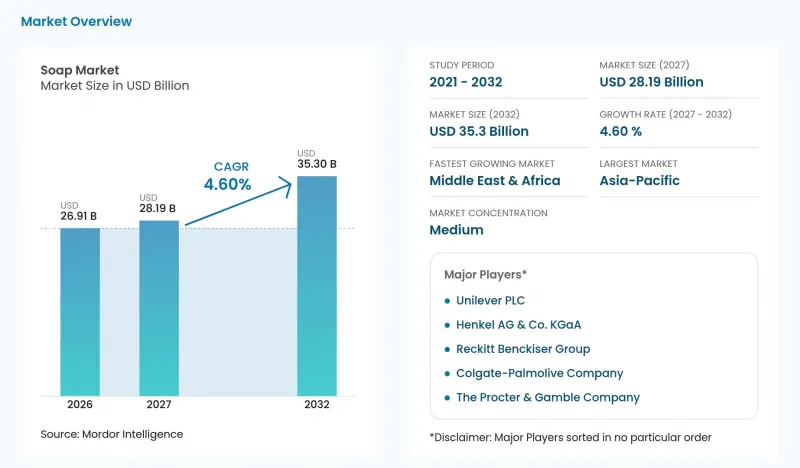
This report is segmented by Product Type (Bar Soap and more), Ingredient Type (Conventional/Synthetic and more), Category (Mass and more), End User (Adults and more), Distribution Channel (Supermarkets/Hypermarkets and more), and Geography (Asia-Pacific and more). The market forecasts are provided in terms of value (USD), based on availability.
Global Soap Market Trends and Insights
Rising consumer awareness of personal hygiene and handwashing practices
More frequent handwashing can support recurring soap use through additional cleansing occasions. A National Foundation for Infectious Diseases survey fielded in November and December 2024 and March 2025 found that 33% of US adult respondents reported washing their hands more than during the COVID-19 pandemic. The self-reported comparison points to additional washing occasions among those respondents. For a bar supplier, the commercial opportunity depends on which cleansing format serves those occasions.
Increasing demand for antibacterial, medicated, and germ-protection soaps
Germ protection can support bar-soap demand without making a medicated formulation the only relevant product proposition. In Q1 2025, Reckitt Benckiser Group reported strong performance for its bar-soap business in India in its Dettol results discussion. The World Health Organization's 2025 community guideline recommends plain soap and water for hand hygiene. It identifies hand rub containing at least 60% alcohol as an effective alternative when hands are not visibly dirty. For suppliers, this makes formulation and claim selection a commercial choice within hand hygiene, rather than a requirement to market every bar as medicated.
Intense competition from alternative cleansing products such as body washes and shower gels
Body wash competes for bathing occasions that might otherwise support repeat purchases of bar soap. In India, household penetration of liquid formats rose from 52% to 58% in the year ended June 2026 across face wash, hand wash, body wash, liquid detergents, and dishwashing liquids. Hindustan Unilever reported double-digit Bodywash growth momentum and improved market leadership in India for the quarter ended June 30, 2026. A narrower clinical substitution route appears in NHS Dorset's 2025-26 advice for patients with diagnosed dermatological conditions to use their usual emollient instead of soap. Prescribed bath and shower emollients were reserved for specialist recommendations for severe eczema or infants under 1 year, with pharmacy purchase also permitted. Where a liquid or emollient replaces a bar in repeated bathing, the supplier risks losing subsequent bar purchases rather than only a single trial.
Other drivers and restraints analyzed in the detailed report include:
- Expansion of premium, organic, natural, and herbal soap segments
- Growth of e-commerce and omnichannel retail distribution networks
- Volatility in raw material prices, particularly vegetable oils, palm oil, fragrances, and surfactants
For complete list of drivers and restraints, kindly check the Table Of Contents.
Segment Analysis
Bar soap accounted for a 96.86% share of the soap market size in 2026. Blue Power Group, a Jamaican manufacturer, produced more than 20 million soap bars in 2025, which shows the bar format's reach among regional producers. For an incumbent, the dominant format provides an established commercial base on which to develop product differentiation while continuing to serve routine cleansing demand. Because solid form alone offers little differentiation in such a concentrated product mix, a new supplier needs a proposition that wins a place within the existing bar format.
Paper soaps and strips are the fastest-growing segment, with a 5% CAGR forecast for 2027-2032. For a travel-focused offer, commercial development hinges on giving each soap strip a defined cleansing task and quantity. A pack organized around a trip's intended handwashing occasions makes the unit of sale a set of uses, creating room for a supplementary travel purchase alongside a household bar.
Conventional/synthetic soap held 86.02% of the market in 2026, making it the largest segment. Unilever reported scaling soap-bar reformulation across priority brands in India and Indonesia in 2025, using patented structuring technology to reduce palm-oil-derived total fatty matter. This places formulation development inside established bar brands, allowing a producer to improve the product proposition without making a separate ingredient-positioned brand the only route to innovation.
Natural/organic soap is the fastest-growing segment, with a 5.7% CAGR forecast for 2027-2032. Dr. Squatch sells cold-process bar soap that it describes as made with natural ingredients, within a broader grooming portfolio that also includes deodorant, hair care, skin care, and cologne. Unilever completed the acquisition of a 98.7% stake in that US-based natural personal-care business on September 2, 2025. The acquisition adds a natural-ingredient bar brand to an owner also reformulating conventional bars, placing two ingredient routes within one group.
Complete Report Scope:
- By Product Type
- Bar Soap
- Paper Soaps and Strips
- By Ingredient Type
- Conventional/Synthetic
- Natural/Organic
- By Category
- Mass
- Premium
- By End User
- Kids/Children
- Adults
- By Distribution Channel
- Supermarkets/Hypermarkets
- Health & Beauty Stores
- Online Retail Stores
- Other Distribution Channels
- By Geography
- North America
- United States
- Canada
- Mexico
- Rest of North America
- Europe
- Germany
- United Kingdom
- Italy
- France
- Spain
- Netherlands
- Poland
- Belgium
- Sweden
- Rest of Europe
- Asia-Pacific
- China
- India
- Japan
- Australia
- Indonesia
- South Korea
- Thailand
- Singapore
- Rest of Asia-Pacific
- South America
- Brazil
- Argentina
- Colombia
- Chile
- Peru
- Rest of South America
- Middle East & Africa
- South Africa
- Saudi Arabia
- United Arab Emirates
- Nigeria
- Egypt
- Morocco
- Turkey
- Rest of Middle East and Africa
- North America
Geography Analysis
Asia-Pacific was the largest region, accounting for 37.68% of the soap market size in 2026. Godrej Consumer Products inaugurated its fourth manufacturing unit at Malanpur, Madhya Pradesh, India, on August 26, 2026, and reported total soap capacity at the multi-product site of more than 200,000 metric tons per year. Malanpur's broader output includes hair colors and household insecticides, placing the soap expansion within a facility with several consumer-product roles. Expansion at an established multi-product site can reinforce local soap-supply capacity without making a separate soap-only factory the sole route to scale.
Middle East & Africa is the fastest-growing region, with a 5.12% CAGR forecast for 2027-2032. PZ Cussons Nigeria Plc reported that Joy soap net sales grew 65% and volume grew 9% in FY2025, the year ended May 31, 2025. The company also described Joy's strength in the traditional 56- to 70-gram beauty-soap pack segment. The volume gain is the physical-demand signal, while the much larger net-sales increase includes effects beyond unit growth. Expanding units in an established small beauty-soap format is a clearer production objective than treating nominal revenue growth as equivalent demand.
In North America, Jamaica's Blue Power reported lost sales in some value-priced bath-soap lines in the year ended April 2026 after a 40% duty on soapmaking inputs imported from outside CARICOM. Blue Power attributed those lost sales to the duty amid intense competition from sporadic informal imports. In Europe, CBI identifies luxury soap bars as gifts and home-use products, connecting their offer to a small indulgence within the home. In South America, Neogrid's April 2024 to March 2025 Brazilian grocery-retail panel recorded bar-soap purchase incidence of 37.5% in the Center-West and 43.4% in the North. For Blue Power's value-priced bath bars, informal-import competition limits the room to recover the non-CARICOM input duty through higher selling prices.
- Unilever PLC
- The Procter & Gamble Company
- Colgate-Palmolive Company
- Reckitt Benckiser Group
- Henkel AG & Co. KGaA
- Kao Corporation
- Lion Corporation
- Beiersdorf AG
- Godrej Consumer Products Limited
- Kenvue Inc.
- Natura Cosmeticos S.A.
- L'Occitane International S.A.
- Dabur India Limited
- Wipro Consumer Care and Lighting
- Nirma Limited
- The Clorox Company
- Church & Dwight Co., Inc.
- Amway Corporation
- Shanghai Jahwa United Co., Ltd.
- Ecolab Inc.
Additional Benefits:
- The market estimate (ME) sheet in Excel format
- 3 months of analyst support
TABLE OF CONTENTS
1 INTRODUCTION
- 1.1 Study Assumptions and Market Definition
- 1.2 Scope of the Study
2 RESEARCH METHODOLOGY
3 EXECUTIVE SUMMARY
4 MARKET LANDSCAPE
- 4.1 Market Overview
- 4.2 Market Drivers
- 4.2.1 Rising consumer awareness of personal hygiene and handwashing practices
- 4.2.2 Increasing demand for antibacterial, medicated, and germ-protection soaps
- 4.2.3 Expansion of premium, organic, natural, and herbal soap segments
- 4.2.4 Growth of e-commerce and omnichannel retail distribution networks
- 4.2.5 Product innovation in skin-nourishing, moisturizing, and dermatologically tested formulations
- 4.2.6 Increasing demand for sustainable, eco-friendly, and ethically sourced soap products
- 4.3 Market Restraints
- 4.3.1 Intense competition from alternative cleansing products such as body washes and shower gels
- 4.3.2 Volatility in raw material prices, particularly vegetable oils, palm oil, fragrances, and surfactants
- 4.3.3 Rising environmental concerns regarding packaging waste and ingredient sourcing
- 4.3.4 Stringent regulatory requirements for product safety, labeling, and ingredient compliance
- 4.4 Industry Value Chain Analysis
- 4.5 Regulatory Landscape
- 4.6 Technological Outlook
- 4.7 Porter's Five Forces Analysis
- 4.7.1 Threat of New Entrants
- 4.7.2 Bargaining Power of Suppliers
- 4.7.3 Bargaining Power of Buyers
- 4.7.4 Threat of Substitutes
- 4.7.5 Competitive Rivalry
- 4.8 Consumer Behavior Analysis
5 MARKET SIZE AND GROWTH FORECASTS (VALUE)
- 5.1 By Product Type
- 5.1.1 Bar Soap
- 5.1.2 Paper Soaps and Strips
- 5.2 By Ingredient Type
- 5.2.1 Conventional/Synthetic
- 5.2.2 Natural/Organic
- 5.3 By Category
- 5.3.1 Mass
- 5.3.2 Premium
- 5.4 By End User
- 5.4.1 Kids/Children
- 5.4.2 Adults
- 5.5 By Distribution Channel
- 5.5.1 Supermarkets/Hypermarkets
- 5.5.2 Health & Beauty Stores
- 5.5.3 Online Retail Stores
- 5.5.4 Other Distribution Channels
- 5.6 By Geography
- 5.6.1 North America
- 5.6.1.1 United States
- 5.6.1.2 Canada
- 5.6.1.3 Mexico
- 5.6.1.4 Rest of North America
- 5.6.2 Europe
- 5.6.2.1 Germany
- 5.6.2.2 United Kingdom
- 5.6.2.3 Italy
- 5.6.2.4 France
- 5.6.2.5 Spain
- 5.6.2.6 Netherlands
- 5.6.2.7 Poland
- 5.6.2.8 Belgium
- 5.6.2.9 Sweden
- 5.6.2.10 Rest of Europe
- 5.6.3 Asia-Pacific
- 5.6.3.1 China
- 5.6.3.2 India
- 5.6.3.3 Japan
- 5.6.3.4 Australia
- 5.6.3.5 Indonesia
- 5.6.3.6 South Korea
- 5.6.3.7 Thailand
- 5.6.3.8 Singapore
- 5.6.3.9 Rest of Asia-Pacific
- 5.6.4 South America
- 5.6.4.1 Brazil
- 5.6.4.2 Argentina
- 5.6.4.3 Colombia
- 5.6.4.4 Chile
- 5.6.4.5 Peru
- 5.6.4.6 Rest of South America
- 5.6.5 Middle East & Africa
- 5.6.5.1 South Africa
- 5.6.5.2 Saudi Arabia
- 5.6.5.3 United Arab Emirates
- 5.6.5.4 Nigeria
- 5.6.5.5 Egypt
- 5.6.5.6 Morocco
- 5.6.5.7 Turkey
- 5.6.5.8 Rest of Middle East and Africa
- 5.6.1 North America
6 COMPETITIVE LANDSCAPE
- 6.1 Market Concentration
- 6.2 Strategic Moves
- 6.3 Market Share Analysis
- 6.4 Company Profiles (includes Global level Overview, Market level overview, Core Segments, Financials as available, Strategic Information, Market Rank/Share for key companies, Products and Services, and Recent Developments)
- 6.4.1 Unilever PLC
- 6.4.2 The Procter & Gamble Company
- 6.4.3 Colgate-Palmolive Company
- 6.4.4 Reckitt Benckiser Group
- 6.4.5 Henkel AG & Co. KGaA
- 6.4.6 Kao Corporation
- 6.4.7 Lion Corporation
- 6.4.8 Beiersdorf AG
- 6.4.9 Godrej Consumer Products Limited
- 6.4.10 Kenvue Inc.
- 6.4.11 Natura Cosmeticos S.A.
- 6.4.12 L'Occitane International S.A.
- 6.4.13 Dabur India Limited
- 6.4.14 Wipro Consumer Care and Lighting
- 6.4.15 Nirma Limited
- 6.4.16 The Clorox Company
- 6.4.17 Church & Dwight Co., Inc.
- 6.4.18 Amway Corporation
- 6.4.19 Shanghai Jahwa United Co., Ltd.
- 6.4.20 Ecolab Inc.
7 MARKET OPPORTUNITIES AND FUTURE OUTLOOK
- 7.1 White-Space and Unmet-Need Assessment

