PUBLISHER: Mordor Intelligence | PRODUCT CODE: 2187740

PUBLISHER: Mordor Intelligence | PRODUCT CODE: 2187740
India OTT - Market Share Analysis, Industry Trends & Statistics, Growth Forecasts (2027 - 2032)
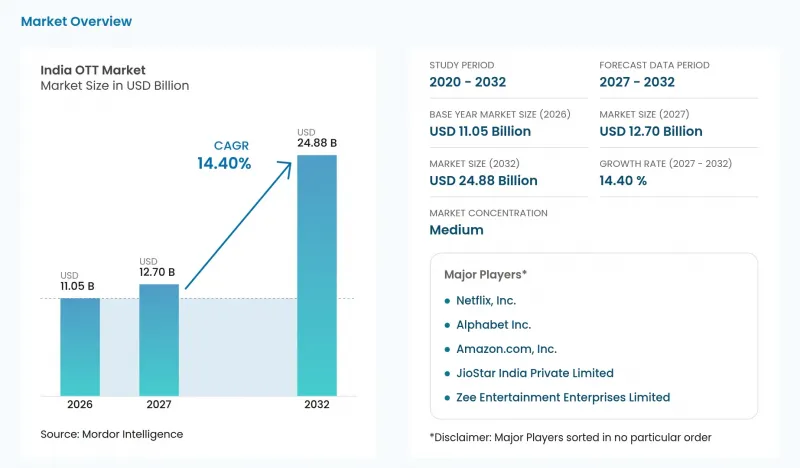
According to Mordor Intelligence, the India OTT market size is expected to increase from USD 11.05 billion in 2026 to USD 12.7 billion in 2027 and reach USD 24.88 billion by 2032, growing at a CAGR of 14.4% over 2027-2032.
India OTT Market Trends and Insights
Rising Connected TV Adoption in Urban Households
Big-screen streaming gives platforms a substantial urban audience beyond individual mobile viewing. A Kantar survey commissioned by Amazon Ads found that approximately 60% of urban TV audiences watched through internet-connected televisions in September to October 2025. The survey covered 5,780 online video streamers aged 18 to 55 in NCCS A and B across 25 Indian metro and Tier 2 cities. For services addressing this audience, television access can make a subscription relevant to shared viewing rather than a single person's entertainment. That expands the rationale for programming that earns repeated attention on the household screen. Sustaining television viewing occasions is what turns this urban audience into recurring subscription value.
Sports Rights and Live Event Monetization
Live sports creates concentrated viewing occasions that can connect streaming engagement with advertiser demand. JioStar reported 25 billion digital video views for TATA IPL 2026, up 8% year on year. It also reported 125 new advertisers for its cross-platform tournament presentation compared with the previous season. For a rights holder, this combination makes the commercial opportunity broader than collecting subscriptions from viewers who follow the competition. Live-event audiences can support additional advertising relationships, giving the platform another route to recover the cost of carrying the tournament. The resulting demand advantage depends on turning concentrated match viewing into saleable exposure, rather than treating a large view count as revenue by itself.
Subscription Fatigue Among Price-Sensitive Users
For a price-sensitive viewer, another recurring subscription must justify the value of the programming it adds. A Meta and Ormax survey conducted from November 2025 to January 2026 covered 2,000 micro-drama viewers across 14 Indian states. More than half cited auto-renewal concerns as a reason for avoiding paid micro-drama plans. That reluctance to accept automatic renewal shows that the recurring commitment itself holds back paid take-up in this format. Each added plan needs enough distinct, regularly relevant programming to hold its place in the viewer's entertainment spending. Otherwise, the fee required to fund the offer can exceed the value a price-sensitive buyer assigns to continued access.
Other drivers and restraints analyzed in the detailed report include:
- Hybrid Monetization Broadens the Revenue Stack
- Regional Language Content Expands Audience Reach Beyond Metro Cities
- Content Piracy and Account Sharing Pressure Monetization
For complete list of drivers and restraints, kindly check the Table Of Contents.
Segment Analysis
SVOD accounted for a 46.18% share of the India OTT market size in 2026. Ormax estimated 172.6 million active paid OTT subscriptions in India in 2026. Its count covered subscriptions used at least once in the preceding month, including access obtained through telecom bundles and OTT aggregators. SVOD providers can offer a recurring content proposition through either a direct plan or a bundled entitlement, connecting the same programming asset to different access relationships. Because subscription scale rewards sustained viewing across distribution partners, partner access belongs in the content investment case.
AVOD is forecast to be the fastest-growing segment, with a CAGR of 14.9% over 2027-2032. Samsung Ads' proprietary data showed that AVOD users on Samsung smart TVs in India increased 26% in 2025. Ad-supported access gives a service a route to viewers without first requiring a recurring subscription payment, shifting the revenue opportunity toward advertisers. For a platform, that separates the task of attracting viewing from the task of selling the resulting exposure, so both relationships matter to commercial expansion. AVOD can widen access without adding a billing relationship for each viewer, making advertiser demand the constraint on monetizing broader use.
Complete Report Scope:
- By Revenue Model
- SVOD
- AVOD
- TVOD
- Hybrid Subscription and Ads
- By Device Type
- Smartphones and Tablets
- Smart TVs
- Laptops and Desktops
- Other Device Types
- By Content Genre
- Movies and Films
- TV Shows and Episodic Content
- Documentaries
- Other Content Genres
List of Companies Covered in this Report:
- Netflix, Inc.
- Amazon.com, Inc.
- Alphabet Inc.
- JioStar India Private Limited
- Zee Entertainment Enterprises Limited
- Sony Pictures Networks India Private Limited
- Sun TV Network Limited
- Skydance Corporation
- Apple Inc.
- Arha Media & Broadcasting Private Limited
- Tata Play Limited
- Bharti Airtel Limited
- Pocket FM
- Shemaroo Entertainment Limited
- Eros Media World PLC
- Hoichoi Technologies Private Limited
- YuppTV, Inc.
- Balaji Telefilms Limited
- Hungama Digital Media Entertainment Private Limited
Additional Benefits:
- The market estimate (ME) sheet in Excel format
- 3 months of analyst support
TABLE OF CONTENTS
1 INTRODUCTION
- 1.1 Study Assumptions and Market Definition
- 1.2 Scope of the Study
2 RESEARCH METHODOLOGY
3 EXECUTIVE SUMMARY
4 MARKET LANDSCAPE
- 4.1 Market Overview
- 4.2 Market Drivers
- 4.2.1 Rising Connected TV Adoption in Urban Households
- 4.2.2 Sports Rights and Live Event Monetization
- 4.2.3 Hybrid Monetization Broadens the Revenue Stack
- 4.2.4 Regional Language Content Expands Audience Reach Beyond Metro Cities
- 4.2.5 Programmatic CTV Advertising Improves Ad Yield and Targeting
- 4.2.6 Bundling With Telco and Broadband Plans Lowers Acquisition Friction
- 4.3 Market Restraints
- 4.3.1 Subscription Fatigue Among Price-Sensitive Users
- 4.3.2 Content Piracy and Account Sharing Pressure Monetization
- 4.3.3 High Content Costs for Premium Sports and Originals
- 4.3.4 Fragmented Payments and Renewal Drop-Off in Mass-Market Segments
- 4.4 Industry Value Chain Analysis
- 4.5 Regulatory Landscape
- 4.6 Technological Outlook
- 4.7 Porter's Five Forces Analysis
- 4.7.1 Threat of New Entrants
- 4.7.2 Bargaining Power of Suppliers
- 4.7.3 Bargaining Power of Buyers
- 4.7.4 Threat of Substitutes
- 4.7.5 Competitive Rivalry
- 4.8 Impact of Macroeconomic Factors on the Market
5 MARKET SIZE AND GROWTH FORECASTS (VALUE)
- 5.1 By Revenue Model
- 5.1.1 SVOD
- 5.1.2 AVOD
- 5.1.3 TVOD
- 5.1.4 Hybrid Subscription and Ads
- 5.2 By Device Type
- 5.2.1 Smartphones and Tablets
- 5.2.2 Smart TVs
- 5.2.3 Laptops and Desktops
- 5.2.4 Other Device Types
- 5.3 By Content Genre
- 5.3.1 Movies and Films
- 5.3.2 TV Shows and Episodic Content
- 5.3.3 Documentaries
- 5.3.4 Other Content Genres
6 COMPETITIVE LANDSCAPE
- 6.1 Market Concentration
- 6.2 Strategic Moves
- 6.3 Market Share Analysis
- 6.4 Company Profiles (includes Global level Overview, Market level overview, Core Segments, Financials as available, Strategic Information, Market Rank/Share for key companies, Products and Services, and Recent Developments)
- 6.4.1 Netflix, Inc.
- 6.4.2 Amazon.com, Inc.
- 6.4.3 Alphabet Inc.
- 6.4.4 JioStar India Private Limited
- 6.4.5 Zee Entertainment Enterprises Limited
- 6.4.6 Sony Pictures Networks India Private Limited
- 6.4.7 Sun TV Network Limited
- 6.4.8 Skydance Corporation
- 6.4.9 Apple Inc.
- 6.4.10 Arha Media & Broadcasting Private Limited
- 6.4.11 Tata Play Limited
- 6.4.12 Bharti Airtel Limited
- 6.4.13 Pocket FM
- 6.4.14 Shemaroo Entertainment Limited
- 6.4.15 Eros Media World PLC
- 6.4.16 Hoichoi Technologies Private Limited
- 6.4.17 YuppTV, Inc.
- 6.4.18 Balaji Telefilms Limited
- 6.4.19 Hungama Digital Media Entertainment Private Limited
7 MARKET OPPORTUNITIES AND FUTURE OUTLOOK
- 7.1 White-Space and Unmet-Need Assessment

