PUBLISHER: Mordor Intelligence | PRODUCT CODE: 2119245

PUBLISHER: Mordor Intelligence | PRODUCT CODE: 2119245
Commerce Media Services - Market Share Analysis, Industry Trends & Statistics, Growth Forecasts (2026 - 2031)
According to Mordor Intelligence, the commerce media services market size is projected to expand from USD 11.32 billion in 2025 and USD 12.34 billion in 2026 to USD 19.81 billion by 2031, registering a CAGR of 9.92% between 2026 to 2031.
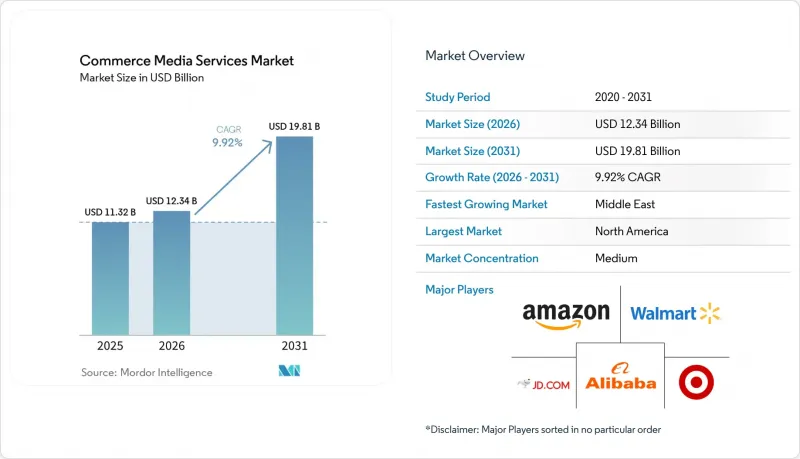
This report is Segmented by Platform Ownership Model (Owned and Operated, Third-Party Networks, Integrated Commerce Media Platforms, White-Label Enablement Platforms), Advertising Format (Sponsored Products and Search Ads, Display Ads, Video Ads, Native and Shoppable, Audio Ads, DOOH and In-Transit Ads), and Geography (North America, and More). The Market Forecasts are Provided in Terms of Value (USD).
Global Commerce Media Services Market Trends and Insights
First-Party Data Monetization After Third-Party Cookie Loss
The decline of third-party identifiers has made first-party purchase and loyalty data more important to the commerce media services market. Retailers can use consented transaction signals to support targeting and measurement within their own digital properties. IAB projected 12.1% commerce media growth in 2026 and linked the outlook to the continued development of first-party data ecosystems and repeat purchases. This position gives retailers a data asset that open-web publishers cannot replicate without direct transactional relationships. Smaller retailers can also use category-specific loyalty data in areas such as pharmacy and specialty food, where relevance may matter more than audience scale. The commerce media services market can therefore support narrower networks that offer advertisers a defined customer context and measurable purchase outcomes.
Margin Expansion From High-Gross-Margin Media Revenue
Media income has become a strategic revenue stream for retailers as their core operations face profitability pressure. Walmart reported strong growth in global advertising revenue, while Walmart Connect U.S. revenue also grew significantly. This performance has encouraged retailers to use advertising to fund store digitization, loyalty program development, and data infrastructure. Grocery retailers, which typically operate with lower net margins, have a strong incentive to develop media businesses that leverage customer data and existing digital traffic. This model can strengthen the commerce media services market, as investments in advertising tools also enhance retailers' ability to sell and measure campaigns. It may also widen the gap between retailers with meaningful digital customer relationships and those that have not yet developed them.
Fragmented Measurement and Reporting Standards
The absence of a common reporting standard remains a material constraint for the commerce media services market. IAB Europe found that many respondents identified a lack of standardization and network fragmentation as significant barriers to retail media growth. Platforms use different return-on-ad-spend definitions, attribution windows, and treatments of view-through activity. These differences make cross-retailer budget decisions more difficult and can increase manual work for advertisers and agencies. IAB Europe's Commerce Media Measurement Standards and IAB's Project Eidos offer frameworks for more consistent reporting. Adoption is still uneven, particularly among smaller networks that have limited engineering capacity and operate across multiple jurisdictions.
Other drivers and restraints analyzed in the detailed report include:
- Closed-Loop Measurement and Incrementality Proof
- Offsite and Full-Funnel Expansion Into CTV and Social
- Ad Load Saturation and Shopper Experience Erosion
For complete list of drivers and restraints, kindly check the Table Of Contents.
Segment Analysis
Owned and Operated Networks held 43.80% of commerce media services market share in 2025, supported by their exclusive access to purchase, loyalty, browsing, and in-store behavior data. Their direct relationship with the shopper supports closed-loop measurement that third-party providers cannot reproduce in the same way. This feature helps advertisers connect campaign activity with sales outcomes and evaluate the value of placements. Amazon also stated that Sponsored Products remained its largest advertising offering. Its Ads Agent reduced cost per impression and cost per acquisition compared with an unassisted setup, according to the company. Regulatory scrutiny of sponsored ranking practices in the United States and Europe may limit how far the largest networks can increase monetization. This gives mid-tier operators an opening to compete on transparency, brand safety, and customer experience.
Integrated Commerce Media Platforms are projected to record the fastest growth at a CAGR of 10.89% from 2026 to 2031. Their model brings onsite, offsite, and in-store inventory into one buying and measurement environment. Brands can use these platforms to plan campaigns across several stages of the commerce journey without relying on separate tools for each channel. This approach can reduce the operational complexity created by isolated owned networks and fragmented third-party supply. Third-Party Networks are also gaining relevance because they aggregate mid-market retailer inventory and provide access through a single demand-side platform connection. That structure can help consumer packaged goods advertisers reach grocery, pharmacy, and convenience retail audiences while managing duplication. White-Label Enablement Platforms remain smaller by direct revenue, but they provide the technical foundation for retailers that lack internal advertising technology teams. Their presence can widen participation in the commerce media services market across the Middle East, Southeast Asia, and Africa.
Complete Report Scope:
- By Platform Ownership Model
- Owned and Operated Networks
- Third-Party Networks
- Integrated Commerce Media Platforms
- White-Label Enablement Platforms
- By Advertising Format
- Sponsored Products and Sponsored Search Ads
- Display Ads
- Video Ads (including Connected TV)
- Native and Shoppable Content Ads
- Audio Ads
- Digital Out-of-Home (DOOH) and In-Transit Ads
- By Geography
- North America
- United States
- Canada
- Mexico
- South America
- Brazil
- Argentina
- Chile
- Rest of South America
- Europe
- Germany
- United Kingdom
- France
- Italy
- Spain
- Russia
- Netherlands
- Nordics
- Rest of Europe
- Asia-Pacific
- China
- Japan
- India
- South Korea
- Australia
- Southeast Asia
- Rest of Asia-Pacific
- Middle East
- Saudi Arabia
- United Arab Emirates
- Turkey
- Israel
- Rest of Middle East
- Africa
- South Africa
- Egypt
- Nigeria
- Kenya
- Rest of Africa
- North America
Geography Analysis
North America held 39.00% of the commerce media services market share in 2025. U.S. retail media advertising spending has grown significantly and is expected to continue expanding. Offsite activation represents a meaningful share of this total. Walmart is aligning Walmart Connect U.S., Walmart Connect International, and Sam's Club through shared technology and platforms.
Asia-Pacific is the second-largest regional cluster within the commerce media services market. Alibaba's Alimama platform and JD.com's Jingzhuntong system anchor a large ecosystem in China, where a coalition including Alibaba and JD.com committed substantial instant retail subsidies. Japan's domestic retail media sector expanded significantly year over year. Google Japan and BCG estimated that in-store retail media could grow substantially over the long term. Europe is expanding as retailers build consent management and clean-room capabilities, while Carrefour Links is built on a large base of transactions and global customers.
The Middle East is projected to be the fastest-expanding geography at 10.81% CAGR during the forecast period. IAB MENA documented several active retail media networks across the Gulf Cooperation Council. In South America, MercadoLibre reported strong year-over-year advertising revenue growth in U.S. dollars. Africa remains at an earlier stage, where Criteo and Massmart introduced Sponsored Product Ads and Onsite Display Ads in South Africa. These developments extend the commerce media services market into retail systems where mobile performance advertising is becoming more important.
- Amazon.com, Inc.
- Alibaba Group Holding Limited
- JD.com, Inc.
- Walmart Inc.
- Target Corporation
- The Kroger Co.
- Maplebear Inc.
- DoorDash, Inc.
- Uber Technologies, Inc.
- Criteo S.A.
- Publicis Groupe S.A.
- Albertsons Companies, Inc.
- Koninklijke Ahold Delhaize N.V.
- Carrefour SA
- Tesco PLC
- MercadoLibre, Inc.
- eBay Inc.
- Booking Holdings Inc.
- Expedia Group, Inc.
- Marriott International, Inc.
Additional Benefits:
- The market estimate (ME) sheet in Excel format
- 3 months of analyst support
TABLE OF CONTENTS
1 INTRODUCTION
- 1.1 Study Assumptions and Market Definition
- 1.2 Scope of the Study
2 RESEARCH METHODOLOGY
3 EXECUTIVE SUMMARY
4 MARKET LANDSCAPE
- 4.1 Market Overview
- 4.2 Impact of Macroeconomic Factors on the Market
- 4.3 Market Drivers
- 4.3.1 First-Party Data Monetization After Third-Party Cookie Loss
- 4.3.2 Margin Expansion from High-Gross-Margin Media Revenue
- 4.3.3 Closed-Loop Measurement and Incrementality Proof
- 4.3.4 Offsite and Full-Funnel Expansion into CTV and Social
- 4.3.5 Travel and Hospitality Booking Platforms Entering Commerce Media
- 4.3.6 Clean-Room Collaboration Unlocking Non-Endemic Spend
- 4.4 Market Restraints
- 4.4.1 Fragmented Measurement and Reporting Standards
- 4.4.2 Ad Load Saturation and Shopper Experience Erosion
- 4.4.3 Sponsored Ranking Transparency and Antitrust Scrutiny
- 4.4.4 Catalog and Identity Interoperability Gaps Across Verticals
- 4.5 Industry Value Chain Analysis
- 4.6 Regulatory Landscape
- 4.7 Technological Outlook
- 4.8 Porter's Five Forces Analysis
- 4.8.1 Threat of New Entrants
- 4.8.2 Bargaining Power of Buyers
- 4.8.3 Bargaining Power of Suppliers
- 4.8.4 Threat of Substitutes
- 4.8.5 Industry Rivalry
5 MARKET SIZE AND GROWTH FORECASTS (VALUE)
- 5.1 By Platform Ownership Model
- 5.1.1 Owned and Operated Networks
- 5.1.2 Third-Party Networks
- 5.1.3 Integrated Commerce Media Platforms
- 5.1.4 White-Label Enablement Platforms
- 5.2 By Advertising Format
- 5.2.1 Sponsored Products and Sponsored Search Ads
- 5.2.2 Display Ads
- 5.2.3 Video Ads (including Connected TV)
- 5.2.4 Native and Shoppable Content Ads
- 5.2.5 Audio Ads
- 5.2.6 Digital Out-of-Home (DOOH) and In-Transit Ads
- 5.3 By Geography
- 5.3.1 North America
- 5.3.1.1 United States
- 5.3.1.2 Canada
- 5.3.1.3 Mexico
- 5.3.2 South America
- 5.3.2.1 Brazil
- 5.3.2.2 Argentina
- 5.3.2.3 Chile
- 5.3.2.4 Rest of South America
- 5.3.3 Europe
- 5.3.3.1 Germany
- 5.3.3.2 United Kingdom
- 5.3.3.3 France
- 5.3.3.4 Italy
- 5.3.3.5 Spain
- 5.3.3.6 Russia
- 5.3.3.7 Netherlands
- 5.3.3.8 Nordics
- 5.3.3.9 Rest of Europe
- 5.3.4 Asia-Pacific
- 5.3.4.1 China
- 5.3.4.2 Japan
- 5.3.4.3 India
- 5.3.4.4 South Korea
- 5.3.4.5 Australia
- 5.3.4.6 Southeast Asia
- 5.3.4.7 Rest of Asia-Pacific
- 5.3.5 Middle East
- 5.3.5.1 Saudi Arabia
- 5.3.5.2 United Arab Emirates
- 5.3.5.3 Turkey
- 5.3.5.4 Israel
- 5.3.5.5 Rest of Middle East
- 5.3.6 Africa
- 5.3.6.1 South Africa
- 5.3.6.2 Egypt
- 5.3.6.3 Nigeria
- 5.3.6.4 Kenya
- 5.3.6.5 Rest of Africa
- 5.3.1 North America
6 COMPETITIVE LANDSCAPE
- 6.1 Market Concentration
- 6.2 Strategic Moves
- 6.3 Market Share Analysis
- 6.4 Company Profiles (includes Global Level Overview, Market Level Overview, Core Segments, Financials as available, Strategic Information, Market Rank/Share, Products and Services, Recent Developments)
- 6.4.1 Amazon.com, Inc.
- 6.4.2 Alibaba Group Holding Limited
- 6.4.3 JD.com, Inc.
- 6.4.4 Walmart Inc.
- 6.4.5 Target Corporation
- 6.4.6 The Kroger Co.
- 6.4.7 Maplebear Inc.
- 6.4.8 DoorDash, Inc.
- 6.4.9 Uber Technologies, Inc.
- 6.4.10 Criteo S.A.
- 6.4.11 Publicis Groupe S.A.
- 6.4.12 Albertsons Companies, Inc.
- 6.4.13 Koninklijke Ahold Delhaize N.V.
- 6.4.14 Carrefour SA
- 6.4.15 Tesco PLC
- 6.4.16 MercadoLibre, Inc.
- 6.4.17 eBay Inc.
- 6.4.18 Booking Holdings Inc.
- 6.4.19 Expedia Group, Inc.
- 6.4.20 Marriott International, Inc.
7 MARKET OPPORTUNITIES AND FUTURE OUTLOOK
- 7.1 White-Space and Unmet-Need Assessment

