PUBLISHER: Mordor Intelligence | PRODUCT CODE: 2124570

PUBLISHER: Mordor Intelligence | PRODUCT CODE: 2124570
United States OTT - Market Share Analysis, Industry Trends & Statistics, Growth Forecasts (2026 - 2031)
According to Mordor Intelligence, the United States OTT market size reached USD 135.09 billion in 2026 and is projected to climb to USD 208.58 billion by 2031, advancing at an 9.08% CAGR.
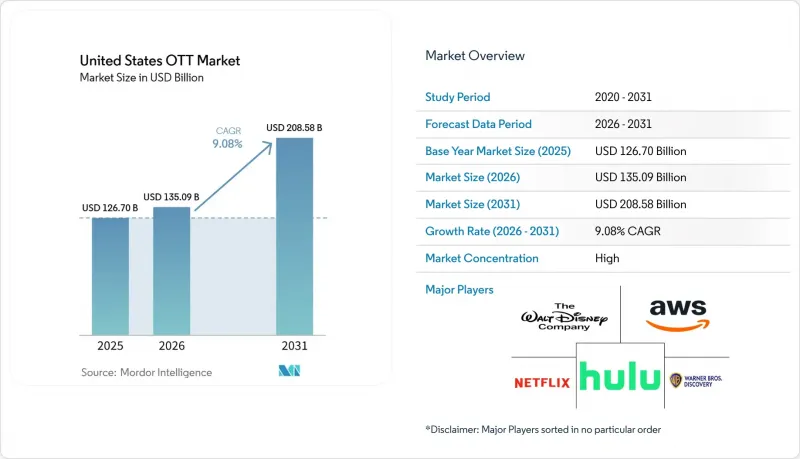
This report is Segmented by Revenue Model (SVOD, TVOD, AVOD, and Hybrid Subscription and Ads), Device Type (Smartphones and Tablets, Smart TVs, Laptops and Desktops, Game Consoles, and Set-Top Boxes and Media Streamers), and Content Genre (Movies and Films, TV Shows and Episodic Content, Documentaries, and Other Content Genres). The Market Forecasts are Provided in Terms of Value (USD).
United States OTT Market Trends and Insights
Rising Cord-Cutting Rates Among US Households Accelerate Direct-to-Consumer Adoption
Cord-cutting became a defining force for the United States OTT market in 2025, when non-pay-TV households outnumbered pay-TV households. The Video Advertising Bureau reported that 77.2 million US households had cut the cord in 2025, and it expects the total to reach 80.7 million by the end of 2026. Streaming accounted for 47.5% of total US television viewing in December 2025, compared with 20.2% for cable and 21.4% for broadcast. Each household that leaves traditional pay television becomes a direct customer of one or more OTT services. The change gives platforms more control over billing, plan selection, and advertising exposure. It also makes retention more important, as consumers can switch providers with little effort.
Rapid Expansion of Fiber and 5G Networks Enables Higher-Quality Streaming
Broadband quality supports the United States OTT market by improving the reliability of high-resolution video delivery. Faster fixed and wireless connections reduce buffering and can improve completion rates for 4K programming. Better viewing experiences can reduce cancellations caused by poor service quality and increase advertising inventory on connected television services. Fiber and fixed wireless access can extend premium streaming to exurban and rural areas where legacy cable networks may not support consistent high-bandwidth viewing. The Federal Communications Commission has continued to direct broadband support toward rural coverage and infrastructure expansion. These investments can enlarge the addressable household base over the forecast period if platforms offer services and content that meet the needs of newly connected households.
Growing Content Licensing Costs and Competition for Premium IP Squeeze Margins
Content licensing costs remain a significant restraint on the United States OTT market. Netflix and Sony Pictures Entertainment finalized a global Pay-1 licensing agreement valued above USD 7 billion in January 2026, while Disney increased its fiscal 2026 content budget by USD 1 billion to USD 24 billion, with NBA rights identified as a major driver. These commitments show the continuing importance of premium franchises, theatrical rights, and live sports to leading platforms. New AVC, or H.264, streaming fee structures can also add fixed annual expenses for large platforms. Smaller services may lack the scale needed to spread content and technology costs across a large subscriber base. Platforms are responding through pricing, advertising income, disciplined content spending, licensing partnerships, and acquisitions.
Other drivers and restraints analyzed in the detailed report include:
- Shift Toward Ad-Supported and Hybrid Models Expands Audience Reach
- Niche SVOD Services Targeting Multicultural and Faith-Based Audiences Unlock New Subscriber Pools
- Market Saturation and Subscriber Churn Fueled by Low Switching Costs
For complete list of drivers and restraints, kindly check the Table Of Contents.
Segment Analysis
SVOD held 51.75% of the United States OTT market share in 2025, making it the largest revenue model. Recurring monthly subscriptions remain central to platform economics because they provide a predictable revenue base. Serialized programming and broad content libraries support reuse across major releases. Disney's USD 29.99 monthly bundle for Disney+, Hulu, and ESPN+ illustrates how combined services can increase value for households. The bundle reportedly added 11 million domestic subscribers since January 2026. TVOD serves viewers who prefer to pay for individual titles or live events rather than maintain a recurring service. Its role is more limited as subscription services move recent releases into their catalogs faster.
Hybrid subscription and advertising plans are changing the way leading platforms serve households across different budgets. The draft states that 80.4% of sub-OTT viewers are expected to have at least 1 advertising-supported subscription in 2026, compared with 71.5% in 2024. AVOD is the fastest-growing revenue model, with the United States OTT market size for AVOD projected to expand at a 9.71% CAGR through 2031. The Video Advertising Bureau projects that there will be 209.4 million AVOD viewers in the United States in 2026. FAST viewership is also projected to exceed 125 million viewers in 2026. Greater scale can attract advertisers, fund content acquisitions, and improve the appeal of free or low-cost services. Netflix's in-house advertising platform shows that the largest subscription services now treat advertising infrastructure as a strategic capability.
Complete Report Scope:
- By Revenue Model
- SVOD
- TVOD
- AVOD
- Hybrid Subscription and Ads
- By Device Type
- Smartphones and Tablets
- Smart TVs
- Laptops and Desktops
- Game Consoles
- Set-Top Boxes and Media Streamers
- By Content Genre
- Movies and Films
- TV Shows and Episodic Content
- Documentaries
- Other Content Genres
List of Companies Covered in this Report:
- Netflix, Inc.
- The Walt Disney Company
- Amazon.com, Inc.
- Hulu, LLC (The Walt Disney Company)
- Warner Bros. Discovery, Inc.
- Comcast Corporation
- Paramount Global
- Apple Inc.
- Roku, Inc.
- Google LLC
- DISH Network Corporation (EchoStar Corporation)
- FuboTV Inc.
- Fox Corporation
- Crunchyroll, LLC (Sony Group Corporation)
- BritBox LLC
- Starz Entertainment, LLC (Lions Gate Entertainment Corp.)
- ESPN+ (The Walt Disney Company)
- AMC Networks Inc.
Additional Benefits:
- The market estimate (ME) sheet in Excel format
- 3 months of analyst support
TABLE OF CONTENTS
1 INTRODUCTION
- 1.1 Study Assumptions and Market Definition
- 1.2 Scope of the Study
2 RESEARCH METHODOLOGY
3 EXECUTIVE SUMMARY
4 MARKET LANDSCAPE
- 4.1 Market Overview
- 4.2 Market Drivers
- 4.2.1 Rising Cord-Cutting Rates Among US Households Accelerating Direct-to-Consumer Adoption
- 4.2.2 Rapid Expansion of Fiber and 5G Networks Enabling Higher-Quality Streaming
- 4.2.3 Shift Toward Ad-Supported and Hybrid Models Expanding Audience Reach
- 4.2.4 Emergence of Niche SVOD Services Targeting Multicultural and Faith-Based Audiences Unlocking New Subscriber Pools
- 4.2.5 Tax Incentive Programs by States for In-State Original Content Production Lowering Cost Barriers
- 4.2.6 Adoption of AI-Powered Hyper-Personalization Increasing Average Watch Time and Retention
- 4.3 Market Restraints
- 4.3.1 Growing Content Licensing Costs and Competition for Premium IP Squeezing Margins
- 4.3.2 Market Saturation and Subscriber Churn Fueled by Low Switching Costs
- 4.3.3 Declining Content Discoverability Amid App Overload Reducing Engagement
- 4.3.4 Rising Carbon Footprint Scrutiny of Streaming Workloads Triggering Regulatory Headwinds
- 4.4 Industry Value Chain Analysis
- 4.5 Regulatory Outlook
- 4.6 Impact of Macroeconomic Factors on the Market
- 4.7 Technological Outlook
- 4.8 Porter's Five Forces Analysis
- 4.8.1 Bargaining Power of Suppliers
- 4.8.2 Bargaining Power of Buyers
- 4.8.3 Threat of New Entrants
- 4.8.4 Threat of Substitutes
- 4.8.5 Intensity of Competitive Rivalry
5 MARKET SIZE AND GROWTH FORECASTS (VALUE)
- 5.1 By Revenue Model
- 5.1.1 SVOD
- 5.1.2 TVOD
- 5.1.3 AVOD
- 5.1.4 Hybrid Subscription and Ads
- 5.2 By Device Type
- 5.2.1 Smartphones and Tablets
- 5.2.2 Smart TVs
- 5.2.3 Laptops and Desktops
- 5.2.4 Game Consoles
- 5.2.5 Set-Top Boxes and Media Streamers
- 5.3 By Content Genre
- 5.3.1 Movies and Films
- 5.3.2 TV Shows and Episodic Content
- 5.3.3 Documentaries
- 5.3.4 Other Content Genres
6 COMPETITIVE LANDSCAPE
- 6.1 Market Concentration
- 6.2 Strategic Moves
- 6.3 Market Share Analysis
- 6.4 Company Profiles (includes Global Level Overview, Market Level Overview, Core Segments, Financials as Available, Strategic Information, Market Rank/Share for Key Companies, Products and Services, and Recent Developments)
- 6.4.1 Netflix, Inc.
- 6.4.2 The Walt Disney Company
- 6.4.3 Amazon.com, Inc.
- 6.4.4 Hulu, LLC (The Walt Disney Company)
- 6.4.5 Warner Bros. Discovery, Inc.
- 6.4.6 Comcast Corporation
- 6.4.7 Paramount Global
- 6.4.8 Apple Inc.
- 6.4.9 Roku, Inc.
- 6.4.10 Google LLC
- 6.4.11 DISH Network Corporation (EchoStar Corporation)
- 6.4.12 FuboTV Inc.
- 6.4.13 Fox Corporation
- 6.4.14 Crunchyroll, LLC (Sony Group Corporation)
- 6.4.15 BritBox LLC
- 6.4.16 Starz Entertainment, LLC (Lions Gate Entertainment Corp.)
- 6.4.17 ESPN+ (The Walt Disney Company)
- 6.4.18 AMC Networks Inc.
7 MARKET OPPORTUNITIES AND FUTURE OUTLOOK
- 7.1 White-Space and Unmet-Need Assessment

