PUBLISHER: Mordor Intelligence | PRODUCT CODE: 2194764

PUBLISHER: Mordor Intelligence | PRODUCT CODE: 2194764
United Kingdom Banking-as-a-Service - Market Share Analysis, Industry Trends & Statistics, Growth Forecasts (2027 - 2032)
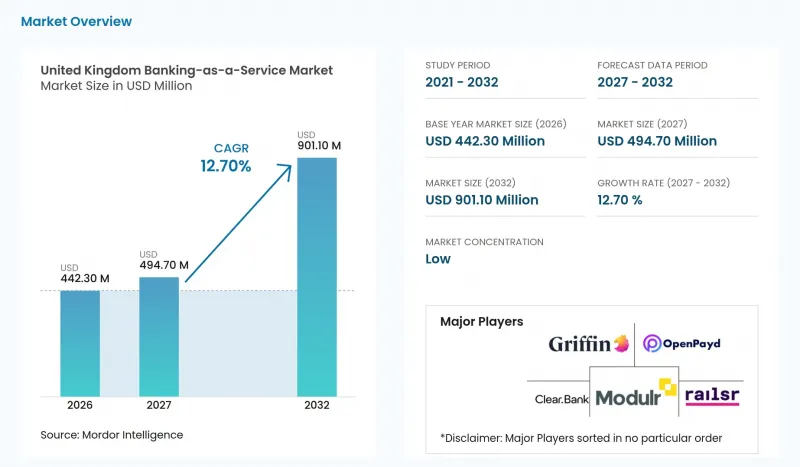
According to Mordor Intelligence, the United Kingdom Banking-as-a-Service market size is expected to grow from USD 442.30 million in 2026 to USD 494.70 million in 2027 and is forecast to reach USD 901.10 million by 2032 at 12.70% CAGR over 2027-2032.
United Kingdom Banking-as-a-Service Market Trends and Insights
Demand for Banking Infrastructure Without Obtaining a Full Banking License
The United Kingdom banking-as-a-service market benefits from fintechs and digital platforms using established banking infrastructure rather than obtaining direct bank authorization and building their own regulated operations. Griffin expanded its customer base across wealth management, remittances, lending, and property technology in 2025, while Sidekick went live eight weeks after signing with Griffin, demonstrating how existing banking infrastructure can accelerate product launches. These developments highlight demand for regulated banking capabilities that can be integrated into digital platforms without establishing a standalone bank.
Expansion of Embedded Banking Through Vertical SaaS and Digital Platforms
The United Kingdom Banking-as-a-Service market is expanding as software platforms integrate banking and payment capabilities into existing business workflows. In October 2025, ClearBank announced PayCaptain as its first corporate embedded-banking partner, supporting real-time payroll payments and embedded savings for employees across more than 300 corporate clients. This partnership demonstrates how embedded financial services are extending beyond traditional financial technology businesses into corporate software and payroll platforms. Embedded financial functions can also bring operational and transaction information into the same workflow used by a platform. That information can support more contextual credit assessment and risk decisions when a platform later adds lending services.
Regulatory Accountability and Compliance Complexity Across BaaS Partnerships
The United Kingdom Banking-as-a-Service market faces regulatory complexity because partnerships can involve licensed banks, electronic money institutions, technology providers, and third-party distributors operating under different regulatory requirements. The Financial Conduct Authority's Consumer Duty applies to regulated firms across product distribution chains when their activities determine or materially influence retail customer outcomes, including in some cases where they have no direct customer relationship. From 15 July 2026, the United Kingdom also brought relevant buy-now-pay-later lending within the FCA's regulatory framework, requiring affected providers to obtain authorization or operate under applicable transitional arrangements. These requirements increase the need for regulatory due diligence, clear allocation of responsibilities, and ongoing compliance monitoring across BaaS partnerships. The resulting compliance burden can increase onboarding time and operating costs, particularly for smaller providers and platform businesses.
Other drivers and restraints analyzed in the detailed report include:
- Growth of Open Banking-Enabled Account-to-Account Payments
- Adoption of API-Based Banking and Real-Time Payment Capabilities
- Safeguarding and Client-Fund Protection Obligations for Payment and E-Money Models
For complete list of drivers and restraints, kindly check the Table Of Contents.
Segment Analysis
Payments and money movement held 39.6% of the United Kingdom banking-as-a-service market in 2026. The segment leads because payment processing, account connectivity, and money movement form core capabilities of most BaaS offerings. ClearBank processed 262 million payment transactions in 2025, compared with 167 million in 2024, representing growth of approximately 57%. Modulr processed more than GBP 180 billion (USD 230 billion) in annualized payments for over 6,000 businesses, demonstrating demand for scalable payment infrastructure.
Lending and credit are projected to grow at a CAGR of 16.4% through 2032. The regulation of relevant buy-now-pay-later products from 15 July 2026 brought affected lenders within the Financial Conduct Authority's regulatory framework, increasing the importance of compliant credit infrastructure and administration. Accounts and safeguarding also remain important following the introduction of enhanced safeguarding requirements for payment and e-money firms in May 2026. Card issuing continues to offer opportunities as businesses integrate card programs into digital banking, expense management, and consumer payment products.
Large enterprises held 62.1% of the United Kingdom banking-as-a-service market share in 2026. Enterprise relationships can generate substantial payment activity and provide infrastructure providers with opportunities to serve large downstream customer bases. ClearBank reported 279 live group clients at the end of 2025, while its embedded banking platform supported Tide, which served nearly 800,000 SMEs. ClearBank also reported that Capital on Tap's savings accounts reached GBP 1 billion (USD 1.35 billion) in customer deposits by January 2026, illustrating the scale that embedded financial products can achieve through established platforms.
SMEs are projected to grow at a CAGR of 14.7% through 2032. Smaller businesses increasingly seek integrated payment capabilities that simplify supplier payments, cross-border transactions, and routine financial operations. In October 2026, OakNorth selected Wise Platform to power international payments for eligible United Kingdom business customers with annual turnover between GBP 1 million (USD 1.35 million) and GBP 100 million (USD 135 million). The partnership illustrates how financial infrastructure providers can deliver international payment capabilities to SMEs through existing digital banking relationships.
Complete Report Scope:
- By Product Type
- Accounts & Safeguarding
- Payments & Money Movement
- Card Issuing
- Lending & Credit
- Compliance & Operational Services
- Other Capabilities
- By Client Size
- Large Enterprises
- Small and Medium Enterprises (SMEs)
- By Client Type
- Fintech Corporations
- Marketplaces, Platforms & Vertical SaaS
- Non-financial Enterprises and Other Clients
- By Revenue Component
- Platform / Infrastructure Fees
- Transaction & Account-Based Fees
- Interchange Share & Scheme-Related Income
- Net Interest on Client Funds
- Compliance & Ancillary Service Fees
List of Companies Covered in this Report:
- ClearBank
- Griffin
- Modulr
- Railsr
- OpenPayd
- Bankable
- Starling Bank
- Adyen
- Stripe
- Weavr
- Thought Machine
- Finastra
- Marqeta
- Currencycloud
- Wise Platform
- Treezor
- Solaris
- Unnax
- Paynetics
- 11:FS Foundry
Additional Benefits:
- The market estimate (ME) sheet in Excel format
- 3 months of analyst support
TABLE OF CONTENTS
1 INTRODUCTION
- 1.1 Study Assumptions and Market Definition
- 1.2 Scope of the Study
2 RESEARCH METHODOLOGY
3 EXECUTIVE SUMMARY
4 MARKET LANDSCAPE
- 4.1 Market Overview
- 4.2 Market Drivers
- 4.2.1 Demand for Banking Infrastructure Without Obtaining a Full Banking Licence
- 4.2.2 Expansion of Embedded Banking Through Vertical SaaS and Digital Platforms
- 4.2.3 Growth of Open Banking-Enabled Account-to-Account Payments
- 4.2.4 Adoption of API-Based Banking and Real-Time Payment Capabilities
- 4.2.5 SME Demand for Integrated Business Accounts and Financial Workflows
- 4.2.6 Demand for Outsourced Banking Integration and Compliance Capabilities
- 4.3 Market Restraints
- 4.3.1 Regulatory Accountability and Compliance Complexity Across BaaS Partnerships
- 4.3.2 Safeguarding and Client-Fund Protection Obligations for Payment and E-Money Models
- 4.3.3 Dependence on Sponsor Banks and Concentrated Banking Infrastructure
- 4.3.4 Fraud, Financial Crime and Operational Resilience Risks
- 4.4 Value Chain Analysis
- 4.4.1 Regulated Banking Partners and Deposit-Holding Infrastructure
- 4.4.2 Core Banking Platforms, Ledgers and Account Servicing
- 4.4.3 Payment Processing, Card Issuing and Account Connectivity
- 4.4.4 Customer Onboarding, Identity Verification and Financial-Crime Controls
- 4.5 Regulatory Landscape
- 4.5.1 FCA and PRA Regulatory Perimeters and Authorisation Requirements
- 4.5.2 Payment Services Regulations 2017 and Electronic Money Regulations 2011
- 4.5.3 Customer-Fund Safeguarding and Supplementary Regime Effective May 2026
- 4.5.4 Consumer Protection, Payment Fraud and Operational Resilience Requirements
- 4.6 Technological Outlook
- 4.6.1 API-First Banking Platforms and Real-Time Account Integration
- 4.6.2 Cloud-Native Core Banking and Scalable Infrastructure
- 4.6.3 AI-Enabled Identity Verification, Fraud Detection and Compliance Monitoring
- 4.6.4 Open Banking, Smart Data and Programmable Payment Innovation
- 4.7 Porter's Five Forces Analysis
- 4.7.1 Competitive Rivalry
- 4.7.2 Threat of New Entrants
- 4.7.3 Bargaining Power of Suppliers
- 4.7.4 Bargaining Power of Buyers
- 4.7.5 Threat of Substitutes
5 MARKET SIZE AND GROWTH FORECASTS
- 5.1 By Product Type
- 5.1.1 Accounts & Safeguarding
- 5.1.2 Payments & Money Movement
- 5.1.3 Card Issuing
- 5.1.4 Lending & Credit
- 5.1.5 Compliance & Operational Services
- 5.1.6 Other Capabilities
- 5.2 By Client Size
- 5.2.1 Large Enterprises
- 5.2.2 Small and Medium Enterprises (SMEs)
- 5.3 By Client Type
- 5.3.1 Fintech Corporations
- 5.3.2 Marketplaces, Platforms & Vertical SaaS
- 5.3.3 Non-financial Enterprises and Other Clients
- 5.4 By Revenue Component
- 5.4.1 Platform / Infrastructure Fees
- 5.4.2 Transaction & Account-Based Fees
- 5.4.3 Interchange Share & Scheme-Related Income
- 5.4.4 Net Interest on Client Funds
- 5.4.5 Compliance & Ancillary Service Fees
6 COMPETITIVE LANDSCAPE
- 6.1 Market Concentration
- 6.2 Strategic Moves
- 6.3 Market Share Analysis (Top 5-6 players)
- 6.4 Company Profiles (includes Global Level Overview, Market Level Overview, Core Segments, Financials as available, Strategic Information, Market Rank/Share, Products and Services, Recent Developments)
- 6.4.1 ClearBank
- 6.4.2 Griffin
- 6.4.3 Modulr
- 6.4.4 Railsr
- 6.4.5 OpenPayd
- 6.4.6 Bankable
- 6.4.7 Starling Bank
- 6.4.8 Adyen
- 6.4.9 Stripe
- 6.4.10 Weavr
- 6.4.11 Thought Machine
- 6.4.12 Finastra
- 6.4.13 Marqeta
- 6.4.14 Currencycloud
- 6.4.15 Wise Platform
- 6.4.16 Treezor
- 6.4.17 Solaris
- 6.4.18 Unnax
- 6.4.19 Paynetics
- 6.4.20 11:FS Foundry
7 MARKET OPPORTUNITIES AND FUTURE OUTLOOK
- 7.1 White-Space and Unmet-Need Assessment
- 7.1.1 Regulated BaaS Solutions for Underserved SMEs and Niche Businesses
- 7.1.2 Simplified Safeguarding, Reconciliation and Wind-Down Solutions
- 7.1.3 Multi-Provider Resilience and BaaS Migration Solutions
- 7.1.4 Embedded Treasury Solutions for Vertical SaaS Platforms
- 7.1.5 Cross-Border Account and Payment Connectivity for United Kingdom-EU Businesses
- 7.2 Future Outlook
- 7.2.1 Base-Case United Kingdom BaaS Market Development Scenario
- 7.2.2 Accelerated Embedded-Finance Adoption Scenario
- 7.2.3 Regulatory and Compliance-Cost Pressure Scenario
- 7.2.4 Strategic Priorities for BaaS Providers and Buyers

