PUBLISHER: Mordor Intelligence | PRODUCT CODE: 2194829

PUBLISHER: Mordor Intelligence | PRODUCT CODE: 2194829
Hand Geometry Biometrics - Market Share Analysis, Industry Trends & Statistics, Growth Forecasts (2027 - 2032)
According to Mordor Intelligence, the hand geometry biometrics market size is expected to increase from USD 0.74 billion in 2026 to USD 0.82 billion in 2027 and reach USD 1.21 billion by 2032, expanding at a CAGR of 10.14% over 2027-2032.
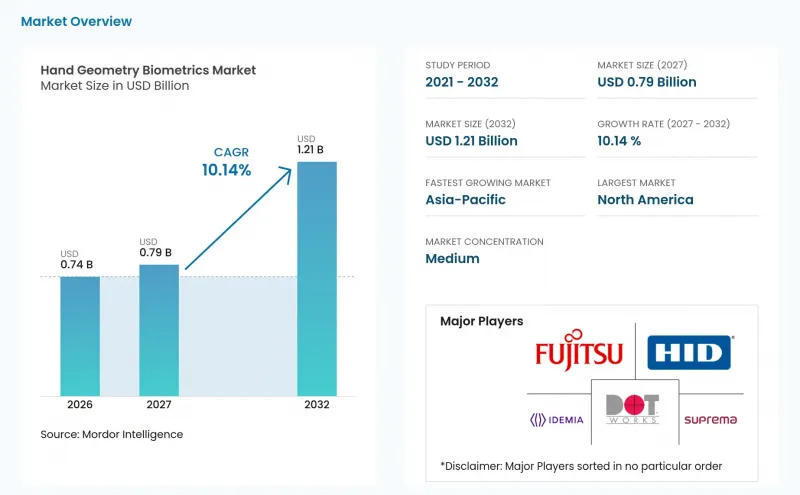
Global Hand Geometry Biometrics Market Trends and Insights
Expansion of Government and Critical-Infrastructure Access Modernization
Government agencies remain a durable source of demand for the hand geometry biometrics market because procurement programs are often multiyear and compliance-led. In January 2025, IDEMIA received a 10-year Blanket Purchase Agreement worth up to USD 194.5 million from the U.S. General Services Administration for Login.gov identity proofing. Identity credential programs create opportunities for reader upgrades at physical access points when agencies renew related access systems, templates, and credentialing processes. Federal Identity, Credential, and Access Management requirements support demand for systems that work with existing cards, access panels, and facility operating procedures. Government buyers also value hand geometry systems where dependable verification, documented access events, and operational continuity are more important than consumer-style convenience. This pattern gives suppliers a route into hand geometry biometrics market projects where certification, service capability, interoperability, and long-term support influence purchasing decisions.
Growth in Contactless Authentication for High-Throughput Worksites
Contactless hand authentication helps address throughput challenges at worksites where workers use gloves or protective equipment. Food processing, chemical manufacturing, and pharmaceutical packaging sites may need identity checks without requiring repeated contact with a reader during a shift. A 2025 study described a contactless platform that captured wrist, palm, and finger-vein data at the same time and reported a 0.057% finger-vein recognition half-total error rate. The result supports the use of contactless hand-based systems where sanitation, access speed, and repeatable operation across changing work teams matter together. ZKTeco presented terminals combining contactless palm, facial, and vein recognition for industrial entry at its September 2025 conference in Seoul. The hand geometry biometrics market can benefit when organizations refresh older contact-based readers while retaining the network, enrollment records, and access-control investments already in place.
Lower Distinctiveness Than Fingerprint, Iris, and Palm-Vein Modalities
Lower distinctiveness remains a structural limit for hand geometry in high-assurance identification programs. The technology is better suited to one-to-one verification when a credential supplies the claimed identity and the system confirms a specific person rather than searches a large population. It is less suited to large one-to-many searches used in national identity or forensic repositories, where competing modalities can offer stronger differentiation. Organizations with several thousand enrolled people may need additional controls when using hand geometry alone, particularly when the risk of a false acceptance has material consequences. Many deployments therefore pair the modality with a smart card, face, or vein-based method so that the physical access process has more than one assurance element. This design improves assurance but can increase hardware costs and narrow the use cases that fit the hand geometry biometrics market.
Other drivers and restraints analyzed in the detailed report include:
- Replacement of Fingerprint Readers in Harsh and Hygiene-Sensitive Environments
- Increasing Demand for Integrated Physical and Logical Access Control
- Legacy Protocol Integration and Middleware Complexity
For complete list of drivers and restraints, kindly check the Table Of Contents.
Segment Analysis
Hardware held 58.00% of the hand geometry biometrics market share in 2026 because every controlled entry point needs a sensor, optics, and a protective enclosure. Near-infrared sensor arrays, precision light guides, and ruggedized cases contribute to hardware value at industrial and outdoor locations. These requirements keep hardware important when buyers pursue lower-cost deployment models, since the reader remains the physical point of verification. Services cover installation, system integration, maintenance, and managed-service work that help a customer keep the system operating after deployment. Government and critical-infrastructure customers often bundle these services with equipment under multiyear operating agreements.
Software is projected to expand at an 11.25% CAGR through 2032, the highest rate among components in the hand geometry biometrics industry. The hand geometry biometrics market is moving from local template management toward identity platforms that coordinate verification, mobile credentials, document authentication, and site-level access rules. A 2025 IEEE study on 3D contactless fingerprint recognition examined robust feature extraction and graph embedding methods, showing the software work being applied to contactless hand-based matching. Matching software can help organizations manage templates and verification records across several facilities without treating each location as a separate system. Providers that offer certified REST API connections to identity governance platforms can compete on integration, administration, and device performance.
2D Optical Hand Geometry Systems accounted for 46.00% of the hand geometry biometrics market in 2026. Their position reflects deployments in government lobbies, manufacturing shift stations, and campuses over several decades. Many sites continue to use these systems because their original investment remains functional and staff already understand the enrollment process. New buyers now compare 2D optical tools with structured-light and time-of-flight alternatives as they review reader replacement plans. That comparison places greater value on contactless capture, liveness detection, and the ability to work within a modern identity architecture.
3D Structured-Light and Time-of-Flight Hand Geometry Systems are projected to expand at an 11.56% CAGR through 2032. The hand geometry biometrics market is using depth-aware capture to support new enterprise installations where buyers prefer contactless operation. A 2025 patent record describes a structured-light camera-projector configuration for real-time 3D hand-position detection without additional distance sensors. Hybrid systems can combine contact and contactless methods where an entry point cannot tolerate a single-mode failure or interruption during a transition. Electrical, capacitive, and pressure-based variants remain relevant for specialized measurement settings where optical installation is limited by space or site conditions.
Complete Report Scope:
- By Component
- Hardware
- Services
- Software
- By Technology Type
- 2D Hand Geometry Systems
- 3D Hand Geometry Systems
- Hybrid Hand Geometry Systems
- Optical Hand Geometry
- Electrical Hand Geometry
- Capacitive and Pressure-Based Hand Geometry
- Time-of-Flight and Structured-Light Hand Geometry
- By Contact Mode
- Contact-Based Systems
- Contactless Systems
- Hybrid Contact and Contactless Systems
- By End User
- Government and Defense
- Banking, Financial Services, and Insurance
- Healthcare
- Manufacturing and Industrial
- Commercial Enterprises
- Education
- Other End Users
- By Geography
- North America
- United States
- Canada
- Mexico
- South America
- Brazil
- Argentina
- Chile
- Rest of South America
- Europe
- United Kingdom
- Germany
- France
- Italy
- Spain
- Rest of Europe
- Asia-Pacific
- China
- Japan
- India
- South Korea
- Australia
- Singapore
- Rest of Asia-Pacific
- Middle East
- United Arab Emirates
- Saudi Arabia
- Turkey
- Israel
- Rest of Middle East
- Africa
- South Africa
- Nigeria
- Egypt
- Rest of Africa
- North America
Geography Analysis
North America held 32.00% of the hand geometry biometrics market share in 2026, the largest regional position. The hand geometry biometrics market benefits in the region from federal identity requirements and an established network of system integrators. Government procurement cycles can sustain reader refresh projects over several years and allow contractors to plan around formal renewal processes. Canada is developing its digital identity environment. Mexico benefits from manufacturing activity in the Bajio and northern border corridors, where automotive and aerospace suppliers need attendance and access tracking.
Asia-Pacific is projected to expand at an 11.82% CAGR through 2032, making it the fastest-growing regional area. The hand geometry biometrics market is supported in India by workforce attendance digitization in manufacturing and public infrastructure. South Korea is upgrading security systems at semiconductor and electronics facilities. In December 2025, IDEMIA Public Security and Tsuzuki Denki signed a memorandum to develop and deploy access-management solutions in Japan. Chinese manufacturers such as ZKTeco use manufacturing scale to serve mid-market deployments in Southeast Asia and the Middle East.
Europe has meaningful revenue from Germany, the United Kingdom, and France, where government and financial-services applications are important. Biometric data governance increases the value of on-device template storage and deletion-on-demand features. IDEMIA Public Security and Sopra Steria completed the eu-LISA shared Biometric Matching System go-live in August 2025 for fingerprint and facial-image comparison across the Schengen Area. The Middle East has greenfield demand linked to critical-infrastructure development, while Africa and South America remain early-stage areas focused on government and extractive-industry identity programs.
- Recognition Systems, Inc.
- BioSec Group Ltd.
- IdentyTech Solutions Ltd.
- BioEnable Technologies Private Limited
- M2SYS Technology
- Suprema Inc.
- ZKTeco Co., Ltd.
- Mantra Softech (India) Private Limited
- Anviz Global Inc.
- Fujitsu Limited
- HID Global Corporation
- IDEMIA Group
- NEC Corporation
- 3M Company
- Crossmatch Technologies, Inc.
- Fulcrum Biometrics, LLC
- SecuGen Corporation
- Bio-Key International, Inc.
- Precise Biometrics AB
- Recogtech B.V.
- Integrated Biometrics, LLC
- ValidSoft UK Limited
- Facebanx, Inc.
- Amano Corporation
Additional Benefits:
- The market estimate (ME) sheet in Excel format
- 3 months of analyst support
TABLE OF CONTENTS
1 INTRODUCTION
- 1.1 Study Assumptions and Market Definition
- 1.2 Scope of the Study
2 RESEARCH METHODOLOGY
3 EXECUTIVE SUMMARY
4 MARKET LANDSCAPE
- 4.1 Market Overview
- 4.2 Impact of Macroeconomic Factors on the Market
- 4.3 Market Drivers
- 4.3.1 Expansion of Government and Critical-Infrastructure Access Modernization
- 4.3.2 Growth in Contactless Authentication for High-Throughput Worksites
- 4.3.3 Replacement of Fingerprint Readers in Harsh and Hygiene-Sensitive Environments
- 4.3.4 Increasing Demand for Integrated Physical and Logical Access Control
- 4.3.5 Rising Adoption of Multimodal Hand-Based Authentication
- 4.3.6 Expansion of Smart-Campus, Healthcare, and Industrial Identity Workflows
- 4.4 Market Restraints
- 4.4.1 Lower Distinctiveness Than Fingerprint, Iris, and Palm-Vein Modalities
- 4.4.2 Legacy Protocol Integration and Middleware Complexity
- 4.4.3 Biometric Privacy, Consent, and Cross-Border Data-Transfer Requirements
- 4.4.4 Sensor Performance Constraints From Gloves, Swelling, Low Light, and Fixed Capture Geometry
- 4.5 Industry Value Chain Analysis
- 4.6 Regulatory Landscape
- 4.7 Technological Outlook
- 4.8 Porter's Five Forces Analysis
- 4.8.1 Threat of New Entrants
- 4.8.2 Bargaining Power of Suppliers
- 4.8.3 Bargaining Power of Buyers
- 4.8.4 Threat of Substitutes
- 4.8.5 Competitive Rivalry
5 MARKET SIZE AND GROWTH FORECASTS (VALUE)
- 5.1 By Component
- 5.1.1 Hardware
- 5.1.2 Services
- 5.1.3 Software
- 5.2 By Technology Type
- 5.2.1 2D Hand Geometry Systems
- 5.2.2 3D Hand Geometry Systems
- 5.2.3 Hybrid Hand Geometry Systems
- 5.2.4 Optical Hand Geometry
- 5.2.5 Electrical Hand Geometry
- 5.2.6 Capacitive and Pressure-Based Hand Geometry
- 5.2.7 Time-of-Flight and Structured-Light Hand Geometry
- 5.3 By Contact Mode
- 5.3.1 Contact-Based Systems
- 5.3.2 Contactless Systems
- 5.3.3 Hybrid Contact and Contactless Systems
- 5.4 By End User
- 5.4.1 Government and Defense
- 5.4.2 Banking, Financial Services, and Insurance
- 5.4.3 Healthcare
- 5.4.4 Manufacturing and Industrial
- 5.4.5 Commercial Enterprises
- 5.4.6 Education
- 5.4.7 Other End Users
- 5.5 By Geography
- 5.5.1 North America
- 5.5.1.1 United States
- 5.5.1.2 Canada
- 5.5.1.3 Mexico
- 5.5.2 South America
- 5.5.2.1 Brazil
- 5.5.2.2 Argentina
- 5.5.2.3 Chile
- 5.5.2.4 Rest of South America
- 5.5.3 Europe
- 5.5.3.1 United Kingdom
- 5.5.3.2 Germany
- 5.5.3.3 France
- 5.5.3.4 Italy
- 5.5.3.5 Spain
- 5.5.3.6 Rest of Europe
- 5.5.4 Asia-Pacific
- 5.5.4.1 China
- 5.5.4.2 Japan
- 5.5.4.3 India
- 5.5.4.4 South Korea
- 5.5.4.5 Australia
- 5.5.4.6 Singapore
- 5.5.4.7 Rest of Asia-Pacific
- 5.5.5 Middle East
- 5.5.5.1 United Arab Emirates
- 5.5.5.2 Saudi Arabia
- 5.5.5.3 Turkey
- 5.5.5.4 Israel
- 5.5.5.5 Rest of Middle East
- 5.5.6 Africa
- 5.5.6.1 South Africa
- 5.5.6.2 Nigeria
- 5.5.6.3 Egypt
- 5.5.6.4 Rest of Africa
- 5.5.1 North America
6 COMPETITIVE LANDSCAPE
- 6.1 Market Concentration
- 6.2 Strategic Moves
- 6.3 Market Share Analysis
- 6.4 Company Profiles (includes Global Level Overview, Market Level Overview, Core Segments, Financials as available, Strategic Information, Market Rank/Share, Products and Services, Recent Developments)
- 6.4.1 Recognition Systems, Inc.
- 6.4.2 BioSec Group Ltd.
- 6.4.3 IdentyTech Solutions Ltd.
- 6.4.4 BioEnable Technologies Private Limited
- 6.4.5 M2SYS Technology
- 6.4.6 Suprema Inc.
- 6.4.7 ZKTeco Co., Ltd.
- 6.4.8 Mantra Softech (India) Private Limited
- 6.4.9 Anviz Global Inc.
- 6.4.10 Fujitsu Limited
- 6.4.11 HID Global Corporation
- 6.4.12 IDEMIA Group
- 6.4.13 NEC Corporation
- 6.4.14 3M Company
- 6.4.15 Crossmatch Technologies, Inc.
- 6.4.16 Fulcrum Biometrics, LLC
- 6.4.17 SecuGen Corporation
- 6.4.18 Bio-Key International, Inc.
- 6.4.19 Precise Biometrics AB
- 6.4.20 Recogtech B.V.
- 6.4.21 Integrated Biometrics, LLC
- 6.4.22 ValidSoft UK Limited
- 6.4.23 Facebanx, Inc.
- 6.4.24 Amano Corporation
7 MARKET OPPORTUNITIES AND FUTURE OUTLOOK
- 7.1 White-Space and Unmet-Need Assessment

