PUBLISHER: Mordor Intelligence | PRODUCT CODE: 2195011

PUBLISHER: Mordor Intelligence | PRODUCT CODE: 2195011
Renewable Natural Gas - Market Share Analysis, Industry Trends & Statistics, Growth Forecasts (2027 - 2032)
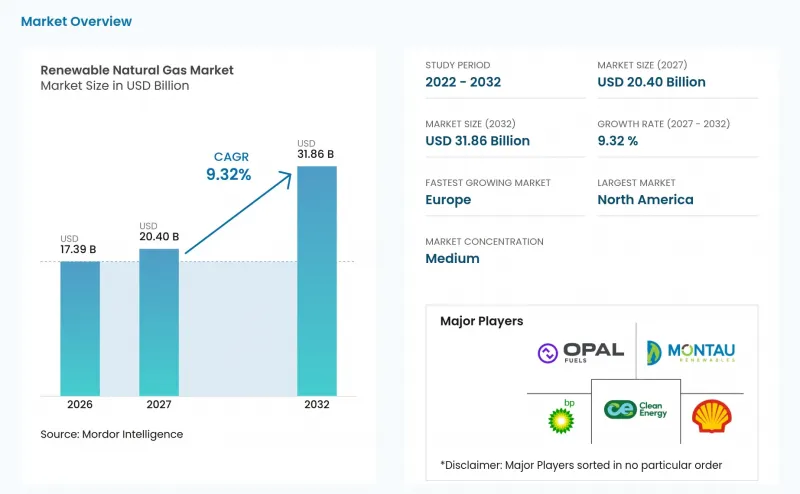
According to Mordor Intelligence, the global renewable natural gas market size is expected to grow from USD 17.39 billion in 2026 to USD 20.40 billion in 2027 and is forecast to reach USD 31.86 billion by 2032 at 9.32% CAGR over 2027-2032.
Global Renewable Natural Gas Market Trends and Insights
Policy-Driven Demand for Low-Carbon Transport Fuel
The renewable natural gas market draws much of its near-term demand from transportation policies in the United States. The Environmental Protection Agency set cellulosic biofuel volumes at 1.36 billion D3 Renewable Identification Numbers (RINs) for 2026 and 1.43 billion for 2027. The rule applied a 9% annual production-growth assumption and provided pipeline-connected projects with a clearer planning basis. D3 RIN prices traded between USD 2.50 and USD 3.00 per RIN during 2024 through 2026, making credit income an important factor in project returns. Brazil established a Biomethane Certificate of Origin under Law No. 14,993/2024 and set a 0.5% biomethane blending requirement for natural gas in 2026. Its mandate is intended to rise to 10%, broadening the policy base beyond North America and Europe.
Mandatory Organic-Waste Diversion and Methane-Abatement Rules
Rules that separate organic material from waste streams are changing the feedstock base for the renewable natural gas market. Food-waste-only biogas investment in the United States reached USD 325 million in 2025, more than double the prior-year level. Biogas capture at dedicated food-waste facilities rose 18% to 28 billion cubic feet (Bcf) annually. As jurisdictions limit landfill disposal of organics, developers can rely less on spot-market feedstock procurement, making the renewable natural gas market more closely tied to waste-collection systems and local compliance rules. Germany recorded 12.3 TWh of biomethane injection in 2025 across 268 grid-connected sites, an increase of 12% from 2024.
Dependence on Volatile RIN and LCFS Environmental-Attribute Revenue
Credit-market exposure remains a central financial constraint for the renewable natural gas market. D3 RIN prices averaged USD 3.30 per RIN in 2024, while Environmental Protection Agency decisions indicated that compliance volumes can change after projects have secured financing. California credit values also fell from the USD 150 to USD 200 range used in many 2021 and 2022 financing cases. The California Air Resources Board amended its program in November 2024 by raising the 2030 carbon-intensity reduction target from 20% to 30%. It also introduced constraints that can reduce credit generation for some pathways. Long project debt terms of 15 to 20 years do not align well with credit markets that can move within 2 to 4 years.
Other drivers and restraints analyzed in the detailed report include:
- Expansion of Anaerobic Digestion and Landfill-Gas Upgrading
- Industrial and Fleet Decarbonization Through Existing Gas Infrastructure
- High Pretreatment, Upgrading, and Pipeline-Interconnection Capital Costs
For complete list of drivers and restraints, kindly check the Table Of Contents.
Segment Analysis
Landfill gas held 41.3% of the renewable natural gas market share in 2026, supported by mature collection systems in North America and Western Europe. United States landfill gas facilities produced 559 billion cubic feet (Bcf) per year across 599 active sites in 2025. Investment in landfill gas projects reached USD 912 million, representing 43% of total United States biogas investment. This feedstock offers established gas collection and more predictable operating conditions than many mixed organic streams. Dairy manure projects are concentrated in the United States Midwest and Pacific Northwest. Wastewater sludge digestion has a larger role in European urban systems.
Food waste is projected to grow at a 9.7% CAGR through 2032 within the renewable natural gas market. Dedicated United States food-waste facilities captured 28 Bcf annually in 2025, and 124 facilities were operating. Around 200 agriculture and wastewater sites also co-processed food waste with primary feedstocks. Diversion mandates make supply more stable than discretionary waste procurement. Agricultural residues remain important in Germany and France, where farm access is supported by national programs. Industrial organic waste and forestry residues remain limited at scale because wider use depends on commercial gasification systems.
Anaerobic digestion accounted for 56.7% of the renewable natural gas market size in 2026. The process accepts manure, food waste, wastewater sludge, and crop residues. Its position reflects operating experience, established credit eligibility, and revenue from digestate products. Modular plant designs can reduce construction risk and allow phased capacity additions. Landfill gas is the second-largest pathway by volume, although it relies on in-place decomposition rather than controlled digestion. This difference creates greater gas-quality management needs at landfill sites.
Gasification is forecast to grow at a 10.3% CAGR through 2032 in the renewable natural gas market. It can process compostable bags, contaminated organic material, woody residues, and other streams that digestion systems may reject. The Dem-Con and Kanadevia Inova facility in Minnesota is expected to process 75,000 tonnes of organic waste annually from 2027, producing 200,000 million British thermal units (MMBtu) of RNG and 8,000 tonnes of biochar. Oak Ridge National Laboratory estimated United States biomass-derived gasification potential at 9,203 million GJ, with an expected cost range of USD 12 to USD 30 per GJ. Power-to-gas and other synthetic methane routes are currently at demonstration scale as of 2026.
Complete Report Scope:
- By Feedstock
- Landfill Gas
- Livestock Manure
- Agricultural Residues
- Municipal Solid Waste
- Food Waste
- Wastewater and Sewage Sludge
- Industrial Organic Waste
- Forestry and Wood Residues
- Other Feedstocks
- By Production Pathway
- Anaerobic Digestion-Based RNG
- Landfill Gas-Based RNG
- Gasification-Based RNG
- Power-to-Gas-Based RNG
- Other Production Pathways
- By Application
- Transportation Fuel
- Electricity Generation
- Industrial Fuel
- Residential and Commercial Fuel
- Pipeline Injection
- Chemical and Bio-based Feedstock
- Other Applications
- By Form
- Compressed RNG
- Liquefied RNG
- Pipeline-Injected RNG
- Geography
- North America
- United States
- Canada
- Mexico
- Europe
- Germany
- France
- Italy
- Spain
- United Kingdom
- Poland
- Russia
- Rest of Europe
- Asia-Pacific
- China
- India
- Japan
- South Korea
- Australia
- Indonesia
- Vietnam
- Thailand
- Rest of Asia-Pacific
- South America
- Brazil
- Argentina
- Chile
- Rest of South America
- Middle East and Africa
- Saudi Arabia
- United Arab Emirates
- Egypt
- South Africa
- Morocco
- Rest of Middle East and Africa
- North America
Geography Analysis
North America held 44.7% of the renewable natural gas market share in 2026. The region has the most developed production and distribution infrastructure, centered on the United States. US investment reached USD 2.1 billion in 2025, with 659 facilities producing pipeline-quality gas. Output reached 225.6 million MMBtu. Canada is expanding through utility offtake agreements and municipal digestion, while Mexico remains at an earlier stage due to limited injection infrastructure.
Europe is forecast to grow at a 10.9% CAGR through 2032 in the renewable natural gas market. The EU has set a target of 35 billion cubic meters (bcm) of biomethane, with national programs being aligned with Renewable Energy Directive III (RED III). Germany reached 12.3 TWh of biomethane injection in 2025 and had 9 facilities in development with 11,280 Nm3/h of capacity. France had 803 active injection installations with 15.5 TWh per year of capacity at the end of 2025. Its development pipeline included 1,117 facilities representing 18.7 TWh per year.
Asia-Pacific, South America, and the Middle East and Africa remain at earlier stages of renewable natural gas market development. China and India offer substantial agricultural waste potential, although monetization frameworks and gas grid access are still developing. India targets 15 million tonnes per year under its Compressed Biogas program by 2028. Japan, South Korea, Australia, and Vietnam are exploring imports and domestic digestion as part of energy security plans. Brazil has commercial sugarcane residue and cattle manure resources, and its 2026 blending requirement provides a formal demand signal. Saudi Arabia, the UAE, Egypt, Morocco, and South Africa are evaluating waste-to-energy systems that could support future supply chains.
- Air Liquide S.A.
- Ameresco, Inc.
- Anaergia Inc.
- bp plc
- Chevron Corporation
- Clean Energy Fuels Corp.
- DMT Environmental Technology
- EnviTec Biogas AG
- Gasum Ltd.
- Greenlane Renewables Inc.
- Kinder Morgan, Inc.
- Montauk Renewables, Inc.
- Nature Energy (Shell plc)
- OPAL Fuels Inc.
- Renewi plc
- Republic Services, Inc.
- Shell plc
- SUEZ S.A.
- TotalEnergies SE
- Vanguard Renewables
- Veolia Environnement S.A.
- Verbio SE
- Waga Energy SA
- Waste Management, Inc.
Additional Benefits:
- The market estimate (ME) sheet in Excel format
- 3 months of analyst support
TABLE OF CONTENTS
1 INTRODUCTION
- 1.1 Study Assumptions and Market Definition
- 1.2 Scope of the Study
2 RESEARCH METHODOLOGY
3 EXECUTIVE SUMMARY
4 MARKET LANDSCAPE
- 4.1 Market Overview
- 4.2 Market Drivers
- 4.2.1 Policy-Driven Demand for Low-Carbon Transport Fuel
- 4.2.2 Mandatory Organic-Waste Diversion and Methane-Abatement Rules
- 4.2.3 Expansion of Anaerobic Digestion and Landfill-Gas Upgrading
- 4.2.4 Industrial and Fleet Decarbonization Through Existing Gas Infrastructure
- 4.2.5 Corporate Long-Term RNG Offtake and Environmental-Attribute Procurement
- 4.2.6 Digital Feedstock Monitoring and Higher-Yield Co-Digestion
- 4.3 Market Restraints
- 4.3.1 Dependence on Volatile RIN and LCFS Environmental-Attribute Revenue
- 4.3.2 High Pretreatment, Upgrading, and Pipeline-Interconnection Capital Costs
- 4.3.3 Feedstock Contamination and Seasonal Supply Variability
- 4.3.4 Inconsistent Injection Standards and Certification Systems
- 4.4 Supply-Chain Analysis
- 4.5 Porter's Five Forces Analysis
- 4.5.1 Bargaining Power of Suppliers
- 4.5.2 Bargaining Power of Buyers
- 4.5.3 Threat of New Entrants
- 4.5.4 Threat of Substitutes
- 4.5.5 Competitive Rivalry
- 4.6 Technology Outlook
- 4.7 Regulatory Landscape
- 4.8 Investment Analysis
5 MARKET SIZE AND GROWTH FORECASTS
- 5.1 By Feedstock
- 5.1.1 Landfill Gas
- 5.1.2 Livestock Manure
- 5.1.3 Agricultural Residues
- 5.1.4 Municipal Solid Waste
- 5.1.5 Food Waste
- 5.1.6 Wastewater and Sewage Sludge
- 5.1.7 Industrial Organic Waste
- 5.1.8 Forestry and Wood Residues
- 5.1.9 Other Feedstocks
- 5.2 By Production Pathway
- 5.2.1 Anaerobic Digestion-Based RNG
- 5.2.2 Landfill Gas-Based RNG
- 5.2.3 Gasification-Based RNG
- 5.2.4 Power-to-Gas-Based RNG
- 5.2.5 Other Production Pathways
- 5.3 By Application
- 5.3.1 Transportation Fuel
- 5.3.2 Electricity Generation
- 5.3.3 Industrial Fuel
- 5.3.4 Residential and Commercial Fuel
- 5.3.5 Pipeline Injection
- 5.3.6 Chemical and Bio-based Feedstock
- 5.3.7 Other Applications
- 5.4 By Form
- 5.4.1 Compressed RNG
- 5.4.2 Liquefied RNG
- 5.4.3 Pipeline-Injected RNG
- 5.5 Geography
- 5.5.1 North America
- 5.5.1.1 United States
- 5.5.1.2 Canada
- 5.5.1.3 Mexico
- 5.5.2 Europe
- 5.5.2.1 Germany
- 5.5.2.2 France
- 5.5.2.3 Italy
- 5.5.2.4 Spain
- 5.5.2.5 United Kingdom
- 5.5.2.6 Poland
- 5.5.2.7 Russia
- 5.5.2.8 Rest of Europe
- 5.5.3 Asia-Pacific
- 5.5.3.1 China
- 5.5.3.2 India
- 5.5.3.3 Japan
- 5.5.3.4 South Korea
- 5.5.3.5 Australia
- 5.5.3.6 Indonesia
- 5.5.3.7 Vietnam
- 5.5.3.8 Thailand
- 5.5.3.9 Rest of Asia-Pacific
- 5.5.4 South America
- 5.5.4.1 Brazil
- 5.5.4.2 Argentina
- 5.5.4.3 Chile
- 5.5.4.4 Rest of South America
- 5.5.5 Middle East and Africa
- 5.5.5.1 Saudi Arabia
- 5.5.5.2 United Arab Emirates
- 5.5.5.3 Egypt
- 5.5.5.4 South Africa
- 5.5.5.5 Morocco
- 5.5.5.6 Rest of Middle East and Africa
- 5.5.1 North America
6 COMPETITIVE LANDSCAPE
- 6.1 Market Concentration
- 6.2 Strategic Moves
- 6.3 Market Share Analysis
- 6.4 Company Profiles (includes Global Level Overview, Market Level Overview, Core Segments, Financials as available, Strategic Information, Market Rank/Share, Products and Services, Recent Developments)
- 6.4.1 Air Liquide S.A.
- 6.4.2 Ameresco, Inc.
- 6.4.3 Anaergia Inc.
- 6.4.4 bp plc
- 6.4.5 Chevron Corporation
- 6.4.6 Clean Energy Fuels Corp.
- 6.4.7 DMT Environmental Technology
- 6.4.8 EnviTec Biogas AG
- 6.4.9 Gasum Ltd.
- 6.4.10 Greenlane Renewables Inc.
- 6.4.11 Kinder Morgan, Inc.
- 6.4.12 Montauk Renewables, Inc.
- 6.4.13 Nature Energy (Shell plc)
- 6.4.14 OPAL Fuels Inc.
- 6.4.15 Renewi plc
- 6.4.16 Republic Services, Inc.
- 6.4.17 Shell plc
- 6.4.18 SUEZ S.A.
- 6.4.19 TotalEnergies SE
- 6.4.20 Vanguard Renewables
- 6.4.21 Veolia Environnement S.A.
- 6.4.22 Verbio SE
- 6.4.23 Waga Energy SA
- 6.4.24 Waste Management, Inc.
7 MARKET OPPORTUNITIES AND FUTURE OUTLOOK
- 7.1 White-Space and Unmet-Need Assessment

