PUBLISHER: Mordor Intelligence | PRODUCT CODE: 2195441

PUBLISHER: Mordor Intelligence | PRODUCT CODE: 2195441
GCC Beach Hotels and Resorts - Market Share Analysis, Industry Trends & Statistics, Growth Forecasts (2027 - 2032)
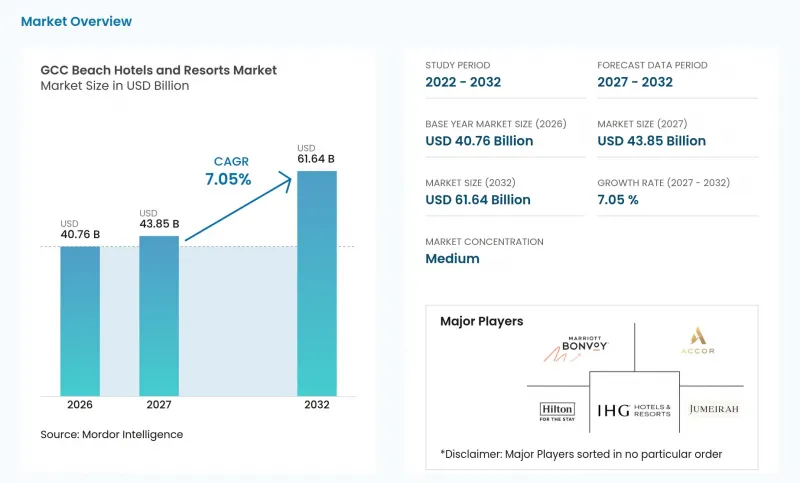
According to Mordor Intelligence, the GCC beach hotels and resorts market size was valued at USD 40.76 billion in 2026 and is estimated to grow from USD 43.85 billion in 2027 to reach USD 61.64 billion by 2032, at a CAGR of 7.05% during the forecast period (2027-2032).
GCC Beach Hotels and Resorts Market Trends and Insights
Strong tourism diversification agendas driving coastal resort investment
Saudi Arabia recorded 122 million overnight visitors in 2025, surpassing its previous target of 100 million visitors for the third consecutive year. The country has raised its 2030 visitor target to 150 million, increasing the need for leisure accommodation across coastal destinations. This policy direction provides the GCC beach hotels and resorts market with a demand base beyond seasonal international leisure travel. Government-linked events and business travel can support occupancy at coastal properties during periods of weaker leisure demand. The shift also improves the viability of coastal resort investments in locations where private demand would otherwise take longer to develop.
Giga-projects and large-scale coastal developments expanding resort supply
Red Sea Global has opened resorts at The Red Sea destination and continues to develop a broader hotel portfolio under a controlled coastal development model. AMAALA welcomed its first guests in 2026, with Four Seasons Resort and Residences AMAALA at Triple Bay opening in June 2026, and limits visitor numbers to protect marine ecosystems. In Ras Al Khaimah, Wynn Al Marjan Island reached a major construction milestone in December 2025 and is scheduled to open in September 2027. These projects add rooms, leisure facilities, and destination visibility. They may increase competition for nearby hotels while expanding the visitor base across the broader coastal corridor. The GCC beach hotels and resorts market benefits from destination-building investments but faces a greater need for product differentiation.
Seasonal Demand Fluctuations Driven by Extreme Summer Temperatures and Humidity Across Gulf Coastlines
Extreme summer conditions remain a structural constraint, as beach amenities are less usable for several months each year. This concentrates leisure demand in more comfortable months and pressures operators to maintain rates during a shorter high season. Resorts also require indoor amenities, cooling infrastructure, and summer programming to retain guests. Oman provides a contrasting case, as Salalah's Khareef season attracts summer travelers, unlike much of the region. Therefore, the GCC beach hotels and resorts market must manage seasonality at the property level rather than treat the region as a uniform climate market. Resorts offering wellness facilities, indoor recreation, and family activities can reduce exposure to the summer revenue gap.
Other drivers and restraints analyzed in the detailed report include:
- Premiumization of Beachfront Stays, Ultra-Luxury Resorts, Private Island Retreats, and Villa-Based Hospitality
- Expansion of Integrated Resorts Combining Accommodation, Dining, Wellness, Marine Activities, and Entertainment
- Dependence on International Tourism and Exposure to Geopolitical Tensions and Regional Instability
For complete list of drivers and restraints, kindly check the Table Of Contents.
Segment Analysis
Luxury beach hotels and resorts accounted for 37.74% of the GCC beach hotels and resorts market share in 2026. Branded residences, villa stays, and high-service resort formats support this position. AMAALA's portfolio includes wellness-focused properties that extend luxury travel beyond conventional accommodations. These properties can command higher rates by combining privacy, beachfront access, and a strong brand proposition. They also attract guests who value destination experiences alongside room quality. This segment continues to contribute a substantial share of market revenue.
Eco-resorts and regenerative beach resorts are projected to grow at a 7.84% CAGR through 2032. Red Sea Global positions the Red Sea around regenerative tourism and limits development to protect natural assets. Hawar Resort by Mantis offers a similar ecology-led format within a wildlife sanctuary. These properties appeal to travelers seeking lower-density stays in environmental settings. Mid-range properties serve growing domestic travel in emerging coastal corridors, while budget and hostel formats remain limited in high-cost beachfront areas. Boutique and lifestyle hotels meet demand for smaller-scale stays with local character and curated services.
Online Travel Agencies accounted for 41.93% of booking revenue in 2026 in the GCC beach hotels and resorts market. Their scale enables resorts to reach guests comparing destinations, rates, and package options across the region. These platforms are particularly valuable for new resorts without established direct customer relationships and for short booking windows and mobile-led leisure planning. Resorts must manage commission costs and avoid excessive reliance on a limited number of intermediaries. Corporate and travel management company channels remain relevant in the UAE and Qatar, where events and government-linked travel generate predictable room blocks.
Direct Booking Channels are forecast to grow at a CAGR of 8.93% through 2032. GHA Discovery's UAE hotel results indicate that loyalty members drive higher room-night growth and spending than guests booking through other channels. Direct channels enable resorts to promote room upgrades, dining, spa services, and return offers before arrival, strengthening guest relationships and supporting revenue beyond room rates. This channel is most effective when operators provide practical loyalty benefits and a seamless mobile booking experience. Resorts can use direct reservations to improve margins while retaining Online Travel Agencies for broader reach.
Complete Report Scope:
- By Accommodation Type
- Luxury Beach Hotels and Resorts
- Mid-Range Beach Hotels and Resorts
- Budget Beach Hotels, Hostels, and Guesthouses
- Boutique and Lifestyle Beach Hotels
- Eco-Resorts and Regenerative Beach Resorts
- By Booking Channel
- Direct Booking Channels
- Online Travel Agencies (OTAs)
- Corporate / Travel Management Companies
- Offline Travel Agents
- By Property Type
- Chain / Branded Properties
- Independent Properties
- By Tourism Type
- Domestic Tourism
- International Tourism
- By Geography
- United Arab Emirates
- Saudi Arabia
- Oman
- Qatar
- Other GCC (Bahrain, Kuwait)
List of Companies Covered in this Report:
- Marriott International
- Hilton
- Hyatt Hotels Corporation
- Accor
- InterContinental Hotels Group (IHG)
- Four Seasons Hotels and Resorts
- Minor Hotels (Anantara)
- Jumeirah Group
- Kerzner International
- Rotana Hotels & Resorts
- Emaar Hospitality Group
- Red Sea Global
- Rixos Hotels
- Kempinski Hotels
- Shangri-La Group
- Rosewood Hotel Group
- Aman Group
- Radisson Hotel Group
- Omran Group
Additional Benefits:
- The market estimate (ME) sheet in Excel format
- 3 months of analyst support
TABLE OF CONTENTS
1 Introduction
- 1.1 Study Assumptions and Market Definition
- 1.2 Scope of the Study
2 Executive Summary
3 Market Landscape
- 3.1 Market Overview
- 3.2 Market Drivers
- 3.2.1 Strong tourism diversification agendas driving coastal resort investment
- 3.2.2 Giga-projects and large-scale coastal developments expanding resort supply
- 3.2.3 Premiumization of beachfront stays, ultra-luxury resorts, private island retreats, and villa-based hospitality
- 3.2.4 Expansion of integrated resorts combining accommodation, dining, wellness, marine activities, and entertainment
- 3.2.5 Rising international arrivals and improved air connectivity through Emirates, Etihad, Qatar, and new airports
- 3.2.6 Growth in domestic and regional staycation demand, along with increasing mobile bookings, and direct hotel reservations
- 3.3 Market Restraints
- 3.3.1 Seasonal demand fluctuations driven by extreme summer temperatures and humidity across Gulf coastlines
- 3.3.2 Dependence on international tourism and exposure to geopolitical tensions and regional instability
- 3.3.3 Competition from holiday homes, serviced apartments, short-term rentals, and non-beach urban hotels
- 3.3.4 High development costs, labor and skilled workforce constraints, and environmental restrictions on coastal and marine ecosystems
- 3.4 Regulatory Landscape
- 3.5 Technological Outlook
- 3.6 Porter's Five Forces Analysis
- 3.6.1 Threat of New Entrants
- 3.6.2 Bargaining Power of Suppliers
- 3.6.3 Bargaining Power of Buyers
- 3.6.4 Threat of Substitutes
- 3.6.5 Intensity of Competitive Rivalry
4 Hospitality Supply & Development Intelligence
- 4.1 Supply Landscape & Development Trends
- 4.2 Existing Hospitality Supply and Room Inventory
5 Hospitality Performance Intelligence
- 5.1 Occupany Rates
- 5.2 Averages Daily Rates
6 Consumer Behavior Analysis
- 6.1 Traveler Preferences and Demand Patterns
- 6.2 Booking Behavior and Channel Preferences
- 6.3 Travel Spending and Emerging Preferences
7 GCC Countries Beach Hotels and Resorts Market Size & Growth Forecasts (Value) 2022- 2032
- 7.1 By Accommodation Type
- 7.1.1 Luxury Beach Hotels and Resorts
- 7.1.2 Mid-Range Beach Hotels and Resorts
- 7.1.3 Budget Beach Hotels, Hostels, and Guesthouses
- 7.1.4 Boutique and Lifestyle Beach Hotels
- 7.1.5 Eco-Resorts and Regenerative Beach Resorts
- 7.2 By Booking Channel
- 7.2.1 Direct Booking Channels
- 7.2.2 Online Travel Agencies (OTAs)
- 7.2.3 Corporate / Travel Management Companies
- 7.2.4 Offline Travel Agents
- 7.3 By Property Type
- 7.3.1 Chain / Branded Properties
- 7.3.2 Independent Properties
- 7.4 By Tourism Type
- 7.4.1 Domestic Tourism
- 7.4.2 International Tourism
- 7.5 By Geography
- 7.5.1 United Arab Emirates
- 7.5.2 Saudi Arabia
- 7.5.3 Oman
- 7.5.4 Qatar
- 7.5.5 Other GCC (Bahrain, Kuwait)
8 United Arab Emirates Beach Hotels and Resorts Market Size & Growth Forecasts (Value) 2022- 2032
- 8.1 By Accommodation Type
- 8.2 By Booking Channel
- 8.3 By Property Type
- 8.4 By Tourism Type
9 Saudi Arabia Beach Hotels and Resorts Market Size & Growth Forecasts (Value) 2022- 2032
- 9.1 By Accommodation Type
- 9.2 By Booking Channel
- 9.3 By Property Type
- 9.4 By Tourism Type
10 Oman Beach Hotels and Resorts Market Size & Growth Forecasts (Value) 2022- 2032
- 10.1 By Accommodation Type
- 10.2 By Booking Channel
- 10.3 By Property Type
- 10.4 By Tourism Type
11 Qatar Beach Hotels and Resorts Market Size & Growth Forecasts (Value) 2022- 2032
- 11.1 By Accommodation Type
- 11.2 By Booking Channel
- 11.3 By Property Type
- 11.4 By Tourism Type
12 Other GCC (Bahrain, Kuwait) Beach Hotels and Resorts Market Size & Growth Forecasts (Value) 2022- 2032
- 12.1 By Accommodation Type
- 12.2 By Booking Channel
- 12.3 By Property Type
- 12.4 By Tourism Type
13 Competitive Landscape
- 13.1 Market Concentration
- 13.2 Strategic Moves
- 13.3 Market Share Analysis
- 13.4 Company Profiles (includes Global Level Overview, Market Level Overview, Core Segments, Financials as available, Strategic Information, Market Rank/Share, Products and Services, Recent Developments)
- 13.4.1 Marriott International
- 13.4.2 Hilton
- 13.4.3 Hyatt Hotels Corporation
- 13.4.4 Accor
- 13.4.5 InterContinental Hotels Group (IHG)
- 13.4.6 Four Seasons Hotels and Resorts
- 13.4.7 Minor Hotels (Anantara)
- 13.4.8 Jumeirah Group
- 13.4.9 Kerzner International
- 13.4.10 Rotana Hotels & Resorts
- 13.4.11 Emaar Hospitality Group
- 13.4.12 Red Sea Global
- 13.4.13 Rixos Hotels
- 13.4.14 Kempinski Hotels
- 13.4.15 Shangri-La Group
- 13.4.16 Rosewood Hotel Group
- 13.4.17 Aman Group
- 13.4.18 Radisson Hotel Group
- 13.4.19 Omran Group
14 Market Opportunities & Future Outlook
- 14.1 Market Opportunities
- 14.1.1 Development of Sustainable, Regenerative, and Nature-Based Beach Resorts
- 14.1.2 Expansion of Premium and Experiential Resort Offerings in Emerging Coastal
- 14.2 Future Outlook
15 Research Methodology

