PUBLISHER: Mordor Intelligence | PRODUCT CODE: 2195470

PUBLISHER: Mordor Intelligence | PRODUCT CODE: 2195470
Hotel Franchise - Market Share Analysis, Industry Trends & Statistics, Growth Forecasts (2027 - 2032)
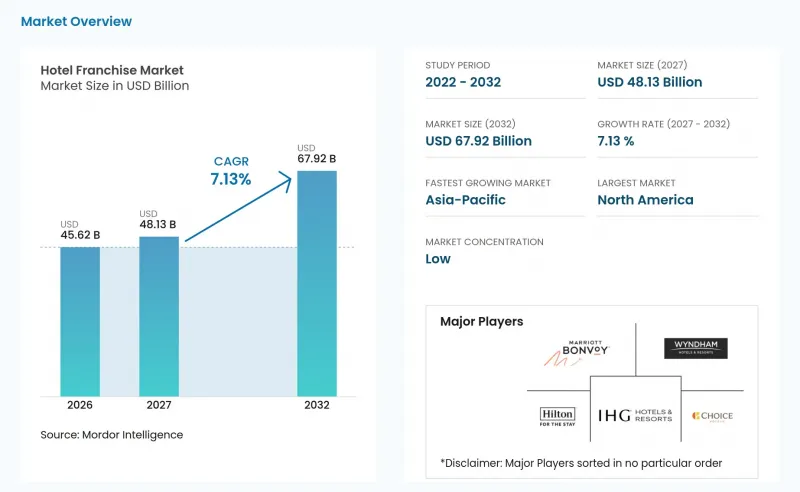
According to Mordor Intelligence, the global hotel franchise market size was valued at USD 45.62 billion in 2026 and is estimated to grow from USD 48.13 billion in 2027 to reach USD 67.92 billion by 2032, at a CAGR of 7.13% during the forecast period (2027-2032).
Global Hotel Franchise Market Trends and Insights
Brand Recognition and Loyalty Program Reach
Loyalty programs provide franchisees with access to repeat guests and established booking channels that many independent hotels cannot develop independently. Wyndham licenses its brands to more than 6,200 franchises globally and provides access to Wyndham Rewards, which had more than 122 million enrolled members in 2025. Marriott generated USD 3,325 million in franchise fee revenue in 2025, a 7% increase from the prior year, demonstrating the value of a large branded system even when hotel performance growth is moderate. Loyalty platforms also support direct bookings, reduce reliance on third-party channels, and help properties retain guest data. In emerging markets, international hotel chains can use these networks to attract inbound travelers, while domestic guests can access familiar rewards across multiple cities. These benefits strengthen franchisee renewal incentives by providing a stable demand source across travel cycles.
Rising Hotel Development Demand in Secondary and Emerging Markets
Hotel franchising is expanding beyond established gateway cities as brands target emerging destinations across Asia-Pacific, the Middle East, South America, and Europe. Marriott signed nearly 1,200 global development agreements in 2025, covering 163,000 rooms, including 187 agreements in Asia-Pacific excluding China and 201 in Greater China. Conversions accounted for more than 30% of globally signed rooms, enabling owners to adopt established brands without developing new properties. In the Caribbean and Latin America, Marriott signed a record 94 agreements and added more than 10,000 rooms to its regional portfolio. These developments highlight opportunities in secondary cities and emerging leisure destinations, where brand recognition, distribution access, and conversion-friendly models support expansion while reducing development costs.
Franchise Development and Property Improvement Costs
Property improvement plans can impose high initial or renewal costs on franchisees. Requirements often include guest room upgrades, public-area renovations, safety enhancements, accessibility improvements, and technology updates. Construction financing, material prices, and labor costs can further increase project expenses and complicate approval decisions. Owners must also meet local construction approval, fire safety, and building compliance requirements before opening or relaunching a property. Owners may therefore pursue conversions only when anticipated revenue gains justify capital investment. The hotel franchise market depends on owners' ability to fund upgrades without compromising property cash flow. These requirements can also delay expansion in locations where smaller owners have limited access to long-term financing.
Other drivers and restraints analyzed in the detailed report include:
- Asset-Light Expansion and Fee-Based Economics
- Affordable Limited-Service and Extended-Stay Demand
- Labor Availability and Service-Quality Pressure
For complete list of drivers and restraints, kindly check the Table Of Contents.
Segment Analysis
Midscale hotels accounted for a 36.5% revenue share of the global hotel franchise market in 2026 and are projected to grow at an 8.67% CAGR through 2032. Their position reflects demand for accommodation that is affordable for guests and financially viable for property owners. Midscale hotels require less capital than luxury properties and can be developed in secondary markets. They serve domestic leisure, business, and small-group travelers without the operating costs of full-service models. This format is relevant to emerging markets, where travelers seek familiar standards at value-oriented price points.
Luxury properties can generate higher fees per room when room rates and guest spending are strong. Hilton reported Waldorf Astoria RevPAR of USD 304.14 in 2025, up 9.7% from 2024. However, luxury franchising has a smaller addressable owner base because of higher development, staffing, and brand-standard compliance costs. Economy hotels offer volume and conversion opportunities but face pressure from labor and renovation costs. The hotel franchise market benefits operators that maintain balanced portfolios across hotel classes rather than relying on a single traveler segment.
Limited-Service Hotels accounted for 38.9% of the global hotel franchise market size in 2026. Their operating model requires smaller teams and more standardized processes than many full-service hotels. This structure can improve owner economics and support faster expansion across suburban, highway, airport, and business locations. Limited-service properties are also easier for first-time owners to operate within an established brand framework. In emerging markets, the format aligns with demand in business corridors and emerging city markets that require predictable accommodation without extensive amenities.
Extended-Stay Hotels are projected to grow at a CAGR of 8.12% through 2032. The format serves long-duration demand from project workers, remote professionals, relocating households, and medical travelers. Choice Hotels reported a 12% increase in United States extended-stay net rooms in 2025. Resorts, boutiques, and lifestyle hotels also support soft-brand growth, as owners seek distribution benefits while retaining local character. Full-Service Hotels remain important; however, complex staffing and food-and-beverage operations can make management contracts more suitable than franchise agreements.
Complete Report Scope:
- By Hotel Class
- Luxury
- Upper-Upscale
- Midscale
- Economy
- By Hotel Type
- Full-Service Hotels
- Limited-Service Hotels
- Extended-Stay Hotels
- Resort Hotels
- Boutique and Lifestyle Hotels
- By Franchise Agreement Type
- Traditional Franchise
- Soft-Brand Franchise
- Conversion Franchise
- New-Build Franchise
- By Brand Category
- International Hotel Brands
- Domestic and Regional Hotel Brands
- By Geography
- North America
- United States
- Canada
- Mexico
- South America
- Brazil
- Peru
- Chile
- Argentina
- Rest of South America
- Europe
- United Kingdom
- Germany
- France
- Spain
- Italy
- BENELUX (Belgium, Netherlands, and Luxembourg)
- NORDICS (Denmark, Finland, Iceland, Norway, and Sweden)
- Rest of Europe
- Asia-Pacific
- India
- China
- Japan
- Australia
- South Korea
- South East Asia (Singapore, Malaysia, Thailand, Indonesia, Vietnam, and the Philippines)
- Rest of Asia-Pacific
- Middle East
- United Arab Emirates
- Saudi Arabia
- South Africa
- Nigeria
- Rest of the Middle East and Africa
- North America
Geography Analysis
North America held a 39.4% revenue share of the global hotel franchise market in 2026. Established regulations, owner networks, loyalty programs, and branded hotels support the region. AHLA identifies franchising as central to the United States hotel operating model. Choice Hotels acquired the remaining 50% stake in Choice Hotels Canada in July 2025, transitioning to a direct-franchise model. The region provides a reference for emerging markets in balancing brand standards, owner returns, and technology fees under long-term contracts.
Asia-Pacific is forecast to grow at an 8.96% CAGR through 2032, the fastest among regions. Markets such as India, Vietnam, and Japan support this growth as hotel development expands into secondary cities amid stronger domestic travel and improved access. Marriott reported 8.0% RevPAR growth, 71.4% occupancy, and USD 182.35 ADR in Asia-Pacific excluding China in 2025. BWH Hotels identified India, Vietnam, and Japan as key growth markets for 2026, reflecting opportunities for international hotel-franchise expansion. Flexible franchise structures and locally informed site selection remain important across the region.
Europe and emerging markets offer franchise opportunities as owners seek distribution support and established brands. IHG reported over 1,100 open and pipeline hotels in Europe in 2025. High construction and financing costs support conversions. Government-backed tourism projects drive luxury and upper-upscale development in the Middle East. Marriott signed 94 deals and added nearly 40 properties in the Caribbean and Latin America in 2025.
- Marriott International, Inc.
- Hilton Worldwide Holdings Inc.
- InterContinental Hotels Group plc
- Wyndham Hotels & Resorts, Inc.
- Choice Hotels International, Inc.
- Accor S.A.
- Hyatt Hotels Corporation
- Jin Jiang International Holdings Co., Ltd.
- H World Group Limited
- Melia Hotels International, S.A.
- Minor International Public Company Limited
- Sonesta International Hotels Corporation
- Extended Stay America, Inc.
- Radisson Hotel Group
- G6 Hospitality LLC
- Lemon Tree Hotels Limited
- Magnuson Hotels
- OYO Hotels & Homes
- Dusit International
- Red Roof
Additional Benefits:
- The market estimate (ME) sheet in Excel format
- 3 months of analyst support
TABLE OF CONTENTS
1 Introduction
- 1.1 Study Assumptions & Market Definition
- 1.2 Scope of the Study
2 Executive Summary
3 Market Landscape
- 3.1 Market Overview
- 3.2 Market Drivers
- 3.2.1 Brand Recognition and Loyalty Program Reach
- 3.2.2 Rising Hotel Development Demand in Secondary and Emerging Markets
- 3.2.3 Asset-Light Expansion and Fee-Based Economics
- 3.2.4 Affordable Limited Service and Extended-Stay Demand
- 3.2.5 Conversion-Led Growth and Adaptive Reuse
- 3.2.6 Data-Rich Revenue Management and Direct Booking Enablement
- 3.3 Market Restraints
- 3.3.1 Franchise Development and Property Improvement Costs
- 3.3.2 Labor Availability and Service-Quality Pressure
- 3.3.3 Channel, Loyalty, and Technology Fee Escalation
- 3.3.4 Brand-Standard Rigidity in Local Operating Contexts
- 3.4 Regulatory Landscape
- 3.5 Technological Outlook
- 3.6 Porter's Five Forces Analysis
- 3.6.1 Bargaining Power of Franchisees
- 3.6.2 Bargaining Power of Suppliers
- 3.6.3 Threat of New Entrants
- 3.6.4 Threat of Substitutes
- 3.6.5 Intensity of Competitive Rivalry
4 Supply & Infrastructure Intelligence
- 4.1 Supply Landscape & Development Trends
- 4.2 Existing Hotel Supply and Room Inventory
5 Hotel Performance Intelligence
- 5.1 Occupany Rates
- 5.2 Averages Daily Rates
6 Consumer Behavior Analysis
- 6.1 Traveler Preferences and Demand Patterns
- 6.2 Booking Behavior and Channel Preferences
- 6.3 Travel Spending and Emerging Preferences
7 Global Market Size & Growth Forecasts (USD, Value) 2022-2031
- 7.1 By Hotel Class
- 7.1.1 Luxury
- 7.1.2 Upper-Upscale
- 7.1.3 Midscale
- 7.1.4 Economy
- 7.2 By Hotel Type
- 7.2.1 Full-Service Hotels
- 7.2.2 Limited-Service Hotels
- 7.2.3 Extended-Stay Hotels
- 7.2.4 Resort Hotels
- 7.2.5 Boutique and Lifestyle Hotels
- 7.3 By Franchise Agreement Type
- 7.3.1 Traditional Franchise
- 7.3.2 Soft-Brand Franchise
- 7.3.3 Conversion Franchise
- 7.3.4 New-Build Franchise
- 7.4 By Brand Category
- 7.4.1 International Hotel Brands
- 7.4.2 Domestic and Regional Hotel Brands
- 7.5 By Geography
- 7.5.1 North America
- 7.5.1.1 United States
- 7.5.1.2 Canada
- 7.5.1.3 Mexico
- 7.5.2 South America
- 7.5.2.1 Brazil
- 7.5.2.2 Peru
- 7.5.2.3 Chile
- 7.5.2.4 Argentina
- 7.5.2.5 Rest of South America
- 7.5.3 Europe
- 7.5.3.1 United Kingdom
- 7.5.3.2 Germany
- 7.5.3.3 France
- 7.5.3.4 Spain
- 7.5.3.5 Italy
- 7.5.3.6 BENELUX (Belgium, Netherlands, and Luxembourg)
- 7.5.3.7 NORDICS (Denmark, Finland, Iceland, Norway, and Sweden)
- 7.5.3.8 Rest of Europe
- 7.5.4 Asia-Pacific
- 7.5.4.1 India
- 7.5.4.2 China
- 7.5.4.3 Japan
- 7.5.4.4 Australia
- 7.5.4.5 South Korea
- 7.5.4.6 South East Asia (Singapore, Malaysia, Thailand, Indonesia, Vietnam, and the Philippines)
- 7.5.4.7 Rest of Asia-Pacific
- 7.5.5 Middle East
- 7.5.5.1 United Arab Emirates
- 7.5.5.2 Saudi Arabia
- 7.5.5.3 South Africa
- 7.5.5.4 Nigeria
- 7.5.5.5 Rest of the Middle East and Africa
- 7.5.1 North America
8 North America Market Size & Growth Forecasts (USD, Value) 2022-2031
- 8.1 By Franchise Type
- 8.2 By Service Type
- 8.3 By Franchising Model
- 8.4 By Customer Type
- 8.5 By Countries
9 South America Market Size & Growth Forecasts (USD, Value) 2022-2031
- 9.1 By Franchise Type
- 9.2 By Service Type
- 9.3 By Franchising Model
- 9.4 By Customer Type
- 9.5 By Countries
10 Europe Market Size & Growth Forecasts (USD, Value) 2022-2031
- 10.1 By Franchise Type
- 10.2 By Service Type
- 10.3 By Franchising Model
- 10.4 By Customer Type
- 10.5 By Countries
11 Asia-Pacific Market Size & Growth Forecasts (USD, Value) 2022-2031
- 11.1 By Franchise Type
- 11.2 By Service Type
- 11.3 By Franchising Model
- 11.4 By Customer Type
- 11.5 By Countries
12 Middle East and Africa Market Size & Growth Forecasts (USD, Value) 2022-2031
- 12.1 By Franchise Type
- 12.2 By Service Type
- 12.3 By Franchising Model
- 12.4 By Customer Type
- 12.5 By Countries
13 Competitive Landscape
- 13.1 Market Concentration
- 13.2 Strategic Moves
- 13.3 Market Share Analysis
- 13.4 Company Profiles (includes Global Level Overview, Market Level Overview, Core Segments, Financials as available, Strategic Information, Market Rank/Share, Products and Services, and Recent Developments)
- 13.4.1 Marriott International, Inc.
- 13.4.2 Hilton Worldwide Holdings Inc.
- 13.4.3 InterContinental Hotels Group plc
- 13.4.4 Wyndham Hotels & Resorts, Inc.
- 13.4.5 Choice Hotels International, Inc.
- 13.4.6 Accor S.A.
- 13.4.7 Hyatt Hotels Corporation
- 13.4.8 Jin Jiang International Holdings Co., Ltd.
- 13.4.9 H World Group Limited
- 13.4.10 Melia Hotels International, S.A.
- 13.4.11 Minor International Public Company Limited
- 13.4.12 Sonesta International Hotels Corporation
- 13.4.13 Extended Stay America, Inc.
- 13.4.14 Radisson Hotel Group
- 13.4.15 G6 Hospitality LLC
- 13.4.16 Lemon Tree Hotels Limited
- 13.4.17 Magnuson Hotels
- 13.4.18 OYO Hotels & Homes
- 13.4.19 Dusit International
- 13.4.20 Red Roof
14 Market Opportunities & Future Outlook
- 14.1 White-Space and Unmet-Need Assessment
- 14.2 Market Opportunities
- 14.2.1 Secondary-City and Emerging-Market Franchise Expansion
- 14.2.2 Adaptive Reuse and Conversion-Led Growth
- 14.3 Future Outlook
15 Research Methodology

