PUBLISHER: Mordor Intelligence | PRODUCT CODE: 2195535

PUBLISHER: Mordor Intelligence | PRODUCT CODE: 2195535
North America Renewable Diesel - Market Share Analysis, Industry Trends & Statistics, Growth Forecasts (2027 - 2032)
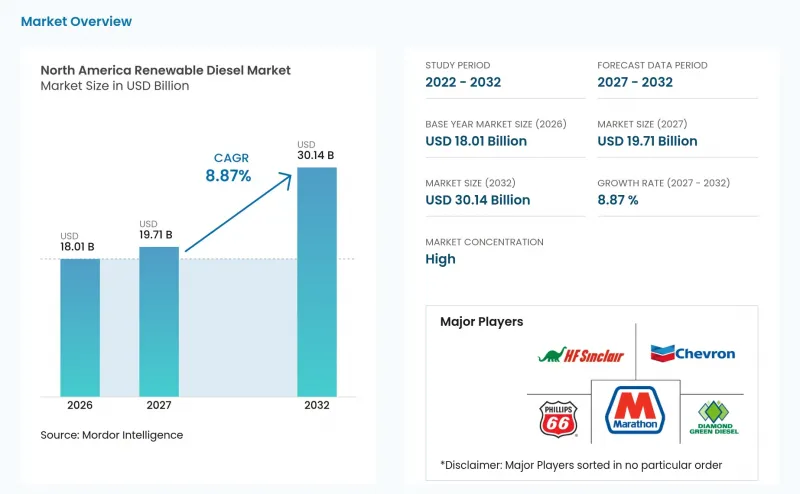
According to Mordor Intelligence, the North America renewable diesel market was valued at USD 18.01 billion in 2026 and is estimated to grow from USD 19.71 billion in 2027 to USD 30.14 billion by 2032, at a CAGR of 8.87% during the forecast period (2027-2032).
North America Renewable Diesel Market Trends and Insights
Federal And State Low-Carbon Fuel Incentives
Federal and state programs provide the most direct demand support for the North America renewable diesel market. The U.S. Environmental Protection Agency set biomass-based diesel obligations at a minimum of 5.33 billion physical gallons for 2026 and 5.75 billion gallons for 2027 under the Renewable Fuel Standard Set 2 rule. These obligations help refiners assess revenue before committing capital to conversion projects. The Clean Fuel Production Credit provides higher support for sustainable aviation fuel than for non-SAF renewable fuels, making product flexibility more valuable at multi-product facilities. California's Low Carbon Fuel Standard tightens carbon-intensity benchmarks, increasing the value of lower-carbon pathways and verified feedstock supply chains.
Drop-In Compatibility with Existing Diesel Infrastructure
Renewable diesel can be used within existing fuel handling systems without modification, which supports its adoption. The U.S. Department of Energy states that renewable diesel is chemically similar to petroleum diesel and can be used in diesel engines without blending limitations. This characteristic reduces operational changes for fleet managers, distributors, and terminal operators. Detroit Diesel's renewable diesel policy confirms that approved renewable diesel use does not require engine modifications across its covered engine range. This policy also gives procurement teams clearer assurance when changing fuel specifications. The North America renewable diesel market benefits because adoption does not depend on widespread replacement of trucks, tanks, or fueling equipment.
Feedstock Availability and Price Volatility
Feedstock availability and pricing remain the primary operating risks for renewable diesel producers. HF Sinclair Corporation reported a full-year 2025 adjusted renewables gross margin of negative USD -0.16 per gallon after operating expenses. Soybean oil, canola oil, tallow, and used cooking oil are affected by food demand, weather, trade conditions, and collection systems that do not always align with fuel margins. California's 2025 Low Carbon Fuel Standard amendments add traceability and sustainability requirements for certain crop-based pathways. Producers with pretreatment assets can use a broader range of inputs and reduce reliance on spot vegetable oil purchases. The North America renewable diesel market remains vulnerable when feedstock costs rise faster than fuel, Renewable Identification Number, and low-carbon credit values.
Other drivers and restraints analyzed in the detailed report include:
- Heavy-Duty Fleet Decarbonization
- Refinery Conversion and Co-Processing Economics
- Competition From Electrification and Hydrogen
For complete list of drivers and restraints, kindly check the Table Of Contents.
Segment Analysis
Pure Renewable Diesel (HVO100) held 53.2% of the North America renewable diesel market in 2026. Its position reflects the product's ability to function as a direct diesel substitute in existing engines and fuel systems. The U.S. Department of Energy identifies renewable diesel as a hydrocarbon fuel that is chemically similar to petroleum diesel. Fleet buyers value HVO100 because it avoids blend limits and can be supplied through conventional fuel channels. Its cold-weather suitability also supports use in Canadian operations when approved fuel specifications are met. HVO100's broad compatibility with transport, industrial, and backup-power applications gives suppliers a large potential customer base.
Renewable diesel blends remain relevant for customers that shift their fuel procurement gradually. Co-processed renewable diesel is also gaining attention because refiners can use existing infrastructure to introduce renewable feedstocks. Parkland Corporation's 47% year-over-year increase in bio-based feedstock processing during the third quarter of 2025 demonstrates the operational interest in this route. Algae-derived and other novel feedstock variants are forecast to record the highest CAGR of 12.3% through 2032. These pathways are of interest because they may avoid competition with food crops and support lower carbon-intensity outcomes. Their commercial progress depends on lower production costs and reliable scale-up. The North America renewable diesel market will continue to favor types that preserve engine compatibility while improving feedstock flexibility.
Vegetable oils held 35.4% of feedstock value in 2026 within the North America renewable diesel market. Soy, canola, and palm oils have established supply chains and are compatible with both hydroprocessing and transesterification routes. Canadian canola is particularly important to the country's supply chain. Imperial Oil Limited commissioned its Strathcona renewable diesel facility in Alberta in 2025 with a capacity of up to 20,000 barrels per day and planned use of Canadian bio-feedstocks. British Columbia also introduced a requirement for Canadian-origin renewable content in diesel, which supports domestic sourcing.
Animal fats and used cooking oil are increasingly attractive because they can generate lower lifecycle emissions than virgin vegetable oils. These inputs can therefore earn stronger low-carbon credit values when their origin and treatment meet program rules. Algae is forecast to grow at a CAGR of 13.1% through 2032, the highest rate among the listed feedstocks. California's amended Low Carbon Fuel Standard places greater importance on sustainable feedstocks, traceability, and carbon-intensity performance. Tall oil and waste residues may also help producers reduce exposure to food-commodity price cycles. The relative value of feedstocks will increasingly depend on documented carbon performance, supply security, and pretreatment capability.
Complete Report Scope:
- By Type
- Pure Renewable Diesel (HVO100)
- Renewable Diesel Blends
- Co-processed Renewable Diesel
- Others (e.g., Algae-derived)
- By Feedstock
- Vegetable Oils (Palm, Soy, Canola, etc.)
- Animal Fats
- Used Cooking Oil
- Algae
- Tall Oil & Waste Residues
- Others (e.g., MSW)
- By Application
- Transportation Fuel
- Aviation (SAF)
- Marine
- Industrial Use
- Power Generation
- Others (Military, Agri-equipment)
- By End-user
- Oil Refineries and Blenders
- Commercial Fleet Operators
- Airlines and Aviation Authorities
- Government and Defense
- Marine Transport Operators
- Industrial and Utility Sector
- Others
- By Geography
- North America
- United States
- Canada
- Mexico
- North America
List of Companies Covered in this Report:
- BP p.l.c.
- Braya Renewable Fuels LP
- Calumet, Inc.
- Chevron Corporation
- CVR Energy, Inc.
- Diamond Green Diesel LLC
- East Kansas Agri-Energy, LLC
- Eni S.p.A.
- HF Sinclair Corporation
- Imperial Oil Limited
- Jaxon Energy, LLC
- Kern Oil & Refining Co.
- Marathon Petroleum Corporation
- Parkland Corporation
- PBF Energy Inc.
- Phillips 66 Company
- Seaboard Corporation
- Tidewater Renewables Ltd.
- Vertex Energy, Inc.
- World Energy, LLC
Additional Benefits:
- The market estimate (ME) sheet in Excel format
- 3 months of analyst support
TABLE OF CONTENTS
1 INTRODUCTION
- 1.1 Study Assumptions and Market Definition
- 1.2 Scope of the Study
2 RESEARCH METHODOLOGY
3 EXECUTIVE SUMMARY
4 MARKET LANDSCAPE
- 4.1 Market Overview
- 4.2 Market Drivers
- 4.2.1 Federal and State Low-Carbon Fuel Incentives
- 4.2.2 Drop-In Compatibility With Existing Diesel Infrastructure
- 4.2.3 Heavy-Duty Fleet Decarbonization
- 4.2.4 Refinery Conversion and Co-Processing Economics
- 4.2.5 SAF and Renewable Diesel Co-Production
- 4.2.6 Growing Demand for Lower-Carbon Backup and Industrial Fuels
- 4.3 Market Restraints
- 4.3.1 Feedstock Availability and Price Volatility
- 4.3.2 Competition From Electrification and Hydrogen
- 4.3.3 Carbon-Intensity Penalties for Crop-Based Feedstocks
- 4.3.4 Regional Feedstock Logistics and Pretreatment Bottlenecks
- 4.4 Supply-Chain Analysis
- 4.5 Porter's Five Forces Analysis
- 4.5.1 Bargaining Power of Suppliers
- 4.5.2 Bargaining Power of Buyers
- 4.5.3 Threat of New Entrants
- 4.5.4 Threat of Substitutes
- 4.5.5 Competitive Rivalry
- 4.6 Technology Outlook
- 4.7 Regulatory Landscape
- 4.8 Investment Analysis
5 MARKET SIZE AND GROWTH FORECASTS
- 5.1 By Type
- 5.1.1 Pure Renewable Diesel (HVO100)
- 5.1.2 Renewable Diesel Blends
- 5.1.3 Co-processed Renewable Diesel
- 5.1.4 Others (e.g., Algae-derived)
- 5.2 By Feedstock
- 5.2.1 Vegetable Oils (Palm, Soy, Canola, etc.)
- 5.2.2 Animal Fats
- 5.2.3 Used Cooking Oil
- 5.2.4 Algae
- 5.2.5 Tall Oil & Waste Residues
- 5.2.6 Others (e.g., MSW)
- 5.3 By Application
- 5.3.1 Transportation Fuel
- 5.3.2 Aviation (SAF)
- 5.3.3 Marine
- 5.3.4 Industrial Use
- 5.3.5 Power Generation
- 5.3.6 Others (Military, Agri-equipment)
- 5.4 By End-user
- 5.4.1 Oil Refineries and Blenders
- 5.4.2 Commercial Fleet Operators
- 5.4.3 Airlines and Aviation Authorities
- 5.4.4 Government and Defense
- 5.4.5 Marine Transport Operators
- 5.4.6 Industrial and Utility Sector
- 5.4.7 Others
- 5.5 By Geography
- 5.5.1 North America
- 5.5.1.1 United States
- 5.5.1.2 Canada
- 5.5.1.3 Mexico
- 5.5.1 North America
6 COMPETITIVE LANDSCAPE
- 6.1 Market Concentration
- 6.2 Strategic Moves
- 6.3 Market Share Analysis
- 6.4 Company Profiles (includes Global Level Overview, Market Level Overview, Core Segments, Financials as available, Strategic Information, Market Rank/Share, Products and Services, Recent Developments)
- 6.4.1 BP p.l.c.
- 6.4.2 Braya Renewable Fuels LP
- 6.4.3 Calumet, Inc.
- 6.4.4 Chevron Corporation
- 6.4.5 CVR Energy, Inc.
- 6.4.6 Diamond Green Diesel LLC
- 6.4.7 East Kansas Agri-Energy, LLC
- 6.4.8 Eni S.p.A.
- 6.4.9 HF Sinclair Corporation
- 6.4.10 Imperial Oil Limited
- 6.4.11 Jaxon Energy, LLC
- 6.4.12 Kern Oil & Refining Co.
- 6.4.13 Marathon Petroleum Corporation
- 6.4.14 Parkland Corporation
- 6.4.15 PBF Energy Inc.
- 6.4.16 Phillips 66 Company
- 6.4.17 Seaboard Corporation
- 6.4.18 Tidewater Renewables Ltd.
- 6.4.19 Vertex Energy, Inc.
- 6.4.20 World Energy, LLC
7 MARKET OPPORTUNITIES AND FUTURE OUTLOOK
- 7.1 White-Space and Unmet-Need Assessment

