PUBLISHER: Mordor Intelligence | PRODUCT CODE: 2195551

PUBLISHER: Mordor Intelligence | PRODUCT CODE: 2195551
Europe Data Center Energy Storage and Microgrids - Market Share Analysis, Industry Trends & Statistics, Growth Forecasts (2027 - 2032)
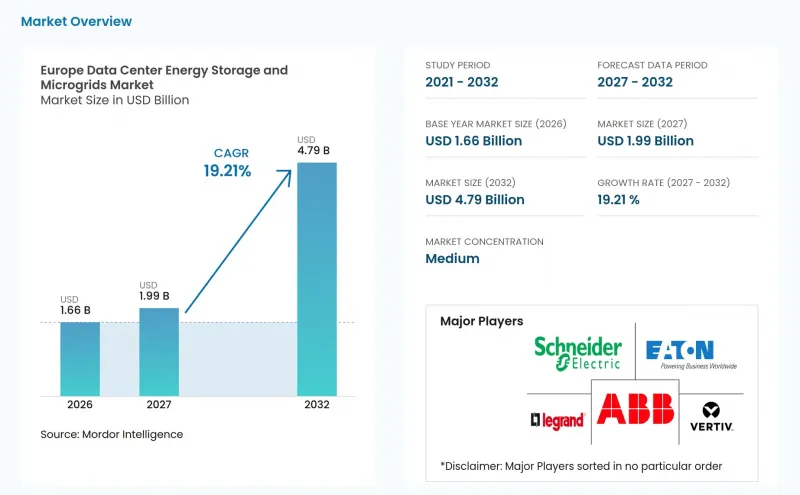
According to Mordor Intelligence, the Europe data center energy storage and microgrids market size is projected to be USD 1.66 billion in 2026, USD 1.99 billion in 2027, and reach USD 4.79 billion by 2032, at a CAGR of 19.21% from 2027 to 2032.
Europe Data Center Energy Storage and Microgrids Market Trends and Insights
Artificial Intelligence and Hyperscale Data Center Expansion
AI-related demand is increasing the need for storage and microgrids at European data centers. European data center power demand is expected to rise from 10 GW to 35 GW by 2030, representing a 250% increase, according to a 2025 Wartsila and AVK analysis. The European Commission's 2025 AI Continent Action Plan aims to triple European Union data center capacity within 5-7 years and identifies energy availability as a central constraint. GPU clusters can create irregular and high-amplitude demand peaks that conventional utility feeds and legacy UPS systems were not designed to absorb. Behind-the-meter batteries can manage those fluctuations while reducing exposure to peak demand periods. This makes energy storage a core part of design for AI facilities rather than an optional resilience addition in the Europe data center energy storage and microgrids market.
Grid-Connection Queues and Local Power Constraints
Long connection timelines are accelerating the use of on-site power systems across Europe. Connection queues in the FLAP-D markets of Frankfurt, London, Amsterdam, Paris, and Dublin can average 7-10 years, while wait times across European countries range from 2-10 years. The Agency for the Cooperation of Energy Regulators recorded EUR 4.3 billion (USD 4.79 billion) in direct European Union grid congestion costs during 2024. Wartsila and AVK project that 40% of existing AI data centers could face operational constraints from power availability by 2027. Developers are therefore considering Spain, the Nordics, and other locations with greater grid headroom. Islanded and hybrid systems can shorten the route to commissioning where grid capacity is unavailable within commercial timelines.
High Installed Costs for Integrated Storage and Microgrid Systems
High upfront costs remain the main commercial barrier for integrated battery energy storage systems and microgrids. Wartsila and AVK modeled the levelized electricity cost of an optimized microgrid for an 80 MW data center at EUR 108 per MWh, which the source converted to USD 122 per MWh. Most projects require bespoke engineering, site-specific permits, and integration with existing electrical equipment. These requirements increase both cost and schedule uncertainty. Battery-as-a-Service and Energy-as-a-Service models may shift expenditure from capital budgets to operating budgets. However, smaller colocation and enterprise facilities still have fewer financing options than hyperscale and cloud operators.
Other drivers and restraints analyzed in the detailed report include:
- EU Energy Efficiency and Carbon-Reduction Requirements
- Data Center Dispatchable Capacity as a Grid Resource
- Fire-Safety and Thermal-Management Requirements for Lithium-Ion Systems
For complete list of drivers and restraints, kindly check the Table Of Contents.
Segment Analysis
Energy storage systems held 30.08% of the European data center energy storage and microgrids market share in 2026 and are projected to expand at a 20.21% CAGR through 2032. Their position reflects the role of batteries in maintaining power quality, reducing peak demand, and supporting the use of renewable electricity. Storage must be available before an integrated microgrid can manage fluctuations in local generation or utility supply. Integrated microgrid solutions remain important for operators seeking controls, generation, and storage on a single platform. Microgrid control systems are becoming a higher-value part of the offer because they can allocate stored power across resilience, peak shaving, and grid services. Power conversion systems and distributed generation are generally procured as components of wider campus energy projects.
The shift from a single-function UPS to a multi-use energy asset is changing purchase specifications. Operators are considering storage capable of discharging for hours rather than designing only for 5-15 minutes of backup. Longer duration enables participation in frequency regulation and allows renewable electricity to be used later in the day. The reporting framework under Commission Delegated Regulation 2024/1364 includes indicators of systemic efficiency and flexibility. This creates a commercial reason to deploy controls that can manage site assets beyond basic backup use. The Europe data center energy storage and microgrids industry is consequently placing greater value on systems that can support several operational functions. Vendors that can demonstrate reliable coordination between these functions have a stronger position in large-campus projects.
Lithium-ion batteries held 56.21% of storage technology revenue in 2026. Established supply chains, falling manufacturing costs, and high energy density support their use in short-duration backup applications. Lead-acid batteries continue to serve some retrofit projects that use established legacy designs. Flywheels address limited-frequency-response applications where a very fast response is needed without the risk of electrochemical fire. Flow batteries are projected to expand at a 20.19% CAGR through 2032 as hyperscale operators assess long-duration renewable time shifting and multi-hour grid services. FlexBase Group began construction in June 2025 of an 800 MW, 1.6 GWh vanadium redox flow battery site in Laufenburg, Switzerland.
The Laufenburg project sits near the Swiss, German, and French transmission networks and is intended to support grid stability and serve as a power source for a colocated AI data center. It also includes a district heating network, which demonstrates how large storage projects can connect multiple local energy uses. Flow battery chemistry can offer a different safety profile for sites that require long discharge periods. This matters because data center operators must respond to varying fire safety rules across European Union member states. Interest in storage capable of operating beyond conventional UPS durations supports long-duration applications. The German Institute for Economic Research estimated that Europe may require 351 TWh of long-duration storage to address extended periods of low renewable generation, underscoring the need for technologies suited to longer discharge cycles.
Grid-connected microgrids accounted for 47.31% of revenue in 2026. Established facilities prefer this design because they can retain utility supply while using local generation and batteries during high-tariff or high-demand periods. Hybrid systems that can remain grid-connected or operate independently are gaining attention in projects across continental Europe. They offer the cost benefits of utility supply with black-start capability during extended outages. Islanded microgrids are projected to expand at a 19.78% CAGR through 2032 as connection delays require new projects to plan for greater energy independence. Wartsila and AVK found that islanded systems combining renewables, balancing engines, and storage could serve 80 MW-scale data centers.
Islanded designs are not only a response to a delayed grid connection. They can enable operators to enter into longer-term power purchase agreements with renewable developers. This approach can reduce exposure to volatile spot electricity prices and improve visibility for long-term capacity planning. A 2025 feasibility study validated hybrid renewable and battery configurations for hyperscale off-grid loads and found that grid-forming battery controls can maintain frequency within data center operating limits. Spain and the Nordics have conditions that support this model because renewable resources and available development sites can be more favorable. Operators still need to consider fuel availability, permitting, and equipment lead times before selecting a fully islanded architecture.
Complete Report Scope:
- By Solution Type
- Integrated Microgrid Solutions
- Energy Storage Systems
- Microgrid Control Systems
- Distributed Generation Systems
- Power Conversion Systems
- By Storage Technology
- Lithium-Ion Batteries
- Lead-Acid Batteries
- Flow Batteries
- Flywheel Storage
- Other Storage Technologies
- By Microgrid Configuration
- Grid-Connected Microgrids
- Islanded Microgrids
- Hybrid Grid-Connected and Islandable Microgrids
- By Primary Energy Source
- Grid Electricity
- Diesel and Natural Gas
- Solar Power
- Wind Power
- Fuel Cells
- Other Energy Sources
- By Primary Application
- Backup Power and Resilience
- Peak Shaving and Load Shifting
- Renewable Energy Integration
- Grid Services
- Energy Cost Optimization
- By Data Center Size
- Small
- Medium
- Large
- Hyperscale
- By Data Center Type
- Colocation
- Cloud Service Providers (CSPs)
- Enterprise and Edge
- By Geography
- United Kingdom
- Germany
- Netherlands
- Ireland
- France
- Spain
- Italy
- Nordics
- Rest of Europe
List of Companies Covered in this Report:
- Schneider Electric SE
- ABB Ltd.
- Eaton Corporation plc
- Vertiv Group Corporation
- Legrand SA
- Siemens AG
- Siemens Energy AG
- Huawei Technologies Co., Ltd.
- Delta Electronics, Inc.
- Cummins Inc.
- Caterpillar Inc.
- Rolls-Royce Holdings plc
- Mitsubishi Electric Corporation
- Hitachi Energy Ltd.
- Fluence Energy, Inc.
- Tesla, Inc.
- EnerSys
- Saft Groupe S.A.
- Socomec Group S.A.
- Piller Power Systems GmbH
- Riello UPS Manufacturing S.p.A.
- Wartsila Corporation
- Ingeteam S.A.
- Skeleton Technologies Group OU
Additional Benefits:
- The market estimate (ME) sheet in Excel format
- 3 months of analyst support
TABLE OF CONTENTS
1 INTRODUCTION
- 1.1 Study Assumptions and Market Definition
- 1.2 Scope of the Study
2 RESEARCH METHODOLOGY
3 EXECUTIVE SUMMARY
4 MARKET LANDSCAPE
- 4.1 Market Overview
- 4.2 Impact of Macroeconomic Factors on the Market
- 4.3 Market Drivers
- 4.3.1 Artificial Intelligence and Hyperscale Data Center Expansion
- 4.3.2 EU Energy Efficiency and Carbon-Reduction Requirements
- 4.3.3 Renewable Power Procurement and Time-Shifting Demand
- 4.3.4 Grid-Connection Queues and Local Power Constraints
- 4.3.5 Data Center Dispatchable Capacity as a Grid Resource
- 4.3.6 Grid-Interactive UPS and Battery Flexibility Monetization
- 4.4 Market Restraints
- 4.4.1 High Installed Costs for Integrated Storage and Microgrid Systems
- 4.4.2 Fire-Safety and Thermal-Management Requirements for Lithium-Ion Systems
- 4.4.3 Transformer, Battery, and High-Voltage Equipment Supply Constraints
- 4.4.4 Legacy Backup Architectures and Retrofit Disruption
- 4.5 Industry Value Chain Analysis
- 4.6 Regulatory Landscape
- 4.7 Technological Outlook
- 4.8 Porter's Five Forces Analysis
- 4.8.1 Bargaining Power of Suppliers
- 4.8.2 Bargaining Power of Buyers
- 4.8.3 Threat of New Entrants
- 4.8.4 Threat of Substitutes
- 4.8.5 Competitive Rivalry
5 MARKET SIZE AND GROWTH FORECASTS (VALUE)
- 5.1 By Solution Type
- 5.1.1 Integrated Microgrid Solutions
- 5.1.2 Energy Storage Systems
- 5.1.3 Microgrid Control Systems
- 5.1.4 Distributed Generation Systems
- 5.1.5 Power Conversion Systems
- 5.2 By Storage Technology
- 5.2.1 Lithium-Ion Batteries
- 5.2.2 Lead-Acid Batteries
- 5.2.3 Flow Batteries
- 5.2.4 Flywheel Storage
- 5.2.5 Other Storage Technologies
- 5.3 By Microgrid Configuration
- 5.3.1 Grid-Connected Microgrids
- 5.3.2 Islanded Microgrids
- 5.3.3 Hybrid Grid-Connected and Islandable Microgrids
- 5.4 By Primary Energy Source
- 5.4.1 Grid Electricity
- 5.4.2 Diesel and Natural Gas
- 5.4.3 Solar Power
- 5.4.4 Wind Power
- 5.4.5 Fuel Cells
- 5.4.6 Other Energy Sources
- 5.5 By Primary Application
- 5.5.1 Backup Power and Resilience
- 5.5.2 Peak Shaving and Load Shifting
- 5.5.3 Renewable Energy Integration
- 5.5.4 Grid Services
- 5.5.5 Energy Cost Optimization
- 5.6 By Data Center Size
- 5.6.1 Small
- 5.6.2 Medium
- 5.6.3 Large
- 5.6.4 Hyperscale
- 5.7 By Data Center Type
- 5.7.1 Colocation
- 5.7.2 Cloud Service Providers (CSPs)
- 5.7.3 Enterprise and Edge
- 5.8 By Geography
- 5.8.1 United Kingdom
- 5.8.2 Germany
- 5.8.3 Netherlands
- 5.8.4 Ireland
- 5.8.5 France
- 5.8.6 Spain
- 5.8.7 Italy
- 5.8.8 Nordics
- 5.8.9 Rest of Europe
6 COMPETITIVE LANDSCAPE
- 6.1 Market Concentration
- 6.2 Strategic Moves
- 6.2.1 Product Launches and Platform Expansion
- 6.2.2 Strategic Partnerships and Joint Ventures
- 6.2.3 Battery-as-a-Service and Energy-as-a-Service Models
- 6.2.4 Data Center Microgrid Demonstration Projects
- 6.3 Market Share Analysis
- 6.4 Company Profiles (includes Global Level Overview, Market Level Overview, Core Segments, Financials as available, Strategic Information, Market Rank/Share, Products and Services, Recent Developments)
- 6.4.1 Schneider Electric SE
- 6.4.2 ABB Ltd.
- 6.4.3 Eaton Corporation plc
- 6.4.4 Vertiv Group Corporation
- 6.4.5 Legrand SA
- 6.4.6 Siemens AG
- 6.4.7 Siemens Energy AG
- 6.4.8 Huawei Technologies Co., Ltd.
- 6.4.9 Delta Electronics, Inc.
- 6.4.10 Cummins Inc.
- 6.4.11 Caterpillar Inc.
- 6.4.12 Rolls-Royce Holdings plc
- 6.4.13 Mitsubishi Electric Corporation
- 6.4.14 Hitachi Energy Ltd.
- 6.4.15 Fluence Energy, Inc.
- 6.4.16 Tesla, Inc.
- 6.4.17 EnerSys
- 6.4.18 Saft Groupe S.A.
- 6.4.19 Socomec Group S.A.
- 6.4.20 Piller Power Systems GmbH
- 6.4.21 Riello UPS Manufacturing S.p.A.
- 6.4.22 Wartsila Corporation
- 6.4.23 Ingeteam S.A.
- 6.4.24 Skeleton Technologies Group OU
7 MARKET OPPORTUNITIES AND FUTURE OUTLOOK
- 7.1 White-Space and Unmet-Need Assessment

