PUBLISHER: Mordor Intelligence | PRODUCT CODE: 2196552

PUBLISHER: Mordor Intelligence | PRODUCT CODE: 2196552
Middle East and Africa Data Center Energy Storage and Microgrids - Market Share Analysis, Industry Trends & Statistics, Growth Forecasts (2027 - 2032)
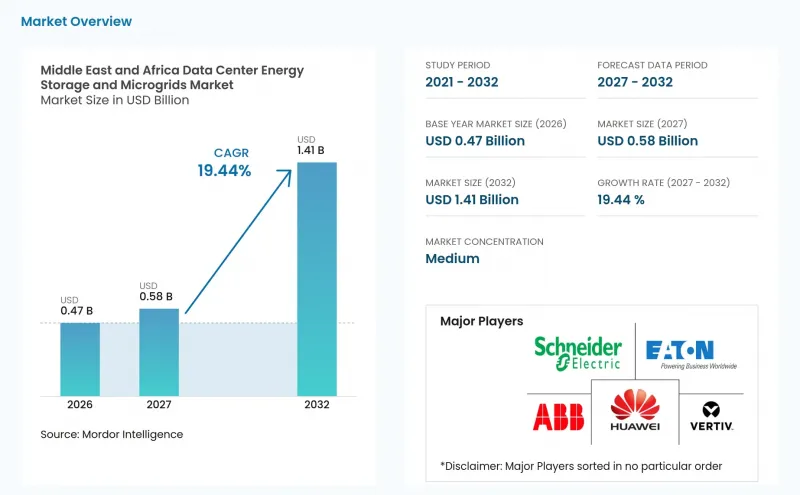
According to Mordor Intelligence, the Middle East and Africa data center energy storage and microgrids market size is projected to expand from USD 0.47 billion in 2026 and USD 0.58 billion in 2027 to USD 1.41 billion by 2032, registering a CAGR of 19.44% between 2027 and 2032.
Middle East and Africa Data Center Energy Storage and Microgrids Market Trends and Insights
Hyperscale and AI Data Center Capacity Expansion
Saudi Arabia's data center IT capacity rose from 68 MW in 2021 to 467 MW in the first quarter of 2026, driven by a rapid national buildout. The Ministry of Communications and Information Technology set a 1.5 GW data center capacity target for 2030 through the National Data Center Strategy. AMD and HUMAIN announced a USD 10 billion collaboration in May 2025 to deploy 500 MW of AI computing capacity over 5 years. Such facilities are a major source of demand within the Middle East and Africa data center energy storage and microgrids market because they require storage systems that manage rapid changes in power demand and maintain service during grid events. The Middle East and Africa data center energy storage and microgrids market benefits from these requirements, which favor systems designed as a single power architecture. The NEOM and DataVolt agreement for a USD 5 billion AI facility also underscores the scale of dedicated energy infrastructure required for new campuses.
Rising Grid Reliability and Backup Autonomy Requirements
South African data center operators have placed a high value on resilient power because electricity disruptions have affected business continuity. Battery systems can bridge short interruptions and reduce dependency on generator operation when integrated with uninterruptible power supply equipment. Schneider Electric stated that microgrids can manage backup energy systems more effectively, where load shedding remains a concern. In Gulf countries, high-density AI workloads can also create power-quality challenges that require responsive controls and storage. This means resilience has become a core design requirement rather than an add-on for the Middle East and Africa data center energy storage and microgrids market. Schneider Electric commissioned 2 microgrid sites for MIS SAHAYEB Datacenters in Dammam during 2025, integrating photovoltaic power, the utility grid, and generators.
High Capital and Lifecycle Costs for Redundant Power Architectures
Integrated power systems require batteries, inverters, controls, generators, and site works in addition to conventional redundancy. This raises the initial cost for enterprise and smaller colocation projects. Operators also face battery equipment replacement planning for frequently used systems to manage volatile AI loads. The burden can delay projects where customers cannot support hyperscale-level power budgets. The Middle East and Africa data center energy storage and microgrids market can therefore favor large developers with stronger financing and long-term tenant commitments. A modular design can limit early-stage expenditure in the Middle East and Africa data center energy storage and microgrids market, but it does not eliminate the need for safe and reliable redundancy.
Other drivers and restraints analyzed in the detailed report include:
- Government-Led Digital Economy and Data Sovereignty Programs
- Renewable Energy and Battery Storage Procurement by Gulf Economies
- Battery Safety, Fire Protection, and Permitting Complexity
For complete list of drivers and restraints, kindly check the Table Of Contents.
Segment Analysis
Integrated microgrid solutions accounted for 30.43% of revenue in 2026. These solutions combine power generation assets, battery energy storage systems, control platforms, and grid management capabilities within a single operating design. This integrated approach enables operators to commission capacity more efficiently when utility supply is constrained or when grid connections face delays. It also simplifies project execution by reducing the need to coordinate multiple equipment providers and system interfaces. In addition, integrated solutions assign a single supplier responsibility for overall system performance, reliability, and operational coordination.
Integrated microgrid solutions are projected to expand at a 20.43% CAGR through 2032. Their growth is supported by the increasing need for resilient, efficient, and centrally managed power systems across applications with critical energy requirements. Control software plays a central role by coordinating solar generation, battery dispatch, grid supply, and backup equipment in response to operating conditions. This coordination helps optimize the use of available energy resources while maintaining power continuity. An IEEE study of a 1 MW NEOM data center microgrid achieved zero modeled grid imports, demonstrating the potential for integrated control and generation systems to reduce reliance on the utility grid. ABB stated that its Infinitus DC architecture can reduce conversion losses by more than 5%, highlighting the efficiency benefits of integrated system architectures.
Lithium-ion batteries accounted for 68.12% of storage technology revenue in 2026. Their leading position reflects well-established supply chains, mature product offerings, and extensive operational experience across critical power applications. These batteries are widely deployed because they offer high energy density, relatively compact footprints, and reliable performance for data center backup and energy storage requirements. Lithium-iron-phosphate systems are becoming increasingly relevant at larger sites, particularly where operators prioritize thermal stability, safety, and longer operating life. Tesla increased Megapack capacity from 3.9 MWh to 5 MWh in its latest platform, supporting the deployment of larger-scale battery storage installations.
Flow batteries are projected to expand at a 20.46% CAGR through 2032. Their growth is supported by their ability to provide long-duration energy storage and withstand repeated charge-discharge cycles with limited performance degradation. These characteristics make flow batteries suitable for applications that require extended backup durations and frequent cycling. A 2025 technical review assessed their suitability for AI data center applications, highlighting their potential to meet the growing power reliability requirements of high-density computing facilities. Lead-acid batteries and flywheels will retain narrower roles in the market, particularly in applications where established operating practices, lower upfront costs, or rapid-response capabilities are required.
Grid-connected microgrids accounted for 53.67% of revenue in 2026, making them the leading configuration within the market. These systems serve sites with utility access that require additional operational resilience, improved power quality, and greater integration of renewable energy sources. Batteries support peak-demand management, help maintain power quality, and provide backup power during short-duration disruptions, while the utility grid continues to supply electricity under normal operating conditions. This configuration remains prevalent across mature Gulf data center locations, where operators can leverage established utility infrastructure while strengthening on-site power reliability.
Hybrid grid-connected and islandable microgrids are expected to expand at a 20.07% CAGR through 2032. These systems combine the benefits of grid connectivity with the ability to operate independently when required. They can separate from the grid during an outage or other disruption, allowing critical data center loads to remain powered by on-site generation and storage, and reconnect once grid conditions normalize. Dii Desert Energy identified integrated renewable generation and storage as a resilient approach for data centers, particularly where uninterrupted operations are essential. Islanded systems will remain important for remote locations that lack dependable grid access and require self-sufficient power infrastructure.
Complete Report Scope:
- By Solution Type
- Integrated Microgrid Solutions
- Energy Storage Systems
- Microgrid Control Systems
- Distributed Generation Systems
- Power Conversion Systems
- By Storage Technology
- Lithium-Ion Batteries
- Lead-Acid Batteries
- Flow Batteries
- Flywheel Storage
- Other Storage Technologies
- By Microgrid Configuration
- Grid-Connected Microgrids
- Islanded Microgrids
- Hybrid Grid-Connected and Islandable Microgrids
- By Primary Energy Source
- Grid Electricity
- Diesel and Natural Gas
- Solar Power
- Wind Power
- Fuel Cells
- Other Energy Sources
- By Primary Application
- Backup Power and Resilience
- Peak Shaving and Load Shifting
- Renewable Energy Integration
- Grid Services
- Energy Cost Optimization
- By Data Center Size
- Small
- Medium
- Large
- Hyperscale
- By Data Center Type
- Colocation
- Cloud Service Providers (CSPs)
- Enterprise and Edge
- By Geography
- Saudi Arabia
- United Arab Emirates
- South Africa
- Israel
- Egypt
- Qatar
- Rest of Middle East and Africa
List of Companies Covered in this Report:
- Schneider Electric SE
- Vertiv Holdings Co
- Eaton Corporation plc
- ABB Ltd.
- Huawei Technologies Co., Ltd.
- Cummins Inc.
- Caterpillar Inc.
- Delta Electronics, Inc.
- Legrand SA
- Socomec Group
- Siemens Energy AG
- Sungrow Power Supply Co., Ltd.
- Tesla, Inc.
- BYD Co., Ltd.
- Fluence Energy, Inc.
- Wartsila Oyj
- Saft Groupe S.A.
- Mitsubishi Electric Corporation
- Rolls-Royce plc
- Aggreko plc
Additional Benefits:
- The market estimate (ME) sheet in Excel format
- 3 months of analyst support
TABLE OF CONTENTS
1 INTRODUCTION
- 1.1 Study Assumptions and Market Definition
- 1.2 Scope of the Study
2 RESEARCH METHODOLOGY
3 EXECUTIVE SUMMARY
4 MARKET LANDSCAPE
- 4.1 Market Overview
- 4.2 Impact of Macroeconomic Factors on the Market
- 4.3 Market Drivers
- 4.3.1 Hyperscale and AI Data Center Capacity Expansion
- 4.3.2 Rising Grid Reliability and Backup Autonomy Requirements
- 4.3.3 Government-Led Digital Economy and Data Sovereignty Programs
- 4.3.4 Renewable Energy and Battery Storage Procurement by Gulf Economies
- 4.3.5 Declining Lithium-Ion Storage Costs and Improving System Efficiency
- 4.3.6 Data Center Microgrids as a Response to Grid-Connection Constraints
- 4.4 Market Restraints
- 4.4.1 High Capital and Lifecycle Costs for Redundant Power Architectures
- 4.4.2 Grid Interconnection Delays and Limited Distribution-Network Visibility
- 4.4.3 Shortage of Specialized Power and Microgrid Operations Talent
- 4.4.4 Battery Safety, Fire Protection, and Permitting Complexity
- 4.5 Industry Value Chain Analysis
- 4.6 Regulatory Landscape
- 4.7 Technological Outlook
- 4.8 Porter's Five Forces Analysis
- 4.8.1 Bargaining Power of Suppliers
- 4.8.2 Bargaining Power of Buyers
- 4.8.3 Threat of New Entrants
- 4.8.4 Threat of Substitutes
- 4.8.5 Competitive Rivalry
5 MARKET SIZE AND GROWTH FORECASTS (VALUE)
- 5.1 By Solution Type
- 5.1.1 Integrated Microgrid Solutions
- 5.1.2 Energy Storage Systems
- 5.1.3 Microgrid Control Systems
- 5.1.4 Distributed Generation Systems
- 5.1.5 Power Conversion Systems
- 5.2 By Storage Technology
- 5.2.1 Lithium-Ion Batteries
- 5.2.2 Lead-Acid Batteries
- 5.2.3 Flow Batteries
- 5.2.4 Flywheel Storage
- 5.2.5 Other Storage Technologies
- 5.3 By Microgrid Configuration
- 5.3.1 Grid-Connected Microgrids
- 5.3.2 Islanded Microgrids
- 5.3.3 Hybrid Grid-Connected and Islandable Microgrids
- 5.4 By Primary Energy Source
- 5.4.1 Grid Electricity
- 5.4.2 Diesel and Natural Gas
- 5.4.3 Solar Power
- 5.4.4 Wind Power
- 5.4.5 Fuel Cells
- 5.4.6 Other Energy Sources
- 5.5 By Primary Application
- 5.5.1 Backup Power and Resilience
- 5.5.2 Peak Shaving and Load Shifting
- 5.5.3 Renewable Energy Integration
- 5.5.4 Grid Services
- 5.5.5 Energy Cost Optimization
- 5.6 By Data Center Size
- 5.6.1 Small
- 5.6.2 Medium
- 5.6.3 Large
- 5.6.4 Hyperscale
- 5.7 By Data Center Type
- 5.7.1 Colocation
- 5.7.2 Cloud Service Providers (CSPs)
- 5.7.3 Enterprise and Edge
- 5.8 By Geography
- 5.8.1 Saudi Arabia
- 5.8.2 United Arab Emirates
- 5.8.3 South Africa
- 5.8.4 Israel
- 5.8.5 Egypt
- 5.8.6 Qatar
- 5.8.7 Rest of Middle East and Africa
6 COMPETITIVE LANDSCAPE
- 6.1 Market Concentration
- 6.2 Strategic Moves
- 6.3 Market Share Analysis
- 6.4 Company Profiles (includes Global Level Overview, Market Level Overview, Core Segments, Financials as available, Strategic Information, Market Rank/Share, Products and Services, Recent Developments)
- 6.4.1 Schneider Electric SE
- 6.4.2 Vertiv Holdings Co
- 6.4.3 Eaton Corporation plc
- 6.4.4 ABB Ltd.
- 6.4.5 Huawei Technologies Co., Ltd.
- 6.4.6 Cummins Inc.
- 6.4.7 Caterpillar Inc.
- 6.4.8 Delta Electronics, Inc.
- 6.4.9 Legrand SA
- 6.4.10 Socomec Group
- 6.4.11 Siemens Energy AG
- 6.4.12 Sungrow Power Supply Co., Ltd.
- 6.4.13 Tesla, Inc.
- 6.4.14 BYD Co., Ltd.
- 6.4.15 Fluence Energy, Inc.
- 6.4.16 Wartsila Oyj
- 6.4.17 Saft Groupe S.A.
- 6.4.18 Mitsubishi Electric Corporation
- 6.4.19 Rolls-Royce plc
- 6.4.20 Aggreko plc
7 MARKET OPPORTUNITIES AND FUTURE OUTLOOK
- 7.1 White-Space and Unmet-Need Assessment

