PUBLISHER: Mordor Intelligence | PRODUCT CODE: 2196559

PUBLISHER: Mordor Intelligence | PRODUCT CODE: 2196559
Middle East and Africa Technical Textile Manufacturing - Market Share Analysis, Industry Trends & Statistics, Growth Forecasts (2027 - 2032)
According to Mordor Intelligence, the Middle East and Africa technical textile manufacturing market size was valued at USD 12.07 billion in 2026 and is estimated to grow from USD 13 billion in 2027 to reach USD 20.5 billion by 2032, at a CAGR of 9.54% during the forecast period (2027-2032).
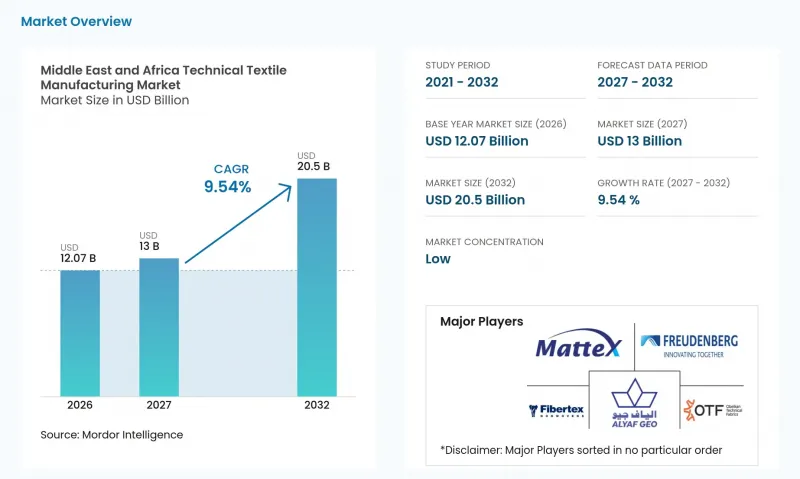
Middle East and Africa Technical Textile Manufacturing Market Trends and Insights
Mega-Project Infrastructure and Geosynthetics Demand
Saudi Arabia's major construction pipeline supports demand for geotextiles, geogrids, geomembranes, and geocomposites across large, complex development sites. These materials are used for erosion control, soil reinforcement, drainage, and containment during foundational works that must be performed under demanding site conditions. Aramco reported 67% local procurement across its supply base at its 2025 IKTVA conference, which reflects the greater importance of local sourcing in major procurement programs. The Middle East and Africa Technical Textile Manufacturing Market can benefit when domestic producers meet the required technical specifications, testing needs, and project qualification rules. Infrastructure programs therefore support both product volumes and local manufacturing capability, but suppliers must qualify early in the procurement process.
Healthcare Modernization and Medical Nonwovens
Healthcare investment supports demand for single-use medical textiles, including gowns, drapes, caps, wound-care materials, and protective barriers in clinical settings. New hospitals and surgical facilities require these materials repeatedly because they are not reused after procedures or patient care. Saudi German Nonwovens entered the medical segment in 2025 with its Ultramed brand, expanding its existing Saudi production base into clinical products. Saudi clinical requirements for single-use barrier materials establish a recurring need for products that meet defined performance standards and registration requirements. This gives the Middle East and Africa Technical Textile Manufacturing Market a stable demand base beyond construction activity and supports producers with dependable product quality.
Import Dependence for Advanced Fibers, Machinery and Finishes
Regional manufacturers depend on imported aramid, carbon fiber, specialty coatings, and PFAS-free finishes for higher-performance products. Spunbond and meltblown lines, precision coating systems, and technical looms also come mainly from established overseas equipment suppliers. This increases lead times, raises the imported-input value of finished materials, and limits the amount of value retained within the region. Cost measures can reduce some landed-cost pressure, but they do not replace missing upstream supply or specialized equipment capability. The Middle East and Africa Technical Textile Manufacturing Market will capture more value as domestic capability moves beyond conversion into specialized inputs and finishing.
Other drivers and restraints analyzed in the detailed report include:
- Oil, Gas, Mining and Industrial Safety Requirements
- Defense Localization and Protective Textile Procurement
- Certification and Specification Gaps Among Local Producers
For complete list of drivers and restraints, kindly check the Table Of Contents.
Segment Analysis
Synthetic fibers account for 75% of the Middle East and Africa Technical Textile Manufacturing Market size in 2026. Their leading position reflects access to polypropylene and polyester feedstocks from petrochemical complexes in Saudi Arabia, the United Arab Emirates, and Qatar. Polyester and polypropylene are used across geosynthetics, nonwovens, and industrial filtration. Their use across these applications links feedstock availability to several large demand pools rather than one specialized product line. Polyamide supports protective workwear and automotive textiles, while polyethylene, UHMWPE, and Aramid serve higher-performance protective applications. The material group remains important because the region has a direct feedstock advantage and broad demand across infrastructure and industrial uses.
Regenerated and other fibers are forecast to grow at a 10.5% CAGR from 2027 to 2032. Buyers increasingly seek verified sustainable fiber content and PFAS-free performance in specified applications. This creates a requirement for traceability and consistent performance, not simply a substitution of one fiber for another. Conductive and sensor-integrated fibers are also relevant to defense and medical uses. Natural fibers serve narrower roles in Agrotech, Packtech, and Hometech where biodegradability is required. Inorganic fibers such as glass, carbon, and basalt are used in structural composites and fire protection, but they remain largely imported because regional draw-tower capability is limited. This mix shows why the Middle East and Africa technical textile manufacturing industry must combine feedstock strength with access to specialized materials.
Complete Report Scope:
- By Material Type
- Natural Fiber
- Cotton
- Jute
- Others - Flax, Wool, Hemp, Coir, etc.
- Synthetic Fiber
- Polyester
- Polyamide / Nylon
- Polypropylene
- Polyethylene / UHMWPE
- Aramid and Other Specialty Synthetic Fibers
- Regenerated Fiber - Viscose, Lyocell, and Modal
- Inorganic Fibers (Glass, Carbon, Basalt, etc.)
- Others (Metallic, Conductive, and Other Specialty Fibers)
- Natural Fiber
- By Form and Structure
- Technical Yarns, Cords, and Rovings
- Woven Technical Textiles
- Nonwoven Technical Textiles
- Knitted Technical Textiles
- Braided Technical Textiles
- Other Engineered Textile Structures
- By Application
- Mobiltech - Automotive, Transportation, and Mobility
- Indutech - Industrial and Manufacturing Applications
- Buildtech - Building and Construction
- Medtech - Medical and Hygiene
- Protech - Personal and Property Protection
- Agrotech - Agriculture, Horticulture, Forestry, and Fishing
- Geotech - Geotextiles and Civil Engineering
- Packtech - Packaging and Containment
- Oekotech - Environmental Protection
- Hometech - Furniture, Floor Coverings, and Domestic Technical Applications
- Clothtech - Functional Components for Clothing and Footwear
- Sporttech - Sports and Leisure Applications
- By Geography
- Saudi Arabia
- United Arab Emirates
- Turkey
- South Africa
- Nigeria
- Qatar
- Kuwait
- Oman
- Iraq
- Rest of the Middle East and Africa (Bahrain, Jordan, Lebanon, Yemen, Syria, Palestine, etc.)
List of Companies Covered in this Report:
- Mattex Group
- ALYAF INDUSTRIAL COMPANY LTD.
- Obeikan Technical Fabrics
- FPC Industry
- TexoFib
- Exeed Geotextile
- Infrastructure Reinforcement Industrial Company
- Fibertex Nonwovens (Pty) Ltd
- Kaytech Engineered Fabrics
- Spunchem International
- PFNonwovens
- Freudenberg Performance Materials
- Ahlstrom
- Berry Global Group, Inc.
- DuPont de Nemours, Inc.
- Toray Industries, Inc.
- Mitsui Chemicals, Inc.
- Sioen Industries NV
- HUESKER Group
- Officine Maccaferri S.p.A.
- Solmax
Additional Benefits:
- The market estimate (ME) sheet in Excel format
- 3 months of analyst support
TABLE OF CONTENTS
1 INTRODUCTION
- 1.1 Study Assumptions and Market Definition
- 1.2 Scope of the Study
2 RESEARCH METHODOLOGY
3 EXECUTIVE SUMMARY
4 MARKET LANDSCAPE
- 4.1 Market Overview
- 4.2 Market Drivers
- 4.2.1 Mega-Project Infrastructure and Geosynthetics Demand
- 4.2.2 Healthcare Modernization and Medical Nonwovens
- 4.2.3 Oil, Gas, Mining, and Industrial Safety Requirements
- 4.2.4 Defense Localization and Protective Textile Procurement
- 4.2.5 Local-Content Policies and Import Substitution
- 4.2.6 Climate-Resilient Water, Coastal, and Waste Infrastructure
- 4.3 Market Restraints
- 4.3.1 Import Dependence for Advanced Fibers, Machinery, and Finishes
- 4.3.2 Certification and Specification Gaps Among Local Producers
- 4.3.3 High Energy, Water, and Chemical Intensity of Finishing
- 4.3.4 Uneven Technical-Textile Skills and Application Engineering
- 4.4 Value and Supply-Chain Analysis
- 4.4.1 Polymer, Fiber, and Additive Inputs
- 4.4.2 Spinning, Extrusion, and Yarn Formation
- 4.4.3 Weaving, Knitting, Braiding, and Nonwoven Formation
- 4.4.4 Coating, Lamination, Finishing, and Composite Integration
- 4.4.5 Testing, Certification, and Technical Specification
- 4.4.6 Distributors, EPC Contractors, and Project Procurement
- 4.5 Regulatory Landscape
- 4.5.1 Saudi Textile Product Regulation and Conformity Assessment
- 4.5.2 Nigeria Environmental Requirements for Textile Facilities
- 4.5.3 South Africa Cleaner Production and Textile-Sector Guidance
- 4.5.4 GCC Product, Fire, Building, and Civil-Engineering Requirements
- 4.5.5 Medical, PPE, Automotive, and Geosynthetic Standards
- 4.5.6 Chemical Restrictions, PFAS, Formaldehyde, Heavy Metals, and Restricted Dyes
- 4.6 Technological Outlook
- 4.6.1 High-Throughput Needle-Punching and Spunbond Lines
- 4.6.2 Coated Architectural Membranes and Structural Tensile Fabrics
- 4.6.3 Geocomposites, Geogrids, and Geosynthetic Clay Liners
- 4.6.4 Recycled, Bio-Based, and Mono-Material Technical Textiles
- 4.6.5 Digital Quality Control, Traceability and Predictive Maintenance
- 4.7 Industry and Supply-Chain Trends
- 4.7.1 Regionalization and Localization of Technical Textile Manufacturing
- 4.7.2 Supplier Consolidation and Vertical Integration
- 4.7.3 Capacity Expansion and Manufacturing Investment
- 4.7.4 Changing Procurement and Performance-Specification Requirements
- 4.7.5 Impact of Trade and Geopolitical Developments
- 4.8 Woven, Knitted, and Braided Manufacturing Technologies
- 4.8.1 High-Speed and Technical Weaving
- 4.8.2 3D Weaving
- 4.8.3 Warp and Weft Knitting
- 4.8.4 3D Knitting
- 4.9 Emerging Manufacturing Technologies
- 4.9.1 Nanotechnology and Nanofiber Structures
- 4.9.2 Additive and Digital Textile Manufacturing
- 4.9.3 Smart and Connected Textile Integration
- 4.9.4 Conductive and Sensor-Integrated Textiles
- 4.9.5 Automated Inspection and Quality Control
- 4.9.6 AI, Digital Manufacturing, and Industry 4.0
- 4.10 Sustainability and Circularity Landscape
- 4.10.1 Recycled Fiber Adoption
- 4.10.2 Bio-Based and Renewable Raw Materials
- 4.10.3 Textile-to-Textile Recycling
- 4.10.4 Mono-Material and Design-for-Recycling Approaches
- 4.10.5 PFAS-Free and Lower-Impact Functional Finishes
- 4.10.6 Waste Reduction and Manufacturing Resource Efficiency
- 4.10.7 Traceability and Sustainability Certification
- 4.11 Spotlight on High-Growth Technical Textile Applications
- 4.11.1 EV and Next-Generation Mobility Textiles
- 4.11.2 Advanced Filtration Materials
- 4.11.3 Medical and Healthcare Textiles
- 4.11.4 Protective and Defense Textiles
- 4.11.5 Infrastructure and Geosynthetics
- 4.11.6 Renewable-Energy and Environmental Applications
5 MARKET SIZE AND GROWTH FORECASTS
- 5.1 By Material Type
- 5.1.1 Natural Fiber
- 5.1.1.1 Cotton
- 5.1.1.2 Jute
- 5.1.1.3 Others - Flax, Wool, Hemp, Coir, etc.
- 5.1.2 Synthetic Fiber
- 5.1.2.1 Polyester
- 5.1.2.2 Polyamide / Nylon
- 5.1.2.3 Polypropylene
- 5.1.2.4 Polyethylene / UHMWPE
- 5.1.2.5 Aramid and Other Specialty Synthetic Fibers
- 5.1.3 Regenerated Fiber - Viscose, Lyocell, and Modal
- 5.1.4 Inorganic Fibers (Glass, Carbon, Basalt, etc.)
- 5.1.5 Others (Metallic, Conductive, and Other Specialty Fibers)
- 5.1.1 Natural Fiber
- 5.2 By Form and Structure
- 5.2.1 Technical Yarns, Cords, and Rovings
- 5.2.2 Woven Technical Textiles
- 5.2.3 Nonwoven Technical Textiles
- 5.2.4 Knitted Technical Textiles
- 5.2.5 Braided Technical Textiles
- 5.2.6 Other Engineered Textile Structures
- 5.3 By Application
- 5.3.1 Mobiltech - Automotive, Transportation, and Mobility
- 5.3.2 Indutech - Industrial and Manufacturing Applications
- 5.3.3 Buildtech - Building and Construction
- 5.3.4 Medtech - Medical and Hygiene
- 5.3.5 Protech - Personal and Property Protection
- 5.3.6 Agrotech - Agriculture, Horticulture, Forestry, and Fishing
- 5.3.7 Geotech - Geotextiles and Civil Engineering
- 5.3.8 Packtech - Packaging and Containment
- 5.3.9 Oekotech - Environmental Protection
- 5.3.10 Hometech - Furniture, Floor Coverings, and Domestic Technical Applications
- 5.3.11 Clothtech - Functional Components for Clothing and Footwear
- 5.3.12 Sporttech - Sports and Leisure Applications
- 5.4 By Geography
- 5.4.1 Saudi Arabia
- 5.4.2 United Arab Emirates
- 5.4.3 Turkey
- 5.4.4 South Africa
- 5.4.5 Nigeria
- 5.4.6 Qatar
- 5.4.7 Kuwait
- 5.4.8 Oman
- 5.4.9 Iraq
- 5.4.10 Rest of the Middle East and Africa (Bahrain, Jordan, Lebanon, Yemen, Syria, Palestine, etc.)
6 COMPETITIVE LANDSCAPE
- 6.1 Market Concentration
- 6.2 Strategic Moves
- 6.3 Market Share Analysis
- 6.4 Company Profiles (includes Global Level Overview, Market Level Overview, Core Segments, Financials as available, Strategic Information, Products and Services, Recent Developments)
- 6.4.1 Mattex Group
- 6.4.2 ALYAF INDUSTRIAL COMPANY LTD.
- 6.4.3 Obeikan Technical Fabrics
- 6.4.4 FPC Industry
- 6.4.5 TexoFib
- 6.4.6 Exeed Geotextile
- 6.4.7 Infrastructure Reinforcement Industrial Company
- 6.4.8 Fibertex Nonwovens (Pty) Ltd
- 6.4.9 Kaytech Engineered Fabrics
- 6.4.10 Spunchem International
- 6.4.11 PFNonwovens
- 6.4.12 Freudenberg Performance Materials
- 6.4.13 Ahlstrom
- 6.4.14 Berry Global Group, Inc.
- 6.4.15 DuPont de Nemours, Inc.
- 6.4.16 Toray Industries, Inc.
- 6.4.17 Mitsui Chemicals, Inc.
- 6.4.18 Sioen Industries NV
- 6.4.19 HUESKER Group
- 6.4.20 Officine Maccaferri S.p.A.
- 6.4.21 Solmax
7 MARKET OPPORTUNITIES AND FUTURE OUTLOOK
- 7.1 White-Space and Unmet-Need Assessment
- 7.1.1 Local Production of High-Specification Geosynthetics
- 7.1.2 Regional Medical and Hygiene Nonwoven Capacity
- 7.1.3 Heat-, Flame- and Chemical-Resistant Protective Textiles
- 7.1.4 Water, Desalination and Waste-Containment Textiles
- 7.1.5 Recycled Polymer and Circular Technical-Textile Platforms
- 7.1.6 Export Hubs and Regional Technical-Service Networks

