PUBLISHER: Mordor Intelligence | PRODUCT CODE: 2196782

PUBLISHER: Mordor Intelligence | PRODUCT CODE: 2196782
Data Center On-Site Power Generation - Market Share Analysis, Industry Trends & Statistics, Growth Forecasts (2027 - 2032)
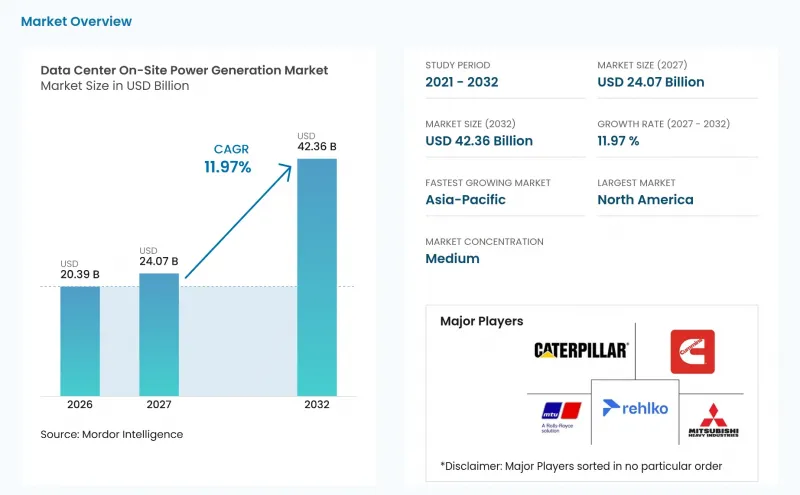
According to Mordor Intelligence, the data center On-Site power generation market size is projected to be USD 20.39 billion in 2026, USD 24.07 billion in 2027, and reach USD 42.36 billion by 2032, growing at a CAGR of 11.97% from 2027 to 2032.
Global Data Center On-Site Power Generation Market Trends and Insights
Delays in Utility Grid Connections and Power Availability
Grid interconnection delays have become a central reason for on-site generation in the Data Center On-Site Power Generation Market. The International Energy Agency stated that new transmission lines in advanced economies can take 4-8 years to build. The agency also reported that waiting times for critical grid components doubled during the 3 years before 2026. Schneider Electric noted that some US grid connection queues extend beyond a decade, which does not align with typical data center construction schedules. Operators are therefore selecting sites based more directly on available power, ahead of factors such as fiber access, land cost, and tax incentives. This shift increases the value of generation systems that can operate before full grid service is available.
Higher Power Demand From AI and High-Density Computing
AI workloads in the Data Center On-Site Power Generation Market consume more electricity than many traditional storage and enterprise computing loads. The International Energy Agency expects data center electricity demand to increase as AI adoption expands. Bloom Energy stated that AI data center infrastructure can cost USD 30-USD 50 per watt, making delayed power access a significant financial risk for project owners. The Data Center On-Site Power Generation Market benefits because developers require solutions that can be deployed alongside high-density facilities. Load fluctuations from training and inference systems also increase the need for flexible, responsive generation equipment. Dedicated systems can help operators meet these power requirements while transmission projects remain under development.
High Upfront Investment and Installation Costs
High installation costs can delay investment in power systems for the Data Center On-Site Power Generation Market. Engineering, procurement, and construction costs for gas turbine installations in the United States can be substantial. Fuel cells can have higher unit capital costs, although their operating profile can offset part of this difference over time. Smaller operators often rely on energy-as-a-service arrangements because these models reduce the initial capital requirement. Bridge power providers can also supply capacity as an operating expense rather than a large upfront purchase. This financing difference favors hyperscalers and cloud service providers with stronger balance sheets. It can also widen the adoption gap between large operators and smaller facilities in the Data Center On-Site Power Generation Market.
Other drivers and restraints analyzed in the detailed report include:
- Increasing Requirements for Uninterrupted Data Center Operations
- Adoption of Dedicated Gas-Fired Generation and Bridge Power
- Emissions Regulations and Environmental Permitting
For complete list of drivers and restraints, kindly check the Table Of Contents.
Segment Analysis
Diesel generator sets held 42.31% of the Data Center On-Site Power Generation Market share in 2026. Their position reflects established service networks, fast starts, and the ability to store fuel on site for emergency operation. Natural gas generator sets and reciprocating engines are gaining use for prime power and bridge power applications. Caterpillar and Cummins are directing significant capacity toward data center demand for natural gas generation equipment. Gas turbines from Solar Turbines, MAN Energy Solutions, and Wartsila serve larger facilities that need continuous operation and fuel flexibility.
Fuel cells are expected to register a 13.17% CAGR through 2032. Bloom Energy expanded its agreement with Oracle in April 2026 for up to 2.8 GW of solid-oxide fuel cell capacity, with 1.2 GW contracted and deployment underway. Bloom Energy stated that the first system was delivered in 55 days, ahead of a 90-day schedule. INNIO completed a 3 MW demonstration of 100% hydrogen-fueled backup power in April 2026. This supports the potential role of hydrogen-capable engines alongside fuel cells as fuel infrastructure develops.
The 5-20 MW band accounted for 33.83% of installed capacity in the Data Center On-Site Power Generation Market in 2026. This range serves large colocation facilities and cloud campuses that built their on-site power systems around the scale of prior data center development. The below-1 MW category supports edge nodes and smaller facilities where compact fuel cells and containerized gas generator sets can fit on constrained sites. The 1-5 MW band serves mid-market colocation providers and enterprise facilities. These operators can combine distributed generation with battery storage in hybrid power arrangements.
The above 20 MW category is projected to expand at a 12.76% CAGR through 2032. Wartsila announced a 282 MW US data center power order in October 2026 using 15 Wartsila 50SG engines. The order demonstrates the larger project sizes entering the Data Center On-Site Power Generation Market. Framework agreements are also replacing site-by-site procurement for some hyperscale buyers. This approach rewards manufacturers with available production capacity and experience delivering equipment over several years.
Complete Report Scope:
- By Generation Technology
- Diesel Generator Sets
- Natural Gas Generator Sets
- Gas Turbines
- Reciprocating Gas Engines
- Fuel Cells
- Other Generation Technologies
- By Installed Generation Capacity
- Below 1 MW
- 1-5 MW
- Above 5-20 MW
- Above 20 MW
- By Fuel Type
- Diesel
- Natural Gas
- Renewable Fuels and Biogas
- Hydrogen and Hydrogen Blends
- Other Fuel Types
- By Application
- Emergency Backup Power
- Prime Power
- Continuous Power
- Temporary and Bridge Power
- By Data Center Size
- Small
- Medium
- Large
- Hyperscale
- By Data Center Type
- Colocation
- Cloud Service Providers (CSPs)
- Enterprise and Edge
- By Geography
- North America
- United States
- Canada
- Mexico
- South America
- Brazil
- Chile
- Colombia
- Argentina
- Peru
- Rest of South America
- Europe
- United Kingdom
- Germany
- France
- Ireland
- Netherlands
- Spain
- Italy
- Finland
- Sweden
- Rest of Europe
- Middle East and Africa
- Saudi Arabia
- United Arab Emirates
- South Africa
- Israel
- Egypt
- Rest of Middle East and Africa
- Asia-Pacific
- China
- India
- Japan
- Australia
- Singapore
- South Korea
- Malaysia
- Indonesia
- Rest of Asia-Pacific
- North America
Geography Analysis
North America held 43.22% of the Data Center On-Site Power Generation Market share in 2026. The region has a large concentration of hyperscaler and colocation capacity. Caterpillar announced a USD 725 million expansion of its Lafayette engine facility in 2025, which is set to more than double output by 2027. This environment supports Data Center On-Site Power Generation Market suppliers capable of delivering natural gas, diesel, and lower-emission alternatives.
Asia-Pacific is projected to expand at a 12.98% CAGR through 2032. The region is experiencing cloud and AI build-outs across China, India, Southeast Asia, Japan, and other markets. Aggreko Japan began its domestic bridging power service in November 2025, citing grid connection delays of more than 5 years. Topco Group and Bloom Energy installed a 2.6-MW solid-oxide fuel cell system at a data center in Miaoli, Taiwan, in May 2026. South America remains the smallest geographic segment, with Brazil representing the region's more developed data center base.
Europe faces significant power constraints alongside strong decarbonization requirements, creating a challenging operating environment for data center development and expansion. These conditions are increasing interest in cleaner and more reliable alternatives to conventional backup power solutions. Equinix's Dublin hydrogen pilot demonstrates the region's growing interest in hydrogen-based power systems as an alternative to diesel generation, particularly for supporting data center resilience while reducing emissions. The International Energy Agency identified Saudi Arabia's target of 1.9 GW of data center capacity by 2030 and 6.6 GW by 2034, reflecting the country's planned expansion of digital infrastructure. Meanwhile, the United Arab Emirates has agreements for 5 GW of AI data center capacity, underscoring the scale of planned AI-focused data center development in the region.
- Caterpillar
- Cummins
- Rolls-Royce Power Systems (MTU)
- Rehlko
- Generac Power Systems
- Wartsila
- Mitsubishi Power
- Solar Turbines
- Baker Hughes
- MAN Energy Solutions
- INNIO
- 2G Energy
- Bloom Energy
- FuelCell Energy
- Bosch
- Mitsubishi Heavy Industries
- Doosan Enerbility
- Atlas Copco
- Aggreko
- APR Energy
Additional Benefits:
- The market estimate (ME) sheet in Excel format
- 3 months of analyst support
TABLE OF CONTENTS
1 INTRODUCTION
- 1.1 Study Assumptions and Market Definition
- 1.2 Scope of the Study
2 RESEARCH METHODOLOGY
3 EXECUTIVE SUMMARY
4 MARKET LANDSCAPE
- 4.1 Market Overview
- 4.2 Market Drivers
- 4.2.1 Delays in utility grid connections and power availability
- 4.2.2 Higher power demand from AI and high-density computing
- 4.2.3 Increasing requirements for uninterrupted data center operations
- 4.2.4 Adoption of dedicated gas-fired generation and bridge power
- 4.2.5 Demand for energy independence and greater control over supply
- 4.2.6 Growth of fuel cells and lower-carbon on-site generation technologies
- 4.3 Market Restraints
- 4.3.1 High upfront investment and installation costs
- 4.3.2 Emissions regulations and environmental permitting
- 4.3.3 Natural gas availability and fuel infrastructure constraints
- 4.3.4 Noise, land, and local environmental restrictions
- 4.4 Generation Technology Trends
- 4.5 Fuel Availability and Emissions Landscape
- 4.6 Regulatory and Environmental Requirements
- 4.7 Porter's Five Forces Analysis
- 4.7.1 Threat of New Entrants
- 4.7.2 Bargaining Power of Suppliers
- 4.7.3 Bargaining Power of Buyers
- 4.7.4 Threat of Substitutes
- 4.7.5 Competitive Rivalry
5 MARKET SIZE AND GROWTH FORECAST (VALUE AND VOLUME)
- 5.1 By Generation Technology
- 5.1.1 Diesel Generator Sets
- 5.1.2 Natural Gas Generator Sets
- 5.1.3 Gas Turbines
- 5.1.4 Reciprocating Gas Engines
- 5.1.5 Fuel Cells
- 5.1.6 Other Generation Technologies
- 5.2 By Installed Generation Capacity
- 5.2.1 Below 1 MW
- 5.2.2 1-5 MW
- 5.2.3 Above 5-20 MW
- 5.2.4 Above 20 MW
- 5.3 By Fuel Type
- 5.3.1 Diesel
- 5.3.2 Natural Gas
- 5.3.3 Renewable Fuels and Biogas
- 5.3.4 Hydrogen and Hydrogen Blends
- 5.3.5 Other Fuel Types
- 5.4 By Application
- 5.4.1 Emergency Backup Power
- 5.4.2 Prime Power
- 5.4.3 Continuous Power
- 5.4.4 Temporary and Bridge Power
- 5.5 By Data Center Size
- 5.5.1 Small
- 5.5.2 Medium
- 5.5.3 Large
- 5.5.4 Hyperscale
- 5.6 By Data Center Type
- 5.6.1 Colocation
- 5.6.2 Cloud Service Providers (CSPs)
- 5.6.3 Enterprise and Edge
- 5.7 By Geography
- 5.7.1 North America
- 5.7.1.1 United States
- 5.7.1.2 Canada
- 5.7.1.3 Mexico
- 5.7.2 South America
- 5.7.2.1 Brazil
- 5.7.2.2 Chile
- 5.7.2.3 Colombia
- 5.7.2.4 Argentina
- 5.7.2.5 Peru
- 5.7.2.6 Rest of South America
- 5.7.3 Europe
- 5.7.3.1 United Kingdom
- 5.7.3.2 Germany
- 5.7.3.3 France
- 5.7.3.4 Ireland
- 5.7.3.5 Netherlands
- 5.7.3.6 Spain
- 5.7.3.7 Italy
- 5.7.3.8 Finland
- 5.7.3.9 Sweden
- 5.7.3.10 Rest of Europe
- 5.7.4 Middle East and Africa
- 5.7.4.1 Saudi Arabia
- 5.7.4.2 United Arab Emirates
- 5.7.4.3 South Africa
- 5.7.4.4 Israel
- 5.7.4.5 Egypt
- 5.7.4.6 Rest of Middle East and Africa
- 5.7.5 Asia-Pacific
- 5.7.5.1 China
- 5.7.5.2 India
- 5.7.5.3 Japan
- 5.7.5.4 Australia
- 5.7.5.5 Singapore
- 5.7.5.6 South Korea
- 5.7.5.7 Malaysia
- 5.7.5.8 Indonesia
- 5.7.5.9 Rest of Asia-Pacific
- 5.7.1 North America
6 COMPETITIVE LANDSCAPE
- 6.1 Market Concentration Analysis
- 6.2 Technology and Fuel Strategy Developments
- 6.3 Strategic Partnerships and Project Deployments
- 6.4 Competitive Positioning
- 6.5 Company Profiles (includes Global Level Overview, Market Level Overview, Core Segments, Financials as available, Strategic Information, Market Rank/Share, Products and Services, Recent Developments)
- 6.5.1 Caterpillar
- 6.5.2 Cummins
- 6.5.3 Rolls-Royce Power Systems (MTU)
- 6.5.4 Rehlko
- 6.5.5 Generac Power Systems
- 6.5.6 Wartsila
- 6.5.7 Mitsubishi Power
- 6.5.8 Solar Turbines
- 6.5.9 Baker Hughes
- 6.5.10 MAN Energy Solutions
- 6.5.11 INNIO
- 6.5.12 2G Energy
- 6.5.13 Bloom Energy
- 6.5.14 FuelCell Energy
- 6.5.15 Bosch
- 6.5.16 Mitsubishi Heavy Industries
- 6.5.17 Doosan Enerbility
- 6.5.18 Atlas Copco
- 6.5.19 Aggreko
- 6.5.20 APR Energy
7 MARKET OUTLOOK AND FUTURE TRENDS
- 7.1 Growth of On-Site Generation as Bridge Power
- 7.2 Adoption of Natural Gas Engines and Turbines for Large
- 7.3 Expansion of Fuel Cell Deployments
- 7.4 Development of Lower-Emission and Hydrogen-Ready Generation Systems
- 7.5 Integration of On-Site Generation with Grid and Backup Systems
- 7.6 Emerging Opportunities in Markets Facing Grid Capacity Constraints

