PUBLISHER: Mordor Intelligence | PRODUCT CODE: 2196887

PUBLISHER: Mordor Intelligence | PRODUCT CODE: 2196887
Grid Connected PV Systems - Market Share Analysis, Industry Trends & Statistics, Growth Forecasts (2027 - 2032)
According to Mordor Intelligence, the grid connected PV systems market size in terms of installed base was valued at 3.49 terawatt in 2026 and is estimated to grow from 4.05 terawatt in 2027 to reach 14.62 terawatt by 2032, at a CAGR of 29.27% during the forecast period (2027-2032).
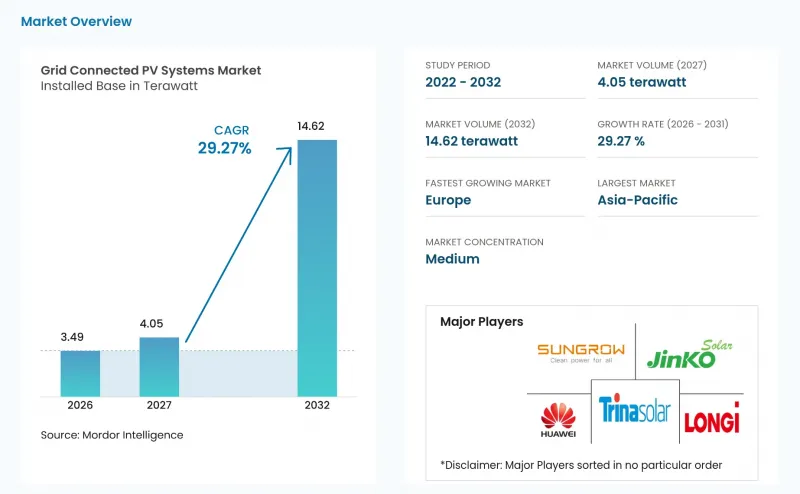
Global Grid Connected PV Systems Market Trends and Insights
Declining Levelized Cost and Rapid PV Deployment
Solar PV remained one of the lowest-cost options for new power generation in 2025. The International Renewable Energy Agency (IRENA) reported a global weighted-average solar PV cost of USD 44 per MWh in 2025, which was 41% below the lowest-cost new fossil-fuel alternative. The grid-connected PV systems market continues to benefit from this cost position, as public and private buyers can procure solar with a clearer long-term cost case. IRENA also reported that 91% of newly commissioned utility-scale renewable projects in 2024 produced electricity below the cost of the cheapest new fossil-fuel alternative. Hardware costs continued to decline between 2024 and 2025, but financing costs offset part of those gains. Future cost improvements will depend more on financing conditions, grid connection access, and project design, particularly in markets where risk premiums remain high.
Renewable-Energy Targets and Decarbonization Procurement
National renewable energy targets continue to translate broad policy commitments into procurement pipelines for the grid-connected PV systems market. The EU's Renewable Energy Directive III introduced time limits for permitting and measures intended to accelerate interconnection. However, permitting delays in several EU member states still exceeded two years and reached four years in some cases. India's 500 GW non-fossil power target for 2030 has also supported a large solar procurement pipeline. The IEA Photovoltaic Power Systems (PVPS) program reported that India commissioned approximately 32 GW of solar in 2024 and reached 124.6 GW of cumulative PV capacity. More structured procurement programs support longer offtake contracts and more rigorous storage and reliability terms, favoring developers with integrated delivery capabilities.
Transmission Congestion, Curtailment, and Negative Pricing
Transmission capacity has become a material constraint on the grid-connected PV systems market. India curtailed 8,133 GWh of solar power in the April to June 2026 quarter because transmission infrastructure lagged generation additions. Analysis also identified nearly 300 GWh of transmission-related curtailment in Indian interstate projects during the first quarter of 2026. California curtailed 4.5 million MWh in the first half of 2026, exceeding the full-year curtailment recorded in 2025. Curtailment reduces expected output and can weaken project revenue forecasts. It also raises the value of storage, flexible connection agreements, transmission expansion, and operating systems that can respond to grid conditions.
Other drivers and restraints analyzed in the detailed report include:
- Corporate PPAs and Industrial Electrification
- Distributed Solar and Self-Consumption Economics
- Interconnection Queues and Permitting Delays
For complete list of drivers and restraints, kindly check the Table Of Contents.
Segment Analysis
Centralized and utility-scale PV held 58.4% of the grid-connected PV systems market share in 2026. Large procurement programs, institutional PPAs, and auction structures support this position by enabling capacity contracting at scale. IEA PVPS reported approximately 410 GW of new utility-scale solar additions in 2025, representing nearly 59% of global additions. These systems remain central to public utility procurement and large corporate offtake arrangements. Their development outlook is closely tied to transmission capacity, land access, and the availability of grid connection rights.
Distributed PV systems are forecast to grow at a 29.8% CAGR from 2027 to 2032. Rooftop mandates, self-consumption economics, and integration with battery storage and electric-vehicle charging support this growth. China's controllability requirements place distributed assets within an operating model that supports demand response and ancillary services. The two system types serve different purposes: centralized projects focus on large-volume generation, while distributed systems are positioned closer to end users. The grid-connected PV systems market therefore requires both large project execution capability and local installation capability.
Solar PV modules represented 49.2% of component revenue in 2026 and are forecast to grow at a 29.5% CAGR through 2032. Modules remain the core electricity-generating element in every project, which explains their large share of the grid-connected PV systems market. Sustained manufacturing overcapacity continues to pressure module pricing. At the same time, component requirements are moving beyond basic module supply toward performance documentation and equipment compatibility. As a result, module selection depends on reliability, power output, warranties, and compliance, in addition to purchase price.
Trackers, inverters, mounting systems, cables, connectors, and switchgear each serve distinct roles in project performance and grid compliance. Trackers and inverters are areas where software-based optimization, terrain adaptation, and predictive maintenance can preserve value more effectively than commoditized hardware. Inverter requirements are becoming more important as grids incorporate more inverter-based generation. The IEC 61724 performance-monitoring standard and IEEE 2800 grid-connection requirements shape procurement specifications. These conditions make component integration important for the grid-connected PV systems market, particularly for developers seeking stable yields and compliant connection performance.
Complete Report Scope:
- By System Type
- Distributed PV Systems
- Centralized/Utility-Scale PV Systems
- By Component
- Solar PV Modules
- Inverters
- Mounting Structures
- Solar Trackers
- DC Cables and Connectors
- AC Cables and Switchgear
- Other Components
- By Installation
- Rooftop PV
- Ground-Mounted PV
- Building-Integrated PV (BIPV)
- Carport PV
- Floating PV
- Infrastructure-Integrated PV
- By End Use
- Residential
- Commercial
- Industrial
- Utility
- By Capacity
- Up to 10 kW
- 10-100 kW
- 100 kW-1 MW
- 1-10 MW
- 10-50 MW
- Above 50 MW
- By Geography
- North America
- United States
- Canada
- Mexico
- Europe
- Germany
- France
- Italy
- Spain
- United Kingdom
- Poland
- Russia
- Rest of Europe
- Asia-Pacific
- China
- India
- Japan
- South Korea
- Australia
- Indonesia
- Vietnam
- Thailand
- Rest of Asia-Pacific
- South America
- Brazil
- Argentina
- Chile
- Rest of South America
- Middle East and Africa
- Saudi Arabia
- United Arab Emirates
- Egypt
- South Africa
- Morocco
- Rest of Middle East and Africa
- North America
Geography Analysis
Asia-Pacific held 59.4% of the grid-connected PV systems market share in 2026. China accounted for about 415 GW of the nearly 698 GW installed globally that year, supported by its domestic supply chain and deployment scale. India added substantial capacity but faced a gap between project commissioning and transmission availability. Vietnam, Indonesia, Thailand, Australia, and South Korea broadened deployment beyond China and India. Grid readiness remained a key regional issue.
Europe is forecast to grow at a 30.5% CAGR from 2027 to 2032. The region added 65.7 GW in 2025 and reached 406 GW of cumulative capacity, according to IEA PVPS. Germany, France, Spain, Italy, and Poland led national additions. The Energy Performance of Buildings Directive (EPBD) creates a more predictable route for solar deployment on qualifying new buildings. Slower rooftop adoption following subsidy changes and longer permitting processes could limit part of the regional opportunity.
North America combines high electricity demand with long project queues. The United States added 43.2 GW in 2025 and is expected to add 43.4 GW of utility-scale solar in 2026. Mexico and Canada provide additional commercial and industrial demand opportunities. In the Middle East and Africa, Saudi Arabia, the United Arab Emirates, Egypt, South Africa, and Morocco lead national programs. Nextpower Arabia's contract to supply 2.25 GW of trackers for the Bisha Solar project illustrates the scale of Saudi procurement.
- Trina Solar Co., Ltd.
- JinkoSolar Holding Co., Ltd.
- Canadian Solar Inc.
- First Solar, Inc.
- Hanwha Q CELLS Co., Ltd.
- SMA Solar Technology AG
- ABB Ltd.
- Schneider Electric SE
- Huawei Technologies Co., Ltd.
- SolarEdge Technologies, Inc.
- JA Solar Technology Co., Ltd.
- Delta Electronics, Inc.
- SunPower Corporation
- Sungrow Power Supply Co., Ltd.
- LONGi Green Energy Technology Co., Ltd.
- Enphase Energy, Inc.
- Fronius International GmbH
- Sineng Electric Co., Ltd.
- Growatt New Energy Technology Co., Ltd.
- Nextracker Inc.
- Array Technologies, Inc.
Additional Benefits:
- The market estimate (ME) sheet in Excel format
- 3 months of analyst support
TABLE OF CONTENTS
1 INTRODUCTION
- 1.1 Study Assumptions and Market Definition
- 1.2 Scope of the Study
2 RESEARCH METHODOLOGY
3 EXECUTIVE SUMMARY
4 MARKET LANDSCAPE
- 4.1 Market Overview
- 4.2 Market Drivers
- 4.2.1 Declining Levelized Cost and Rapid PV Deployment
- 4.2.2 Renewable-Energy Targets and Decarbonization Procurement
- 4.2.3 Corporate PPAs and Industrial Electrification
- 4.2.4 Distributed Solar and Self-Consumption Economics
- 4.2.5 Smart Inverter and Grid-Modernization Investment
- 4.2.6 Data-Center and Load-Growth Demand for Firmed Solar
- 4.3 Market Restraints
- 4.3.1 Transmission Congestion, Curtailment, and Negative Pricing
- 4.3.2 Interconnection Queues and Permitting Delays
- 4.3.3 Tariff, Subsidy, and Local-Content Uncertainty
- 4.3.4 Inverter-Dominated Grid Stability and Cybersecurity Requirements
- 4.4 Supply-Chain Analysis
- 4.5 Porter's Five Forces Analysis
- 4.5.1 Bargaining Power of Suppliers
- 4.5.2 Bargaining Power of Buyers
- 4.5.3 Threat of New Entrants
- 4.5.4 Threat of Substitutes
- 4.5.5 Competitive Rivalry
- 4.6 Technology Outlook
- 4.7 Regulatory Landscape
- 4.8 Investment Analysis
5 MARKET SIZE AND GROWTH FORECASTS
- 5.1 By System Type
- 5.1.1 Distributed PV Systems
- 5.1.2 Centralized/Utility-Scale PV Systems
- 5.2 By Component
- 5.2.1 Solar PV Modules
- 5.2.2 Inverters
- 5.2.3 Mounting Structures
- 5.2.4 Solar Trackers
- 5.2.5 DC Cables and Connectors
- 5.2.6 AC Cables and Switchgear
- 5.2.7 Other Components
- 5.3 By Installation
- 5.3.1 Rooftop PV
- 5.3.2 Ground-Mounted PV
- 5.3.3 Building-Integrated PV (BIPV)
- 5.3.4 Carport PV
- 5.3.5 Floating PV
- 5.3.6 Infrastructure-Integrated PV
- 5.4 By End Use
- 5.4.1 Residential
- 5.4.2 Commercial
- 5.4.3 Industrial
- 5.4.4 Utility
- 5.5 By Capacity
- 5.5.1 Up to 10 kW
- 5.5.2 10-100 kW
- 5.5.3 100 kW-1 MW
- 5.5.4 1-10 MW
- 5.5.5 10-50 MW
- 5.5.6 Above 50 MW
- 5.6 By Geography
- 5.6.1 North America
- 5.6.1.1 United States
- 5.6.1.2 Canada
- 5.6.1.3 Mexico
- 5.6.2 Europe
- 5.6.2.1 Germany
- 5.6.2.2 France
- 5.6.2.3 Italy
- 5.6.2.4 Spain
- 5.6.2.5 United Kingdom
- 5.6.2.6 Poland
- 5.6.2.7 Russia
- 5.6.2.8 Rest of Europe
- 5.6.3 Asia-Pacific
- 5.6.3.1 China
- 5.6.3.2 India
- 5.6.3.3 Japan
- 5.6.3.4 South Korea
- 5.6.3.5 Australia
- 5.6.3.6 Indonesia
- 5.6.3.7 Vietnam
- 5.6.3.8 Thailand
- 5.6.3.9 Rest of Asia-Pacific
- 5.6.4 South America
- 5.6.4.1 Brazil
- 5.6.4.2 Argentina
- 5.6.4.3 Chile
- 5.6.4.4 Rest of South America
- 5.6.5 Middle East and Africa
- 5.6.5.1 Saudi Arabia
- 5.6.5.2 United Arab Emirates
- 5.6.5.3 Egypt
- 5.6.5.4 South Africa
- 5.6.5.5 Morocco
- 5.6.5.6 Rest of Middle East and Africa
- 5.6.1 North America
6 COMPETITIVE LANDSCAPE
- 6.1 Market Concentration
- 6.2 Strategic Moves
- 6.3 Market Share Analysis
- 6.4 Company Profiles (includes Global Level Overview, Market Level Overview, Core Segments, Financials as available, Strategic Information, Market Rank/Share, Products and Services, Recent Developments)
- 6.4.1 Trina Solar Co., Ltd.
- 6.4.2 JinkoSolar Holding Co., Ltd.
- 6.4.3 Canadian Solar Inc.
- 6.4.4 First Solar, Inc.
- 6.4.5 Hanwha Q CELLS Co., Ltd.
- 6.4.6 SMA Solar Technology AG
- 6.4.7 ABB Ltd.
- 6.4.8 Schneider Electric SE
- 6.4.9 Huawei Technologies Co., Ltd.
- 6.4.10 SolarEdge Technologies, Inc.
- 6.4.11 JA Solar Technology Co., Ltd.
- 6.4.12 Delta Electronics, Inc.
- 6.4.13 SunPower Corporation
- 6.4.14 Sungrow Power Supply Co., Ltd.
- 6.4.15 LONGi Green Energy Technology Co., Ltd.
- 6.4.16 Enphase Energy, Inc.
- 6.4.17 Fronius International GmbH
- 6.4.18 Sineng Electric Co., Ltd.
- 6.4.19 Growatt New Energy Technology Co., Ltd.
- 6.4.20 Nextracker Inc.
- 6.4.21 Array Technologies, Inc.
7 MARKET OPPORTUNITIES AND FUTURE OUTLOOK
- 7.1 White-Space and Unmet-Need Assessment

