PUBLISHER: Mordor Intelligence | PRODUCT CODE: 2196928

PUBLISHER: Mordor Intelligence | PRODUCT CODE: 2196928
Telecom Cooling Optimization - Market Share Analysis, Industry Trends & Statistics, Growth Forecasts (2027 - 2032)
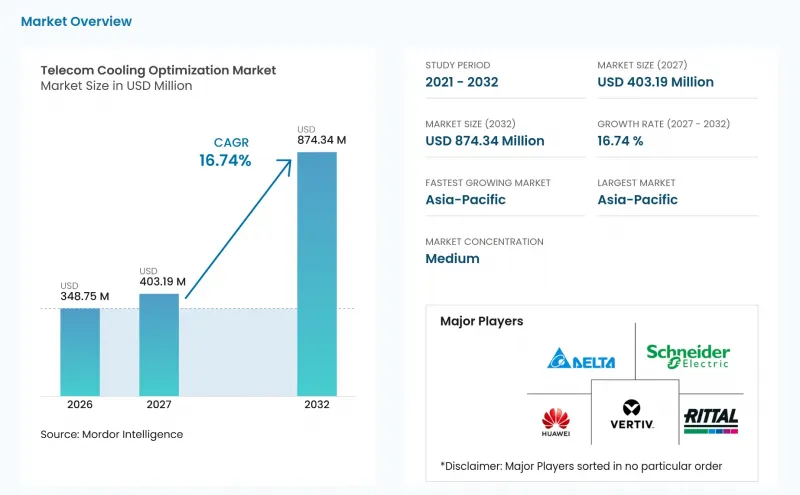
According to Mordor Intelligence, the telecom cooling optimization market size was valued at USD 348.75 million in 2026 and is estimated to expand from USD 407.13 million in 2027 to reach USD 874.34 million by 2032, at a CAGR of 16.74% during the forecast period (2027-2032).
Global Telecom Cooling Optimization Market Trends and Insights
5G Network Densification and Rising Thermal Loads
The Telecom cooling optimization market is gaining support as 5G equipment creates more concentrated heat loads than earlier network equipment. A 2025 study reported average power use of 3,000-5,000 W for a single 5G base station unit and local heat flux of 80-120 W/cm2. The same study found that a 10°C increase in chip temperature raised failure rates by 25% and reduced component life by more than 30%. These conditions make cooling performance relevant to network availability and operating costs. ITU-T L.1326 sets out requirements and use cases for liquid cooling and other high-efficiency cooling solutions for 5G baseband units in centralized RAN deployments. The Telecom cooling optimization market therefore benefits when operators need to reduce equipment failures across large estates of unattended sites.
Growth of Edge Computing and Distributed RAN
Edge computing adds thermal demands at sites that often have limited power capacity, fewer technicians, and less sophisticated cooling equipment. Distributed RAN deployments place more compute resources outside central offices, which increases the need for compact thermal systems. A 2025 review of base-station thermal management identified distributed architectures as a setting where legacy cooling designs are under pressure. A cooling failure at a remote site can also require an unplanned field visit, increasing the cost of maintaining network availability. The Telecom cooling optimization market can address this need through enclosed, self-contained systems that require minimal site intervention. These requirements favor solutions designed for variable outdoor conditions and continuous monitoring.
High Retrofit and Integration Costs
Existing telecom sites were usually designed around air cooling, so a liquid or hybrid retrofit can require changes to piping, power feeds, cabinet layouts, and structural loading. These changes make an upgrade more expensive than a greenfield installation. The Telecom cooling optimization market is affected because operators often manage sites built to different civil and mechanical specifications. Tower companies face an additional challenge because they may fund thermal upgrades while tenants capture the main network reliability benefit. The GSMA identifies shared infrastructure as a material area requiring action in telecom decarbonization planning. Reporting requirements can increase the case for upgrades, but they do not resolve how multi-tenant retrofit costs should be allocated.
Other drivers and restraints analyzed in the detailed report include:
- Network Energy Efficiency and Carbon Reduction Targets
- Remote Monitoring and AI-Based Thermal Optimization
- Limited Availability of Skilled Thermal Engineering and Field Service Personnel
For complete list of drivers and restraints, kindly check the Table Of Contents.
Segment Analysis
Hardware is projected to account for 41.22% of the telecom cooling optimization market in 2026, as site upgrades require physical equipment. Precision cooling units, coolant distribution units, heat exchangers, and cabinet enclosures remain essential for upgrades at 5G base stations, centralized RAN halls, and telecom-adjacent data centers. These products represent a significant share of capital expenditure because they directly manage heat at the equipment level. Services include commissioning, maintenance contracts, and managed thermal operations. The telecom cooling optimization market will continue to require these services as operators transfer technical responsibility to specialized vendors.
Software is projected to expand at a CAGR of 17.32% through 2032, the fastest growth rate among solution components. AI-based platforms can adjust cooling settings according to traffic loads, ambient conditions, and equipment telemetry. Documented deployments have reduced cooling energy consumption by up to 20%, strengthening the operational case for software investment. NTT and Nokia are expected to deploy a multi-vendor platform with Indosat Ooredoo Hutchison in 2025 to manage network energy without upfront capital expenditure. The telecom cooling optimization industry is moving toward integrated systems that combine instrumented equipment with analytics, as hardware generates the data required by optimization platforms.
Complete Report Scope:
- By Solution Component
- Hardware
- Software
- Services
- By Cooling Technology
- Air Cooling
- Liquid Cooling
- Phase-Change Cooling
- Thermoelectric Cooling
- Hybrid Cooling
- By End User
- Mobile Network Operators
- Tower Companies
- Telecom Equipment Manufacturers
- Data Center Operators
- Enterprise Private 5G Networks
- Government, Defense, and Public-Safety Networks
- By Geography
- North America
- United States
- Canada
- Mexico
- South America
- Brazil
- Argentina
- Rest of South America
- Europe
- Germany
- France
- United Kingdom
- Italy
- Spain
- Rest of Europe
- Asia-Pacific
- China
- Japan
- India
- South Korea
- Australia
- Rest of Asia-Pacific
- Middle East
- Saudi Arabia
- United Arab Emirates
- Rest of Middle East
- Africa
- South Africa
- Nigeria
- Rest of Africa
- North America
Geography Analysis
North America and Europe are capital-intensive markets for telecom cooling optimization, driven by mature 5G networks and stringent energy compliance requirements. The United States is deploying standalone 5G networks and AI-capable infrastructure, increasing thermal loads in telecom data centers. Cross-border supply chain investments support the Canadian market, while Mexico is generating greenfield demand for cooling solutions as its 5G infrastructure expands. In Europe, the Energy Efficiency Directive and Regulation (EU) 2024/573 on fluorinated gases are increasing the demand for low-GWP refrigerants and energy-efficient cooling systems.
Asia-Pacific is projected to account for 30.34% of regional market value in 2026 and expand at a CAGR of 18.78% through 2032. China has dense 5G infrastructure, and China Mobile attributes more than 30% of radio access network energy consumption to cooling. India is expanding its telecom networks while pursuing lower sector emissions and greater use of renewable electricity. South Korean operators are validating liquid-cooling technologies for AI data centers, strengthening demand for high-density thermal management equipment. Japan, Australia, Southeast Asia, and South Asia are expected to drive additional demand as network operators transition from air cooling to hybrid and liquid cooling configurations.
South America, the Middle East, and Africa present distinct conditions for the telecom cooling optimization market. Brazil and Argentina are expanding infrastructure through 5G spectrum and network deployment programs. Saudi Arabia and the United Arab Emirates experience high ambient temperatures, which increase the operating costs of conventional air-cooling systems and drive interest in free-cooling and hybrid designs. South Africa and Nigeria are key African markets, where cooling can account for 30-50% of tower energy consumption; however, capital constraints continue to limit deployment.
- Vertiv Group Corp.
- Schneider Electric SE
- Delta Electronics, Inc.
- Huawei Technologies Co., Ltd.
- STULZ GmbH
- Rittal GmbH & Co. KG
- Johnson Controls International plc
- Eaton Corporation plc
- Mitsubishi Electric Corporation
- Daikin Industries, Ltd.
- Danfoss A/S
- nVent Electric plc
- Canovate Group
- Eltek AS
- Shenzhen Envicool Technology Co., Ltd.
- Airsys Refrigeration Engineering Technology Co., Ltd.
- CoolIT Systems, Inc.
- Iceotope Technologies Limited
- LiquidStack Limited
- Submer Technologies S.L.
- Asetek A/S
- Boyd Corporation
Additional Benefits:
- The market estimate (ME) sheet in Excel format
- 3 months of analyst support
TABLE OF CONTENTS
1 INTRODUCTION
- 1.1 Study Assumptions and Market Definition
- 1.2 Scope of the Study
2 RESEARCH METHODOLOGY
3 EXECUTIVE SUMMARY
4 MARKET LANDSCAPE
- 4.1 Market Overview
- 4.2 Market Drivers
- 4.2.1 5G Network Densification and Rising Thermal Loads
- 4.2.2 Growth of Edge Computing and Distributed RAN
- 4.2.3 Network Energy-Efficiency and Carbon-Reduction Targets
- 4.2.4 Increasing Adoption of Remote Monitoring and AI-Based Thermal Optimization
- 4.2.5 Cabinet-Level Cooling Optimization for Unattended Sites
- 4.2.6 High-Density C-RAN Baseband Deployments Reaching Air-Cooling Limits
- 4.3 Market Restraints
- 4.3.1 High Retrofit and Integration Costs
- 4.3.2 Limited Availability of Skilled Thermal-Engineering and Field-Service Personnel
- 4.3.3 Liquid-Coolant Safety, Leakage, and End-of-Life Compliance
- 4.3.4 Fragmented Site Telemetry and Multivendor Interoperability
- 4.4 Impact of Macroeconomic Factors on the Market
- 4.5 Industry Value Chain Analysis
- 4.6 Regulatory Landscape
- 4.7 Technological Outlook
- 4.8 Porter's Five Forces Analysis
- 4.8.1 Bargaining Power of Suppliers
- 4.8.2 Bargaining Power of Buyers
- 4.8.3 Threat of New Entrants
- 4.8.4 Threat of Substitutes
- 4.8.5 Competitive Rivalry
5 MARKET SIZE AND GROWTH FORECASTS (VALUE)
- 5.1 By Solution Component
- 5.1.1 Hardware
- 5.1.2 Software
- 5.1.3 Services
- 5.2 By Cooling Technology
- 5.2.1 Air Cooling
- 5.2.2 Liquid Cooling
- 5.2.3 Phase-Change Cooling
- 5.2.4 Thermoelectric Cooling
- 5.2.5 Hybrid Cooling
- 5.3 By End User
- 5.3.1 Mobile Network Operators
- 5.3.2 Tower Companies
- 5.3.3 Telecom Equipment Manufacturers
- 5.3.4 Data Center Operators
- 5.3.5 Enterprise Private 5G Networks
- 5.3.6 Government, Defense, and Public-Safety Networks
- 5.4 By Geography
- 5.4.1 North America
- 5.4.1.1 United States
- 5.4.1.2 Canada
- 5.4.1.3 Mexico
- 5.4.2 South America
- 5.4.2.1 Brazil
- 5.4.2.2 Argentina
- 5.4.2.3 Rest of South America
- 5.4.3 Europe
- 5.4.3.1 Germany
- 5.4.3.2 France
- 5.4.3.3 United Kingdom
- 5.4.3.4 Italy
- 5.4.3.5 Spain
- 5.4.3.6 Rest of Europe
- 5.4.4 Asia-Pacific
- 5.4.4.1 China
- 5.4.4.2 Japan
- 5.4.4.3 India
- 5.4.4.4 South Korea
- 5.4.4.5 Australia
- 5.4.4.6 Rest of Asia-Pacific
- 5.4.5 Middle East
- 5.4.5.1 Saudi Arabia
- 5.4.5.2 United Arab Emirates
- 5.4.5.3 Rest of Middle East
- 5.4.6 Africa
- 5.4.6.1 South Africa
- 5.4.6.2 Nigeria
- 5.4.6.3 Rest of Africa
- 5.4.1 North America
6 COMPETITIVE LANDSCAPE
- 6.1 Market Concentration
- 6.2 Strategic Moves
- 6.3 Market Share Analysis
- 6.4 Company Profiles (includes Global Level Overview, Market Level Overview, Core Segments, Financials as available, Strategic Information, Market Rank/Share, Products and Services, Recent Developments)
- 6.4.1 Vertiv Group Corp.
- 6.4.2 Schneider Electric SE
- 6.4.3 Delta Electronics, Inc.
- 6.4.4 Huawei Technologies Co., Ltd.
- 6.4.5 STULZ GmbH
- 6.4.6 Rittal GmbH & Co. KG
- 6.4.7 Johnson Controls International plc
- 6.4.8 Eaton Corporation plc
- 6.4.9 Mitsubishi Electric Corporation
- 6.4.10 Daikin Industries, Ltd.
- 6.4.11 Danfoss A/S
- 6.4.12 nVent Electric plc
- 6.4.13 Canovate Group
- 6.4.14 Eltek AS
- 6.4.15 Shenzhen Envicool Technology Co., Ltd.
- 6.4.16 Airsys Refrigeration Engineering Technology Co., Ltd.
- 6.4.17 CoolIT Systems, Inc.
- 6.4.18 Iceotope Technologies Limited
- 6.4.19 LiquidStack Limited
- 6.4.20 Submer Technologies S.L.
- 6.4.21 Asetek A/S
- 6.4.22 Boyd Corporation
7 MARKET OPPORTUNITIES AND FUTURE OUTLOOK
- 7.1 White-Space and Unmet-Need Assessment

