PUBLISHER: Mordor Intelligence | PRODUCT CODE: 2197056

PUBLISHER: Mordor Intelligence | PRODUCT CODE: 2197056
Dry Cat Pet Food - Market Share Analysis, Industry Trends & Statistics, Growth Forecasts (2026 - 2031)
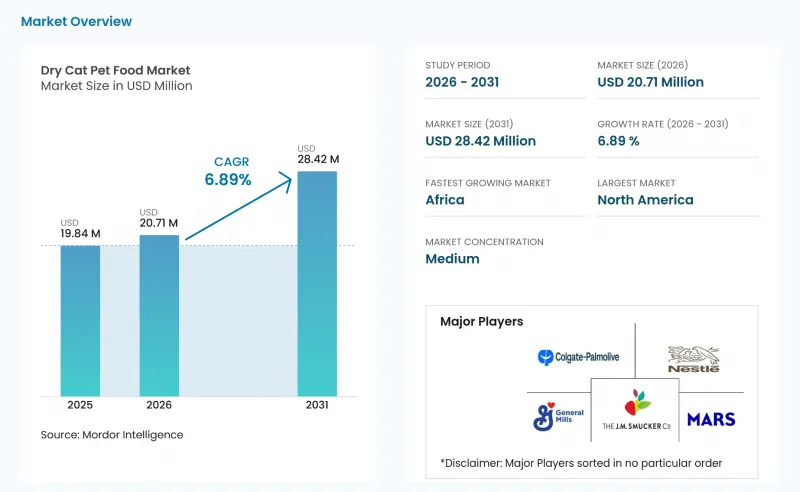
According to Mordor Intelligence, the dry cat pet food market size is projected to expand from USD 19.84 million in 2025 and USD 20.71 million in 2026 to USD 28.42 million by 2031, registering a CAGR of 6.89% between 2026 and 2031.
Global Dry Cat Pet Food Market Trends and Insights
Rising Cat Ownership in Urban Single-Person and Senior Households
The dry cat pet food market is gaining steady support from the expansion of single-person and senior households that favor cats over more demanding companion animals. The American Pet Products Association reported that cat ownership in the United States rose in 2024, reaching 49 million households, and homes with 3 or more cats increased. These homes usually value easy storage, clean feeding, and flexible portion control, which makes dry food better suited to daily routines than wet food that spoils faster. This pattern also supports higher-value products because older cat populations and multi-cat homes are more likely to buy dental care, kidney care, and joint support products. The same urban living pattern is supporting the dry cat pet food market across Asia-Pacific, where cats fit smaller homes and busier schedules more easily than larger pets.
Dry Food Affordability and Long Shelf Life
The dry cat pet food market continues to benefit from the cost efficiency of kibble, especially in regions where household budgets remain tight. Dry food carries an ambient shelf life of 12 to 18 months, which removes cold chain dependence and helps retailers distribute products more widely in South America, Africa, and parts of the Middle East. The Pet Food Institute and IFEEDER reported that upcycled ingredients entered measured pet food manufacturing in 2024, with over 1 million metric tons used in cat food, showing that cost and ingredient efficiency are improving at the production level. This makes dry food the practical volume base of the category, because consumers often shift within price tiers before moving away from the format itself. Retailers also benefit because dry products reduce spoilage risk and make inventory handling easier across the dry cat pet food market.
Volatile Meat And Fish Meal Input Costs
The dry cat pet food market remains exposed to protein cost volatility because cat diets depend heavily on animal-based and fish-derived ingredients. The Pet Food Institute and IFEEDER noted that marine ingredients were the most valuable ingredient category by weight in United States cat food manufacturing in 2024, underscoring how sensitive this category is to movements in fishery and protein costs. The Producer Price Index for meats, poultry, and fish has remained elevated since 2024, suggesting a firmer cost floor rather than a short-lived spike. User-supplied material also showed taurine price fluctuations of 15% to 25% year on year, which adds another pressure point because most feline formulas require supplementation. This environment favors larger companies with stronger buying power and longer procurement contracts, which can squeeze smaller operators across the dry cat pet food market.
Other drivers and restraints analyzed in the detailed report include:
- E-Commerce Reordering and Subscription Penetration
- Premiumization of Functional Dry Kibble
- Tight Labeling And Food Safety Compliance Burden
For complete list of drivers and restraints, kindly check the Table Of Contents.
Segment Analysis
Kibbles were the largest segment and accounted for 63.0% of dry cat pet food market size in 2025. Their lead comes from easy storage, broad price coverage, and a formulation base that can support everyday maintenance recipes as well as veterinary and therapeutic diets. This makes kibbles the central volume engine of the dry cat pet food market, especially in homes that want convenience and less spoilage risk. The J.M. Smucker Company stated in user supplied material that its Meow Mix Gravy Bursts line ranked as the top dry cat food innovation launch in the 2025 measured retail period, which shows how product upgrades can still move household penetration within a mature format. Other dry pet food formats, including biscuits and pellet blends, remain smaller because they are used more for variety or targeted functions than for complete daily feeding.
Within kibbles, a clear split is now emerging between mainstream value products and premium variants with higher per unit realization. The dry cat pet food industry is seeing stronger competition in freeze dried raw blends, cold pressed recipes, and breed specific formulas that push the format above its older commodity image. General Mills, Inc. launched Edgard and Cooper in the United States in July 2025 through PetSmart, using fresh ingredient positioning to extend its premium reach in dry food. This places pressure on middle tier kibble, because it now faces upgraded premium offers above and stronger private label pressure below. As a result, the dry cat pet food market is becoming more polarized in value capture even though kibble remains the largest product format by volume.
Complete Report Scope:
- Sub Dry Pet Food
- Kibbles
- Other Dry Pet Food
- Ingredient Type
- Protein
- Animal-Derived
- Plant-Derived
- Cereals and Cereal Derivatives
- Others
- Protein
- Distribution Channel
- Convenience Stores
- Online Channel
- Specialty Stores
- Supermarkets/Hypermarkets
- Other Channels
- Geography
- North America
- United States
- Canada
- Mexico
- Rest of North America
- South America
- Brazil
- Argentina
- Rest of South America
- Europe
- Germany
- United Kingdom
- France
- Italy
- Spain
- Russia
- Rest of Europe
- Asia-Pacific
- China
- India
- Japan
- South Korea
- Australia and New Zealand
- Rest of Asia-Pacific
- Middle East
- Saudi Arabia
- United Arab Emirates
- Rest of Middle East
- Africa
- South Africa
- Egypt
- Rest of Africa
- North America
Geography Analysis
North America was the largest region, accounting for 39.9% of the dry cat pet food market share in 2025. The region benefits from a large ownership base, because the American Pet Products Association reported that 49 million households in the United States owned at least 1 cat by the end of 2024, after a 23% increase during the year. Mature specialty retail, deeper online adoption, and broad premium brand architecture keep North America at the center of value creation in the dry cat pet food market. Nestle S.A. has opened its USD 550 million Batavia, Ohio, facility in May 2026, which produces dry cat and dog food for Purina Pro Plan, Purina ONE, and Dog Chow, and signals continued confidence in regional demand.
Europe remains an important center for premium and regulatory standards in the dry cat pet food market. The region has stronger early movement on insect derived ingredient approvals and labeling alignment, which raises compliance demands but also creates barriers that can protect early movers. Asia-Pacific shows wider internal variation, with Japan representing a mature premium environment and China offering larger volume expansion potential. Unicharm Corporation commenced full operations at a new pet food manufacturing plant in China in September 2025, which reduced transport distances and lead times compared with its earlier import-led model. In Australia, Mars, Incorporated opened its AUD 112.5 million (USD 73 million) Wodonga facility in June 2026, expanding local pet food manufacturing capacity through automated production.
Africa was the fastest-growing region and is projected to expand at an 8.6% CAGR through 2031, putting it at the forefront of growth in the dry cat pet food market by geography. Urbanization, rising household incomes, and the format advantage of ambient storage support wider distribution in markets with less developed cold chain infrastructure. South America is also moving from a lower-penetration base toward a more competitive environment as multinationals deepen their manufacturing reach and increase category investment. The Middle East remains more import-dependent, but higher urban disposable incomes and improving retail infrastructure are supporting steady demand for dry cat food across the main Gulf markets. These patterns show that the dry cat pet food market is still driven by mature value pools in North America and Europe, while faster incremental expansion comes from Africa and selected emerging markets.
- Nestle S.A. (Purina)
- Mars, Incorporated
- Colgate-Palmolive Company
- General Mills, Inc.
- The J.M. Smucker Company
- Wellness Pet Company, Inc.
- Unicharm Corporation
- Affinity Petcare, S.A.
- Diamond Pet Foods, Inc.
- Deuerer GmbH
- Sunshine Mills, Inc.
- heristo aktiengesellschaft
- Agroindustrias Baires S.A.
- Central Garden and Pet Company
- Simmons Foods, Inc.
Additional Benefits:
- The market estimate (ME) sheet in Excel format
- 3 months of analyst support
TABLE OF CONTENTS
1 INTRODUCTION
- 1.1 Study Assumptions And Market Definition
- 1.2 Scope of the Study
- 1.3 Research Methodology
2 REPORT OFFERS
3 EXECUTIVE SUMMARY AND KEY FINDINGS
4 KEY INDUSTRY TRENDS
- 4.1 Pet Population
- 4.1.1 Cats
- 4.2 Pet Expenditure
- 4.3 Consumer Trends
5 SUPPLY AND PRODUCTION DYNAMICS
- 5.1 Trade Analysis
- 5.2 Ingredient Trends
- 5.3 Value Chain And Distribution Channel Analysis
- 5.4 Regulatory Framework
- 5.5 Market Drivers
- 5.5.1 Rising cat ownership in urban single-person and senior households
- 5.5.2 Dry food affordability and long shelf life
- 5.5.3 E-commerce reordering and subscription penetration
- 5.5.4 Premiumization of functional dry kibble
- 5.5.5 Insect and single-cell protein reformulation
- 5.5.6 Ai-guided personalized feline nutrition
- 5.6 Market Restraints
- 5.6.1 Volatile meat and fish meal input costs
- 5.6.2 Tight labeling and food safety compliance burden
- 5.6.3 Premium price sensitivity in inflationary cycles
- 5.6.4 Carbon footprint scrutiny on animal-protein formulations
6 MARKET SIZE AND GROWTH FORECASTS (VALUE AND VOLUME)
- 6.1 Sub Dry Pet Food
- 6.1.1 Kibbles
- 6.1.2 Other Dry Pet Food
- 6.2 Ingredient Type
- 6.2.1 Protein
- 6.2.1.1 Animal-Derived
- 6.2.1.2 Plant-Derived
- 6.2.2 Cereals and Cereal Derivatives
- 6.2.3 Others
- 6.2.1 Protein
- 6.3 Distribution Channel
- 6.3.1 Convenience Stores
- 6.3.2 Online Channel
- 6.3.3 Specialty Stores
- 6.3.4 Supermarkets/Hypermarkets
- 6.3.5 Other Channels
- 6.4 Geography
- 6.4.1 North America
- 6.4.1.1 United States
- 6.4.1.2 Canada
- 6.4.1.3 Mexico
- 6.4.1.4 Rest of North America
- 6.4.2 South America
- 6.4.2.1 Brazil
- 6.4.2.2 Argentina
- 6.4.2.3 Rest of South America
- 6.4.3 Europe
- 6.4.3.1 Germany
- 6.4.3.2 United Kingdom
- 6.4.3.3 France
- 6.4.3.4 Italy
- 6.4.3.5 Spain
- 6.4.3.6 Russia
- 6.4.3.7 Rest of Europe
- 6.4.4 Asia-Pacific
- 6.4.4.1 China
- 6.4.4.2 India
- 6.4.4.3 Japan
- 6.4.4.4 South Korea
- 6.4.4.5 Australia and New Zealand
- 6.4.4.6 Rest of Asia-Pacific
- 6.4.5 Middle East
- 6.4.5.1 Saudi Arabia
- 6.4.5.2 United Arab Emirates
- 6.4.5.3 Rest of Middle East
- 6.4.6 Africa
- 6.4.6.1 South Africa
- 6.4.6.2 Egypt
- 6.4.6.3 Rest of Africa
- 6.4.1 North America
7 COMPETITIVE LANDSCAPE
- 7.1 Key Strategic Moves
- 7.2 Market Share Analysis
- 7.3 Brand Positioning Matrix
- 7.4 Market Claim Analysis
- 7.5 Company Landscape
- 7.6 Company Profiles (Includes Global Level Overview, Market Level Overview, Core Business Segments, Financials, Key Information, Market Rank, Market Share, Products and Services, and Analysis of Recent Developments).
- 7.6.1 Nestle S.A. (Purina)
- 7.6.2 Mars, Incorporated
- 7.6.3 Colgate-Palmolive Company
- 7.6.4 General Mills, Inc.
- 7.6.5 The J.M. Smucker Company
- 7.6.6 Wellness Pet Company, Inc.
- 7.6.7 Unicharm Corporation
- 7.6.8 Affinity Petcare, S.A.
- 7.6.9 Diamond Pet Foods, Inc.
- 7.6.10 Deuerer GmbH
- 7.6.11 Sunshine Mills, Inc.
- 7.6.12 heristo aktiengesellschaft
- 7.6.13 Agroindustrias Baires S.A.
- 7.6.14 Central Garden and Pet Company
- 7.6.15 Simmons Foods, Inc.
8 KEY STRATEGIC QUESTIONS FOR PET FOOD CEOS

