PUBLISHER: Roots Analysis | PRODUCT CODE: 2005200

PUBLISHER: Roots Analysis | PRODUCT CODE: 2005200
Middle East & Africa Medical Aesthetics Devices Market - Distribution by Type of Product and / or Device Offered, Procedure, End User, and Key Geographical Regions: Industry Trends and Global Forecasts, till 2035
Middle East and Africa Medical Aesthetics Devices Market: Overview
As per Roots Analysis, the Middle East and Africa medical aesthetics devices market is estimated to grow from USD 0.95 billion in the current year to USD 2.43 billion by 2035 at a CAGR of 11.0% during the forecast period, till 2035.
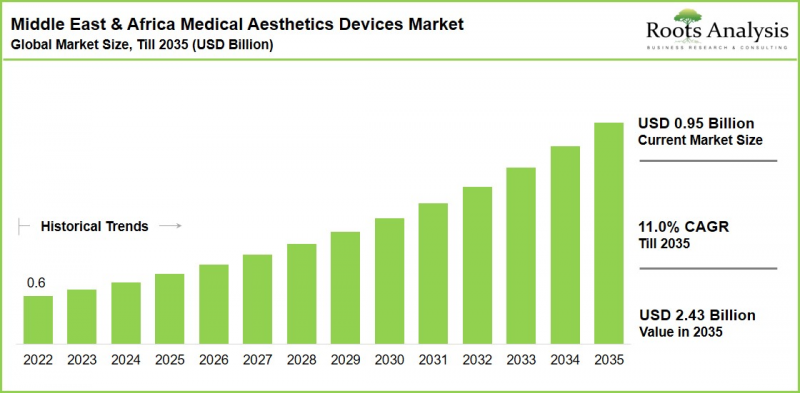
Middle East and Africa Medical Aesthetics Devices Market: Growth and Trends
Medical aesthetics is a recognized field of contemporary medicine that primarily aims to improve an individual's cosmetic appearance without undergoing surgical procedures. Such solutions are primarily employed for anti-aging reasons by minimizing fine lines and wrinkles, tightening loose skin, and revitalizing the skin. Moreover, medical aesthetic treatments can assist in diminishing excess fat and cellulite, unwanted hair, and spider veins. It is worth highlighting that almost 90% of the industry's clients are women; however, these cosmetic treatments are also becoming increasingly popular with men.
It is also worth mentioning that numerous medical issues are increasingly being managed with treatments, procedures, or devices mostly used for aesthetic purposes. This expansion has broadened the range of treatment options available for dermatologists to address diverse indications that extend beyond aesthetic dermatology.
The market for medical aesthetics devices in the Middle East & Africa (MEA) is also experiencing significant growth, fueled by a growing preference for minimally invasive treatments, the popularity of medical procedures, and a rise in the number of aesthetic clinics. The demand for medical aesthetics equipment in the MENA region is rapidly increasing, driven by a combination of economic changes, cultural factors, and improvements in healthcare. It is worth highlighting that the leading non-surgical cosmetic treatments in MENA, especially in the UAE and Saudi Arabia, focus on injectables, skin renewal, and body contouring with little recovery time. Botox and dermal fillers are favored for their rapid effects on wrinkles and volume increase, followed by laser therapies and skin firming. Owing to the abovementioned factors, the MENA medical aesthetics devices market is poised for notable growth during the forecast period.
Growth Drivers: Strategic Enablers of Market Expansion
The MENA market for medical aesthetics devices is driven by a mixture of technological, demographic, and socioeconomic factors that foster an environment conducive to growth. Increasing disposable incomes in oil-rich Gulf Cooperation Council (GCC) countries such as Saudi Arabia and the UAE, along with swift urban development, have enabled an expanding middle and upper class to invest in high-quality, non-invasive cosmetic procedures, transforming consumer habits from luxury purchases to regular self-care practices. The widespread impact of social media enhances beauty standards, as platforms such as Instagram and TikTok promote trending procedures like Botox, fillers, and laser treatments among a youthful audience. Further, medical tourism centers, especially Dubai and Riyadh, draw international patients with advanced clinics and attractive pricing, enhanced by government initiatives, investing billions into health infrastructure.
Market Challenges: Critical Barriers Impeding Progress
Challenges persist in the MENA medical aesthetics devices market despite the ongoing market growth, hindering faster adoption. These challenges include regulatory inconsistencies, cultural considerations, and infrastructure issues that may hinder growth. The shortage of skilled experts in the aesthetic services industry greatly hinders the expansion of these services. Aesthetic treatments, typically requiring specific expertise and understanding, demand a proficient workforce with most recent technologies, methods, and safety standards. The lack of certified professionals restricts service availability and threatens patient safety, resulting in possible complications and dissatisfaction with outcomes. This establishes a loop in which consumers are reluctant to interact with medical aesthetic products, thereby hindering market expansion. Further, the potential for side effects linked to aesthetic treatments serves as a major limitation for the medical aesthetic market, instilling fear in prospective clients. Numerous cosmetic treatments, whether they are surgical or non-surgical, have an inherent risk of complications like infections, scarring, or unsatisfactory outcomes. This anxiety regarding negative consequences can prevent people from pursuing these services, as users are more aware via social media and online platforms about others' experiences, encompassing unfavorable results. As a result, the possibility of side effects may foster the belief that these procedures are not worth the risk, resulting in decreased interest and involvement in the market.
Invasive Procedures: Leading Market Segment
At present, the invasive procedures segment holds almost 65% of the total market share in Middle East and Africa. This leading position is mainly due to deep-seated cultural inclinations towards dramatic, transformative outcomes instead of subtle improvements. In nations such as Saudi Arabia, Iran, and South Africa, treatments like liposuction, rhinoplasty (nose reshaping), and genioplasty (chin enhancement) lead in procedure numbers, typically making up 50-60% of overall surgeries. Patients seek bold facial restructuring and body contouring aligned with localized beauty ideals such as sharper noses, defined jaws, and slimmer silhouettes that signal status and youth in social circles.
Females: Dominating Market Segment
Currently, females lead the MENA medical aesthetics devices market, representing around 90% of procedure volumes and revenue share. This dominance arises from deep-rooted cultural and societal expectations that highly prioritize feminine beauty and physical perfection. Intense beauty standards, amplified by social media influencers and celebrity culture in urban hubs like Dubai and Riyadh, propel women, particularly those aged 25-45 to seek anti-aging fixes like fillers, Botox, and lasers to combat wrinkles, enhance facial contours, and achieve luminous skin suited to the harsh desert climate
Middle East and Africa Medical Aesthetics Devices Market: Key Segments
Type of Product and / or Device Offered
- Botulinum toxin
- Dermal Fillers
- Chemical Peels
- Body Contouring
- Gluteal Implants
- Hair Removal
- Breast Implants
- Other Products / Devices
By Type of Procedure
- Non Invasive
- Minimally Invasive
- Invasive
By End User
- Hospitals
- Clinics / Med Spas and Dermatology / Cosmetology Centers
- Other end users
By Gender
- Male
- Female
Distribution Channel
- Direct Distribution
- Indirect Distribution
Example Players in Middle East and Africa Medical Aesthetics Devices Market
- Allergan (part of AbbVie)
- Alma Lasers
- Bausch Health
- Candela Medical
- Cutera
- Cynosure
- Galderma
- Hologic
- Johnson & Johnson
- Lumenis
- Merz Pharma
Key Questions Answered in this Report
- How many Middle East and Africa medical aesthetics device developers are currently engaged in this market?
- Which are the leading companies in this market?
- Which country dominates the Middle East and Africa medical aesthetics devices market?
- What are the key trends observed in the Middle East and Africa medical aesthetics devices market?
- What factors are likely to influence the evolution of this market?
- What are the primary challenges faced by medical aesthetics device developers in Middle East and Africa?
- What is the current and future Middle East and Africa medical aesthetics devices market size?
- What is the CAGR of Middle East and Africa medical aesthetics devices market?
- How is the current and future market opportunity likely to be distributed across key market segments?
Reasons to Buy this Report
- The report provides a comprehensive market analysis, offering detailed revenue projections of the overall market and its specific sub-segments. This information is valuable to both established market leaders and emerging entrants.
- The report offers stakeholders a comprehensive overview of the market, including key drivers, barriers, opportunities, and challenges. This information empowers stakeholders to stay abreast of market trends and make data-driven decisions to capitalize on growth prospects.
- The report can aid businesses in identifying future opportunities in any sector. It also helps in understanding if those opportunities are worth pursuing.
- The report helps in identifying customer demand by understanding the needs, preferences, and behavior of the target audience in order to tailor products or services effectively.
- The report equips new entrants with requisite information regarding a particular market to help them build successful business strategies.
- The report allows for more effective communication with the audience and in building strong business relations.
Complementary Benefits
- Complimentary PPT Insights Packs
- Complimentary Excel Data Packs for all Analytical Modules in the Report
- 15% Free Content Customization
- Detailed Report Walkthrough Session with Research Team
- Free Updated report if the report is 6-12 months old or older
TABLE OF CONTENTS
1.PREFACE
- 1.1. Introduction
- 1.2. Market Share Insights
- 1.3. Key Market Insights
- 1.4. Report Coverage
- 1.5. Key Questions Answered
- 1.6. Chapter Outlines
2. RESEARCH METHODOLOGY
- 2.1. Chapter Overview
- 2.2. Research Assumptions
- 2.2.1. Market Landscape and Market Trends
- 2.2.2. Market Forecast and Opportunity Analysis
- 2.2.3. Comparative Analysis
- 2.3. Database Building
- 2.3.1. Data Collection
- 2.3.2. Data Validation
- 2.3.3. Data Analysis
- 2.4. Project Methodology
- 2.4.1. Secondary Research
- 2.4.1.1. Annual Reports
- 2.4.1.2. Academic Research Papers
- 2.4.1.3. Company Websites
- 2.4.1.4. Investor Presentations
- 2.4.1.5. Regulatory Filings
- 2.4.1.6. White Papers
- 2.4.1.7. Industry Publications
- 2.4.1.8. Conferences and Seminars
- 2.4.1.9. Government Portals
- 2.4.1.10. Media and Press Releases
- 2.4.1.11. Newsletters
- 2.4.1.12. Industry Databases
- 2.4.1.13. Roots Proprietary Databases
- 2.4.1.14. Paid Databases and Sources
- 2.4.1.15. Social Media Portals
- 2.4.1.16. Other Secondary Sources
- 2.4.2. Primary Research
- 2.4.2.1. Types of Primary Research
- 2.4.2.1.1. Qualitative Research
- 2.4.2.1.2. Quantitative Research
- 2.4.2.1.3. Hybrid Approach
- 2.4.2.2. Advantages of Primary Research
- 2.4.2.3. Techniques for Primary Research
- 2.4.2.3.1. Interviews
- 2.4.2.3.2. Surveys
- 2.4.2.3.3. Focus Groups
- 2.4.2.3.4. Observational Research
- 2.4.2.3.5. Social Media Interactions
- 2.4.2.4. Key Opinion Leaders Considered in Primary Research
- 2.4.2.4.1. Company Executives (CXOs)
- 2.4.2.4.2. Board of Directors
- 2.4.2.4.3. Company Presidents and Vice Presidents
- 2.4.2.4.4. Research and Development Heads
- 2.4.2.4.5. Technical Experts
- 2.4.2.4.6. Subject Matter Experts
- 2.4.2.4.7. Scientists
- 2.4.2.4.8. Doctors and Other Healthcare Providers
- 2.4.2.5. Ethics and Integrity
- 2.4.2.5.1. Research Ethics
- 2.4.2.5.2. Data Integrity
- 2.4.2.1. Types of Primary Research
- 2.4.3. Analytical Tools and Databases
- 2.4.1. Secondary Research
- 2.5. Robust Quality Control
3. MARKET DYNAMICS
- 3.1. Chapter Overview
- 3.2. Forecast Methodology
- 3.2.1. Top-down Approach
- 3.2.2. Bottom-up Approach
- 3.2.3. Hybrid Approach
- 3.3. Market Assessment Framework
- 3.3.1. Total Addressable Market (TAM)
- 3.3.2. Serviceable Addressable Market (SAM)
- 3.3.3. Serviceable Obtainable Market (SOM)
- 3.3.4. Currently Acquired Market (CAM)
- 3.4. Forecasting Tools and Techniques
- 3.4.1. Qualitative Forecasting
- 3.4.2. Correlation
- 3.4.3. Regression
- 3.4.4. Extrapolation
- 3.4.5. Convergence
- 3.4.6. Sensitivity Analysis
- 3.4.7. Scenario Planning
- 3.4.8. Data Visualization
- 3.4.9. Time Series Analysis
- 3.4.10. Forecast Error Analysis
- 3.5. Key Considerations
- 3.5.1. Demographics
- 3.5.2. Government Regulations
- 3.5.3. Reimbursement Scenarios
- 3.5.4. Market Access
- 3.5.5. Supply Chain
- 3.5.6. Industry Consolidation
- 3.5.7. Pandemic / Unforeseen Disruptions Impact
- 3.6. Limitations
4. MACRO-ECONOMIC INDICATORS
- 4.1. Chapter Overview
- 4.2. Market Dynamics
- 4.2.1. Time Period
- 4.2.1.1. Historical Trends
- 4.2.1.2. Current and Forecasted Estimates
- 4.2.2. Currency Coverage
- 4.2.2.1. Major Currencies Affecting the Market
- 4.2.2.2. Factors Affecting Currency Fluctuations on the Industry
- 4.2.2.3. Impact of Currency Fluctuations on the Industry
- 4.2.3. Foreign Currency Exchange Rate
- 4.2.3.1. Impact of Foreign Exchange Rate Volatility on the Market
- 4.2.3.2. Strategies for Mitigating Foreign Exchange Risk
- 4.2.4. Recession
- 4.2.4.1. Assessment of Current Economic Conditions and Potential Impact on the Market
- 4.2.4.2. Historical Analysis of Past Recessions and Lessons Learnt
- 4.2.5. Inflation
- 4.2.5.1. Measurement and Analysis of Inflationary Pressures in the Economy
- 4.2.5.2. Potential Impact of Inflation on the Market Evolution
- 4.2.6. Interest Rates
- 4.2.6.1. Interest Rates and Their Impact on the Market
- 4.2.6.2. Strategies for Managing Interest Rate Risk
- 4.2.7. Commodity Flow Analysis
- 4.2.7.1. Type of Commodity
- 4.2.7.2. Origins and Destinations
- 4.2.7.3. Value and Weights
- 4.2.7.4. Modes of Transportation
- 4.2.8. Global Trade Dynamics
- 4.2.8.1. Import Scenario
- 4.2.8.2. Export Scenario
- 4.2.8.3. Trade Policies
- 4.2.8.4. Strategies for Mitigating the Risks Associated with Trade Barriers
- 4.2.8.5. Impact of Trade Barriers on the Market
- 4.2.9. War Impact Analysis
- 4.2.9.1. Russian-Ukraine War
- 4.2.9.2. Israel-Hamas War
- 4.2.10. COVID Impact / Related Factors
- 4.2.10.1. Global Economic Impact
- 4.2.10.2. Industry-specific Impact
- 4.2.10.3. Government Response and Stimulus Measures
- 4.2.10.4. Future Outlook and Adaptation Strategies
- 4.2.11. Other Indicators
- 4.2.11.1. Fiscal Policy
- 4.2.11.2. Consumer Spending
- 4.2.11.3. Gross Domestic Product (GDP)
- 4.2.11.4. Employment
- 4.2.11.5. Taxes
- 4.2.11.6. Stock Market Performance
- 4.2.11.7. Cross-Border Dynamics
- 4.2.1. Time Period
- 4.3. Conclusion
5. EXECUTIVE SUMMARY
6. INTRODUCTION
- 6.1. Chapter Overview
- 6.2. Concept of Medical Aesthetics
- 6.3. Evolution of Medical Aesthetics
- 6.4. Types of Medical Aesthetic Procedures
- 6.5. Advantages of Medical Aesthetics
- 6.6. Side Effects of Medical Aesthetics
- 6.7. Key Growth Drivers
- 6.8. Emerging Technologies in Medical Aesthetics
- 6.8.1. Virtual Reality in Medical Aesthetics
- 6.8.2. Augmented Reality in Medical Aesthetics
- 6.8.3. Artificial Intelligence in Medical Aesthetics
- 6.8.4. Telemedicine in Medical Aesthetics
- 6.9. Key Challenges of Medical Aesthetics
- 6.10. Future Perspectives
7. MARKET LANDSCAPE
- 7.1. Chapter Overview
- 7.2. Medical Aesthetic Companies: Overall Market Landscape
- 7.2.1. Analysis by Year of Establishment
- 7.2.2. Analysis by Company Size
- 7.2.3. Analysis by Location of Headquarters (Region)
- 7.2.4. Analysis by Location of Headquarters (Country)
- 7.2.5. Analysis by Type of Offering
- 7.2.6. Analysis by Type of Products and / or Devices Offered
- 7.2.7. Analysis by Type of Body Contouring Products and / or Devices Offered
- 7.2.8. Analysis by Type of Hair Removal Devices Offered
- 7.2.9. Analysis by Type of Breast Aesthetic Products and / or Devices Offered
- 7.2.10. Analysis by Application Area
- 7.2.11. Analysis by Type of Procedure
- 7.2.12. Analysis by End-user
8. COMPANY COMPETITIVENESS ANALYSIS
- 8.1. Chapter Overview
- 8.2. Assumptions and Key Parameters
- 8.3. Methodology
- 8.4. Medical Aesthetic Devices: Company Competitiveness Analysis
- 8.4.1. Small Medical Aesthetic Device Developers (Peer Group I)
- 8.4.2. Mid-sized Medical Aesthetic Device Developers (Peer Group II)
- 8.4.3. Large Medical Aesthetic Device Developers (Peer Group III)
9. COMPANY PROFILES: MIDDLE EAST AND AFRICA MEDICAL AESTHETICS DEVICES MARKET
- 9.1. Chapter Overview
- 9.2. Allergan (part of AbbVie)
- 9.2.1. Company Overview
- 9.2.2. Product Portfolio
- 9.2.3. Financial Information
- 9.2.4. Recent Developments and Future Outlook
- 9.3. Galderma
- 9.4. Cutera
- 9.5. Alma Lasers
- 9.6. Cynosure
- 9.7. Lumenis
- 9.8. Merz Pharma
- 9.9. Johnson & Johnson
- 9.10. Bausch Health
- 9.11. Hologic
10. MARKET IMPACT ANALYSIS
- 10.1. Chapter Overview
- 10.2. Market Drivers
- 10.3. Market Restraints
- 10.4. Market Opportunities
- 10.5. Market Challenges
- 10.6. Conclusion
11. MIDDLE EAST AND AFRICA MEDICAL AESTHETICS DEVICES MARKET
- 11.1. Chapter Overview
- 11.2. Key Assumptions and Methodology
- 11.3. Global Middle East and Africa Medical Aesthetics Devices Market, Historical Trends (Since 2022) and Forecasted Estimates (Till 2035)
- 11.4. Roots Analysis Perspective on Market Growth
- 11.5 Scenario Analysis
- 11.5.1. Conservative Scenario
- 11.5.2. Optimistic Scenario
- 11.6. Key Market Segmentations
12. MIDDLE EAST AND AFRICA MEDICAL AESTHETICS DEVICES MARKET, BY TYPE OF PRODUCT AND / OR DEVICE OFFERED
- 12.1. Chapter Overview
- 12.2. Key Assumptions and Methodology
- 12.3. Middle East and Africa Medical Aesthetics Devices Market: Distribution by Type of Product and / or Device Offered
- 12.3.1. Middle East and Africa Medical Aesthetics Devices Market for Botulinum, Historical Trends (Since 2022) and Forecasted Estimates (till 2035)
- 12.3.2. Middle East and Africa Medical Aesthetics Devices Market for Dermal Fillers, Historical Trends (Since 2022) and Forecasted Estimates (till 2035)
- 12.3.3. Middle East and Africa Medical Aesthetics Devices Market for Chemical Peels, Historical Trends (Since 2022) and Forecasted Estimates (till 2035)
- 12.3.4. Middle East and Africa Medical Aesthetics Devices Market for Body Contouring, Historical Trends (Since 2022) and Forecasted Estimates (till 2035)
- 12.3.5. Middle East and Africa Medical Aesthetic Devices Market for Gluteal Implants, Historical Trends (Since 2022) and Forecasted Estimates (till 2035)
- 12.3.6. Middle East and Africa Medical Aesthetic Devices Market for Hair Removal, Historical Trends (Since 2022) and Forecasted Estimates (till 2035)
- 12.3.7. Middle East and Africa Medical Aesthetic Devices Market for Breast Implants, Historical Trends (Since 2022) and Forecasted Estimates (till 2035)
- 12.3.8. Middle East and Africa Medical Aesthetic Devices Market for Other Products / Devices, Historical Trends (Since 2022) and Forecasted Estimates (till 2035)
- 12.4. Data Triangulation and Validation
13. MIDDLE EAST AND AFRICA MEDICAL AESTHETICS DEVICES MARKET, BY TYPE OF PROCEDURE
- 13.1. Chapter Overview
- 13.2. Assumptions and Methodology
- 13.3. Middle East and Africa Medical Aesthetics Devices Market: Distribution by Type of Procedure
- 13.3.1. Middle East and Africa Medical Aesthetics Devices Market for Non-invasive Procedures, Historical Trends (Since 2022) and Forecasted Estimates (till 2035)
- 13.3.2. Middle East and Africa Medical Aesthetics Devices Market for Minimally Invasive Procedures, Historical Trends (Since 2022) and Forecasted Estimates (till 2035)
- 13.3.3. Middle East and Africa Medical Aesthetics Devices Market for Invasive Procedures, Historical Trends (Since 2022) and Forecasted Estimates (till 2035)
- 13.4. Data Triangulation and Validation
14. MIDDLE EAST AND AFRICA MEDICAL AESTHETICS DEVICES MARKET, BY END-USER
- 14.1. Chapter Overview
- 14.2. Assumptions and Methodology
- 14.3. Middle East and Africa Medical Aesthetics Devices Market: Distribution by End-user
- 14.3.1. Middle East and Africa Medical Aesthetics Devices Market for Hospitals, Historical Trends (Since 2022) and Forecasted Estimates (till 2035)
- 14.3.2. Middle East and Africa Medical Aesthetics Devices Market for Clinics / Med Spas and Dermatology / Cosmetology Centers, Historical Trends (Since 2022) and Forecasted Estimates (till 2035)
- 14.4. Data Triangulation and Validation
15. MIDDLE EAST AND AFRICA MEDICAL AESTHETICS DEVICES MARKET, BY DISTRIBUTION CHANNEL
- 15.1. Chapter Overview
- 15.2. Assumptions and Methodology
- 15.3. Middle East and Africa Medical Aesthetics Devices Market: Distribution by Distribution Channel
- 15.3.1. Middle East and Africa Medical Aesthetics Devices Market for Direct Distribution, Historical Trends (Since 2022) and Forecasted Estimates (till 2035)
- 15.3.2. Middle East and Africa Medical Aesthetics Devices Market for Indirect Distribution, Historical Trends (Since 2022) and Forecasted Estimates (till 2035)
- 15.4. Data Triangulation and Validation
16. MIDDLE EAST AND AFRICA MEDICAL AESTHETICS DEVICES MARKET, BY GENDER
- 16.1. Chapter Overview
- 16.2. Assumptions and Methodology
- 16.3. Middle East and Africa Medical Aesthetics Devices Market: Distribution by Gender
- 16.3.1. Middle East and Africa Medical Aesthetics Devices Market for Females, Historical Trends (Since 2022) and Forecasted Estimates (till 2035)
- 16.3.2. Middle East and Africa Medical Aesthetics Devices Market for Males, Historical Trends (Since 2022) and Forecasted Estimates (till 2035)
- 16.4. Data Triangulation and Validation
17. CONCLUDING REMARKS
18. APPENDIX I: TABULATED DATA
19. APPENDIX II: LIST OF COMPANIES AND ORGANIZATIONS

