PUBLISHER: Roots Analysis | PRODUCT CODE: 2088583

PUBLISHER: Roots Analysis | PRODUCT CODE: 2088583
GPU-as-a-Service Market Till 2040: Distribution by Type of Component, Deployment Model, Business Model, Enterprise Size, Application, End User, Geographical Regions, and Key Players
GPU-as-a-Service Market Outlook
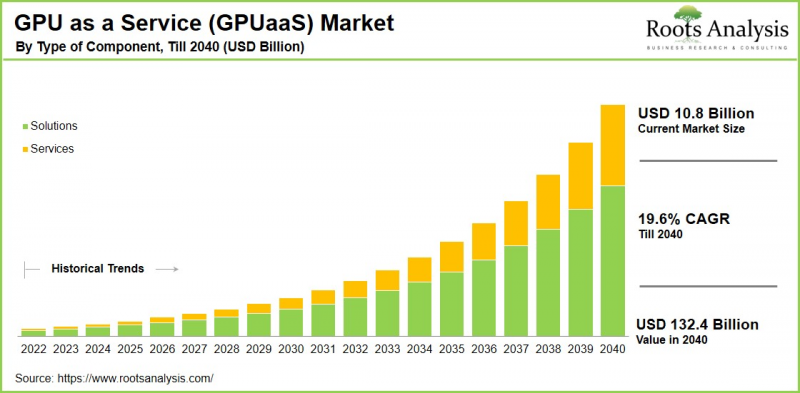
As per Roots Analysis, the global GPU-as-a-service market size is estimated to grow from USD 10.8 billion in the current year to USD 132.4 billion by 2040, at a CAGR of 19.6% during the forecast period, till 2040.
GPUaaS has evolved from a niche GPU rental service into a core AI infrastructure market. Demand no longer originates primarily from individual developers testing models. Instead, it is driven by enterprises requiring elastic training, inference, and burst capacity without committing capital to owned clusters. Supply constraints remain relevant, but the larger transformation is commercialization through capacity aggregation, platform orchestration, and cloud marketplace access.
Growth is currently fueled by generative AI deployment, AI agent workloads, and the need to optimize GPU utilization costs. Sovereign AI infrastructure is also emerging as a policy priority, particularly where governments and regulated organizations require local compute control. Oracle expanded OCI bare metal and GPU infrastructure capacity with NVIDIA Blackwell systems in March 2025. This combination is broadening demand beyond hyperscalers and frontier model developers.
Through 2040, the GPU-as-a-service market is expected to remain high-growth, although its growth drivers will become increasingly segmented. Public cloud will continue providing scale, while hybrid cloud, fractional provisioning, and marketplace models are expected to grow faster as buyers seek portability and lower unit costs. CoreWeave expanded AI cloud capacity agreements with Meta and Anthropic in May 2026. The market outlook remains positive as demand continues to exceed efficient supply.
Some of the key takeaways from this report are highlighted below:
- Based on component, solutions account for 71.0% of the market share in 2026, while services are projected to register a 22.5% CAGR through 2040, supported by increasing enterprise outsourcing demand.
- Based on deployment model, the public cloud accounts for 63.0% of the market share in 2026, while hybrid cloud is projected to register a 24.3% CAGR through 2040, fueled by growing data sovereignty requirements.
- Based on business model, infrastructure-as-a-service (IaaS) accounts for 48.0% of the market share in 2026, while fractional GPU services are projected to register a 25.5% CAGR through 2040, driven by demand for lower-cost AI infrastructure access.
- Based on enterprise size, large enterprises account for 72.0% of the market share in 2026, while SMEs are projected to register a 23.4% CAGR through 2040, supported by the democratization of AI deployment tools.
- Based on geographical regions, North America accounts for 41.0% of the market share in 2026, while Asia-Pacific is projected to register a 24.0% CAGR through 2040, driven by investments in sovereign AI infrastructure.
Strategic Insights for Senior Leaders
Competitive Landscape of GPU-as-a-Service Market
The GPU-as-a-Service market is consolidating around vertically integrated AI infrastructure ecosystems, where hyperscalers, GPU vendors, and AI-native cloud providers increasingly integrate compute, networking, orchestration software, and inference optimization into unified platforms. NVIDIA currently influences the market's architectural direction through seamless integration of GPUs, networking, AI software, and cloud partnerships, while hyperscalers compete through large-scale infrastructure investments and proprietary AI stacks.
The primary commercial force transforming competitive dynamics is the global shortage of AI-ready compute capacity for training and inference workloads. This has accelerated long-term GPU reservation agreements, AI factory expansion, liquid-cooled infrastructure deployment, and strategic collaborations between GPU providers and specialized cloud operators.
Tier 1 Companies in GPU-as-a-service Domain
Large cloud providers are accelerating GPU infrastructure investments to secure long-term enterprise AI workloads and alleviate compute supply constraints. For instance, in March 2026, Amazon Web Services and NVIDIA expanded their AI infrastructure collaboration through an agreement covering one million NVIDIA GPUs for AWS data centers. Meanwhile, Oracle emerged as an early deployment partner for NVIDIA's Vera CPU rack systems introduced during GTC 2026. Oracle's adoption supports high-density AI cloud infrastructure optimized for liquid-cooled AI clusters and large-scale inference environments.
Alibaba Cloud was also identified among hyperscale adopters of NVIDIA's next-generation Vera AI infrastructure platform in 2026. The initiative reflects intensifying competition among global cloud providers to deploy AI-native compute architectures optimized for efficient large-model inference.
AI-native GPU cloud providers developing multi-gigawatt AI factory infrastructure are differentiating themselves through rapid AI infrastructure deployment, flexible compute leasing models, and close alignment with frontier AI developers.
GPU-as-a-service Market Evolution: Recent Developments and Trends
The GPU-as-a-Service market is witnessing a structural shift as GPU capacity evolves from a privately managed infrastructure asset into a commercially tradable platform layer. Capacity aggregation providers to package compute resources with billing, orchestration, and access management, creating scalable and commercially attractive service offerings. In May 2026, CoreWeave expanded its AI cloud capacity agreements, including collaborations with Meta and Anthropic, reinforcing its ability to streamline GPU distribution and strengthen enterprise access to AI infrastructure. This trend increasingly favors providers with established enterprise relationships, long-term cloud contracts, and the ability to guarantee reliable GPU scale. CoreWeave's multi-gigawatt AI infrastructure expansion further demonstrates how large-scale capacity has become a key competitive differentiator.
At the same time, GPU utilization models are transitioning from dedicated instance allocation toward fractional provisioning, improving accessibility and reducing infrastructure costs for small and medium-sized enterprises (SMEs). In April 2026, Akash Network expanded its decentralized GPU marketplace to support fractional AI compute workloads, broadening the addressable customer base while enabling emerging providers to compete on pricing and operational flexibility. The company's deployment with Razer also highlighted the commercial viability of peer-to-peer GPU access for cost-efficient AI image generation. As a result, decentralized and pay-as-you-go GPU provisioning models are intensifying price competition, improving resource utilization, and accelerating enterprise adoption of flexible AI infrastructure services.
Key Market Opportunities: Where Should Decision Makers Invest Next?
The GPU-as-a-Service (GPUaaS) market presents significant investment opportunities across infrastructure, software, and specialized AI service layers as enterprise AI adoption continues to accelerate. One of the most attractive opportunities liein expanding AI-ready data center capacity, particularly through liquid-cooled infrastructure, high-density GPU clusters, and energy-efficient facilities capable of supporting next-generation AI workloads. Hybrid cloud and sovereign AI infrastructure also represent high-growth segments, as governments and regulated industries increasingly prioritize data residency, security, and domestic compute capabilities. Another emerging opportunity is the development of AI orchestration software, workload scheduling platforms, and GPU resource optimization tools that improve utilization while reducing operational costs.
In addition, inference-optimized infrastructure is expected to become an increasingly important investment area as generative AI applications transition from model training toward large-scale commercial deployment. Strategic partnerships between hyperscalers, GPU vendors, AI-native cloud providers, and enterprise software companies will continue to create opportunities for integrated AI infrastructure ecosystems.
Regional Analysis: North America to hold the Largest Share in the Market
According to our analysis, in the current year, North America captures the highest share of the global GPU-as-a-service market. This is driven by its mature digital infrastructure, strong presence of leading AI technology providers, and significant public and private investments in advanced computing capabilities. The region also benefits from investments in AI infrastructure by leading technology companies, including large-scale GPU deployments, AI-optimized data centers, and high-performance networking capabilities. In addition, the presence of major GPU manufacturers, AI-native cloud providers, and enterprise software companies has accelerated the commercialization of GPUaaS solutions for training, inference, and high-performance computing workloads.
GPU-as-a-service Market: Key Market Segmentation
Type of Component
- Solutions
- Services
Deployment Model
- Public Cloud
- Private Cloud
- Hybrid Cloud
Business Model
- Infrastructure-as-a-Service (IaaS)
- Platform-as-a-Service (PaaS)
- Bare Metal GPU Services
- Fractional GPU Services
Enterprise Size
- Large Enterprises
- Small and Medium-Sized Enterprises (SMEs)
Application
- AI and Machine Learning
- High-Performance Computing (HPC)
- Data Analytics
- Rendering and Visualization
- Gaming and Streaming
- Blockchain and Cryptocurrency
- Scientific Simulation
- Others
End User
- IT and Telecommunications
- Healthcare and Life Sciences
- BFSI
- Media and Entertainment
- Automotive
- Manufacturing
- Government and Defense
- Research and Academia
- Others
Geographical Regions
- North America
- Europe
- Asia-Pacific
- Latin America
- Middle East and Africa
- Rest of the World
Example Players in GPU-as-a-Service Market
- Alibaba Cloud
- CoreWeave
- Crusoe Energy
- DigitalOcean (Paperspace)
- E2E Networks
- Gcore
- Google Cloud Platform (GCP)
- IBM Cloud
- Jarvislabs.ai
- Lambda Labs
- Microsoft Azure
- Nebius AI
- Oracle Cloud Infrastructure (OCI)
- OVHcloud
- RunPod
- Scaleway
- Tencent Cloud
- Vast.ai
- Vultr
GPU-as-a-Service Market: Modules Covered
The report on the GPU-as-a-service market features insights on various sections, including:
- Market Sizing and Opportunity Analysis: An in-depth analysis of the GPU-as-a-service market, focusing on key market segments, including [A] type of component, [B] deployment model, [C] business model, [D] enterprise size, [E] application, [F] end user, [G] geographical regions.
- Competitive Landscape: A comprehensive analysis of the companies engaged in the GPU-as-a-service market, based on several relevant parameters, such as [A] year of establishment, [B] company size, [C] location of headquarters and [D] ownership structure.
- Company Profiles: Elaborate profiles of prominent players engaged in the GPU-as-a-service market, providing details on [A] location of headquarters, [B] company size, [C] company mission, [D] company footprint, [E] management team, [F] contact details, [G] financial information, [H] operating business segments, [I] portfolio, [J] recent developments, and an informed future outlook.
- Megatrends: An evaluation of ongoing megatrends in the GPU-as-a-service industry.
- Patent Analysis: An insightful analysis of patents filed / granted in the GPU-as-a-service domain, based on relevant parameters, including [A] type of patent, [B] patent publication year, [C] patent age and [D] leading players.
- Recent Developments: An overview of the recent developments made in the GPU-as-a-service market, along with analysis based on relevant parameters, including [A] year of initiative, [B] type of initiative, [C] geographical distribution and [D] most active players.
- Porter's Five Forces Analysis: An analysis of five competitive forces prevailing in the GPU-as-a-service market, including threats of new entrants, bargaining power of buyers, bargaining power of suppliers, threats of substitute products and rivalry among existing competitors.
- SWOT Analysis: An insightful SWOT framework, highlighting the strengths, weaknesses, opportunities and threats in the domain. Additionally, it provides Harvey ball analysis, highlighting the relative impact of each SWOT parameter.
- Value Chain Analysis: A comprehensive analysis of the value chain, providing information on the different phases and stakeholders involved in the GPU-as-a-service market.
Key Questions Answered in this Report
- What is the current and future market size?
- Who are the leading companies in this market?
- What are the growth drivers that are likely to influence the evolution of this market?
- What are the key partnership and funding trends shaping this industry?
- Which region is likely to grow at higher CAGR till 2040?
- How is the current and future market opportunity likely to be distributed across key market segments?
Reasons to Buy this Report
- Detailed Market Analysis: The report provides a comprehensive market analysis, offering detailed revenue projections of the overall market and its specific sub-segments. This information is valuable to both established market leaders and emerging entrants.
- In-depth Analysis of Trends: Stakeholders can leverage the report to gain a deeper understanding of the competitive dynamics within the market. Each report maps ecosystem activity across partnerships, funding, and patent landscapes to reveal growth hotspots and white spaces in the industry.
- Opinion of Industry Experts: The report features extensive interviews and surveys with key opinion leaders and industry experts to validate market trends mentioned in the report.
- Decision-ready Deliverables: The report offers stakeholders with strategic frameworks (Porter's Five Forces, value chain, SWOT), and complimentary Excel / slide packs with customization support.
Additional Benefits
- Complimentary Dynamic Excel Dashboards for Analytical Modules
- Exclusive 15% Free Content Customization
- Personalized Interactive Report Walkthrough with Our Expert Research Team
- Free Report Updates for Versions Older than 6-12 Months
TABLE OF CONTENTS
1. PROJECT OVERVIEW
- 1.1. Context
- 1.2. Project Objectives
2. RESEARCH METHODOLOGY
- 2.1. Chapter Overview
- 2.2. Research Assumptions
- 2.3. Database Building
- 2.3.1. Data Collection
- 2.3.2. Data Validation
- 2.3.3. Data Analysis
- 2.4. Project Methodology
- 2.4.1. Secondary Research
- 2.4.1.1. Annual Reports
- 2.4.1.2. Academic Research Papers
- 2.4.1.3. Company Websites
- 2.4.1.4. Investor Presentations
- 2.4.1.5. Regulatory Filings
- 2.4.1.6. White Papers
- 2.4.1.7. Industry Publications
- 2.4.1.8. Conferences and Seminars
- 2.4.1.9. Government Portals
- 2.4.1.10. Media and Press Releases
- 2.4.1.11. Newsletters
- 2.4.1.12. Industry Databases
- 2.4.1.13. Roots Proprietary Databases
- 2.4.1.14. Paid Databases and Sources
- 2.4.1.15. Social Media Portals
- 2.4.1.16. Other Secondary Sources
- 2.4.2. Primary Research
- 2.4.2.1. Introduction
- 2.4.2.2. Types
- 2.4.2.2.1. Qualitative
- 2.4.2.2.2. Quantitative
- 2.4.2.3. Advantages
- 2.4.2.4. Techniques
- 2.4.2.4.1. Interviews
- 2.4.2.4.2. Surveys
- 2.4.2.4.3. Focus Groups
- 2.4.2.4.4. Observational Research
- 2.4.2.4.5. Social Media Interactions
- 2.4.2.5. Stakeholders
- 2.4.2.5.1. Company Executives (CXOs)
- 2.4.2.5.2. Board of Directors
- 2.4.2.5.3. Company Presidents and Vice Presidents
- 2.4.2.5.4. Key Opinion Leaders
- 2.4.2.5.5. Research and Development Heads
- 2.4.2.5.6. Technical Experts
- 2.4.2.5.7. Subject Matter Experts
- 2.4.2.5.8. Scientists
- 2.4.2.5.9. Doctors and Other Healthcare Providers
- 2.4.2.6. Ethics and Integrity
- 2.4.2.6.1. Research Ethics
- 2.4.2.6.2. Data Integrity
- 2.4.3. Analytical Tools and Databases
- 2.4.1. Secondary Research
3. MARKET DYNAMICS
- 3.1. Forecast Methodology
- 3.1.1. Top-Down Approach
- 3.1.2. Bottom-Up Approach
- 3.1.3. Hybrid Approach
- 3.2. Market Assessment Framework
- 3.2.1. Total Addressable Market (TAM)
- 3.2.2. Serviceable Addressable Market (SAM)
- 3.2.3. Serviceable Obtainable Market (SOM)
- 3.2.4. Currently Acquired Market (CAM)
- 3.3. Forecasting Tools and Techniques
- 3.3.1. Qualitative Forecasting
- 3.3.2. Correlation
- 3.3.3. Regression
- 3.3.4. Time Series Analysis
- 3.3.5. Extrapolation
- 3.3.6. Convergence
- 3.3.7. Forecast Error Analysis
- 3.3.8. Data Visualization
- 3.3.9. Scenario Planning
- 3.3.10. Sensitivity Analysis
- 3.4. Key Considerations
- 3.4.1. Demographics
- 3.4.2. Market Access
- 3.4.3. Reimbursement Scenarios
- 3.4.4. Industry Consolidation
- 3.5. Robust Quality Control
- 3.6. Key Market Segmentations
- 3.7. Limitations
4. MACRO-ECONOMIC INDICATORS
- 4.1. Chapter Overview
- 4.2. Market Dynamics
- 4.2.1. Time Period
- 4.2.1.1. Historical Trends
- 4.2.1.2. Current and Forecasted Estimates
- 4.2.2. Currency Coverage
- 4.2.2.1. Overview of Major Currencies Affecting the Market
- 4.2.2.2. Impact of Currency Fluctuations on the Industry
- 4.2.3. Foreign Exchange Impact
- 4.2.3.1. Evaluation of Foreign Exchange Rates and Their Impact on Market
- 4.2.3.2. Strategies for Mitigating Foreign Exchange Risk
- 4.2.4. Recession
- 4.2.4.1. Historical Analysis of Past Recessions and Lessons Learnt
- 4.2.4.2. Assessment of Current Economic Conditions and Potential Impact on the Market
- 4.2.5. Inflation
- 4.2.5.1. Measurement and Analysis of Inflationary Pressures in the Economy
- 4.2.5.2. Potential Impact of Inflation on the Market Evolution
- 4.2.6. Interest Rates
- 4.2.6.1. Overview of Interest Rates and Their Impact on the Market
- 4.2.6.2. Strategies for Managing Interest Rate Risk
- 4.2.7. Commodity Flow Analysis
- 4.2.7.1. Type of Commodity
- 4.2.7.2. Origins and Destinations
- 4.2.7.3. Values and Weights
- 4.2.7.4. Modes of Transportation
- 4.2.8. Global Trade Dynamics
- 4.2.8.1. Import Scenario
- 4.2.8.2. Export Scenario
- 4.2.9. War Impact Analysis
- 4.2.9.1. Russian-Ukraine War
- 4.2.9.2. Israel-Hamas War
- 4.2.10. COVID Impact / Related Factors
- 4.2.10.1. Global Economic Impact
- 4.2.10.2. Industry-specific Impact
- 4.2.10.3. Government Response and Stimulus Measures
- 4.2.10.4. Future Outlook and Adaptation Strategies
- 4.2.11. Other Indicators
- 4.2.11.1. Fiscal Policy
- 4.2.11.2. Consumer Spending
- 4.2.11.3. Gross Domestic Product (GDP)
- 4.2.11.4. Employment
- 4.2.11.5. Taxes
- 4.2.11.6. R&D Innovation
- 4.2.11.7. Stock Market Performance
- 4.2.11.8. Supply Chain
- 4.2.11.9. Cross-Border Dynamics
- 4.2.1. Time Period
- 4.3. Concluding Remarks
5. EXECUTIVE SUMMARY
6. INTRODUCTION
- 6.1. Chapter Overview
- 6.2. Overview of GPU as a Service (GPUaaS) Market
- 6.2.1. Type of Component
- 6.2.2. Type of Deployment Model
- 6.2.3. Type of Business Model
- 6.2.4. Type of Enterprise Size
- 6.2.5. By Application Area
- 6.2.6. End Use
- 6.3. Future Perspective
7. REGULATORY SCENARIO
8. COMPREHENSIVE DATABASE OF LEADING PLAYERS
9. COMPETITIVE LANDSCAPE
- 9.1. Chapter Overview
- 9.2. GPU as a Service (GPUaaS) Market: Overall Market Landscape
- 9.2.1. Analysis by Year of Establishment
- 9.2.2. Analysis by Company Size
- 9.2.3. Analysis by Location of Headquarters
- 9.2.4. Analysis by Type of Company
- 9.3. Key Findings
10. WHITE SPACE ANALYSIS
11. COMPANY COMPETITIVENESS ANALYSIS
12. STARTUP ECOSYSTEM ANALYSIS
- 12.1. GPU as a Service (GPUaaS) Market: Startup Ecosystem Analysis
- 12.1.1. Analysis by Year of Establishment
- 12.1.2. Analysis by Company Size
- 12.1.3. Analysis by Location of Headquarters
- 12.1.4. Analysis by Ownership Type
- 12.2. Key Findings
13. COMPANY PROFILES
- 13.1. Chapter Overview
- 13.2. Amazon Web Services (AWS)
- 13.2.1. Company Overview
- 13.2.2. Company Mission
- 13.2.3. Company Footprint
- 13.2.4. Management Team
- 13.2.5. Contact Details
- 13.2.6. Financial Performance
- 13.2.7. Operating Business Segments
- 13.2.8. Service / Product Portfolio (project specific)
- 13.2.9. MOAT Analysis
- 13.2.10. Recent Developments and Future Outlook
- Similar details are presented for other companies are mentioned below (based on information in the public domain)
- 13.3. Alibaba Cloud
- 13.4. CoreWeave
- 13.5. Crusoe Energy
- 13.6. DigitalOcean (Paperspace)
- 13.7. E2E Networks
- 13.8. Gcore
- 13.9. Google Cloud Platform (GCP)
- 13.10. IBM Cloud
- 13.11. Jarvislabs.ai
- 13.12. Lambda Labs
- 13.13. Microsoft Azure
- 13.14. Nebius AI
- 13.15. Oracle Cloud Infrastructure (OCI)
- 13.16. OVHcloud
- 13.17. RunPod
- 13.18. Scaleway
- 13.19. Tencent Cloud
- 13.20. Vast.ai
- 13.21. Vultr
14. MEGA TRENDS ANALYSIS
15. UNMET NEED ANALYSIS
16. PATENT ANALYSIS
17. RECENT DEVELOPMENTS
- 17.1. Chapter Overview
- 17.2. Recent Funding
- 17.3. Recent Partnerships
- 17.4. Other Recent Initiatives
18. GLOBAL GPU AS A SERVICE (GPUaaS) MARKET
- 18.1. Chapter Overview
- 18.2. Key Assumptions and Methodology
- 18.3. Trends Disruption Impacting Market
- 18.4. Demand Side Trends
- 18.5. Supply Side Trends
- 18.6. Global GPU as a Service (GPUaaS) Market, Historical Trends (Since 2022) and Forecasted Estimates (Till 2040)
- 18.7. Multivariate Scenario Analysis
- 18.7.1. Conservative Scenario
- 18.7.2. Optimistic Scenario
- 18.8. Investment Feasibility Index
- 18.9. Key Market Segmentations
19. MARKET OPPORTUNITIES BASED ON TYPE OF COMPONENT
- 19.1. Chapter Overview
- 19.2. Key Assumptions and Methodology
- 19.3. Revenue Shift Analysis
- 19.4. Market Movement Analysis
- 19.5. Penetration-Growth (P-G) Matrix
- 19.6. GPU as a Service (GPUaaS) Market for Solutions: Historical Trends (Since 2022) and Forecasted Estimates (Till 2040)
- 19.7. GPU as a Service (GPUaaS) Market for Services: Historical Trends (Since 2022) and Forecasted Estimates (Till 2040)
- 19.8. Data Triangulation and Validation
- 19.8.1. Secondary Sources
- 19.8.2. Primary Sources
- 19.8.3. Statistical Modeling
20. MARKET OPPORTUNITIES BASED ON DEPLOYMENT MODEL
- 20.1. Chapter Overview
- 20.2. Key Assumptions and Methodology
- 20.3. Revenue Shift Analysis
- 20.4. Market Movement Analysis
- 20.5. Penetration-Growth (P-G) Matrix
- 20.6. GPU as a Service (GPUaaS) Market for Public Cloud: Historical Trends (Since 2022) and Forecasted Estimates (Till 2040)
- 20.7. GPU as a Service (GPUaaS) Market for Private Cloud: Historical Trends (Since 2022) and Forecasted Estimates (Till 2040)
- 20.8. GPU as a Service (GPUaaS) Market for Hybrid Cloud: Historical Trends (Since 2022) and Forecasted Estimates (Till 2040)
- 20.9. Data Triangulation and Validation
- 20.9.1. Secondary Sources
- 20.9.2. Primary Sources
- 20.9.3. Statistical Modeling
21. MARKET OPPORTUNITIES BASED ON TYPE OF BUSINESS MODEL
- 21.1. Chapter Overview
- 21.2. Key Assumptions and Methodology
- 21.3. Revenue Shift Analysis
- 21.4. Market Movement Analysis
- 21.5. Penetration-Growth (P-G) Matrix
- 21.6. GPU as a Service (GPUaaS) Market for Infrastructure-as-a-Service (IaaS): Historical Trends (Since 2022) and Forecasted Estimates (Till 2040)
- 21.7. GPU as a Service (GPUaaS) Market for Platform-as-a-Service (PaaS): Historical Trends (Since 2022) and Forecasted Estimates (Till 2040)
- 21.8. GPU as a Service (GPUaaS) Market for Bare Metal GPU Services: Historical Trends (Since 2022) and Forecasted Estimates (Till 2040)
- 21.9. GPU as a Service (GPUaaS) Market for Fractional Services: Historical Trends (Since 2022) and Forecasted Estimates (Till 2040)
- 21.10. Data Triangulation and Validation
- 21.10.1. Secondary Sources
- 21.10.2. Primary Sources
- 21.10.3. Statistical Modeling
22. MARKET OPPORTUNITIES BASED ON ENTERPRISE SIZE
- 22.1. Chapter Overview
- 22.2. Key Assumptions and Methodology
- 22.3. Revenue Shift Analysis
- 22.4. Market Movement Analysis
- 22.5. Penetration-Growth (P-G) Matrix
- 22.6. GPU as a Service (GPUaaS) Market for Large Enterprises: Historical Trends (Since 2022) and Forecasted Estimates (Till 2040)
- 22.7. GPU as a Service (GPUaaS) Market for Small and Medium Enterprises: Historical Trends (Since 2022) and Forecasted Estimates (Till 2040)
- 22.8. Data Triangulation and Validation
- 22.8.1. Secondary Sources
- 22.8.2. Primary Sources
- 22.8.3. Statistical Modeling
23. MARKET OPPORTUNITIES BASED ON APPLICATION
- 23.1. Chapter Overview
- 23.2. Key Assumptions and Methodology
- 23.3. Revenue Shift Analysis
- 23.4. Market Movement Analysis
- 23.5. Penetration-Growth (P-G) Matrix
- 23.6. GPU as a Service (GPUaaS) Market for AI and Machine Learning: Historical Trends (Since 2022) and Forecasted Estimates (Till 2040)
- 23.7. GPU as a Service (GPUaaS) Market for High-Performance Computing (HPC): Historical Trends (Since 2022) and Forecasted Estimates (Till 2040)
- 23.8. GPU as a Service (GPUaaS) Market for Data Analysis: Historical Trends (Since 2022) and Forecasted Estimates (Till 2040)
- 23.9. GPU as a Service (GPUaaS) Market for Rendering and Visualization: Historical Trends (Since 2022) and Forecasted Estimates (Till 2040)
- 23.10. GPU as a Service (GPUaaS) Market for Gaming and Streaming: Historical Trends (Since 2022) and Forecasted Estimates (Till 2040)
- 23.11. GPU as a Service (GPUaaS) Market for Blockchain and Cryptocurrency: Historical Trends (Since 2022) and Forecasted Estimates (Till 2040)
- 23.12. GPU as a Service (GPUaaS) Market for Scientific Simulation: Historical Trends (Since 2022) and Forecasted Estimates (Till 2040)
- 23.13. GPU as a Service (GPUaaS) Market for Others: Historical Trends (Since 2022) and Forecasted Estimates (Till 2040)
- 23.14. Data Triangulation and Validation
- 23.14.1. Secondary Sources
- 23.14.2. Primary Sources
- 23.14.3. Statistical Modeling
24. MARKET OPPORTUNITIES BASED ON END USER
- 24.1. Chapter Overview
- 24.2. Key Assumptions and Methodology
- 24.3. Revenue Shift Analysis
- 24.4. Market Movement Analysis
- 24.5. Penetration-Growth (P-G) Matrix
- 24.6. GPU as a Service (GPUaaS) Market for IT and Telecommunications: Historical Trends (Since 2022) and Forecasted Estimates (Till 2040)
- 24.7. GPU as a Service (GPUaaS) Market for Health and Lifesciences: Historical Trends (Since 2022) and Forecasted Estimates (Till 2040)
- 24.8. GPU as a Service (GPUaaS) Market for BFSI: Historical Trends (Since 2022) and Forecasted Estimates (Till 2040)
- 24.9. GPU as a Service (GPUaaS) Market for Media and Entertainment: Historical Trends (Since 2022) and Forecasted Estimates (Till 2040)
- 24.10. GPU as a Service (GPUaaS) Market for Automotive: Historical Trends (Since 2022) and Forecasted Estimates (Till 2040)
- 24.11. GPU as a Service (GPUaaS) Market for Manufacturing: Historical Trends (Since 2022) and Forecasted Estimates (Till 2040)
- 24.12. GPU as a Service (GPUaaS) Market for Government and Defense: Historical Trends (Since 2022) and Forecasted Estimates (Till 2040)
- 24.13. GPU as a Service (GPUaaS) Market for Research and Academia: Historical Trends (Since 2022) and Forecasted Estimates (Till 2040)
- 24.14. GPU as a Service (GPUaaS) Market for Others: Historical Trends (Since 2022) and Forecasted Estimates (Till 2040)
- 24.15. Data Triangulation and Validation
- 24.15.1. Secondary Sources
- 24.15.2. Primary Sources
- 24.15.3. Statistical Modeling
25. MARKET OPPORTUNITIES FOR GPU AS A SERVICE (GPUaaS) IN NORTH AMERICA
- 25.1. Chapter Overview
- 25.2. Key Assumptions and Methodology
- 25.3. Revenue Shift Analysis
- 25.4. Market Movement Analysis
- 25.5. Penetration-Growth (P-G) Matrix
- 25.6. GPU as a Service (GPUaaS) Market in North America: Historical Trends (Since 2022) and Forecasted Estimates (Till 2040)
- 25.6.1. GPU as a Service (GPUaaS) Market in the US: Historical Trends (Since 2022) and Forecasted Estimates (Till 2040)
- 25.6.2. GPU as a Service (GPUaaS) Market in Canada: Historical Trends (Since 2022) and Forecasted Estimates (Till 2040)
- 25.6.3. GPU as a Service (GPUaaS) Market in Mexico: Historical Trends (Since 2022) and Forecasted Estimates (Till 2040)
- 25.6.4. GPU as a Service (GPUaaS) Market in Other North American Countries: Historical Trends (Since 2022) and Forecasted Estimates (Till 2040)
- 25.7. Data Triangulation and Validation
26. MARKET OPPORTUNITIES FOR GPU AS A SERVICE (GPUaaS) IN EUROPE
- 26.1. Chapter Overview
- 26.2. Key Assumptions and Methodology
- 26.3. Revenue Shift Analysis
- 26.4. Market Movement Analysis
- 26.5. Penetration-Growth (P-G) Matrix
- 26.6. GPU as a Service (GPUaaS) Market in Europe: Historical Trends (Since 2022) and Forecasted Estimates (Till 2040)
- 26.6.1. GPU as a Service (GPUaaS) Market in Austria: Historical Trends (Since 2022) and Forecasted Estimates (Till 2040)
- 26.6.2. GPU as a Service (GPUaaS) Market in Belgium: Historical Trends (Since 2022) and Forecasted Estimates (Till 2040)
- 26.6.3. GPU as a Service (GPUaaS) Market in Denmark: Historical Trends (Since 2022) and Forecasted Estimates (Till 2040)
- 26.6.4. GPU as a Service (GPUaaS) Market in France: Historical Trends (Since 2022) and Forecasted Estimates (Till 2040)
- 26.6.5. GPU as a Service (GPUaaS) Market in Germany: Historical Trends (Since 2022) and Forecasted Estimates (Till 2040)
- 26.6.6. GPU as a Service (GPUaaS) Market in Ireland: Historical Trends (Since 2022) and Forecasted Estimates (Till 2040)
- 26.6.7. GPU as a Service (GPUaaS) Market in Italy: Historical Trends (Since 2022) and Forecasted Estimates (Till 2040)
- 26.6.8. GPU as a Service (GPUaaS) Market in the Netherlands: Historical Trends (Since 2022) and Forecasted Estimates (Till 2040)
- 26.6.9. GPU as a Service (GPUaaS) Market in Norway: Historical Trends (Since 2022) and Forecasted Estimates (Till 2040)
- 26.6.10. GPU as a Service (GPUaaS) Market in Russia: Historical Trends (Since 2022) and Forecasted Estimates (Till 2040)
- 26.6.11. GPU as a Service (GPUaaS) Market in Spain: Historical Trends (Since 2022) and Forecasted Estimates (Till 2040)
- 26.6.12. GPU as a Service (GPUaaS) Market in Sweden: Historical Trends (Since 2022) and Forecasted Estimates (Till 2040)
- 26.6.13. GPU as a Service (GPUaaS) Market in Switzerland: Historical Trends (Since 2022) and Forecasted Estimates (Till 2040)
- 26.6.14. GPU as a Service (GPUaaS) Market in the UK: Historical Trends (Since 2022) and Forecasted Estimates (Till 2040)
- 26.6.15. GPU as a Service (GPUaaS) Market in Other European Countries: Historical Trends (Since 2022) and Forecasted Estimates (Till 2040)
- 26.7. Data Triangulation and Validation
27. MARKET OPPORTUNITIES FOR GPU AS A SERVICE (GPUaaS) IN ASIA-PACIFIC
- 27.1. Chapter Overview
- 27.2. Key Assumptions and Methodology
- 27.3. Revenue Shift Analysis
- 27.4. Market Movement Analysis
- 27.5. Penetration-Growth (P-G) Matrix
- 27.6. GPU as a Service (GPUaaS) Market in Asia: Historical Trends (Since 2022) and Forecasted Estimates (Till 2040)
- 27.6.1. GPU as a Service (GPUaaS) Market in China: Historical Trends (Since 2022) and Forecasted Estimates (Till 2040)
- 27.6.2. GPU as a Service (GPUaaS) Market in India: Historical Trends (Since 2022) and Forecasted Estimates (Till 2040)
- 27.6.3. GPU as a Service (GPUaaS) Market in Japan: Historical Trends (Since 2022) and Forecasted Estimates (Till 2040)
- 27.6.4. GPU as a Service (GPUaaS) Market in Singapore: Historical Trends (Since 2022) and Forecasted Estimates (Till 2040)
- 27.6.5. GPU as a Service (GPUaaS) Market in South Korea: Historical Trends (Since 2022) and Forecasted Estimates (Till 2040)
- 27.6.6. GPU as a Service (GPUaaS) Market in Other Asian Countries: Historical Trends (Since 2022) and Forecasted Estimates (Till 2040)
- 27.7. Data Triangulation and Validation
28. MARKET OPPORTUNITIES FOR GPU AS A SERVICE (GPUaaS) IN LATIN AMERICA
- 28.1. Chapter Overview
- 28.2. Key Assumptions and Methodology
- 28.3. Revenue Shift Analysis
- 28.4. Market Movement Analysis
- 28.5. Penetration-Growth (P-G) Matrix
- 28.6. GPU as a Service (GPUaaS) Market in Latin America: Historical Trends (Since 2022) and Forecasted Estimates (Till 2040)
- 28.6.1. GPU as a Service (GPUaaS) Market in Argentina: Historical Trends (Since 2022) and Forecasted Estimates (Till 2040)
- 28.6.2. GPU as a Service (GPUaaS) Market in Brazil: Historical Trends (Since 2022) and Forecasted Estimates (Till 2040)
- 28.6.3. GPU as a Service (GPUaaS) Market in Chile: Historical Trends (Since 2022) and Forecasted Estimates (Till 2040)
- 28.6.4. GPU as a Service (GPUaaS) Market in Colombia Historical Trends (Since 2022) and Forecasted Estimates (Till 2040)
- 28.6.5. GPU as a Service (GPUaaS) Market in Venezuela: Historical Trends (Since 2022) and Forecasted Estimates (Till 2040)
- 28.6.6. GPU as a Service (GPUaaS) Market in Other Latin American Countries: Historical Trends (Since 2022) and Forecasted Estimates (Till 2040)
- 28.7. Data Triangulation and Validation
29. MARKET OPPORTUNITIES FOR GPU AS A SERVICE (GPUaaS) IN MIDDLE EAST AND AFRICA (MEA)
- 29.1. Chapter Overview
- 29.2. Key Assumptions and Methodology
- 29.3. Revenue Shift Analysis
- 29.4. Market Movement Analysis
- 29.5. Penetration-Growth (P-G) Matrix
- 29.6. GPU as a Service (GPUaaS) Market in Middle East and Africa (MEA): Historical Trends (Since 2022) and Forecasted Estimates (Till 2040)
- 29.6.1. GPU as a Service (GPUaaS) Market in Egypt: Historical Trends (Since 2022) and Forecasted Estimates (Till 2040)
- 29.6.2. GPU as a Service (GPUaaS) Market in Iran: Historical Trends (Since 2022) and Forecasted Estimates (Till 2040)
- 29.6.3. GPU as a Service (GPUaaS) Market in Iraq: Historical Trends (Since 2022) and Forecasted Estimates (Till 2040)
- 29.6.4. GPU as a Service (GPUaaS) Market in Israel: Historical Trends (Since 2022) and Forecasted Estimates (Till 2040)
- 29.6.5. GPU as a Service (GPUaaS) Market in Kuwait: Historical Trends (Since 2022) and Forecasted Estimates (Till 2040)
- 29.6.6. GPU as a Service (GPUaaS) Market in Saudi Arabia: Historical Trends (Since 2022) and Forecasted Estimates (Till 2040)
- 29.6.7. GPU as a Service (GPUaaS) Market in United Arab Emirates (UAE): Historical Trends (Since 2022) and Forecasted Estimates (Till 2040)
- 29.6.8. GPU as a Service (GPUaaS) Market in Other MEA Countries: Historical Trends (Since 2022) and Forecasted Estimates (Till 2040)
- 29.7. Data Triangulation and Validation
30. MARKET OPPORTUNITIES FOR GPU AS A SERVICE (GPUaaS) IN THE REST OF THE WORLD
31 MARKET CONCENTRATION ANALYSIS: DISTRIBUTION BY LEADING PLAYERS
32. ADJACENT MARKET ANALYSIS
33. KEY WINNING STRATEGIES
34. PORTER'S FIVE FORCES ANALYSIS
35. SWOT ANALYSIS
36. VALUE CHAIN ANALYSIS
37. ROOTS STRATEGIC RECOMMENDATIONS
- 37.1. Chapter Overview
- 37.2. Key Business-related Strategies
- 37.2.1. Research & Development
- 37.2.2. Product Manufacturing
- 37.2.3. Commercialization / Go-to-Market
- 37.2.4. Sales and Marketing
- 37.3. Key Operations-related Strategies
- 37.3.1. Risk Management
- 37.3.2. Workforce
- 37.3.3. Finance
- 37.3.4. Others
38. INSIGHTS FROM PRIMARY RESEARCH
39. REPORT CONCLUSION
40. TABULATED DATA
41. LIST OF COMPANIES AND ORGANIZATIONS

