PUBLISHER: Roots Analysis | PRODUCT CODE: 2125135

PUBLISHER: Roots Analysis | PRODUCT CODE: 2125135
China Next-Generation ADC Innovation Market - Trends and Forecast Till 2035
CHINA NEXT-GENERATION ADC INNOVATION MARKET: OVERVIEW
The China next-generation antibody-drug conjugate (ADC) innovation market is estimated at USD 565.0 million in the current year and is projected to grow to USD 1,328 million by 2035, representing a robust CAGR of approximately 9.96% during the forecast period. This growth significantly outpaces the broader global ADC industry, reflecting China's rapidly strengthening position as the world's leading source of novel ADC assets, next-generation conjugation platforms, and licensable oncology pipelines.
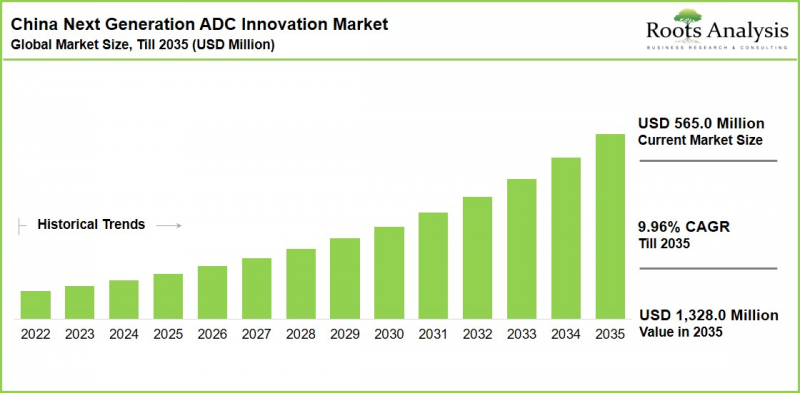
China Next-Generation ADC Innovation Market: Growth and Trends
Antibody-drug conjugates represent one of the fastest-growing modalities in oncology, combining the target specificity of monoclonal antibodies with the potent cytotoxicity of small-molecule payloads through engineered linker chemistries. Within this broader class, next-generation ADC platforms, including bispecific-antibody ADCs, dual-payload ADCs, site-specific conjugation formats, and immune-stimulating antibody conjugates (ISACs), are designed to overcome the therapeutic resistance and toxicity limitations associated with first-generation ADCs such as trastuzumab emtansine.
China has emerged as the epicenter of this innovation wave. Supported by a deep bench of antibody engineering talent, integrated CRO / CDMO infrastructure, government-backed biotech clusters, and a large, treatment-naive oncology patient pool that accelerates clinical enrollment, Chinese biopharmaceutical companies now account for a substantial proportion of clinical-stage ADC candidates globally, highlighting China's growing role in ADC drug development. Multinational pharmaceutical companies, facing an intensifying patent cliff and thinning late-stage oncology pipelines, have responded by aggressively in-licensing China-origin ADC candidates, often at record-setting deal values.
Industry deal-tracking data indicates that Chinese biopharmaceutical companies accounted for close to 90% of global ADC out-licensing transactions by deal count in the recent period, with cumulative China-origin biopharma out-licensing value rising nearly tenfold between 2021 and 2025. Landmark transactions, including multi-billion-dollar bispecific-ADC and dual-payload ADC licensing agreements with leading global oncology franchises, have validated the technical competitiveness of China's next-generation ADC platforms and established the domestic innovation ecosystem as a structural, rather than cyclical, feature of the global oncology pipeline.
Structurally, the market is transitioning from a manufacturing- and biosimilar-oriented base toward a first-in-class / best-in-class innovation model. Chinese developers are increasingly pursuing differentiated conjugation chemistries, novel topoisomerase-I inhibitor and camptothecin-derivative payloads, cleavable linker optimization, and bispecific-antibody targeting strategies (dual tumor-antigen or tumor-antigen / immune-checkpoint combinations) designed for improved efficacy in HER2-low, HER2-ultralow, and other biomarker-defined populations that remain underserved by first-generation ADCs.
Growth Drivers: Strategic Enablers of Market Expansion
China's next-generation ADC innovation market is driven by several structural advantages. China's large patient population, centralized clinical trial network, and streamlined regulatory processes enable faster and more cost-efficient clinical development than many Western markets. A strong ecosystem of antibody engineering expertise, supported by experienced talent and vertically integrated CDMO capabilities, accelerates the development and GMP manufacturing of advanced ADCs.
In addition, growing demand from global pharmaceutical companies for differentiated oncology assets amid patent expirations is increasing licensing and partnership opportunities for China-developed next-generation ADCs. Favorable regulatory reforms, accelerated review pathways, and sustained public and private investment continue to strengthen the country's innovation ecosystem, supporting long-term market growth.
Market Challenges: Critical Barriers Impeding Progress
Despite strong momentum, the market faces meaningful headwinds. Intensifying intra-China competition across overlapping target antigens (notably HER2, TROP2, and Nectin-4) is compressing differentiation and increasing clinical trial failure risk for later entrants. Payload-related toxicity, including interstitial lung disease and ocular toxicity observed across several ADC classes, continues to constrain therapeutic windows and complicate regulatory review.
Geopolitical and regulatory friction, including evolving cross-border data-integrity audit requirements and shifting biosecurity policy discussions in key export markets, introduces uncertainty into the licensing pathway that has underpinned much of the sector's recent valuation growth. Additionally, as global pharma licensing appetite concentrates around a narrow set of validated modalities, contingent "biobucks"-heavy deal structures with comparatively modest upfront payments leave many Chinese developers exposed to financing risk between milestones, and intensifying global IP scrutiny raises the bar for freedom-to-operate diligence on novel linker and payload chemistries.
CHINA NEXT-GENERATION ADC INNOVATION MARKET: KEY INSIGHTS
The report delves into the current state of the China next-generation ADC innovation market and identifies potential growth opportunities within the industry. Some key findings from the report include:
- Driven by rapid clinical validation and increasing global licensing appetite, close to 65% of next-generation ADC developers profiled in this report are based in the Yangtze River Delta and Guangdong-Shenzhen innovation clusters.
- Site-specific conjugated ADCs represent the largest technology platform segment (34% of the active pipeline), followed by bispecific-antibody ADCs (24%), reflecting the shift toward improved drug-to-antibody ratio control and reduced off-target toxicity.
- Bispecific and dual-payload ADC candidates originated in China accounted for a majority of ADC-specific global out-licensing transaction value disclosed since 2023, underscoring the technical competitiveness of domestic next-generation platforms.
- HER2, TROP2, and Nectin-4 remain the leading validated targets; however, emerging programs directed at B7-H3, Claudin18.2, and CEACAM5 are expected to open new indication areas, including gastric, pancreatic, and non-small cell lung cancers.
- Topoisomerase-I inhibitor and camptothecin-derivative payloads dominate the current China ADC pipeline, favored for their bystander effect and improved therapeutic index relative to legacy tubulin-targeting payloads.
- Cleavable linker chemistries account for the majority of pipeline candidates, owing to their favorable balance of plasma stability and intracellular payload release efficiency.
- Since 2023, China-origin ADC assets have been the subject of several multi-billion-dollar licensing agreements with global oncology franchises, with combined potential deal value (upfront plus milestones) across landmark transactions exceeding USD 25 billion.
- Close to 70% of next-generation ADC candidates in China are being developed for solid tumor indications, with breast, gastric, and urothelial cancers representing the leading target indications by number of active programs.
- Venture and strategic capital continue to flow into the domestic ecosystem, with private financing into China-based ADC-focused biotech companies increasing materially over the past three years, alongside a rising share of proceeds allocated toward global-standard GMP bioconjugation capacity.
- Given the pace of platform innovation, expanding licensing activity, and continued investment in bioconjugation infrastructure, the China next-generation ADC innovation market is well positioned for sustained, above-industry-average growth through 2035.
CHINA NEXT-GENERATION ADC INNOVATION MARKET: SEGMENTATION
The market sizing and opportunity analysis presented in this report has been segmented across the following parameters:
By Technology Platform
- Site-Specific Conjugated ADC
- Bispecific-Antibody ADC
- Dual-Payload ADC
- Immune-Stimulating Antibody Conjugate (ISAC)
- Conventional / First-Generation ADC
By Target Antigen
- HER2
- TROP2
- Nectin-4
- Claudin18.2
- B7-H3
- EGFR
- Other Targets
By Payload Class
- Topoisomerase I Inhibitors
- Camptothecin Derivatives
- Auristatins (MMAE / MMAF)
- Maytansinoids
- Other Payloads
By Linker Chemistry
- Cleavable Linkers
- Non-Cleavable Linkers
By Development Stage
- Preclinical / IND-Enabling
- Phase I
- Phase II
- Phase III
- Approved / Marketed
By Business Model
- In-House Development
- Out-Licensed / Co-Development
- CDMO-Enabled Partnership
By Indication
- Breast Cancer
- Gastric Cancer
- Urothelial Cancer
- Lung Cancer
- Hematological Malignancies
- Other Oncological Indications
By End User
- Hospitals
- Cancer Specialty Centers
- Ambulatory Infusion Centers
By Innovation Hub (within China)
- Yangtze River Delta (Shanghai / Suzhou / Jiangsu)
- Guangdong-Shenzhen
- Sichuan-Chongqing
- Beijing-Tianjin-Hebei
- Rest of China
CHINA NEXT-GENERATION ADC INNOVATION MARKET: KEY SEGMENTS
Site-Specific Conjugated ADCs Lead the Technology Landscape
Based on our market assessment, site-specific conjugation platforms currently represent the largest technology segment within China's next-generation ADC pipeline. Notably, this segment is also expected to maintain this position during the forecast period. This leadership is attributable to the superior drug-to-antibody ratio (DAR) uniformity, improved pharmacokinetic predictability, and reduced aggregation risk that site-specific approaches offer relative to stochastic, lysine- or cysteine-based conjugation.
Bispecific-Antibody ADCs Emerge as the Fastest-Growing Segment
Bispecific-antibody ADCs, which combine dual tumor-antigen targeting or tumor-antigen / immune-modulatory targeting within a single ADC construct, are projected to register the highest CAGR among all technology segments. This growth is driven by encouraging early clinical data in biomarker-heterogeneous solid tumors and by the landmark global licensing transactions that this class of assets has commanded since 2023.
Yangtze River Delta and Guangdong-Shenzhen Anchor China's ADC Innovation Base
Shanghai, Suzhou, Jiangsu, and the Guangdong-Shenzhen corridor account for the majority of next-generation ADC developers profiled in this study, supported by the concentration of bioconjugation CDMO capabilities, antibody engineering expertise, and venture capital networks in these regions. This dominance reflects the concentration of bioconjugation CDMO capacity, antibody engineering talent, and venture capital infrastructure in these clusters. The Sichuan-Chongqing hub has also emerged as a significant center of ADC innovation, anchored by globally licensed dual-payload and bispecific ADC programs originating from the region.
Solid Tumor Indications Account for the Majority of Pipeline Activity
Breast, gastric, and urothelial cancers collectively account for the largest share of active next-generation ADC programs in China. This largest share can be attributed to the historical validation of ADCs in HER2-driven breast cancer and the rapid expansion of TROP2 and Nectin-4-directed programs into adjacent solid tumor indications with high unmet need.
Example Innovators in the China Next-Generation ADC Innovation Market
Examples of key players engaged in next-generation ADC development in China include:
- CSPC Megalith Biopharmaceutical
- Duality Biologics
- GeneQuantum
- Hengrui Pharmaceuticals
- Innovent Biologics
- KYM Biosciences
- LaNova Medicines
- RemeGen
- Sichuan Baili Pharmaceutical
- Sichuan Kelun-Biotech Biopharmaceutical
CHINA NEXT-GENERATION ADC INNOVATION MARKET: RESEARCH COVERAGE
- Market Sizing and Opportunity Analysis: The report features an in-depth analysis of the China next-generation ADC innovation market, focusing on key market segments, including [A] technology platform, [B] target antigen, [C] payload class, [D] linker chemistry, [E] development stage, [F] business model, [G] indication, [H] end user, [I] innovation hub and [J] sales / licensing forecast.
- Next-Generation ADC Pipeline Landscape: A detailed assessment of the overall next-generation ADC pipeline in China, featuring information on stage of development, technology platform, target antigen, payload class, linker chemistry, and route of administration, alongside detailed analysis of developers based on year of establishment, company size, and location of headquarters.
- Company Profiles: In-depth profiles of prominent players engaged in China's next-generation ADC innovation ecosystem, featuring information on year of establishment, location of headquarters, company size, management team, product portfolio, and key initiatives.
- Clinical Trial Analysis: An analysis of completed and ongoing clinical trials related to China-origin next-generation ADCs, based on trial registration year, enrolled patient population, trial phase, trial status, type of sponsor / collaborator, study design, leading players, and geography.
- Drug / Candidate Failure Analysis: A dedicated analysis of drug / candidate failure by development stage, primary cause of failure, and technology platform and payload class.
- Success Protocol Analysis: A detailed assessment of successful next-generation ADC development protocols, examining selection criteria, the development journey of disitamab vedotin and sacituzumab tirumotecan (SKB264), and the key clinical, technological, regulatory, and strategic factors contributing to their success.
- Patent Analysis: An analysis of patents filed / granted related to next-generation ADC technologies in China since 2022, based on patent type, application / publication year, jurisdiction, CPC symbols, and type of applicant.
- Licensing, Partnerships and Deal-Making Analysis: A comprehensive analysis of licensing, partnerships, and deal-making activities in the China next-generation ADC innovation market, covering deal trends by year and type, financial structures, target antigens and therapeutic areas, leading licensors and licensees, and emerging cross-border licensing patterns.
- Funding and Investment Analysis: An analysis of venture capital, private equity, and strategic financing rounds raised by China-based next-generation ADC developers, based on year of funding, type of funding, amount raised, and most active investors.
- Recent Developments: A qualitative assessment of recent developments and global events in the China next-generation ADC innovation market, encompassing strategic collaborations and licensing agreements, funding and financing activities, and key scientific conferences and industry events.
- Competitive Benchmarking: A comparative assessment of leading next-generation ADC platforms based on technology differentiation, clinical validation, partnership track record, and manufacturing readiness.
- Porter's Five Forces Analysis: A qualitative analysis of five competitive forces in this domain, namely threat of new entrants, bargaining power of buyers, bargaining power of suppliers, threat of substitute modalities, and rivalry among existing competitors.
- Market Impact Analysis: The report analyzes various factors, such as drivers, restraints, opportunities, and challenges, affecting market growth.
KEY QUESTIONS ANSWERED IN THIS REPORT
- Which are the leading companies in the China next-generation ADC innovation market?
- Which technology platform and target antigen segments dominate the current pipeline?
- What is the current and future market size, and what is the CAGR of this market?
- What are the key trends and licensing patterns observed in China's ADC out-licensing activity?
- What factors are likely to influence the evolution of this market through 2035?
- What are the primary challenges faced by China-based next-generation ADC developers?
- How is the current and future market opportunity likely to be distributed across key market segments and innovation hubs?
- Which recent partnerships, funding rounds, and M&A transactions are shaping the competitive landscape?
REASONS TO BUY THIS REPORT
- The report provides a comprehensive market analysis, offering detailed revenue and deal-value projections for the overall market and its specific sub-segments, valuable to both established market leaders and emerging entrants.
- The report offers stakeholders a comprehensive overview of the market, including key drivers, barriers, opportunities, and challenges, empowering data-driven decision-making to capitalize on growth prospects.
- The report aids business development and licensing teams in identifying and benchmarking prospective China-origin ADC assets and partners across technology platforms and development stages.
- The report helps investors and corporate strategy teams identify future opportunities in this sector and evaluate whether those opportunities are worth pursuing.
- The report equips new entrants with the requisite information regarding this market to help them build successful business and market-entry strategies.
- The report allows for more effective communication with stakeholders and helps build strong business relationships across the China innovation ecosystem across the China innovation ecosystem.
Key Investment Considerations
- Upside Drivers: Structural patent-cliff-driven demand from multinational pharma, continued platform differentiation (bispecific / dual-payload / ISAC), faster and lower-cost clinical development, and an expanding base of globally credible developers.
- Key Risks: Intra-China target-antigen crowding, payload-class toxicity signals, contingent "biobucks" heavy deal structures that limit near-term cash realization and evolving cross-border regulatory / biosecurity policy affecting licensing flows.
- Scenario Range: This report's conservative, base, and optimistic forecast scenarios provide a defensible range for capital allocation and portfolio stress-testing across differing regulatory and clinical-attrition assumptions.
ADDITIONAL BENEFITS
- Complementary Excel Data Packs for all Analytical Modules in the Report
- 15% Free Content Customization
- Detailed Report Walkthrough Session with Research Team
- Free Updated Report if the Report is 6-12 Months Old or Older
TABLE OF CONTENTS
1. PREFACE
- 1.1. Introduction
- 1.2. Market Share Insights
- 1.3. Key Market Insights
- 1.4. Report Coverage
- 1.5. Key Questions Answered
- 1.6. Chapter Outlines
2. RESEARCH METHODOLOGY
- 2.1. Chapter Overview
- 2.2. Research Assumptions
- 2.2.1. Market Landscape and Market Trends
- 2.2.2. Market Forecast and Opportunity Analysis
- 2.2.3. Comparative Analysis
- 2.3. Database Building
- 2.3.1. Data Collection
- 2.3.2. Data Validation
- 2.3.3. Data Analysis
- 2.4. Project Methodology
- 2.4.1. Secondary Research
- 2.4.1.1. Annual Reports
- 2.4.1.2. Academic Research Papers
- 2.4.1.3. Company Websites
- 2.4.1.4. Investor Presentations
- 2.4.1.5. Regulatory Filings
- 2.4.1.6. White Papers
- 2.4.1.7. Industry Publications
- 2.4.1.8. Conferences and Seminars
- 2.4.1.9. Government Portals
- 2.4.1.10. Media and Press Releases
- 2.4.1.11. Newsletters
- 2.4.1.12. Industry Databases
- 2.4.1.13. Roots Proprietary Databases
- 2.4.1.14. Paid Databases and Sources
- 2.4.1.15. Social Media Portals
- 2.4.1.16. Other Secondary Sources
- 2.4.2. Primary Research
- 2.4.2.1. Types of Primary Research
- 2.4.2.1.1. Qualitative Research
- 2.4.2.1.2. Quantitative Research
- 2.4.2.1.3. Hybrid Approach
- 2.4.2.2. Advantages of Primary Research
- 2.4.2.3. Techniques for Primary Research
- 2.4.2.3.1. Interviews
- 2.4.2.3.2. Surveys
- 2.4.2.3.3. Focus Groups
- 2.4.2.3.4. Observational Research
- 2.4.2.3.5. Social Media Interactions
- 2.4.2.4. Key Opinion Leaders Considered in Primary Research
- 2.4.2.4.1. Company Executives (CXOs)
- 2.4.2.4.2. Board of Directors
- 2.4.2.4.3. Company Presidents and Vice Presidents
- 2.4.2.4.4. Research and Development Heads
- 2.4.2.4.5. Technical Experts
- 2.4.2.4.6. Subject Matter Experts
- 2.4.2.4.7. Scientists
- 2.4.2.4.8. Doctors and Other Healthcare Providers
- 2.4.2.5. Ethics and Integrity
- 2.4.2.5.1. Research Ethics
- 2.4.2.5.2. Data Integrity
- 2.4.2.1. Types of Primary Research
- 2.4.3. Analytical Tools and Databases
- 2.4.1. Secondary Research
- 2.5. Robust Quality Control
3. MARKET DYNAMICS
- 3.1. Chapter Overview
- 3.2. Forecast Methodology
- 3.2.1. Top-down Approach
- 3.2.2. Bottom-up Approach
- 3.2.3. Hybrid Approach
- 3.3. Market Assessment Framework
- 3.3.1. Total Addressable Market (TAM)
- 3.3.2. Serviceable Addressable Market (SAM)
- 3.3.3. Serviceable Obtainable Market (SOM)
- 3.3.4. Currently Acquired Market (CAM)
- 3.4. Forecasting Tools and Techniques
- 3.4.1. Qualitative Forecasting
- 3.4.2. Correlation
- 3.4.3. Regression
- 3.4.4. Extrapolation
- 3.4.5. Convergence
- 3.4.6. Sensitivity Analysis
- 3.4.7. Scenario Planning
- 3.4.8. Data Visualization
- 3.4.9. Time Series Analysis
- 3.4.10. Forecast Error Analysis
- 3.5. Key Considerations
- 3.5.1. Demographics
- 3.5.2. Government Regulations
- 3.5.3. Reimbursement Scenarios
- 3.5.4. Market Access
- 3.5.5. Supply Chain
- 3.5.6. Industry Consolidation
- 3.5.7. Pandemic / Unforeseen Disruptions Impact
- 3.6. Limitations
4. MACRO-ECONOMIC INDICATORS
- 4.1. Chapter Overview
- 4.2. Market Dynamics
- 4.2.1. Time Period
- 4.2.1.1. Historical Trends
- 4.2.1.2. Current and Forecasted Estimates
- 4.2.2. Currency Coverage
- 4.2.2.1. Major Currencies Affecting the Market
- 4.2.2.2. Factors Affecting Currency Fluctuations on the Industry
- 4.2.2.3. Impact of Currency Fluctuations on the Industry
- 4.2.3. Foreign Currency Exchange Rate
- 4.2.3.1. Impact of Foreign Exchange Rate Volatility on the Market
- 4.2.3.2. Strategies for Mitigating Foreign Exchange Risk
- 4.2.4. Recession
- 4.2.4.1. Assessment of Current Economic Conditions and Potential Impact on the Market
- 4.2.4.2. Historical Analysis of Past Recessions and Lessons Learnt
- 4.2.5. Inflation
- 4.2.5.1. Measurement and Analysis of Inflationary Pressures in the Economy
- 4.2.5.2. Potential Impact of Inflation on the Market Evolution
- 4.2.6. Interest Rates
- 4.2.6.1. Interest Rates and Their Impact on the Market
- 4.2.6.2. Strategies for Managing Interest Rate Risk
- 4.2.7. Commodity Flow Analysis
- 4.2.7.1. Type of Commodity
- 4.2.7.2. Origins and Destinations
- 4.2.7.3. Values and Weights
- 4.2.7.4. Modes of Transportation
- 4.2.8. Global Trade Dynamics
- 4.2.8.1. Import Scenario
- 4.2.8.2. Export Scenario
- 4.2.8.3. Trade Policies
- 4.2.8.4. Strategies for Mitigating the Risks Associated with Trade Barriers
- 4.2.8.5. Impact of Trade Barriers on the Market
- 4.2.9. War Impact Analysis
- 4.2.9.1. Russian-Ukraine War
- 4.2.9.2. Israel-Hamas War
- 4.2.10. COVID Impact / Related Factors
- 4.2.10.1. Global Economic Impact
- 4.2.10.2. Industry-specific Impact
- 4.2.10.3. Government Response and Stimulus Measures
- 4.2.10.4. Future Outlook and Adaptation Strategies
- 4.2.11. Other Indicators
- 4.2.11.1. Fiscal Policy
- 4.2.11.2. Consumer Spending
- 4.2.11.3. Gross Domestic Product
- 4.2.11.4. Employment
- 4.2.11.5. Taxes
- 4.2.11.6. Stock Market Performance
- 4.2.11.7. Cross Border Dynamics
- 4.2.1. Time Period
- 4.3. Conclusion
5. EXECUTIVE SUMMARY
7. MARKET LANDSCAPE: CHINA NEXT-GENERATION ADC PIPELINE
- 7.1. Research Scope and Evaluation Criteria
- 7.2. Analysis by Stage of Development
- 7.3. Analysis by Technology Platform
- 7.4. Analysis by Target Antigen
- 7.5. Analysis by Payload Class
- 7.6. Analysis by Linker Chemistry
- 7.7. Analysis by Route of Administration
- 7.8. Analysis by Therapeutic Indication
- 7.9. Analysis by Business Model
- 7.10. Analysis by Year of Establishment
- 7.11. Analysis by Company Size
- 7.12. Analysis by Innovation Hub / Headquarters Location
8. COMPANY PROFILES
- 8.1. Leading Developers of Next-Generation ADCs
- 8.1.1. CSPC Megalith Biopharmaceutical
- 8.1.2. Duality Biologics
- 8.1.3. GeneQuantum
- 8.1.4. Hengrui Pharmaceuticals
- 8.1.5. Innovent Biologics
- 8.1.6. KYM Biosciences
- 8.1.7. LaNova Medicines
- 8.1.8. RemeGen
- 8.1.9. Sichuan Baili Pharmaceutical
- 8.1.10. Sichuan Kelun-Biotech Biopharmaceutical
9. CLINICAL TRIAL ANALYSIS
- 9.1. Research Scope and Inclusion Criteria
- 9.2. Analysis by Trial Registration Year
- 9.3. Analysis by Trial Phase and Recruitment Status
- 9.4. Analysis by Patient Enrollment
- 9.5. Analysis by Sponsor and Collaborator Type
- 9.6. Analysis by Therapeutic Indication
- 9.7. Leading Clinical Trial Sponsors
- 9.8. Geographic Distribution of Clinical Trials
10. DRUG / CANDIDATE FAILURE ANALYSIS
- 10.1. Research Scope and Inclusion Criteria
- 10.2. Analysis by Development Stage
- 10.3. Analysis by Primary Cause of Failure
- 10.4. Analysis by Technology Platform and Payload Class
11. SUCCESS PROTOCOL ANALYSIS
- 11.1. Introduction
- 11.2. Selection Criteria for Success Protocols
- 11.3. Disitamab Vedotin (RemeGen): Development Journey and Success Analysis
- 11.4. Sacituzumab Tirumotecan (SKB264): Development Journey and Success Analysis
- 11.5. Key Success Factors and Strategic Insights
12. PATENT ANALYSIS
- 12.1. Introduction
- 12.2. Research Methodology and Scope
- 12.3. Patent Publication and Filing Trends
- 12.4. Analysis by Jurisdiction and CPC Classification
- 12.5. Analysis by Applicant Type
- 12.6. Leading Patent Assignees
- 12.7. Patent Strength and Competitive Benchmarking
13. LICENSING, PARTNERSHIPS AND DEAL-MAKING ANALYSIS
- 13.1. Introduction
- 13.2. Analysis by Year and Deal Type
- 13.3. Analysis by Financial Structure
- 13.4. Analysis by Target Antigen and Therapeutic Area
- 13.5. Leading Licensors and Licensees
- 13.6. Cross-Border Licensing Trends
14. FUNDING AND INVESTMENT ANALYSIS
- 14.1. Introduction
- 14.2. Funding Trends by Investment Type
- 14.3. Analysis of Capital Deployed
- 14.4. Leading Investors and Investment Activity
- 14.5. Key Investment Insights
15. RECENT DEVELOPMENTS AND GLOBAL EVENTS
- 15.1. Introduction
- 15.2. Strategic Collaborations and Licensing Agreements
- 15.3. Funding and Financing Activities
- 15.4. Scientific Conferences and Industry Events
16. COMPETITIVE BENCHMARKING
- 16.1. Introduction
- 16.2. Benchmarking Framework
- 16.3. Technology and Innovation Assessment
- 16.4. Clinical, Regulatory and Commercial Benchmarking
17. PORTER'S FIVE FORCES ANALYSIS
- 17.1. Introduction
- 17.2. Threat of New Entrants
- 17.3. Bargaining Power of Buyers
- 17.4. Bargaining Power of Suppliers
- 17.5. Threat of Substitute Technologies
- 17.6. Competitive Rivalry
- 17.7. Key Takeaways
18. MARKET IMPACT ANALYSIS
- 18.1. Introduction
- 18.2. Market Drivers
- 18.3. Market Restraints
- 18.4. Market Opportunities
- 18.5. Market Challenges
19. CHINA NEXT-GENERATION ADC INNOVATION MARKET
- 19.1. Chapter Overview
- 19.2. Key Assumptions and Methodology
- 19.3. China Next-Generation ADC Innovation Market, Historical Trends (Since 2022) and Forecasted Estimates (Till 2035)
- 19.3.1. Scenario Analysis
- 19.3.1.1. Conservative Scenario
- 19.3.1.2. Optimistic Scenario
- 19.3.1. Scenario Analysis
- 19.4. Key Market Segmentations
20. CHINA NEXT-GENERATION ADC INNOVATION MARKET, BY TYPE OF TECHNOLOGY PLATFORM
- 20.1. Chapter Overview
- 20.2. Key Assumptions and Methodology
- 20.3. China Next-Generation ADC Innovation Market: Distribution by Type of Technology Platform
- 20.3.1. China Next-Generation ADC Innovation Market for Site-Specific Conjugated ADCs, Historical Trends (Since 2022) and Forecasted Estimates (Till 2035)
- 20.3.2. China Next-Generation ADC Innovation Market for Bispecific ADCs, Historical Trends (Since 2022) and Forecasted Estimates (Till 2035)
- 20.3.3. China Next-Generation ADC Innovation Market for Dual-Payload ADCs, Historical Trends (Since 2022) and Forecasted Estimates (Till 2035)
- 20.3.4. China Next-Generation ADC Innovation Market for Immune-Stimulating Antibody Conjugates (ISACs), Historical Trends (Since 2022) and Forecasted Estimates (Till 2035)
- 20.3.5. China Next-Generation ADC Innovation Market for Conventional ADCs, Historical Trends (Since 2022) and Forecasted Estimates (Till 2035)
- 20.4. Data Triangulation and Validation
21. CHINA NEXT-GENERATION ADC INNOVATION MARKET, BY TARGET ANTIGEN
- 21.1. Chapter Overview
- 21.2. Key Assumptions and Methodology
- 21.3. China Next-Generation ADC Innovation Market: Distribution by Target Antigen
- 21.3.1. China Next-Generation ADC Innovation Market for HER2, Historical Trends (Since 2022) and Forecasted Estimates (Till 2035)
- 21.3.2. China Next-Generation ADC Innovation Market for TROP2, Historical Trends (Since 2022) and Forecasted Estimates (Till 2035)
- 21.3.3. China Next-Generation ADC Innovation Market for Nectin-4, Historical Trends (Since 2022) and Forecasted Estimates (Till 2035)
- 21.3.4. China Next-Generation ADC Innovation Market for Claudin18.2, Historical Trends (Since 2022) and Forecasted Estimates (Till 2035)
- 21.3.5. China Next-Generation ADC Innovation Market for B7-H3, Historical Trends (Since 2022) and Forecasted Estimates (Till 2035)
- 21.3.6. China Next-Generation ADC Innovation Market for EGFR, Historical Trends (Since 2022) and Forecasted Estimates (Till 2035)
- 21.3.7. China Next-Generation ADC Innovation Market for Other Emerging Targets, Historical Trends (Since 2022) and Forecasted Estimates (Till 2035)
- 21.4. Data Triangulation and Validation
22. CHINA NEXT-GENERATION ADC INNOVATION MARKET, BY PAYLOAD CLASS
- 22.1. Chapter Overview
- 22.2. Key Assumptions and Methodology
- 22.3. China Next-Generation ADC Innovation Market: Distribution by Payload Class
- 22.3.1. China Next-Generation ADC Innovation Market for Topoisomerase I Inhibitors, Historical Trends (Since 2022) and Forecasted Estimates (Till 2035)
- 22.3.2. China Next-Generation ADC Innovation Market for Camptothecin Derivatives, Historical Trends (Since 2022) and Forecasted Estimates (Till 2035)
- 22.3.3. China Next-Generation ADC Innovation Market for Auristatins, Historical Trends (Since 2022) and Forecasted Estimates (Till 2035)
- 22.3.4. China Next-Generation ADC Innovation Market for Maytansinoids, Historical Trends (Since 2022) and Forecasted Estimates (Till 2035)
- 22.3.5. China Next-Generation ADC Innovation Market for Other Payload Classes, Historical Trends (Since 2022) and Forecasted Estimates (Till 2035)
- 22.4. Data Triangulation and Validation
23. CHINA NEXT-GENERATION ADC INNOVATION MARKET, BY LINKER CHEMISTRY
- 23.1. Chapter Overview
- 23.2. Key Assumptions and Methodology
- 23.3. China Next-Generation ADC Innovation Market: Distribution by Linker Chemistry
- 23.3.1. China Next-Generation ADC Innovation Market for Cleavable Linkers, Historical Trends (Since 2022) and Forecasted Estimates (Till 2035)
- 23.3.2. China Next-Generation ADC Innovation Market for Non-Cleavable Linkers, Historical Trends (Since 2022) and Forecasted Estimates (Till 2035)
- 23.4. Data Triangulation and Validation
24. CHINA NEXT-GENERATION ADC INNOVATION MARKET, BY BUSINESS MODEL
- 24.1. Chapter Overview
- 24.2. Key Assumptions and Methodology
- 24.3. China Next-Generation ADC Innovation Market: Distribution by Business Model
- 24.3.1. China Next-Generation ADC Innovation Market for Development Stage, Historical Trends (Since 2022) and Forecasted Estimates (Till 2035)
- 24.3.2. China Next-Generation ADC Innovation Market for Business Model, Historical Trends (Since 2022) and Forecasted Estimates (Till 2035)
- 24.4. Data Triangulation and Validation
25. CHINA NEXT-GENERATION ADC INNOVATION MARKET, BY THERAPEUTIC INDICATION
- 25.1. Chapter Overview
- 25.2. Key Assumptions and Methodology
- 25.3. China Next-Generation ADC Innovation Market: Distribution by Therapeutic Indication
- 25.3.1. China Next-Generation ADC Innovation Market for Breast Cancer, Historical Trends (Since 2022) and Forecasted Estimates (Till 2035)
- 25.3.2. China Next-Generation ADC Innovation Market for Gastric Cancer, Historical Trends (Since 2022) and Forecasted Estimates (Till 2035)
- 25.3.3. China Next-Generation ADC Innovation Market for Urothelial Cancer, Historical Trends (Since 2022) and Forecasted Estimates (Till 2035)
- 25.3.4. China Next-Generation ADC Innovation Market for Lung Cancer, Historical Trends (Since 2022) and Forecasted Estimates (Till 2035)
- 25.3.5. China Next-Generation ADC Innovation Market for Hematological Malignancy, Historical Trends (Since 2022) and Forecasted Estimates (Till 2035)
- 25.3.6. China Next-Generation ADC Innovation Market for Other Indications, Historical Trends (Since 2022) and Forecasted Estimates (Till 2035)
- 25.4. Data Triangulation and Validation
26. CHINA NEXT-GENERATION ADC INNOVATION MARKET, BY END USER
- 26.1. Chapter Overview
- 26.2. Key Assumptions and Methodology
- 26.3. China Next-Generation ADC Innovation Market: Distribution by End User
- 26.3.1. China Next-Generation ADC Innovation Market for Hospitals, Historical Trends (Since 2022) and Forecasted Estimates (Till 2035)
- 26.3.2. China Next-Generation ADC Innovation Market for Cancer Specialty Centers, Historical Trends (Since 2022) and Forecasted Estimates (Till 2035)
- 26.3.3. China Next-Generation ADC Innovation Market for Ambulatory Infusion Centers, Historical Trends (Since 2022) and Forecasted Estimates (Till 2035)
- 26.4. Data Triangulation and Validation
27. CHINA NEXT-GENERATION ADC INNOVATION MARKET, BY INNOVATION HUB
- 27.1. Chapter Overview
- 27.2. Key Assumptions and Methodology
- 27.3. China Next-Generation ADC Innovation Market: Distribution by Innovation Hub
- 27.3.1. China Next-Generation ADC Innovation Market for Yangtze River Delta, Historical Trends (Since 2022) and Forecasted Estimates (Till 2035)
- 27.3.2. China Next-Generation ADC Innovation Market for Guangdong-Shenzhen, Historical Trends (Since 2022) and Forecasted Estimates (Till 2035)
- 27.3.3. China Next-Generation ADC Innovation Market for Sichuan-Chongqing, Historical Trends (Since 2022) and Forecasted Estimates (Till 2035)
- 27.3.4. China Next-Generation ADC Innovation Market for Beijing-Tianjin-Hebei, Historical Trends (Since 2022) and Forecasted Estimates (Till 2035)
- 27.3.5. China Next-Generation ADC Innovation Market for Rest of China, Historical Trends (Since 2022) and Forecasted Estimates (Till 2035)
- 27.4. Data Triangulation and Validation
28. CONCLUDING REMARKS
29. APPENDIX I: TABULATED DATA

