PUBLISHER: Roots Analysis | PRODUCT CODE: 2125137

PUBLISHER: Roots Analysis | PRODUCT CODE: 2125137
Europe Non-Viral Transfection Reagents Market by Type of Non-Viral Transfection Method, Application Area, and End-User- Trends and Forecast Till 2035
EUROPE NON-VIRAL TRANSFECTION REAGENTS MARKET: OVERVIEW
As per Roots Analysis, the Europe non-viral transfection reagents market is estimated to grow from USD 0.24 billion in the current year to USD 0.40 billion by 2035, at a CAGR of 5.7% during the forecast period, till 2035.
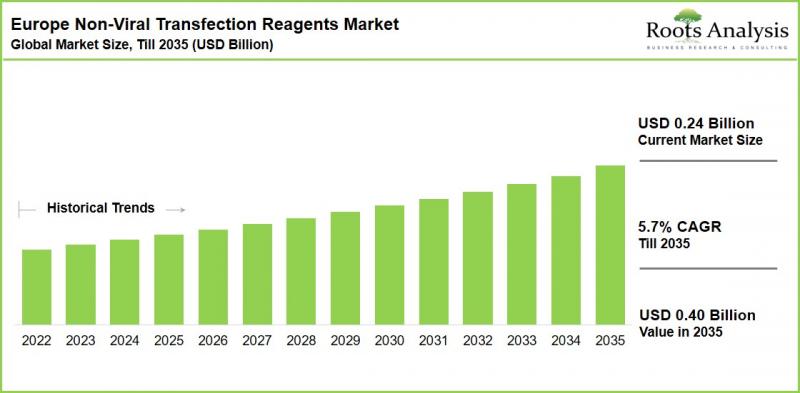
Europe Non-Viral Transfection Reagents Market: Growth and Trends
Non-viral transfection reagents encompass chemical and physical delivery systems designed to introduce nucleic acid cargo, including plasmid DNA, mRNA, siRNA and gene-editing components, into target cells without the use of viral vectors. Their comparatively lower manufacturing complexity, favorable safety characteristics and operational flexibility relative to viral delivery systems have established these reagents as essential tools across academic research institutions, biotechnology companies, pharmaceutical developers and advanced therapy organizations throughout Europe.
Demand is supported by Europe's well-established life sciences ecosystem, with major biotechnology and biopharmaceutical clusters across Germany, France, the UK, Italy and Spain. The region's extensive network of universities, research institutes, biopharmaceutical companies and advanced therapy developers remains actively engaged in gene editing, mRNA therapeutics, ex vivo cell engineering, oncology research and rare disease programs, creating sustained demand for reliable and reproducible transfection workflows.
Europe also benefits from a well-developed supplier and technology landscape. France-based Polyplus, now part of Sartorius, represents a prominent regional supplier of upstream reagents and technologies supporting biologics manufacturing and cell and gene therapy production. The presence of established technology providers and manufacturing capabilities within the region strengthens supply continuity across research, process development and translational applications.
Increasing investment in nucleic acid-based therapeutics and advanced therapy development is expected to provide an additional demand catalyst. For instance, BioNTech's expanded collaboration with the UK government, involving planned investment of up to GBP 1 billion over ten years in domestic research and development activities, highlights the scale of investment being directed toward mRNA and gene-modulation research. Such initiatives are likely to expand the underlying need for dependable transfection technologies across discovery, preclinical and process-development workflows.
Despite these favorable conditions, market participants continue to face technical and operational challenges, including variability in transfection efficiency and cell viability across cell types, reagent stability limitations, and the complexities associated with transitioning from research-grade products to GMP-compatible workflows. Nevertheless, continued investment in advanced therapies, broader adoption of genome-editing technologies and growing industry interest in non-viral alternatives to viral vectors are expected to create sustained growth opportunities for non-viral transfection reagent suppliers across Europe.
Growth Drivers: Factors Fueling Market Expansion
- Expanding Functional Genomics Research: European academic and translational research groups are increasingly deploying non-viral transfection reagents to support CRISPR-based screening, RNA interference studies, reporter assays, iPSC-derived models, organoid systems and other disease-specific cellular models. These workflows require dependable delivery of plasmids, siRNA, mRNA and gene-editing cargo across a wide variety of cell types. As high-throughput screening and cell-based assay programs continue to scale across the continent's laboratories, demand for reproducible, easy-to-use, cell-type-specific transfection reagents is expected to rise correspondingly.
- Shift Towards Non-Viral Delivery Approaches: Developers across Europe are progressively evaluating non-viral delivery routes during the early stages of cell and gene therapy development, largely to reduce dependence on viral vectors, simplify downstream process development, and preserve flexibility while optimizing candidate constructs. Non-viral reagents are particularly well suited to applications requiring transient expression, rapid construct screening, gene modulation studies, and early feasibility testing ahead of a developer's eventual transition to more complex, clinical-scale delivery systems. This trend is likely to sustain reagent demand across research, preclinical development and process optimization activities alike.
Market Challenges: Critical Barriers Hindering Progress
- Variable Performance Across Cell Types: European research and translational programs frequently work with primary cells, immune cells, stem cells, iPSCs, organoids and patient-derived samples, each of which can respond quite differently to an identical transfection reagent. This variability creates recurring challenges around delivery efficiency, cell viability, reproducibility and cross-laboratory assay comparability, often requiring extensive per-cell-type optimization that extends development timelines and constrains routine, standardized adoption for more complex cell models.
- High Cost and Procurement Constraints: A considerable share of European demand originates from universities, public research institutes and hospital-affiliated laboratories, where purchasing decisions are frequently shaped by grant funding cycles, institutional procurement policies and country-specific budget limitations. Premium reagent formulations and GMP-compatible products can, as a result, see comparatively slower uptake in cost-sensitive settings, posing an ongoing challenge for suppliers seeking to scale adoption across Europe's fragmented customer base.
Europe Non-Viral Transfection Reagents Market: Key Insights
The report delves into the current state of the Europe non-viral transfection reagents market and identifies potential growth opportunities within the industry, particularly from a distributor and channel-partner perspective. Some key findings include:
- Leading players in this space include Biontex Laboratories, Lonza, MilliporeSigma, OZ Biosciences, PromoCell, QIAGEN, Sartorius (Polyplus) and ScreenFect.
- Recently, OZ Biosciences shared application data for a proprietary lipid nanoparticle formulation targeting difficult-to-transfect primary human stem cell workflows, underscoring continued technology refinement in this space.
- Clinical translation of non-viral cell-engineering approaches is advancing, illustrated by a European developer's regulatory clearance to begin a first-in-human trial for a non-viral CAR-T candidate targeting relapsed or refractory blood cancers.
- Recognition of newer entrants is growing, as demonstrated by an emerging European platform's shortlisting for innovation honors at a leading laboratory automation and screening industry conference.
- Given rising investment in mRNA and advanced therapy programs, continued expansion of functional genomics research, and Europe's strong reagent-manufacturing base, the market is expected to sustain steady growth through the forecast period.
Europe Non-Viral Transfection Reagents Market Segments
The Europe non-viral transfection reagents market is segmented across the following parameters:
By Type of Non-Viral Transfection Method
- Chemical Methods
- Physical Methods
- Other Methods
By Application Area
- Research Applications
- Clinical Applications
By End-User
- Academic and Research Institutions
- Pharmaceutical and Biopharmaceutical Companies
- Contract Manufacturers
- Other End-Users
Europe Non-Viral Transfection Reagents Market: Key Segments Insight
Chemical Methods Continue to Anchor the Market
Chemical transfection methods currently represent the largest segment of the Europe non-viral transfection reagents market, a position they are expected to retain across the forecast period. This leadership reflects their routine use in plasmid DNA delivery, siRNA-based gene silencing, mRNA delivery and transient protein expression work, coupled with their relative ease of use and cost-efficiency compared to physical delivery approaches, factors that continue to support broad adoption across academic and industry laboratories alike.
On the other hand, physical transfection methods, led by electroporation-based systems, are projected to grow at a comparatively faster CAGR during the forecast period. This trend is being driven by rising use of such systems for primary cells, immune cells, stem cells and other difficult-to-transfect cell populations, as European developers continue to expand ex vivo cell engineering, gene editing and early-stage cell therapy research activities.
Academic and Research Institutions Retain the Largest End-User Share
Academic and research institutions account for the largest share of the Europe non-viral transfection reagents market. This leadership is underpinned by Europe's dense network of universities, public research institutes, hospital-linked research centers and translational laboratories, which collectively generate steady, recurring reagent demand across cell line optimization, protocol screening, gene silencing and genome-editing workflows.
Pharmaceutical and Biopharmaceutical Companies Poised for Faster Growth
While academic institutions currently lead in overall volume, pharmaceutical and biopharmaceutical companies are expected to grow at a comparatively higher rate over the forecast period, as these organizations scale up the use of non-viral reagents for target validation, screening, lead optimization and early process development linked to mRNA, gene-editing and cell therapy programs.
Western Europe Remains the Innovation and Demand Epicenter
Germany, France and the UK together host a substantial share of Europe's non-viral transfection reagent demand, supported by concentrated biotechnology clusters, translational research infrastructure and the presence of established reagent suppliers, including France-based Polyplus (part of Sartorius) and Germany-headquartered Biontex Laboratories and Merck. Rest of Europe markets, including Italy and Spain, are expected to see steady incremental growth as regional research capacity continues to expand.
Example Players in Europe Non-Viral Transfection Reagents Market
- Biontex Laboratories
- Lonza
- MilliporeSigma
- OZ Biosciences
- PromoCell
- QIAGEN
- Sartorius
- ScreenFect
Expert Interview and Industry Insights
The opinions and insights presented in this study were shaped by discussions with multiple stakeholders across the value chain. The research report features detailed transcripts of interviews held with the following industry participants:
- Former Vice President, Business Development and Partnerships, Small Company, US
- Former Global Business Development Manager, Clinical Operations, Mid-sized Company, France
- Researcher, Mid-sized Company, Chile
In addition, the market report includes transcripts of the following other third-party discussions:
- Chairman and Chief Executive Officer, Mid-sized Company, US
- Co-Founder and Chief Executive Officer, Small Company, US
- Chief Scientific Officer and Executive Vice President of R&D, Mid-sized Company, US
- Chief Scientific Officer, Mid-sized Company, US
- Chief Scientific Officer, Small Company, Germany
- Vice President of Cell Therapy Process Development, Large Company, US
- Group Leader of R&D Transfection, and Director and Senior Product Manager, Large Company, Switzerland
- Director, Senior Product Manager, Very Large Company, Switzerland
- Senior Vice President of Technical Applications, Mid-sized Company, US
- Head of Transfection R&D, Very Large Company, Switzerland
EUROPE NON-VIRAL TRANSFECTION REAGENTS MARKET: RESEARCH COVERAGE
- Market Sizing and Opportunity Analysis: An in-depth analysis of the Europe non-viral transfection reagents market, focused on key market segments, including [A] type of non-viral transfection method, [B] application area, and [C] end-user.
- Europe Non-Viral Transfection Reagents Market Landscape: A detailed assessment of the overall market landscape, featuring analysis by compatible cell type / line, transfected molecule, type of transfection carrier used, type of cell culture and serum compatibility, along with profiling of reagent providers based on year of establishment, company size and location of headquarters.
- Europe Electroporation-Based Transfection Systems Landscape: A detailed assessment of the electroporation-based transfection systems market, covering compatible cell type / line, transfected molecule, type of waveform and pulse voltage, along with an overview of leading system providers.
- Other Non-Viral Transfection Technologies / Systems Landscape: An assessment of additional non-viral transfection technologies and systems available in Europe, based on type of offering, compatible cell type / line and transfected molecule.
- Company Competitiveness Analysis: A proprietary benchmarking of non-viral transfection reagent providers based in Europe across relevant competitiveness parameters.
- Technology Competitiveness Analysis: A comparative benchmarking of electroporation-based and other non-viral transfection technologies / systems offered by Europe-based players.
- Company Profiles: In-depth profiles of prominent players engaged in the Europe non-viral transfection reagents domain, featuring company overview, financial information, product portfolio and recent developments.
- Potential Strategic Partners: An analysis identifying potential strategic partners for non-viral transfection reagent and system providers based in Europe, categorized as most likely, likely, less likely and least likely partners.
- Market Trends Analysis: An assessment of prevailing trends across ex vivo and in vivo therapy development, along with the evolving balance between viral and non-viral vector adoption.
- Patent Analysis: An analysis of patents filed / granted related to non-viral transfection reagents and systems, based on patent publication year, application year, jurisdiction, CPC symbols, type of applicant, patent benchmarking and patent valuation.
- Publication Analysis: An assessment of academic and scientific publication activity related to non-viral transfection, based on year of publication, publishing organizations, journal impact factor and copyright holders.
- Roots Analysis Pricing Strategy Framework: A proprietary pricing evaluation framework benchmarking products based on transfection efficiency, compatible cell type / line, type of carrier used, type of molecule delivered and type of reagent.
- Market Impact Analysis: The report analyzes various factors, such as drivers, restraints, opportunities and challenges, likely to influence market growth.
Key Questions Answered in this Report
- What is a non-viral method of transfection?
- How big is the Europe non-viral transfection reagents market?
- What is the projected growth (CAGR) of this market through 2035?
- Which type of non-viral transfection method holds the largest market share?
- Which end-user segment accounts for the highest market share?
- Who are the leading players operating in this market?
- What are the key trends and drivers shaping this market?
- What are the primary challenges faced by non-viral transfection reagent providers in Europe?
- How is the market opportunity likely to be distributed across country-level markets within Europe?
Reasons to Buy this Report
This report has been specifically developed to support distributors, channel partners, and business development teams evaluating entry into the Europe non-viral transfection reagents market.
- The report provides a comprehensive market analysis, offering detailed revenue projections for the overall Europe non-viral transfection reagents market and its specific sub-segments, valuable to both established suppliers and emerging entrants.
- It offers stakeholders a well-rounded overview of the market, including key drivers, restraints, opportunities and challenges, empowering data-driven decision-making.
- It aids businesses in identifying and evaluating future opportunities across the non-viral transfection reagents value chain.
- It helps stakeholders understand end-user needs, preferences and procurement behavior in order to tailor products and commercial strategies effectively.
- It equips new entrants with the requisite market intelligence to build informed go-to-market and business development strategies for the European region.
- It supports more effective, evidence-based communication with investors, partners and other stakeholders.
Additional Benefits
- Complementary PPT Insights Pack
- Complementary Excel Data Packs for all Analytical Modules in the Report
- 15% Free Content Customization
- Detailed Report Walkthrough Session with Research Team
- Free Updated report if the report is 6-12 months old or older
TABLE OF CONTENTS
1. PREFACE
- 1.1. Introduction
- 1.2. Market Share Insights
- 1.3. Key Market Insights
- 1.4. Report Coverage
- 1.5. Key Questions Answered
- 1.6. Chapter Outlines
2. RESEARCH METHODOLOGY
- 2.1. Chapter Overview
- 2.2. Research Assumptions
- 2.2.1. Market Landscape and Market Trends
- 2.2.2. Market Forecast and Opportunity Analysis
- 2.2.3. Comparative Analysis
- 2.3. Database Building
- 2.3.1. Data Collection
- 2.3.2. Data Validation
- 2.3.3. Data Analysis
- 2.4. Project Methodology
- 2.4.1. Secondary Research
- 2.4.1.1. Annual Reports
- 2.4.1.2. Academic Research Papers
- 2.4.1.3. Company Websites
- 2.4.1.4. Investor Presentations
- 2.4.1.5. Regulatory Filings
- 2.4.1.6. White Papers
- 2.4.1.7. Industry Publications
- 2.4.1.8. Conferences and Seminars
- 2.4.1.9. Government Portals
- 2.4.1.10. Media and Press Releases
- 2.4.1.11. Newsletters
- 2.4.1.12. Industry Databases
- 2.4.1.13. Roots Proprietary Databases
- 2.4.1.14. Paid Databases and Sources
- 2.4.1.15. Social Media Portals
- 2.4.1.16. Other Secondary Sources
- 2.4.2. Primary Research
- 2.4.2.1. Types of Primary Research
- 2.4.2.1.1. Qualitative Research
- 2.4.2.1.2. Quantitative Research
- 2.4.2.1.3. Hybrid Approach
- 2.4.2.2. Advantages of Primary Research
- 2.4.2.3. Techniques for Primary Research
- 2.4.2.3.1. Interviews
- 2.4.2.3.2. Surveys
- 2.4.2.3.3. Focus Groups
- 2.4.2.3.4. Observational Research
- 2.4.2.3.5. Social Media Interactions
- 2.4.2.4. Key Opinion Leaders Considered in Primary Research
- 2.4.2.4.1. Company Executives (CXOs)
- 2.4.2.4.2. Board of Directors
- 2.4.2.4.3. Company Presidents and Vice Presidents
- 2.4.2.4.4. Research and Development Heads
- 2.4.2.4.5. Technical Experts
- 2.4.2.4.6. Subject Matter Experts
- 2.4.2.4.7. Scientists
- 2.4.2.4.8. Doctors and Other Healthcare Providers
- 2.4.2.5. Ethics and Integrity
- 2.4.2.5.1. Research Ethics
- 2.4.2.5.2. Data Integrity
- 2.4.2.1. Types of Primary Research
- 2.4.3. Analytical Tools and Databases
- 2.4.1. Secondary Research
- 2.5. Robust Quality Control
3. MARKET DYNAMICS
- 3.1. Chapter Overview
- 3.2. Forecast Methodology
- 3.2.1. Top-down Approach
- 3.2.2. Bottom-up Approach
- 3.2.3. Hybrid Approach
- 3.3. Market Assessment Framework
- 3.3.1. Total Addressable Market (TAM)
- 3.3.2. Serviceable Addressable Market (SAM)
- 3.3.3. Serviceable Obtainable Market (SOM)
- 3.3.4. Currently Acquired Market (CAM)
- 3.4. Forecasting Tools and Techniques
- 3.4.1. Qualitative Forecasting
- 3.4.2. Correlation
- 3.4.3. Regression
- 3.4.4. Extrapolation
- 3.4.5. Convergence
- 3.4.6. Sensitivity Analysis
- 3.4.7. Scenario Planning
- 3.4.8. Data Visualization
- 3.4.9. Time Series Analysis
- 3.4.10. Forecast Error Analysis
- 3.5. Key Considerations
- 3.5.1. Demographics
- 3.5.2. Government Regulations
- 3.5.3. Reimbursement Scenarios
- 3.5.4. Market Access
- 3.5.5. Supply Chain
- 3.5.6. Industry Consolidation
- 3.5.7. Pandemic / Unforeseen Disruptions Impact
- 3.6. Limitations
4. MACRO-ECONOMIC INDICATORS
- 4.1. Chapter Overview
- 4.2. Market Dynamics
- 4.2.1. Time Period
- 4.2.1.1. Historical Trends
- 4.2.1.2. Current and Forecasted Estimates
- 4.2.2. Currency Coverage
- 4.2.2.1. Major Currencies Affecting the Market
- 4.2.2.2. Factors Affecting Currency Fluctuations
- 4.2.2.3. Impact of Currency Fluctuations on the Industry
- 4.2.3. Foreign Currency Exchange Rate
- 4.2.3.1. Impact of Foreign Exchange Rate Volatility on the Market
- 4.2.3.2. Strategies for Mitigating Foreign Exchange Risk
- 4.2.4. Recession
- 4.2.4.1. Assessment of Current Economic Conditions and Potential Impact on the Market
- 4.2.4.2. Historical Analysis of Past Recessions and Lessons Learnt
- 4.2.5. Inflation
- 4.2.5.1. Measurement and Analysis of Inflationary Pressures in the Economy
- 4.2.5.2. Potential Impact of Inflation on the Market Evolution
- 4.2.6. Interest Rates
- 4.2.6.1. Interest Rates and Their Impact on the Market
- 4.2.6.2. Strategies for Managing Interest Rate Risk
- 4.2.7. Commodity Flow Analysis
- 4.2.7.1. Type of Commodity
- 4.2.7.2. Origins and Destinations
- 4.2.7.3. Values and Weights
- 4.2.7.4. Modes of Transportation
- 4.2.8. Global Trade Dynamics
- 4.2.8.1. Import Scenario
- 4.2.8.2. Export Scenario
- 4.2.8.3. Trade Policies
- 4.2.8.4. Strategies for Mitigating the Risks Associated with Trade Barriers
- 4.2.8.5. Impact of Trade Barriers on the Market
- 4.2.9. War Impact Analysis
- 4.2.9.1. Russian-Ukraine War
- 4.2.9.2. Israel-Hamas War
- 4.2.10. COVID Impact / Related Factors
- 4.2.10.1. Global Economic Impact
- 4.2.10.2. Industry-specific Impact
- 4.2.10.3. Government Response and Stimulus Measures
- 4.2.10.4. Future Outlook and Adaptation Strategies
- 4.2.11. Other Indicators
- 4.2.11.1. Fiscal Policy
- 4.2.11.2. Consumer Spending
- 4.2.11.3. Gross Domestic Product
- 4.2.11.4. Employment
- 4.2.11.5. Taxes
- 4.2.11.6. Stock Market Performance
- 4.2.11.7. Cross Border Dynamics
- 4.2.1. Time Period
- 4.3. Conclusion
5. EXECUTIVE SUMMARY
- 5.1. Executive Summary: Market Landscape
- 5.2. Executive Summary: Market Trends
- 5.3. Executive Summary: Market Forecast and Opportunity Analysis
6. INTRODUCTION
- 6.1. Chapter Overview
- 6.2. Introduction to Transfection
- 6.3. Methods of Transfection
- 6.3.1. Virus Based Transfection
- 6.3.1.1. Types of Viral Transfection Vectors
- 6.3.1.1.1. Adeno-associated Virus-based Vectors
- 6.3.1.1.2. Adenovirus-based Vectors
- 6.3.1.1.3. Herpes Virus-based Vectors
- 6.3.1.1.4. Lentivirus-based Vectors
- 6.3.1.1.5. Retrovirus-based Vectors
- 6.3.1.1. Types of Viral Transfection Vectors
- 6.3.2. Non-Virus Based Transfections
- 6.3.2.1. Chemical Methods based Transfection
- 6.3.2.1.1. Lipoplexes-based Transfection
- 6.3.2.1.2. Polyplexes-based Transfection
- 6.3.2.1.3. Lipo-polyplexes-based Transfection
- 6.3.2.1.4. Dendrimer-based Transfection
- 6.3.2.1.5. Cell Penetrating Peptide-based Transfection
- 6.3.2.2. Physical Method based Transfections
- 6.3.2.2.1. Electroporation-based Transfection
- 6.3.2.2.2. Gene Gun-based Transfection
- 6.3.2.2.3. Sonoporation-based Transfection
- 6.3.2.2.4. Microinjection-based Transfection
- 6.3.2.2.5. Magnetofection-based Transfection
- 6.3.2.1. Chemical Methods based Transfection
- 6.3.1. Virus Based Transfection
- 6.4. Applications of Transfection
- 6.4.1. Advanced Therapeutic Medicinal Product Development
- 6.4.2. Gene Silencing
- 6.4.3. Generation of Stable Cell Lines
- 6.4.4. Large-scale Protein Production
- 6.4.5. Stem Cell Engineering
- 6.5. Future Perspective
7. MARKET LANDSCAPE: EUROPE NON-VIRAL TRANSFECTION REAGENTS
- 7.1. Chapter Overview
- 7.2. Europe Non-Viral Transfection Reagents: Overall Market Landscape
- 7.2.1. Analysis by Compatible Cell Type / Line
- 7.2.2. Analysis by Transfected Molecule
- 7.2.3. Analysis by Type of Transfection Carrier Used
- 7.2.4. Analysis by Type of Cell Culture
- 7.2.5. Analysis by Serum Compatibility
- 7.3. Europe Non-Viral Transfection Reagent Providers Landscape
- 7.3.1. Analysis by Year of Establishment
- 7.3.2. Analysis by Company Size
- 7.3.3. Analysis by Location of Headquarters
8. MARKET LANDSCAPE: EUROPE ELECTROPORATION-BASED TRANSFECTION SYSTEMS
- 8.1. Chapter Overview
- 8.2. Europe Electroporation-based Transfection Systems: Overall Market Landscape
- 8.2.1. Analysis by Compatible Cell Type / Line
- 8.2.2. Analysis by Transfected Molecule
- 8.2.3. Analysis by Type of Waveform
- 8.2.4. Analysis by Pulse Voltage
- 8.3. Europe Electroporation-based Transfection System Providers Landscape
- 8.3.1. Analysis by Year of Establishment
- 8.3.2. Analysis by Company Size
- 8.3.3. Analysis by Location of Headquarters
- 8.3.4. Analysis by Leading Players
9. MARKET LANDSCAPE: EUROPE OTHER NON-VIRAL TRANSFECTION TECHNOLOGIES / SYSTEMS
- 9.1. Chapter Overview
- 9.2. Europe Other Non-Viral Transfection Technologies / Systems: Market Landscape
- 9.2.1. Analysis by Type of Offering
- 9.2.2. Analysis by Compatible Cell Type / Line
- 9.2.3. Analysis by Transfected Molecule
- 9.3. Europe Other Non-Viral Transfection Technologies / System Providers Landscape
- 9.3.1. Analysis by Year of Establishment
- 9.3.2. Analysis by Company Size
- 9.3.3. Analysis by Location of Headquarters
10. COMPANY COMPETITIVENESS ANALYSIS
- 10.1. Chapter Overview
- 10.2. Assumptions and Key Parameters
- 10.3. Methodology
- 10.4. Company Competitiveness Analysis
- 10.4.1. Non-Viral Transfection Reagent Providers based in Europe
11. TECHNOLOGY COMPETITIVENESS ANALYSIS
- 11.1. Chapter Overview
- 11.2. Assumptions and Key Parameters
- 11.3. Methodology
- 11.4. Technology Competitiveness Analysis: Electroporation-based Transfection Systems
- 11.4.1. Electroporation-based Transfection Systems Offered by Players based in Europe
- 11.5. Technology Competitiveness Analysis: Other Non-Viral Transfection Technology / Systems
- 11.5.1. Other Non-Viral Transfection Technologies / Systems Offered by Players based in Europe
12. COMPANY PROFILES
- 12.1. Chapter Overview
- 12.2. Biontex Laboratories*
- 12.2.1. Company Overview
- 12.2.2. Financial Information
- 12.2.3. Non-Viral Transfection Reagents Portfolio
- 12.2.4. Recent Developments and Future Outlook
- Similar details are presented for other companies mentioned below (based on information in the public domain)
- 12.3. Lonza
- 12.4. MilliporeSigma
- 12.5. OZ Biosciences
- 12.6. PromoCell
- 12.7. QIAGEN
- 12.8. Sartorius
- 12.9. ScreenFect
13. POTENTIAL STRATEGIC PARTNERS
- 13.1. Chapter Overview
- 13.2. Assumptions and Key Parameters
- 13.3. Scope and Methodology
- 13.4. Potential Strategic Partners for Non-Viral Transfection Reagents and Systems Providers based in Europe
- 13.4.1. Most Likely Partners
- 13.4.2. Likely Partners
- 13.4.3. Less Likely Partners
- 13.4.4. Least Likely Partners
14. MARKET TRENDS ANALYSIS
- 14.1. Chapter Overview
- 14.2. Ex-vivo and In-vivo Therapy Trends
- 14.3. Viral and Non-Viral Vector Trends
15. PATENT ANALYSIS
- 15.1. Chapter Overview
- 15.2. Scope and Methodology
- 15.3. Europe Non-Viral Transfection Reagents Market: Patent Analysis
- 15.3.1. Analysis by Patent Publication Year
- 15.3.2. Analysis by Type of Patent and Publication Year
- 15.3.3. Analysis by Patent Application Year
- 15.3.4. Analysis by Patent Jurisdiction
- 15.3.5. Analysis by CPC Symbols
- 15.3.6. Analysis by Type of Applicant
- 15.3.7. Leading Players: Analysis by Number of Patents
- 15.3.8. Leading Inventors: Analysis by Number of Patents
- 15.4. Patent Benchmarking Analysis
- 15.4.1. Analysis by Patent Characteristics
- 15.5. Patent Valuation
16. PUBLICATION ANALYSIS
- 16.1. Chapter Overview
- 16.2. Scope and Methodology
- 16.3. Europe Non-Viral Transfection Reagents Market: Publication Analysis
- 16.3.1. Analysis by Year of Publication
- 16.3.2. Most Active Publisher: Analysis by Number of Publications
- 16.3.3. Key Journals: Analysis by Journal Impact Factor
- 16.3.4. Most Popular Journals: Analysis by Number of Publications
- 16.4. Prominent Copyright Holders: Analysis by Number of Publications
17. ROOTS ANALYSIS PRICING STRATEGY FRAMEWORK
- 17.1. Chapter Overview
- 17.2. Roots Analysis Framework
- 17.2.1. Methodology
- 17.2.2. Theoretical Framework and Price Evaluation Hypothesis
- 17.2.3. Results and Interpretation
- 17.2.3.1. Product Price Evaluation Matrix: Based on Transfection Efficiency
- 17.2.3.2. Product Price Evaluation Matrix: Based on Compatible Cell Type / Line
- 17.2.3.3. Product Price Evaluation Matrix: Based on Type of Carrier Used
- 17.2.3.4. Product Price Evaluation Matrix: Based on Type of Molecule Delivered
- 17.2.3.5. Product Price Evaluation Matrix: Based on Type of Reagent
- 17.3. Concluding Remarks
18. MARKET IMPACT ANALYSIS
- 18.1. Chapter Overview
- 18.2. Market Drivers
- 18.3. Market Restraints
- 18.4. Market Opportunities
- 18.5. Market Challenges
19. EUROPE NON-VIRAL TRANSFECTION REAGENTS MARKET
- 19.1. Chapter Overview
- 19.2. Key Assumptions and Methodology
- 19.3. Europe Non-Viral Transfection Reagents Market, Historical Trends (Since 2022) and Forecasted Estimates (Till 2035)
- 19.3.1. Scenario Analysis
- 19.3.1.1. Conservative Scenario
- 19.3.1.2. Optimistic Scenario
- 19.3.1. Scenario Analysis
- 19.4. Key Market Segmentations
20. EUROPE NON-VIRAL TRANSFECTION REAGENTS MARKET, BY TYPE OF NON-VIRAL TRANSFECTION METHOD
- 20.1. Chapter Overview
- 20.2. Key Assumptions and Methodology
- 20.3. Europe Non-Viral Transfection Reagents Market: Distribution by Type of Non-Viral Transfection Method
- 20.3.1. Europe Non-Viral Transfection Reagents Market for Chemical Methods, Historical Trends (Since 2022) and Forecasted Estimates (Till 2035)
- 20.3.2. Europe Non-Viral Transfection Reagents Market for Physical Methods, Historical Trends (Since 2022) and Forecasted Estimates (Till 2035)
- 20.3.3. Europe Non-Viral Transfection Reagents Market for Other Methods, Historical Trends (Since 2022) and Forecasted Estimates (Till 2035)
- 20.4. Data Triangulation and Validation
21. EUROPE NON-VIRAL TRANSFECTION REAGENTS MARKET, BY APPLICATION AREA
- 21.1. Chapter Overview
- 21.2. Key Assumptions and Methodology
- 21.3. Europe Non-Viral Transfection Reagents Market: Distribution by Application Area
- 21.3.1. Europe Non-Viral Transfection Reagents Market for Research Applications, Historical Trends (Since 2022) and Forecasted Estimates (Till 2035)
- 21.3.2. Europe Non-Viral Transfection Reagents Market for Clinical Applications, Historical Trends (Since 2022) and Forecasted Estimates (Till 2035)
- 21.4. Data Triangulation and Validation
22. EUROPE NON-VIRAL TRANSFECTION REAGENTS MARKET, BY END-USER
- 22.1. Chapter Overview
- 22.2. Key Assumptions and Methodology
- 22.3. Europe Non-Viral Transfection Reagents Market: Distribution by End-User
- 22.3.1. Europe Non-Viral Transfection Reagents Market for Academic and Research Institutes, Historical Trends (Since 2022) and Forecasted Estimates (Till 2035)
- 22.3.2. Europe Non-Viral Transfection Reagents Market for Pharmaceutical and Biopharmaceutical Companies, Historical Trends (Since 2022) and Forecasted Estimates (Till 2035)
- 22.3.3. Europe Non-Viral Transfection Reagents Market for Contract Manufacturers, Historical Trends (Since 2022) and Forecasted Estimates (Till 2035)
- 22.3.4. Europe Non-Viral Transfection Reagents Market for Other End-Users, Historical Trends (Since 2022) and Forecasted Estimates (Till 2035)
- 22.4. Data Triangulation and Validation
23. CONCLUDING REMARKS
24. EXECUTIVE INSIGHTS
25. APPENDIX I: TABULATED DATA
26. APPENDIX II: LIST OF COMPANIES AND ORGANIZATIONS

