PUBLISHER: Roots Analysis | PRODUCT CODE: 2125145

PUBLISHER: Roots Analysis | PRODUCT CODE: 2125145
United States Antibody Drug Conjugates (ADC) Market
UNITED STATES ANTIBODY DRUG CONJUGATES MARKET: OVERVIEW
As per Roots Analysis, the United States antibody drug conjugate (ADC) market is estimated at USD 7.07 billion in the current year and is projected to reach USD 15.13 billion by 2035, at a CAGR of 8.83% during the forecast period, till 2035.
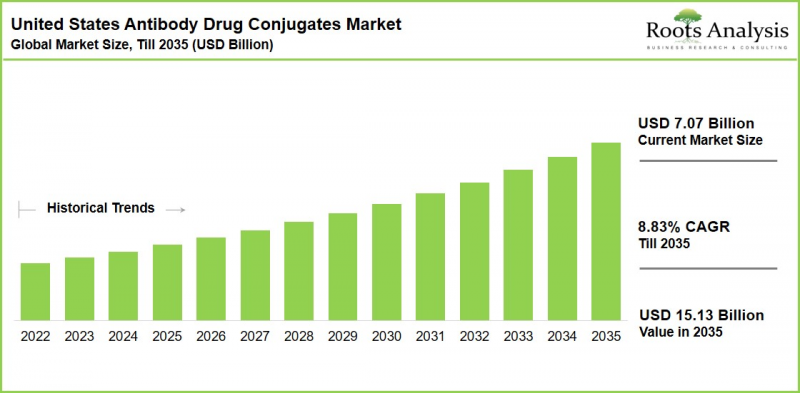
United States Antibody Drug Conjugates Market: Growth and Trends
Antibody drug conjugates combine the target specificity of monoclonal antibodies with the cell-killing activity of potent cytotoxic payloads, connected through chemical linkers. This modality has become one of the most active areas of oncology biologics / targeted cancer therapy development in the United States, supported by a dense concentration of ADC developers, a mature venture financing base, and the USFDA's continued willingness to grant accelerated and breakthrough designations to differentiated candidates.
Notably, the USFDA has approved the majority of the 19 ADCs cleared globally for therapeutic use, including Adcetris, Besponsa, Blenrep, Datroway, Elahere, Emrelis, Enhertu, Kadcyla, Mylotarg, Padcev, Polivy, Tivdak, Trodelvy and Zynlonta. Six of these are approved specifically for hematological malignancies, namely, Adcetris, Besponsa, Blenrep, Mylotarg, Polivy, and Zynlonta. The expanding portfolio of approved antibody-drug conjugates, supported by a robust late-stage pipeline, differentiates the US from all other regional ADC therapeutics markets and reinforces its position as the largest single-country contributor to global ADC revenue.
Domestic developers continue to refine site-specific conjugation chemistries, plasma-stable linker systems and next-generation payload classes to widen the therapeutic index of new candidates. US-based teams are also early and heavy adopters of artificial intelligence for target identification and antibody-linker-payload optimization, a trend that is compressing preclinical timelines and feeding a steady stream of IND filings into the domestic pipeline.
Growth Drivers: Strategic Enablers of Market Expansion
Growth in the US ADC market is underpinned by the country's high cancer incidence, its large base of NCI-designated cancer centers, and a regulatory environment that has repeatedly rewarded differentiated ADC candidates with expedited review. Widening biomarker-testing infrastructure across US oncology centers is improving patient identification for HER-2, TROP-2, and other antigen-defined populations, directly expanding the addressable patient base for currently marketed and pipeline ADCs.
Well-capitalized US pharmaceutical and biotechnology companies continue to allocate substantial R&D and licensing capital toward next-generation ADCs platform, supported by significant acquisitions of ADC-focused biotechnology companies in recent years. This capital intensity, combined with a deep bench of contract development and manufacturing organizations able to handle high-potency conjugation chemistry domestically, continues to shorten the distance between candidate selection and commercial launch in the United States.
Market Challenges: Critical Barriers Impeding Progress
High per-patient treatment cost remains the most significant constraint on US ADC uptake. Payers increasingly require real-world progression-free survival data collected after approval, not solely pivotal-trial endpoints, before extending favorable coverage terms, which lengthens the interval between launch and full reimbursement access.
Reproducing conjugation chemistry consistently, controlling drug-to-antibody ratio across batches, and maintaining cold-chain integrity through fill-finish require specialized capacity that remains concentrated among a limited set of US and allied CDMOs. As the first wave of US-approved ADCs approaches patent expiry, the emerging threat of biosimilar-style challengers, particularly for HER-2-directed therapies, adds a further layer of long-term pricing uncertainty for originator companies.
United States Antibody Drug Conjugates Market: Key Insights
The report delves into the current state of the US antibody drug conjugate market and identifies potential growth opportunities within the industry. Some key findings from the report include:
- Driven by a high cancer burden, dense biomarker-testing infrastructure and the USFDA's continued support for accelerated approval pathways, the United States is estimated to account for the majority of North America's ADC revenue and remains the single largest country market for this modality worldwide.
- The USFDA has approved the majority of the 19 globally approved ADCs, including six specifically indicated for hematological malignancies; a broad late-stage pipeline continues to feed the domestic approval cycle.
- Close to 165 ADC therapy developers are active globally, and more than 35% are headquartered in North America, with the United States hosting the largest concentration of small and mid-sized ADC-focused biotechnology companies.
- Solid tumors currently account for 71% of ADC market share and are projected to expand to 76% by 2035, reflecting sustained development activity in breast, lung, gastric and ovarian cancer indications, all of which carry a substantial US-treated patient population.
- Breast cancer therapies account for 44.7% of current ADC market share on a global basis, supported by established HER-2-targeted products; the US lung cancer segment is expected to grow at a faster rate following the June 2025 accelerated approval of the TROP2-targeted ADC Datroway.
- Tetrapeptide-based linkers hold the largest current and projected market share, combining strong plasma stability with efficient intracellular payload release; the tetrapeptide-maleimide linker sub-segment is projected to grow at a CAGR of 65.7% during the forecast period.
- Monomethyl auristatin E (MMAE) is the leading payload class, underpinning the May 2025 accelerated approval of Emrelis (telisotuzumab vedotin-tllv) for c-Met-overexpressing non-squamous NSCLC.
- HER-2 remains the dominant target antigen, supported by Kadcyla (approved 2013) and Enhertu (approved 2019); the c-Met antigen segment is projected to be the fastest-growing, at a CAGR of 41.8% through 2035.
- Product licensing agreements account for the largest share of US ADC partnership activity, followed by linker and payload technology licensing, a legacy of early platform originators such as ImmunoGen.
- Regulators increasingly link ADC approvals to companion diagnostic requirements, making diagnostic-antibody pairing an important driver of US label language and patient-selection strategy going forward.
- Given the depth of the current approval base, the breadth of late-stage pipeline assets and continued payer engagement on outcomes-linked access, the United States ADC market is well positioned for sustained growth through 2035.
United States Antibody Drug Conjugates Market: Segmentation
The market sizing and opportunity analysis has been segmented across the following parameters:
By Target Indication
- Breast Cancer
- Lung Cancer
- B-Cell Lymphoma
- Multiple Myeloma
- Ovarian Cancer
- Renal Cancer
- Gastric Cancer
- Hodgkin's Lymphoma
- Other Target Indications
By Therapeutic Area
- Solid Tumors
- Hematological Cancer
By Linker
- Tetrapeptide-based Linker
- Valine-Citrulline
- SMCC
- Maleimidocaproyl
- Maleimide
- Sulfo-SPDB
- Tetrapeptide-Maleimide-Linker
- GGFG (Peptide) Linker
- Other Linkers
By Payload
- Monomethyl Auristatin E (MMAE)
- Camptothecin
- Exatecan
- DM1
- Monomethyl Auristatin F (MMAF)
- SN-38 / Irinotecan
- DM4
- Other Payloads
By Target Antigen
- HER-2 (ERBB2)
- TROP-2
- CD79b
- BCMA (TNFRSF17 / BCM)
- FOLR1 (Folate Receptor Alpha)
- c-MET
- Nectin 4
- CD30
- Integrin Beta-6
- Other Target Antigens
By End User
- Hospitals
- Specialty Cancer Centers
- Ambulatory Infusion Centers
United States Antibody Drug Conjugates Market: Key Segments
Solid Tumors Continue to Lead the US ADC Market
Based on our market assessment, ADCs targeting solid tumors represent the largest therapeutic-area segment in the United States and are expected to extend their lead through 2035. This position reflects the large, treated population across breast, lung, gastric and ovarian cancer, the established commercial infrastructure supporting HER-2 and TROP-2-targeted agents, and a steady cadence of new solid-tumor label expansions from the USFDA.
Breast Cancer Remains the Leading Target Indication
Breast cancer therapies account for the largest share of ADC demand, supported by a large HER-2-positive and HER-2-low treated population and the commercial maturity of Kadcyla and Enhertu. The lung cancer indication is expected to grow at a faster rate through the forecast period, following the 2025 accelerated approval of the TROP2-targeted ADC Datroway.
HER-2 Dominates the Target Antigen Landscape, c-Met Emerges Fastest
HER-2 remains the leading target antigen given its overexpression across multiple solid tumor types and the commercial track record of Kadcyla and Enhertu. The c-Met antigen segment, anchored by the 2025 approval of Emrelis for previously treated non-squamous NSCLC, is projected to be the fastest-growing target antigen segment through 2035.
Hospitals and Specialty Cancer Centers Account for the Majority of Administration
Hospitals and specialty cancer centers together account for the majority of market share. This growth reflects the infrastructure, cold-chain handling capability and oncology specialist staffing required to safely prepare and administer high-potency cytotoxic conjugates. Ambulatory infusion centers are gaining share as payers and health systems push lower-acuity ADC regimens into outpatient settings to manage cost of care.
Example Players in the United States ADC Market
- AbbVie
- AstraZeneca
- Bristol-Myers Squibb
- Daiichi Sankyo
- Genentech (Roche)
- Gilead Sciences
- GSK
- ImmunoGen (AbbVie)
- Merck
- Pfizer
UNITED STATES ANTIBODY DRUG CONJUGATES MARKET: RESEARCH COVERAGE
- Market Sizing and Opportunity Analysis: The report features an in-depth analysis of the United States antibody drug conjugate market, focusing on key market segments, including [A] target indication, [B] therapeutic area, [C] linker, [D] payload, [E] target antigen, [F] end user and [G] sales forecast.
- Antibody Drug Conjugates Market Landscape: A detailed assessment of the overall US antibody drug conjugates market landscape, featuring information on stage of development, target indication, therapeutic area, linker, payload and target antigen. Additionally, it features detailed analysis of US ADC developers, based on parameters such as year of establishment, company size (based on employee count) and location of headquarters.
- Company Profiles: In-depth profiles of prominent players engaged in the US ADC industry, featuring information on their year of establishment, location of headquarters, company size (in terms of number of employees), management team, portfolio and key initiatives.
- Clinical Trial Analysis: An analysis of completed and ongoing US-registered clinical trials related to ADCs, based on several relevant parameters, such as trial registration year, enrolled patient population, trial phase, trial status, type of sponsor / collaborator, patient gender, study design and leading industry and non-industry players.
- Drug Failure Analysis: An insightful drug failure analysis, based on several parameters, such as trial phase, trial status, reason of discontinuation, study start year, year of discontinuation, type of molecule and route of administration.
- Success Protocol Analysis: An insightful analysis of recently approved US ADCs, based on several relevant parameters, such as dosing frequency, drug exclusivity, safety and efficacy, geographical reach, intra-class competition, line of treatment, prevalence, price and existing competition among developers.
- Patent Analysis: An analysis of the patents filed / granted related to ADC drugs, since 2022, based on parameters such as type of patent, patent application year, patent publication year, patent jurisdiction, CPC symbols, type of applicant, patent benchmarking and patent valuation.
- Recent Developments: A detailed analysis of the various recent developments in this industry, including partnerships and collaborations, funding and investments, and global events, based on several relevant parameters.
- Porter's Five Forces Analysis: A qualitative analysis of five competitive forces in this domain, namely, threat of new entrants, bargaining power of buyers, bargaining power of suppliers, threat of substitute products, and rivalry among existing competitors.
- Market Impact Analysis: The report analyzes various factors such as drivers, restraints, opportunities and challenges affecting market growth.
KEY QUESTIONS ANSWERED IN THIS REPORT
- Which are the leading companies in the United States antibody drug conjugates market?
- What is the current and future size of the US ADC market?
- What is the CAGR of the US ADC market through 2035?
- Which target indication and therapeutic area account for the largest share of US ADC demand?
- Which target antigen and payload classes are gaining the fastest share in the US market?
- What role do companion diagnostics and payer reimbursement play in shaping US ADC access?
- What are the primary challenges faced by US ADC developers and manufacturers?
- How is the current and future US market opportunity distributed across key segments?
REASONS TO BUY THIS REPORT
- Gain a comprehensive understanding of the current and future landscape of the US antibody drug conjugates (ADC) market, including detailed revenue forecasts across target indications, therapeutic areas, linker technologies, payload classes, target antigens, end users, and sales channels through 2035.
- Identify high-growth market segments and emerging commercial opportunities by evaluating the fastest-growing indications, novel target antigens, next-generation linker technologies, and evolving payload platforms that are expected to shape the future of the ADC industry.
- Benchmark your organization's strategy against leading pharmaceutical companies, biotechnology firms, and emerging ADC developers, enabling informed decisions related to product development, competitive positioning, and market entry.
- Assess the clinical and commercial maturity of the ADC pipeline through detailed analyses of ongoing ADC clinical trials, recently approved therapies, and late-stage development programs, helping stakeholders prioritize high-potential therapeutic opportunities.
- Understand the evolving competitive landscape, including company profiles, strategic collaborations, licensing agreements, mergers and acquisitions, and investment trends, to identify potential partners, acquisition targets, and business expansion opportunities.
- Evaluate the impact of scientific and technological advancements, including innovations in linker chemistry, payload engineering, site-specific conjugation technologies, companion diagnostics, and AI-enabled drug discovery, on future market competitiveness.
- Gain valuable insights into the US regulatory and reimbursement environment, including FDA approval trends, accelerated approval pathways, companion diagnostic requirements, and payer considerations that influence product commercialization and market access.
- Analyze the manufacturing and supply chain ecosystem, including CDMO capabilities, high-potency manufacturing infrastructure, conjugation technologies, and production challenges, to support strategic manufacturing and outsourcing decisions.
- Leverage comprehensive patent intelligence and technology landscape analyses to identify innovation hotspots, evaluate intellectual property trends, assess freedom-to-operate opportunities, and understand the competitive patent environment.
- Identify attractive licensing, collaboration, and investment opportunities by examining recent partnership activities, funding rounds, and technology transactions across the US ADC ecosystem.
- Support strategic planning through an in-depth assessment of market drivers, restraints, opportunities, and emerging risks, enabling organizations to proactively adapt to changing market dynamics and develop sustainable growth strategies.
- Use the report's detailed market intelligence to evaluate new product opportunities, optimize portfolio strategies, prioritize R&D investments, and formulate evidence-based business decisions that maximize long-term commercial success.
- Equip business development, commercial, and strategy teams with actionable insights to identify untapped market opportunities, emerging customer needs, and competitive white spaces, facilitating more effective go-to-market planning and stakeholder engagement.
- Benefit from robust quantitative analysis and expert market insights that enable organizations to reduce investment risks, validate growth strategies, and capitalize on the expanding US ADC market.
ADDITIONAL BENEFITS
- Complimentary Excel Data Packs for all Analytical Modules in the Report
- 15% Free Content Customization
- Detailed Report Walkthrough Session with Research Team
- Free Updated Report if the Report is 6-12 Months Old or Older
TABLE OF CONTENTS
1. PREFACE
- 1.1. Introduction
- 1.2. Market Share Insights
- 1.3. Key Market Insights
- 1.4. Report Coverage
- 1.5. Key Questions Answered
- 1.6. Chapter Outlines
2. RESEARCH METHODOLOGY
- 2.1. Chapter Overview
- 2.2. Research Assumptions
- 2.2.1. Market Landscape and Market Trends
- 2.2.2. Market Forecast and Opportunity Analysis
- 2.2.3. Comparative Analysis
- 2.3. Database Building
- 2.3.1. Data Collection
- 2.3.2. Data Validation
- 2.3.3. Data Analysis
- 2.4. Project Methodology
- 2.4.1. Secondary Research
- 2.4.1.1. Annual Reports
- 2.4.1.2. Academic Research Papers
- 2.4.1.3. Company Websites
- 2.4.1.4. Investor Presentations
- 2.4.1.5. Regulatory Filings
- 2.4.1.6. White Papers
- 2.4.1.7. Industry Publications
- 2.4.1.8. Conferences and Seminars
- 2.4.1.9. Government Portals
- 2.4.1.10. Media and Press Releases
- 2.4.1.11. Newsletters
- 2.4.1.12. Industry Databases
- 2.4.1.13. Roots Proprietary Databases
- 2.4.1.14. Paid Databases and Sources
- 2.4.1.15. Social Media Portals
- 2.4.1.16. Other Secondary Sources
- 2.4.2. Primary Research
- 2.4.2.1. Types of Primary Research
- 2.4.2.1.1. Qualitative Research
- 2.4.2.1.2. Quantitative Research
- 2.4.2.1.3. Hybrid Approach
- 2.4.2.2. Advantages of Primary Research
- 2.4.2.3. Techniques for Primary Research
- 2.4.2.3.1. Interviews
- 2.4.2.3.2. Surveys
- 2.4.2.3.3. Focus Groups
- 2.4.2.3.4. Observational Research
- 2.4.2.3.5. Social Media Interactions
- 2.4.2.4. Key Opinion Leaders Considered in Primary Research
- 2.4.2.4.1. Company Executives (CXOs)
- 2.4.2.4.2. Board of Directors
- 2.4.2.4.3. Company Presidents and Vice Presidents
- 2.4.2.4.4. Research and Development Heads
- 2.4.2.4.5. Technical Experts
- 2.4.2.4.6. Subject Matter Experts
- 2.4.2.4.7. Scientists
- 2.4.2.4.8. Doctors and Other Healthcare Providers
- 2.4.2.5. Ethics and Integrity
- 2.4.2.5.1. Research Ethics
- 2.4.2.5.2. Data Integrity
- 2.4.2.1. Types of Primary Research
- 2.4.3. Analytical Tools and Databases
- 2.4.1. Secondary Research
- 2.5. Robust Quality Control
3. MARKET DYNAMICS
- 3.1. Chapter Overview
- 3.2. Forecast Methodology
- 3.2.1. Top-down Approach
- 3.2.2. Bottom-up Approach
- 3.2.3. Hybrid Approach
- 3.3. Market Assessment Framework
- 3.3.1. Total Addressable Market (TAM)
- 3.3.2. Serviceable Addressable Market (SAM)
- 3.3.3. Serviceable Obtainable Market (SOM)
- 3.3.4. Currently Acquired Market (CAM)
- 3.4. Forecasting Tools and Techniques
- 3.4.1. Qualitative Forecasting
- 3.4.2. Correlation
- 3.4.3. Regression
- 3.4.4. Extrapolation
- 3.4.5. Convergence
- 3.4.6. Sensitivity Analysis
- 3.4.7. Scenario Planning
- 3.4.8. Data Visualization
- 3.4.9. Time Series Analysis
- 3.4.10. Forecast Error Analysis
- 3.5. Key Considerations
- 3.5.1. Demographics
- 3.5.2. Government Regulations
- 3.5.3. Reimbursement Scenarios
- 3.5.4. Market Access
- 3.5.5. Supply Chain
- 3.5.6. Industry Consolidation
- 3.5.7. Pandemic / Unforeseen Disruptions Impact
- 3.6. Limitations
4. MACRO-ECONOMIC INDICATORS
- 4.1. Chapter Overview
- 4.2. Market Dynamics
- 4.2.1. Time Period
- 4.2.1.1. Historical Trends
- 4.2.1.2. Current and Forecasted Estimates
- 4.2.2. Currency Coverage
- 4.2.2.1. Major Currencies Affecting the Market
- 4.2.2.2. Factors Affecting Currency Fluctuations on the Industry
- 4.2.2.3. Impact of Currency Fluctuations on the Industry
- 4.2.3. Foreign Currency Exchange Rate
- 4.2.3.1. Impact of Foreign Exchange Rate Volatility on the Market
- 4.2.3.2. Strategies for Mitigating Foreign Exchange Risk
- 4.2.4. Recession
- 4.2.4.1. Assessment of Current Economic Conditions and Potential Impact on the Market
- 4.2.4.2. Historical Analysis of Past Recessions and Lessons Learnt
- 4.2.5. Inflation
- 4.2.5.1. Measurement and Analysis of Inflationary Pressures in the Economy
- 4.2.5.2. Potential Impact of Inflation on the Market Evolution
- 4.2.6. Interest Rates
- 4.2.6.1. Interest Rates and Their Impact on the Market
- 4.2.6.2. Strategies for Managing Interest Rate Risk
- 4.2.7. Commodity Flow Analysis
- 4.2.7.1. Type of Commodity
- 4.2.7.2. Origins and Destinations
- 4.2.7.3. Values and Weights
- 4.2.7.4. Modes of Transportation
- 4.2.8. Global Trade Dynamics
- 4.2.8.1. Import Scenario
- 4.2.8.2. Export Scenario
- 4.2.8.3. Trade Policies
- 4.2.8.4. Strategies for Mitigating the Risks Associated with Trade Barriers
- 4.2.8.5. Impact of Trade Barriers on the Market
- 4.2.9. War Impact Analysis
- 4.2.9.1. Russian-Ukraine War
- 4.2.9.2. Israel-Hamas War
- 4.2.10. COVID Impact / Related Factors
- 4.2.10.1. Global Economic Impact
- 4.2.10.2. Industry-specific Impact
- 4.2.10.3. Government Response and Stimulus Measures
- 4.2.10.4. Future Outlook and Adaptation Strategies
- 4.2.11. Other Indicators
- 4.2.11.1. Fiscal Policy
- 4.2.11.2. Consumer Spending
- 4.2.11.3. Gross Domestic Product
- 4.2.11.4. Employment
- 4.2.11.5. Taxes
- 4.2.11.6. Stock Market Performance
- 4.2.11.7. Cross Border Dynamics
- 4.2.1. Time Period
- 4.3. Conclusion
5. EXECUTIVE SUMMARY
6. INTRODUCTION
- 6.1. Overview of Antibody Drug Conjugates
- 6.2. Structure and Mechanism of Action
- 6.3. Conjugation Chemistry and Linker Technologies
- 6.4. Payload Classes
- 6.5. US Regulatory Landscape and Approval Pathways
- 6.6. Important Facts in the US ADC Domain
- 6.7. Future Perspectives
7. MARKET LANDSCAPE: US ANTIBODY DRUG CONJUGATE THERAPIES
- 7.1. Methodology and Key Parameters
- 7.2. US ADC Therapies: Market Landscape
- 7.2.1. Analysis by Stage of Development
- 7.2.2. Analysis by Target Indication
- 7.2.3. Analysis by Therapeutic Area
- 7.2.4. Analysis by Linker
- 7.2.5. Analysis by Payload
- 7.2.6. Analysis by Target Antigen
- 7.2.7. Analysis by Year of Establishment
- 7.2.8. Analysis by Company Size
- 7.2.9. Analysis by Location of Headquarters
8. COMPANY PROFILES
- 8.1. AbbVie
- 8.1.1. Company Overview
- 8.1.2. Business Segments
- 8.1.3. US ADC Portfolio
- 8.1.4. Key Initiatives
- 8.2. AstraZeneca
- 8.3. Daiichi Sankyo (US Operations)
- 8.4. Genentech (Roche)
- 8.5. Gilead Sciences
- 8.6. GSK
- 8.7. Merck
- 8.8. Pfizer
9. CLINICAL TRIAL ANALYSIS
- 9.1. Methodology and Key Parameters
- 9.2. US ADC Clinical Trial Analysis
- 9.2.1. Analysis by Trial Registration Year
- 9.2.2. Analysis by Trial Status
- 9.2.3. Analysis by Trial Phase
- 9.2.4. Analysis by Patients Enrolled
- 9.2.5. Analysis by Study Design
- 9.2.6. Most Active Sponsors / Collaborators
10. DRUG FAILURE ANALYSIS
- 10.1. Methodology and Key Parameters
- 10.2. US ADC Drug Failure Analysis
- 10.2.1. Analysis by Trial Phase
- 10.2.2. Analysis by Reasons for Discontinuation
- 10.2.3. Analysis by Type of Molecule
11. SUCCESS PROTOCOL ANALYSIS
- 11.1. Chapter Overview
- 11.2. Methodology and Key Parameters
- 11.3. Success Protocol Analysis: Enhertu (Daiichi Sankyo / AstraZeneca)
- 11.4. Success Protocol Analysis: Kadcyla (Genentech / Roche)
- 11.5. Success Protocol Analysis: Padcev (Astellas / Pfizer)
- 11.6. Success Protocol Analysis: Trodelvy (Gilead Sciences)
- 11.7. Conclusion
12. PATENT ANALYSIS
- 12.1. Chapter Overview
- 12.2. Scope and Methodology
- 12.3. US ADC Patent Analysis
- 12.3.1. Analysis by Patent Publication Year
- 12.3.2. Analysis by Patent Jurisdiction
- 12.3.3. Analysis by Type of Applicant
- 12.4. Patent Benchmarking and Valuation Analysis
- 12.5. Leading Patents by Number of Citations
13. RECENT DEVELOPMENTS
- 13.1. Chapter Overview
- 13.2. Partnership Models (Partnerships and Collaborations)
- 13.3. Funding Models (Funding and Investment Analysis)
- 13.4. Global and US-based Industry Events
14. PORTER'S FIVE FORCES ANALYSIS
- 14.1. Chapter Overview
- 14.2. Threat of New Entrants
- 14.3. Bargaining Power of Buyers
- 14.4. Bargaining Power of Suppliers
- 14.5. Threat of Substitute Solutions
- 14.6. Rivalry Among Existing Competitors
- 14.7. Conclusion
15. MARKET IMPACT ANALYSIS: DRIVERS, RESTRAINTS, OPPORTUNITIES AND CHALLENGES
- 15.1. Chapter Overview
- 15.2. Market Drivers
- 15.3. Market Restraints
- 15.4. Market Opportunities
- 15.5. Market Challenges
16. COMPANION DIAGNOSTICS AND REIMBURSEMENT LANDSCAPE
- 16.1. Chapter Overview
- 16.2. Companion Diagnostics Landscape and Label Impact
- 16.3. US Payer and Reimbursement Dynamics
- 16.4. Post-Market Evidence Requirements
17. UNITED STATES ANTIBODY DRUG CONJUGATES MARKET, TILL 2035
- 17.1. Key Assumptions and Methodology
- 17.2. United States ADC Market, Historical Trends (Since 2023) and Forecasted Estimates (Till 2035)
- 17.2.1. Multivariate Scenario Analysis (Conservative, Base and Optimistic)
- 17.3. Key Market Segmentations
18. US ADC MARKET, BY TARGET INDICATION
- 18.1. Key Assumptions and Methodology
- 18.2. US ADC Market: Distribution by Target Indication
- 18.3. Data Triangulation and Validation
19. US ADC MARKET, BY THERAPEUTIC AREA
- 19.1. Key Assumptions and Methodology
- 19.2. US ADC Market: Distribution by Therapeutic Area (Solid Tumors, Hematological Cancer)
- 19.3. Data Triangulation and Validation
20. US ADC MARKET, BY LINKER
- 20.1. Key Assumptions and Methodology
- 20.2. US ADC Market: Distribution by Linker
- 20.3. Data Triangulation and Validation
21. US ADC MARKET, BY PAYLOAD
- 21.1. Key Assumptions and Methodology
- 21.2. US ADC Market: Distribution by Payload
- 21.3. Data Triangulation and Validation
22. US ADC MARKET, BY TARGET ANTIGEN
- 22.1. Key Assumptions and Methodology
- 22.2. US ADC Market: Distribution by Target Antigen
- 22.3. Data Triangulation and Validation
23. US ADC MARKET, BY END USER
- 23.1. Key Assumptions and Methodology
- 23.2. US ADC Market: Distribution by End User (Hospitals, Specialty Cancer Centers, Ambulatory Infusion Centers)
- 23.3. Data Triangulation and Validation
24. US ADC MARKET, SALES FORECAST OF INDIVIDUAL THERAPIES
- 24.1. Key Assumptions and Methodology
- 24.2. US ADC Market for Enhertu, Historical Trends and Forecasted Estimates (Till 2035)
- 24.3. US ADC Market for Kadcyla, Historical Trends and Forecasted Estimates (Till 2035)
- 24.4. US ADC Market for Padcev, Historical Trends and Forecasted Estimates (Till 2035)
- 24.5. US ADC Market for Trodelvy, Historical Trends and Forecasted Estimates (Till 2035)
- 24.6. US ADC Market for Elahere, Forecasted Estimates (Till 2035)
- 24.7. US ADC Market for Datroway, Forecasted Estimates (Till 2035)
25. CONCLUDING INSIGHTS
26. EXECUTIVE INSIGHTS
- 26.1. Views and Opinions of Key Industry Stakeholders
27. TABULATED DATA
- 27.1. List of Tables
- 27.2. List of Figures
28. LIST OF COMPANIES AND ORGANIZATIONS

