PUBLISHER: Roots Analysis | PRODUCT CODE: 2132684

PUBLISHER: Roots Analysis | PRODUCT CODE: 2132684
United Kingdom (UK) AI in Drug Discovery Market by Application, Type of AI Technology, Drug Type, Deployment Mode, Therapeutic Area, End User and Leading Players - Trends and Forecast Till 2035
UNITED KINGDOM AI IN DRUG DISCOVERY MARKET: OVERVIEW
As per Roots Analysis, the United Kingdom AI in drug discovery market is estimated to grow from USD 0.23 billion in the current year to USD 1.62 billion by 2035, registering a CAGR of 24.12% across the forecast period. The United Kingdom is the third largest regional contributor to this market, and is one of the region's fastest-scaling AI drug discovery hubs, anchored by a dense cluster of AI-native biotech companies, contract research organizations, and academic spinouts concentrated across the Oxford-Cambridge-London corridor.
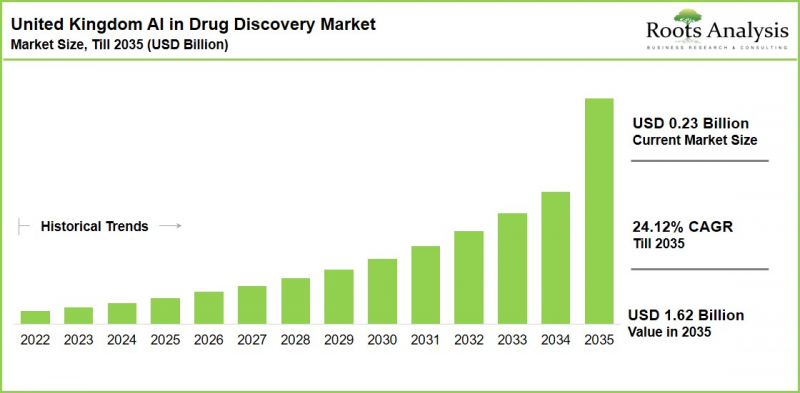
United Kingdom AI in Drug Discovery Market: Growth and Trends
AI in drug discovery refers to the use of machine learning, deep learning, generative models, and omics integration tools to identify disease targets, design and optimize drug candidates, and predict molecular behavior. In the UK, this capability has matured from an academic research tool into a commercial discovery engine embedded across pharma, biotech, and CRO pipelines.
The UK's position is reinforced by state-backed AI infrastructure. The Department for Science, Innovation and Technology's Sovereign AI Unit, backed up to £500 million, has already deployed capital and supercomputing access to AI-enabled drug discovery firms. Meanwhile a separate £137 million AI for Science initiative under UKRI's AI Strategy is directed specifically at accelerating AI-enabled drug development. Recently, the UK government backed a first cohort of Sovereign AI companies spanning drug discovery, autonomous laboratory infrastructure, and AI compute, granting successful applicants fast-track visas and access to national supercomputing resources.
London-based Isomorphic Labs, backed by Alphabet, secured investment from the Sovereign AI Fund, highlighting government support for strengthening domestic AI-driven drug discovery. Leading UK companies, including BenevolentAI, Healx, and Optibrium, are expanding partnerships with global pharmaceutical firms, while Oxford-based Recursion continues to strengthen its UK research and clinical presence. These developments signal that the UK is positioning itself as a sovereign AI drug discovery base rather than a satellite market for US and Asia-Pacific platform providers.
Growth Drivers in UK AI in Drug Discovery Market
The market is being driven by sustained government investment in sovereign AI infrastructure, including compute access, visa fast-tracking, and direct equity backing for AI-native biotech companies. Additionally, the country's dense academic-industry pipeline, spanning the University of Oxford, University of Cambridge, and UCL, continues to feed spinout formation and licensing deals with established pharmaceutical partners. Further, rising R&D cost pressure across UK and European pharma is accelerating adoption of AI platforms for target identification and lead optimization, where the technology has demonstrated measurable reductions in synthesis and experimental effort. Continued build-out of high-value biomedical datasets, including government co-funded structural biology consortia, is also improving model accuracy and lowering the data-access barrier that has historically slowed AI adoption in drug discovery.
Challenges in UK AI in Drug Discovery Market
Although UK AI drug discovery adoption is accelerating, the market still faces several challenges. Data integration remains a persistent barrier, as genomics, proteomics, and preclinical assay data are frequently held in fragmented, incompatible formats across NHS, academic, and commercial systems, complicating multi-omics model training. Regulatory clarity for AI-designed and AI-optimized candidates also remains incomplete, with the MHRA still developing consistent frameworks for validating AI-derived predictions ahead of clinical entry. Intellectual property and data-security concerns further limit the pooling of proprietary compound libraries and clinical datasets, restricting the collaborative model refinement that AI-native platforms depend on for continuous improvement.
United Kingdom AI in Drug Discovery Market: Key Insights
The report delves into the current state of the UK AI in drug discovery market and identifies potential growth opportunities for platform developers, pharmaceutical partners, and distribution and channel intermediaries supporting this ecosystem. Some key findings include:
- Lead optimization holds the largest share of the global AI in drug discovery market, at about 50%. UK developers such as Optibrium focus on AI-driven candidate refinement, strengthening the UK's position in this stage.
- Machine learning accounts for about 40% of the global AI in drug discovery market and remains the dominant AI technology. Deep learning and generative AI are gaining share rapidly, supported by UK platforms such as Isomorphic Labs.
- Government-backed computing and data access through the Sovereign AI Unit is reducing infrastructure barriers for smaller UK AI biotechs. This creates opportunities for channel partners to engage with emerging developers before international expansion.
- Oncology holds the largest therapeutic area share of the global AI in drug discovery market and is expected to maintain its lead. The UK is also seeing growing adoption of AI in oncology programs through established CROs.
- Cloud-based deployment currently holds the largest market share, while SaaS-based delivery is expected to grow fastest. UK providers are increasingly adopting subscription models to improve access for mid-sized biotech and academic users.
- Contract research organizations are expected to see the fastest end-user growth as pharmaceutical companies increasingly outsource AI-enabled drug discovery. This trend is reflected in growing CRO-platform collaborations across existing programs.
Recent Deal Activity Signaling Investor Momentum
- Sovereign Investment: The UK government's Sovereign AI Fund backed Isomorphic Labs (London) as part of a broader fundraising round, extending state-level conviction in domestic AI drug design capability.
- Government Grant Deployment: The Department for Science, Innovation and Technology opened its Sovereign AI Fund's first grant window, offering awards for high-value AI datasets and autonomous laboratory infrastructure, with drug discovery named among the priority application areas.
- Platform Collaboration: DaltonTx launched its agentic AI-enabled discovery platform Dalton and partnered with Nottingham-based CRO Sygnature Discovery to evaluate the platform across a legacy oncology programme, testing whether AI-supported decision-making can reduce synthesis burden.
- Consortium Membership: Nxera Pharma, which maintains its structural biology and drug discovery hub in Cambridge, joined OpenFold, an open-source AI research consortium, to strengthen its GPCR-focused AI discovery capabilities and benchmark structural prediction models.
- R&D Infrastructure Funding: UKRI's £137 million AI for Science initiative is directly funding AI-enabled discovery projects, including sovereign compute allocations to university-based drug discovery and molecular simulation research groups at Oxford and Cambridge.
United Kingdom AI in Drug Discovery Market Segments
The market sizing and opportunity analysis has been segmented across the following parameters:
By Application
- Target Identification / Validation
- Hit Generation / Lead Identification
- Lead Optimization
By Type of AI Technology
- Machine Learning
- Molecular Modelling and Simulation
- Deep Learning
- Omics Integration
- Generative Model
- Structure-based Drug Design
- Other Technologies
By Drug Type
- Small Molecules
- Biologics
By Deployment Mode
- Cloud-based
- On-premises
- SaaS-based
By Therapeutic Area
- Oncological Disorders
- Neurological Disorders
- Cardiovascular Diseases
- Infectious Diseases
- Immunological Disorders
- Respiratory Disorders
- Other Therapeutic Areas
By End User
- Pharma and Biotech Companies
- Contract Research Organizations
- Research and Academic Institutions
United Kingdom AI in Drug Discovery Market: Key Segments
Lead Optimization Leads the Application Segment
Lead optimization currently accounts for the largest share of the market. This growth is supported by its highly iterative nature, where researchers must evaluate and refine large numbers of candidate molecules before selecting a development candidate. UK platform providers, including Optibrium, have built their commercial offering around this stage, using predictive modelling to reduce synthetic and experimental effort for pharma partners.
Target identification and validation is expected to register the fastest CAGR during the forecast period, as UK academic and biotech developers increasingly apply AI to novel target discovery ahead of committing wet-lab resources.
Machine Learning Dominates the Technology Segment
Machine learning holds the largest technology share, owing to its broad applicability across target identification, compound screening, and lead optimization. Deep learning segment is expected to grow at a higher CAGR during the forecast period. This lucrative growth is driven by UK developers such as Isomorphic Labs applying deep learning and generative architectures to de novo molecule and protein design.
Small Molecules Hold the Largest Drug Type Share
Small molecules dominate the drug type segment, reflecting the depth of historical chemical and clinical data available for model training and the scalability of small molecule manufacturing. Biologics are expected to grow at a higher CAGR during the forecast period, as UK developers extend AI platforms into antibody and protein engineering workflows.
Cloud-based Deployment Holds the Highest Share
Cloud-based deployment leads the market, allowing UK biotechs and CROs to access large-scale computing infrastructure without significant upfront capital investment. SaaS-based deployment segment I likely to grow at a higher CAGR during the forecast period, lowering the adoption barrier for smaller research organizations and academic groups.
Oncological Disorders Lead the Therapeutic Area Segment
Oncology retains the largest therapeutic area share. This highest share reflects the complexity of cancer biology and the volume of genomic and clinical data available for AI-driven target and biomarker analysis. This trend is expected to continue through the forecast period as UK CROs expand AI-supported oncology programme evaluations.
Pharma and Biotech Companies Lead End User Segment
Pharma and biotech companies account for the largest end-user share. This dominance is due to their scale, proprietary datasets, and financial capacity to deploy AI across discovery workflows. Contract research organizations are expected to register the fastest CAGR during the forecast period. This lucrative growth is due to the UK and European pharmaceutical companies increasingly outsource AI-enabled discovery activity to specialized service providers.
Example Players in United Kingdom AI in Drug Discovery Market
- BenevolentAI
- Healx
- Isomorphic Labs
- Nxera Pharma
- Optibrium
- Recursion (Oxford Research Hub, formerly Exscientia)
- Sygnature Discovery
UNITED KINGDOM AI IN DRUG DISCOVERY MARKET: RESEARCH COVERAGE
- Market Sizing and Opportunity Analysis: An in-depth analysis of the UK AI in drug discovery market, focusing on key segments, including application, type of AI technology, drug type, deployment mode, therapeutic area, and end user.
- Developer Landscape: A detailed assessment of companies developing and deploying AI drug discovery platforms in the UK, based on parameters such as year of establishment, company size, location of headquarters, and technology focus.
- Company Profiles: In-depth profiles of prominent players engaged in the development and commercialization of AI-driven drug discovery platforms in the UK, featuring information on year of establishment, headquarters, technology stack, and key initiatives.
- Partnerships and Collaborations Analysis: A comprehensive assessment of partnership activity among UK AI drug discovery developers, evaluated by year, partnership type, focus area, and partner geography.
- Sovereign AI and Policy Landscape: A dedicated view of UK government AI infrastructure programmes, including the Sovereign AI Unit and AI for Science initiative, and their direct implications for platform developers and channel partners.
- Porter's Five Forces Analysis: A qualitative assessment of the competitive dynamics within the market using Porter's Five Forces framework, evaluating the threat of new entrants, bargaining power of end users, bargaining power of platform developers, threat of substitute approaches, and rivalry among existing competitors.
- Market Impact Analysis: The report analyzes drivers, restraints, opportunities, and challenges affecting market growth, including the impact of regulatory clarity timelines on AI-derived candidate progression.
KEY QUESTIONS ANSWERED IN THIS REPORT
- How large is the UK AI in drug discovery market today, and how large will it be by 2035?
- Which applications, AI technologies and drug types are gaining or losing share in the UK market?
- Which UK-headquartered and UK-based companies are best positioned across each segment, and how deep is their partnership pipeline?
- How is government Sovereign AI funding reshaping the competitive landscape for UK platform developers?
- Which therapeutic areas and end-user segments offer the strongest near-term revenue and long-term growth combination?
- What is the realistic impact of MHRA regulatory clarity timelines on AI-derived candidate commercialization?
Reasons to Buy this Report
Market players evaluating the UK AI in drug discovery opportunity need more than a headline market size. This report is built to support commercial decision-making, not just awareness, and differentiates itself on the following counts:
- Top-Down and Bottom-Up Triangulated Forecasting: UK-specific revenue projections are derived from the global AI in drug discovery model and cross-validated using company-level data, reducing forecast risk for investors and channel partners.
- Primary Research with Senior Commercial and Technical Leadership: Insights are grounded in interviews with chief executives, chief commercial officers and technical leaders across UK small and mid-sized AI drug discovery companies, not desk research alone.
- Sovereign AI Policy Lens: Unlike generic global AI drug discovery reports, this study maps how UK government compute, funding and visa programmes are reshaping competitive positioning, insights directly relevant to distributors and channel partners assessing which developers are best placed to scale.
- Regulatory-Readiness Analysis: A dedicated view of MHRA treatment of AI-derived drug candidates helps distributors and partners time market-entry and portfolio decisions around regulatory clarity.
- Investor-Grade Financial Context: Company profiles include partnership deal values, recent capital deployment, and Sovereign AI Fund allocations, positioned for use in diligence and business case development.
ADDITIONAL BENEFITS
- Complementary PPT Insights Pack
- Complementary Excel Data Packs for all Analytical Modules in the Report
- 15% Free Content Customization
- Detailed Report Walkthrough Session with Research Team
- Free Updated Report if the Report is 6-12 Months Old or Older
TABLE OF CONTENTS
1. PREFACE
- 1.1. Introduction
- 1.2. Market Share Insights
- 1.3. Key Market Insights
- 1.4. Report Coverage
- 1.5. Key Questions Answered
- 1.6. Chapter Outlines
2. RESEARCH METHODOLOGY
- 2.1. Chapter Overview
- 2.2. Research Assumptions
- 2.2.1. Market Landscape and Market Trends
- 2.2.2. Market Forecast and Opportunity Analysis
- 2.2.3. Comparative Analysis
- 2.3. Database Building
- 2.3.1. Data Collection
- 2.3.2. Data Validation
- 2.3.3. Data Analysis
- 2.4. Project Methodology
- 2.4.1. Secondary Research
- 2.4.1.1. Annual Reports
- 2.4.1.2. Academic Research Papers
- 2.4.1.3. Company Websites
- 2.4.1.4. Investor Presentations
- 2.4.1.5. Regulatory Filings
- 2.4.1.6. White Papers
- 2.4.1.7. Industry Publications
- 2.4.1.8. Conferences and Seminars
- 2.4.1.9. Government and Regulatory Portals
- 2.4.1.10. Media and Press Releases
- 2.4.1.11. Clinical Trial Registries
- 2.4.1.12. Industry Databases
- 2.4.1.13. Roots Proprietary Databases
- 2.4.1.13. Paid Databases and Sources
- 2.4.1.14. Social Media Portals
- 2.4.1.15. Other Secondary Sources
- 2.4.2. Primary Research
- 2.4.2.1. Types of Primary Research
- 2.4.2.1.1. Qualitative Research
- 2.4.2.1.2. Quantitative Research
- 2.4.2.1.3. Hybrid Approach
- 2.4.2.2. Advantages of Primary Research
- 2.4.2.3. Techniques for Primary Research
- 2.4.2.3.1. Interviews
- 2.4.2.3.2. Surveys
- 2.4.2.3.3. Focus Groups
- 2.4.2.3.4. Observational Research
- 2.4.2.3.5. Social Media Interactions
- 2.4.2.4. Key Opinion Leaders Considered in Primary Research
- 2.4.2.4.1. Company Executives
- 2.4.2.4.2. Research and Development Heads
- 2.4.2.4.3. Technical Experts
- 2.4.2.4.4. Subject Matter Experts
- 2.4.2.4.5. Scientists
- 2.4.2.4.6. Physicians and Other Healthcare Providers
- 2.4.2.5. Ethics and Integrity
- 2.4.2.5.1. Research Ethics
- 2.4.2.5.2. Data Integrity
- 2.4.2.1. Types of Primary Research
- 2.4.3. Analytical Tools and Databases
- 2.4.1. Secondary Research
- 2.5. Robust Quality Control
3. MARKET DYNAMICS
- 3.1. Chapter Overview
- 3.2. Forecast Methodology
- 3.2.1. Top-down Approach
- 3.2.2. Bottom-up Approach
- 3.2.3. Hybrid Approach
- 3.3. Market Assessment Framework
- 3.3.1. Total Addressable Market
- 3.3.2. Serviceable Addressable Market
- 3.3.3. Serviceable Obtainable Market
- 3.3.4. Currently Acquired Market
- 3.4. Forecasting Tools and Techniques
- 3.4.1. Qualitative Forecasting
- 3.4.2. Correlation
- 3.4.3. Regression
- 3.4.4. Extrapolation
- 3.4.5. Convergence
- 3.4.6. Sensitivity Analysis
- 3.4.7. Scenario Planning
- 3.4.8. Data Visualization
- 3.4.9. Time Series Analysis
- 3.4.10. Forecast Error Analysis
- 3.5. Key Considerations
- 3.5.1. Disease Epidemiology
- 3.5.2. Regulatory Environment
- 3.5.3. Reimbursement Scenarios
- 3.5.4. Market Access
- 3.5.5. Industry Consolidation
- 3.6. Limitations
4. MACRO-ECONOMIC INDICATORS
- 4.1. Chapter Overview
- 4.2. Market Dynamics
- 4.2.1. Time Period
- 4.2.1.1. Historical Trends
- 4.2.1.2. Current and Forecasted Estimates
- 4.2.2. Currency Coverage
- 4.2.2.1. Major Currencies Affecting the Market
- 4.2.2.2. Factors Affecting Currency Fluctuations
- 4.2.2.3. Impact of Currency Fluctuations on the Market
- 4.2.3. Foreign Currency Exchange Rate
- 4.2.3.1. Impact of Foreign Exchange Rate Volatility
- 4.2.3.2. Strategies for Mitigating Foreign Exchange Risk
- 4.2.4. Recession
- 4.2.4.1. Assessment of Current Economic Conditions
- 4.2.4.2. Historical Analysis of Past Recessions
- 4.2.5. Inflation
- 4.2.5.1. Measurement and Analysis of Inflationary Pressures
- 4.2.5.2. Potential Impact on Market Evolution
- 4.2.6. Interest Rates
- 4.2.6.1. Interest Rates and Their Impact on the Market
- 4.2.6.2. Strategies for Managing Interest Rate Risk
- 4.2.7. Healthcare Expenditure
- 4.2.8. European Healthcare and Biopharmaceutical Investment Trends
- 4.2.9. Cross-Border Healthcare Dynamics
- 4.2.10. Other Macroeconomic Indicators
- 4.2.10.1. Gross Domestic Product
- 4.2.10.2. Employment
- 4.2.10.3. Government Spending
- 4.2.10.4. Taxes
- 4.2.1. Time Period
- 4.3. Conclusion
5. EXECUTIVE SUMMARY
6. INTRODUCTION
- 6.1. Chapter Overview
- 6.2. Artificial Intelligence in Drug Discovery
- 6.2.1. Definition and Scope
- 6.2.2. Evolution of AI in Drug Discovery
- 6.2.3. Traditional Drug Discovery versus AI-enabled Drug Discovery
- 6.3. Drug Discovery Workflow
- 6.3.1. Target Identification and Validation
- 6.3.2. Hit Generation and Lead Identification
- 6.3.3. Lead Optimization
- 6.3.4. Preclinical Development
- 6.4. AI Technologies Used in Drug Discovery
- 6.4.1. Machine Learning
- 6.4.2. Molecular Modelling and Simulation
- 6.4.3. Deep Learning
- 6.4.4. Omics Integration
- 6.4.5. Generative Models
- 6.4.6. Structure-based Drug Design
- 6.4.7. Other Technologies
- 6.5. AI-enabled Drug Discovery Platforms and Tools
- 6.6. Data Sources for AI-enabled Drug Discovery
- 6.7. Advantages of AI in Drug Discovery
- 6.8. Challenges and Limitations
- 6.9. Future Perspectives
7. MARKET LANDSCAPE
- 7.1. Chapter Overview
- 7.2. UK AI in Drug Discovery: Overall Market Landscape
- 7.2.1. Analysis by Application
- 7.2.2. Analysis by Type of AI Technology
- 7.2.3. Analysis by Drug Type
- 7.2.4. Analysis by Deployment Mode
- 7.2.5. Analysis by Therapeutic Area
- 7.2.6. Analysis by End User
- 7.3. AI in Drug Discovery Developer Landscape
- 7.3.1. Analysis by Company Type
- 7.3.2. Analysis by Year of Establishment
- 7.3.3. Analysis by Company Size
- 7.3.4. Analysis by Headquarters Location
- 7.3.5. Analysis by Business Model
- 7.3.6. Analysis by Drug Discovery Application
- 7.3.7. Analysis by AI Technology
- 7.3.8. Most Active Players: Analysis by Number of AI-enabled Drug Discovery Programs
- 7.4. UK AI in Drug Discovery Ecosystem
- 7.4.1. Pharmaceutical and Biotechnology Companies
- 7.4.2. AI Technology Companies
- 7.4.3. Contract Research Organizations
- 7.4.4. Academic and Research Institutions
- 7.4.5. Government and Public Sector Organizations
8. COMPANY COMPETITIVENESS ANALYSIS
- 8.1. Chapter Overview
- 8.2. Assumptions and Key Parameters
- 8.3. Methodology
- 8.4. Company Competitiveness Assessment
- 8.4.1. Company Experience
- 8.4.2. AI Technology Portfolio
- 8.4.3. Drug Discovery Pipeline
- 8.4.4. Therapeutic Area Coverage
- 8.4.5. Partnerships and Collaborations
- 8.4.6. Funding and Financial Strength
- 8.4.7. Intellectual Property Portfolio
- 8.4.8. Commercialization Potential
- 8.5. Competitiveness Matrix
- 8.6. Leading Players: Company Competitiveness Benchmarking
9. COMPANY PROFILES
- 9.1. Chapter Overview
- 9.2. BenevolentAI
- 9.2.1. Company Overview
- 9.2.2. Business Model
- 9.2.3. AI Technology Portfolio
- 9.2.4. Drug Discovery Applications
- 9.2.5. Drug Discovery Pipeline
- 9.2.6. Therapeutic Area Focus
- 9.2.7. Partnerships and Collaborations
- 9.2.8. Funding and Investments
- 9.2.9. Intellectual Property Portfolio
- 9.2.10. Recent Developments and Future Outlook
- Similar details are presented for other below mentioned players based on information in the public domain
- 9.2. Healx
- 9.3. Isomorphic Labs
- 9.4. Nxera Pharma
- 9.5. Optibrium
- 9.6. Recursion (Oxford Research Hub, Formerly Exscientia)
- 9.7. Sygnature Discovery
10. PARTNERSHIPS AND COLLABORATIONS
- 10.1. Chapter Overview
- 10.2. Partnership Models
- 10.3. UK AI in Drug Discovery: Partnerships and Collaborations
- 10.3.1. Analysis by Year of Partnership
- 10.3.2. Analysis by Type of Partnership
- 10.3.3. Analysis by Year and Type of Partnership
- 10.3.4. Analysis by Partner Type
- 10.3.5. Analysis by Application
- 10.3.6. Analysis by AI Technology
- 10.3.7. Analysis by Therapeutic Area
- 10.3.8. Analysis by Drug Type
- 10.3.9. Most Active Players: Analysis by Number of Partnerships
- 10.4. Key Partnerships and Collaborations
- 10.5. Strategic Implications of Partnerships
11. FUNDING ANALYSIS
- 11.1. Chapter Overview
- 11.2. Sovereign AI Landscape in the UK
- 11.3. UK Government AI Initiatives
- 11.3.1. National AI Strategy
- 11.3.2. AI Research Infrastructure
- 11.3.3. AI Compute Infrastructure
- 11.3.4. Biomedical AI Initiatives
- 11.4. Funding for AI-enabled Drug Discovery
- 11.4.1. Analysis by Year of Funding
- 11.4.2. Analysis by Type of Funding
- 11.4.3. Analysis by Funding Organization
- 11.4.4. Analysis by Application
- 11.4.5. Analysis by AI Technology
- 11.4.6. Analysis by Therapeutic Area
- 11.4.7. Analysis by Recipient Type
- 11.5. Key Government and Public Funding Programs
- 11.6. Impact of Government Funding on Market Development
- 11.7. Future Outlook for Sovereign AI and Drug Discovery
12. PATENT ANALYSIS
- 12.1. Chapter Overview
- 12.2. Scope and Methodology
- 12.3. UK AI in Drug Discovery: Patent Analysis
- 12.3.1. Analysis by Type of Patent
- 12.3.2. Analysis by Patent Publication Year
- 12.3.3. Analysis by Patent Application Year
- 12.3.4. Analysis by Patent Jurisdiction
- 12.3.5. Analysis by CPC Symbols
- 12.3.6. Analysis by Type of Applicant
- 12.3.7. Analysis by Application
- 12.3.8. Analysis by AI Technology
- 12.3.9. Leading Industry Players: Analysis by Number of Patents
- 12.3.10. Leading Non-Industry Players: Analysis by Number of Patents
- 12.3.11. Leading Inventors: Analysis by Number of Patents
- 12.4. Patent Benchmarking Analysis
- 12.5. Patent Valuation
- 12.6. Leading Patents by Number of Citations
13. MARKET IMPACT ANALYSIS: DRIVERS, RESTRAINTS, OPPORTUNITIES AND CHALLENGES
- 13.1. Chapter Overview
- 13.2. Market Drivers
- 13.2.1. Growing Pharmaceutical R&D Expenditure
- 13.2.2. Increasing Adoption of AI across Drug Discovery Workflows
- 13.2.3. Rising Demand for Faster Drug Development
- 13.2.4. Increasing Availability of Biomedical and Omics Data
- 13.2.5. Growth of Generative AI and Machine Learning Platforms
- 13.2.6. Strong UK AI and Life Sciences Ecosystem
- 13.3. Market Restraints
- 13.3.1. Data Quality and Data Availability Challenges
- 13.3.2. High Computational Costs
- 13.3.3. Shortage of Skilled AI and Drug Discovery Professionals
- 13.3.4. Regulatory and Validation Uncertainty
- 13.3.5. Integration with Existing Drug Discovery Workflows
- 13.4. Market Opportunities
- 13.4.1. Generative AI-based Drug Design
- 13.4.2. Multi-Omics and Multimodal AI
- 13.4.3. AI-enabled Biologics Discovery
- 13.4.4. Expansion of AI-based Drug Discovery Start-ups
- 13.4.5. Public-sector AI Investment
- 13.4.6. Increasing Pharma-AI Partnerships
- 13.5. Market Challenges
- 13.6. Conclusion
14. UK AI IN DRUG DISCOVERY MARKET
- 14.1. Chapter Overview
- 14.2. Assumptions and Methodology
- 14.3. UK AI in Drug Discovery Market, Historical Trends and Forecasted Estimates
- 14.4. Scenario Analysis
- 14.4.1. Conservative Scenario
- 14.4.2. Base Scenario
- 14.4.3. Optimistic Scenario
- 14.5. Key Market Segmentations
- 14.5.1. By Application
- 14.5.2. By Type of AI Technology
- 14.5.3. By Drug Type
- 14.5.4. By Deployment Mode
- 14.5.5. By Therapeutic Area
- 14.5.6. By End User
15. UK AI IN DRUG DISCOVERY MARKET, BY APPLICATION
- 15.1. Chapter Overview
- 15.2. Key Assumptions and Methodology
- 15.3. UK AI in Drug Discovery Market: Distribution by Application
- 15.3.1. Target Identification / Validation Market, Historical Trends and Forecasted Estimates
- 15.3.2. Hit Generation / Lead Identification Market, Historical Trends and Forecasted Estimates
- 15.3.3. Lead Optimization Market, Historical Trends and Forecasted Estimates
- 15.4. Data Triangulation and Validation
16. UK AI IN DRUG DISCOVERY MARKET, BY TYPE OF AI TECHNOLOGY
- 16.1. Chapter Overview
- 16.2. Key Assumptions and Methodology
- 16.3. UK AI in Drug Discovery Market: Distribution by Type of AI Technology
- 16.3.1. Machine Learning Market, Historical Trends and Forecasted Estimates
- 16.3.2. Molecular Modelling and Simulation Market, Historical Trends and Forecasted Estimates
- 16.3.3. Deep Learning Market, Historical Trends and Forecasted Estimates
- 16.3.4. Omics Integration Market, Historical Trends and Forecasted Estimates
- 16.3.5. Generative Model Market, Historical Trends and Forecasted Estimates
- 16.3.6. Structure-based Drug Design Market, Historical Trends and Forecasted Estimates
- 16.3.7. Other AI Technologies Market, Historical Trends and Forecasted Estimates
- 16.4. Data Triangulation and Validation
17. UK AI IN DRUG DISCOVERY MARKET, BY DRUG TYPE
- 17.1. Chapter Overview
- 17.2. Key Assumptions and Methodology
- 17.3. UK AI in Drug Discovery Market: Distribution by Drug Type
- 17.3.1. Small Molecules Market, Historical Trends and Forecasted Estimates
- 17.3.2. Biologics Market, Historical Trends and Forecasted Estimates
- 17.4. Data Triangulation and Validation
18. UK AI IN DRUG DISCOVERY MARKET, BY DEPLOYMENT MODE
- 18.1. Chapter Overview
- 18.2. Key Assumptions and Methodology
- 18.3. UK AI in Drug Discovery Market: Distribution by Deployment Mode
- 18.3.1. Cloud-based Market, Historical Trends and Forecasted Estimates
- 18.3.2. On-premises Market, Historical Trends and Forecasted Estimates
- 18.3.3. SaaS-based Market, Historical Trends and Forecasted Estimates
- 18.4. Data Triangulation and Validation
19. UK AI IN DRUG DISCOVERY MARKET, BY THERAPEUTIC AREA
- 19.1. Chapter Overview
- 19.2. Key Assumptions and Methodology
- 19.3. UK AI in Drug Discovery Market: Distribution by Therapeutic Area
- 19.3.1. Oncological Disorders Market, Historical Trends and Forecasted Estimates
- 19.3.2. Neurological Disorders Market, Historical Trends and Forecasted Estimates
- 19.3.3. Cardiovascular Diseases Market, Historical Trends and Forecasted Estimates
- 19.3.4. Infectious Diseases Market, Historical Trends and Forecasted Estimates
- 19.3.5. Immunological Disorders Market, Historical Trends and Forecasted Estimates
- 19.3.6. Respiratory Disorders Market, Historical Trends and Forecasted Estimates
- 19.3.7. Other Therapeutic Areas Market, Historical Trends and Forecasted Estimates
- 19.4. Data Triangulation and Validation
20. UK AI IN DRUG DISCOVERY MARKET, BY END USER
- 20.1. Chapter Overview
- 20.2. Key Assumptions and Methodology
- 20.3. UK AI in Drug Discovery Market: Distribution by End User
- 20.3.1. Pharma and Biotech Companies Market, Historical Trends and Forecasted Estimates
- 20.3.2. Contract Research Organizations Market, Historical Trends and Forecasted Estimates
- 20.3.3. Research and Academic Institutions Market, Historical Trends and Forecasted Estimates
- 20.4. Data Triangulation and Validation
21. CONCLUSION
- 21.1. Chapter Overview
- 21.2. Key Findings
- 21.3. Key Market Trends
- 21.4. Strategic Implications
- 21.5. Future Outlook
22. EXECUTIVE INSIGHTS
- 22.1. Chapter Overview
- 22.2. Market Opportunity Matrix
- 22.3. Key Investment Opportunities
- 22.4. Key Growth Opportunities
- 22.5. Strategic Recommendations for Market Participants
22.6. Future Market Outlook
23. APPENDIX 1: TABULATED DATA
24. APPENDIX 2: LIST OF COMPANIES AND ORGANIZATIONS

