PUBLISHER: Roots Analysis | PRODUCT CODE: 2161893

PUBLISHER: Roots Analysis | PRODUCT CODE: 2161893
Fill Finish Pharmaceutical Contract Manufacturing Market - Trends and Forecast, Till 2035
FILL FINISH PHARMACEUTICAL CONTRACT MANUFACTURING MARKET: OVERVIEW
The global fill finish pharmaceutical contract manufacturing market is estimated to grow from USD 7.9 billion in the current year to USD 12.1 billion by 2035, registering a CAGR of 4.8% during the forecast period.
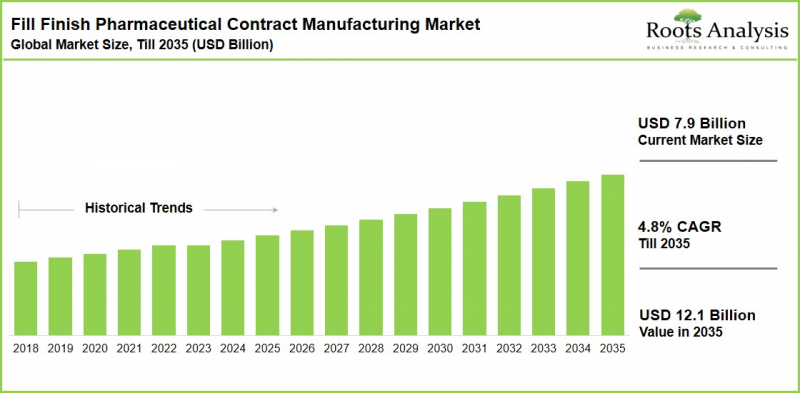
Fill Finish Pharmaceutical Contract Manufacturing Market: Growth And Trends
Fill finish represents one of the most critical and technically demanding stages of small-molecule pharmaceutical manufacturing, marking the transition of a drug product from bulk formulation to its final clinical or commercial presentation. Because contamination, packaging incompatibility or process deviations at this stage can compromise product quality and jeopardize regulatory approval, drug developers are placing a growing premium on service providers with validated aseptic processing capabilities, robust quality systems and a clean inspection history with agencies such as the USFDA and EMA.
The capital intensity and regulatory complexity associated with fill finish operations have made outsourcing the default strategy for a large share of small-molecule drug developers, rather than an exception. Pharmaceutical companies are increasingly outsourcing finished dosage form (FDF) manufacturing while often retaining drug substance production in-house, reflecting the comparatively short manufacturing timelines and higher throughput requirements associated with fill finish relative to upstream synthesis. This dynamic is reinforcing demand for CMOs and CDMOs that can offer flexible, multi-format filling capacity across clinical and commercial scales.
Service providers are responding by investing in aseptic isolators, restricted access barrier systems (RABS), robotic filling and capping lines, real-time environmental monitoring and single-use technologies, all aimed at reducing operator intervention, strengthening contamination control and improving batch-to-batch consistency. At the same time, packaging preferences are evolving, while ampoules and vials remain foundational formats, prefilled syringes and other ready-to-use containers are gaining share as manufacturers and drug developers seek greater dosing convenience and administration efficiency. Together, these trends are sustaining demand for compliant, technologically advanced and geographically diversified fill finish capacity through 2035.
Growth Drivers: Factors Fueling Market Expansion
The fill-finish pharmaceutical contract manufacturing market is being driven by the expansion of small-molecule drug pipelines and rising demand for complex sterile injectable formulations that require specialized aseptic manufacturing capabilities. Notably, generic drug developers are outsourcing finished dosage form manufacturing to contract manufacturing organizations (CMOs) and contract development and manufacturing organizations (CDMOs) to avoid the high capital requirements, lengthy validation timelines and stringent regulatory requirements associated with establishing in-house sterile fill-finish facilities.
Capacity expansion and technology upgrades by leading service providers are further broadening outsourcing opportunities. Investments in blow-fill-seal (BFS) technology, high-speed isolator-based filling systems and flexible multi-format packaging lines are enabling providers to support a wider range of pharmaceutical products and container formats. At the same time, growing adoption of prefilled syringes and other ready-to-use delivery formats, increasing outsourcing among generic drug manufacturers, and the expansion of manufacturing capacity in cost-competitive regions are supporting market growth.
Market Restraints: Critical Barriers Hindering Progress
Despite favorable growth, the market faces a capital-intensive and operationally demanding path to expansion. Establishing and validating GMP-compliant aseptic filling lines requires substantial upfront investment in cleanroom infrastructure, isolators and environmental monitoring systems. Meanwhile, evolving regulatory expectations from agencies such as the USFDA and EMA continue to raise the bar for both new entrants and existing facility upgrades.
Additionally, extended qualification and technology-transfer timelines can delay the onboarding of new fill finish partners, creating friction for drug developers working against clinical or commercial launch deadlines. Limited availability of specialized, highly trained aseptic processing personnel, combined with periodic bottlenecks in the supply of primary packaging components such as vials, cartridges and prefilled syringes, adds a further layer of operational risk. For smaller and mid-sized CMOs, the cost of maintaining multiple container-closure formats and sterilization modalities across clinical and commercial scales can constrain their ability to compete for large, multi-year commercial supply agreements against larger, well-capitalized players.
Opportunity Areas: Where Value Creation is Concentrated
Considerable opportunity exists for service providers that can offer integrated, one-stop fill finish solutions spanning formulation support, multiple container-closure formats, and both aseptic filling and terminal sterilization under a single quality system.
Asia-Pacific presents a distinct opportunity for capacity investment, with vial filling capacity in the region expanding at a substantial pace on the back of technological upgrades, competitive labor costs and supportive government policy. Providers that can pair Asia-Pacific manufacturing footprints with the quality systems and inspection history expected by developers targeting regulated Western markets are well positioned to capture cross-border outsourcing demand.
Fill Finish Pharmaceutical Contract Manufacturing Market: Key Insights
The report examines the current state of the fill finish pharmaceutical contract manufacturing market and identifies potential growth opportunities within the industry. Some key findings include:
- The competitive landscape features close to 390 CMOs offering fill finish manufacturing services for small molecules, with a steady rise in the number of participants over the past decade reflecting growing demand for both novel and conventional drug products.
- Among the contract manufacturers identified in the study, 93% offer aseptic filling services, 82% offer blow-fill-seal services and 36% offer terminal-sterilization services, indicating that most providers maintain multi-modality capabilities rather than specializing in a single sterilization approach.
- Vials remain the most widely adopted packaging format for small-molecule fill finish, used by 63% of surveyed contract manufacturers, while ampoules currently hold the largest overall market share by value given their compatibility with terminal sterilization and hermetic sealing requirements.
- Nearly half (48%) of installed small-molecule ampoule filling capacity at large and very large companies is located in Europe, with close to 20% of that European capacity concentrated in France; a similar concentration pattern holds for cartridge filling capacity.
- Vial filling capacity in Asia-Pacific has expanded at a substantial pace over recent years, driven by technological upgrades, favorable labor economics and supportive socio-economic reforms for the region's specialty manufacturing industries.
- Originator finished dosage form (FDF) manufacturing accounts for the largest share of outsourced fill finish value, supported by the cost efficiency, competitive pricing and consistent quality standards maintained by leading contract manufacturers.
- Prefilled syringes are anticipated to grow at a comparatively faster CAGR of 5.1% through the forecast period, as manufacturers and drug developers increasingly favor ready-to-use formats over traditional ampoules and vials for select product classes.
- Primary interviews with industry stakeholders confirm that FDF outsourcing has become a default manufacturing strategy for a large share of drug developers, since drug substance manufacturing timelines are considerably longer and more capital-intensive than drug product (fill finish) manufacturing, which can often be completed within a single day of scheduled production.
Fill Finish Pharmaceutical Contract Manufacturing Market Segments
The market sizing and opportunity analysis has been segmented across the following parameters:
By Type of Fill Finish Service Offered
- Aseptic Filling
- Blow-Fill-Seal (BFS)
- Terminal Sterilization
By Type of FDF
- Generic FDF
- Originator FDF
By API Potency
- Low Potent API
- High Potent API
By Type of Primary Packaging Container
- Ampoules
- Cartridges
- Prefilled Syringes
- Vials
- Other Containers
By Scale of Operation
- Clinical
- Commercial
By Company Size
- Small and Mid-sized Companies
- Large and Very Large Companies
By Geographical Regions
- North America
- Europe
- Asia-Pacific
- Latin America
- Middle East and North Africa
Fill Finish Pharmaceutical Contract Manufacturing Market: Key Segmentation Insights
Terminal Sterilization Holds the Largest Share of the Market
Terminal sterilization currently captures the largest share of the market. This dominance is due to the higher level of sterility assurance it provides relative to aseptic processing, along with its comparative reliability and cost-effectiveness for eligible formulations. This positioning is expected to remain broadly stable through the forecast period.
Originator FDF Accounts for the Largest Share by Type of FDF
The originator FDF segment accounts for the highest share of the market. This dominance reflects the scale of outsourced fill finish activity tied to originator drug products. Further, the cost-effectiveness, competitive pricing and consistent quality standards maintained by contract manufacturers serving originator developers.
Low Potent API Segment Dominates by API Potency
Low potent APIs account for the highest market share. This large share is due to the comparatively simpler manufacturing requirements, higher overall demand and lower production costs associated with low potent formulations relative to high potent APIs, which require dedicated containment infrastructure.
Ampoules Lead by Primary Packaging Container
Ampoules currently hold the largest market share among primary packaging containers, offering a hermetically sealed format well suited to eligible sterile drug products that can withstand terminal sterilization. Prefilled syringes, meanwhile, are projected to register a comparatively faster CAGR during the forecast period, as manufacturers move toward ready-to-use formats that improve dosing convenience and reduce preparation steps.
Commercial-Scale Operations Dominate by Scale of Operation
Commercial-scale operations capture the highest share of the market. This dominance is driven due to the extent to which fill finish outsourcing has shifted from clinical-stage, small-batch activity toward large-volume, recurring commercial manufacturing programs.
Large and Very Large Companies Hold Majority Share by Company Size
Large and very large companies account for the majority of market share. This dominance reflects their ability to maintain multi-modality filling capacity, sustain compliance systems, and absorb the capital investment required to serve both clinical and commercial-scale programs across geographies.
Europe Emerges as the Hub of the Fill Finish Pharmaceutical Contract Manufacturing Market
The majority of companies operating in this market are headquarters in Europe. Rising demand for small-molecule drugs across the region, driven by growing healthcare-industry interest in personalized medicine and a corresponding increase in R&D investment, continues to reinforce Europe's position as the leading regional market.
Example Players in the Fill Finish Pharmaceutical Contract Manufacturing Market
- Alcami
- Amanta Healthcare
- Aurigene Pharmaceutical Services
- Batterjee Pharma
- Burrard Pharmaceuticals
- Curida
- Eriochem
- Fresenius Kabi
- GlaxoSmithKline
- Nextage Therapeutics
- Pfizer CentreOne
- Plastikon Healthcare
- Procaps
- Recipharm
- ROMMELAG CMO
- Sharp
- Sypharma
- Teva Pharmaceuticals
- WuXi AppTec
FILL FINISH PHARMACEUTICAL CONTRACT MANUFACTURING MARKET: RESEARCH COVERAGE
- Market Sizing and Opportunity Analysis: An in-depth analysis of the fill finish pharmaceutical contract manufacturing market across type of fill finish service offered, type of FDF, API potency, type of primary packaging container, scale of operation, company size and geographical regions.
- Manufacturer Landscape: A detailed assessment of fill finish CMOs and CDMOs, covering year of establishment, company size, location of headquarters, sterilization modalities offered and packaging format breadth.
- Company Profiles: In-depth profiles of prominent players engaged in fill finish contract manufacturing, featuring information on year of establishment, headquarters, company size, service portfolio and key initiatives.
- Capacity Analysis: A qualitative and quantitative analysis of installed global fill finish capacity, segmented by company size, scale of operation, type of primary packaging container and location of manufacturing facility.
- Recent Developments: An analysis of recent facility expansions, technology investments and capacity additions, based on year, type of development, and location of the expanded facility.
- Vendor Selection Framework: A detailed assessment of the vendor selection framework for fill finish outsourcing, highlighting strategic drivers for outsourcing and the technical, regulatory and commercial parameters used to evaluate service providers.
- Market Impact Analysis: Coverage of the drivers, restraints, opportunities and challenges affecting market growth through 2035.
KEY QUESTIONS ANSWERED IN THIS REPORT
- Which are the leading companies in the fill finish pharmaceutical contract manufacturing market?
- Which region dominates the fill finish pharmaceutical contract manufacturing market?
- What are the key trends observed in the fill finish pharmaceutical contract manufacturing market?
- What factors are likely to influence the evolution of this market?
- What are the primary challenges faced by fill finish CMOs and CDMOs?
- What is the current and future market size, and what is the CAGR of this market?
- How is the current and future market opportunity likely to be distributed across key market segments?
- What percentage of small-molecule fill finish operations are presently outsourced?
- What are the most widely used primary packaging containers for fill finish of small molecules?
REASONS TO BUY THIS REPORT
The report provides a comprehensive market analysis, offering detailed revenue projections of the overall market and its specific sub-segments. This information is valuable to both established market leaders and emerging entrants.
- The report offers stakeholders a comprehensive overview of the market, including key drivers, barriers, opportunities and challenges, empowering data-driven decisions to capitalize on growth prospects.
- The report aids businesses in identifying future opportunities across the fill finish value chain and assessing whether those opportunities are worth pursuing.
- The report helps identify customer demand by understanding the needs, preferences and behavior of the target audience, enabling more effective tailoring of outsourcing services.
- The report equips new entrants with the information needed to build successful business strategies for entering the fill finish contract manufacturing space.
- The report supports more effective communication with prospective clients and partners, and in building stronger business relationships across the value chain.
ADDITIONAL BENEFITS
- Complimentary Excel data packs for all analytical modules in the report
- Up to 15% complimentary content customization
- In-depth report walkthrough with the research team
- Complimentary report update if the report is 6+ months old
TABLE OF CONTENTS
1. PREFACE
- 1.1. Introduction
- 1.2. Market Share Insights
- 1.3. Key Market Insights
- 1.4. Report Coverage
- 1.5. Key Questions Answered
- 1.6. Chapter Outlines
2. RESEARCH METHODOLOGY
- 2.1. Chapter Overview
- 2.2. Research Assumptions
- 2.2.1. Market Landscape and Market Trends
- 2.2.2. Market Forecast and Opportunity Analysis
- 2.2.3. Comparative Analysis
- 2.3. Database Building
- 2.3.1. Data Collection
- 2.3.2. Data Validation
- 2.3.3. Data Analysis
- 2.4. Project Methodology
- 2.4.1. Secondary Research
- 2.4.1.1. Annual Reports
- 2.4.1.2. Academic Research Papers
- 2.4.1.3. Company Websites
- 2.4.1.4. Investor Presentations
- 2.4.1.5. Regulatory Filings
- 2.4.1.6. White Papers
- 2.4.1.7. Industry Publications
- 2.4.1.8. Conferences and Seminars
- 2.4.1.9. Government Portals
- 2.4.1.10. Media and Press Releases
- 2.4.1.11. Newsletters
- 2.4.1.12. Industry Databases
- 2.4.1.13. Roots Proprietary Databases
- 2.4.1.14. Paid Databases and Sources
- 2.4.1.15. Social Media Portals
- 2.4.1.16. Other Secondary Sources
- 2.4.2. Primary Research
- 2.4.2.1. Types of Primary Research
- 2.4.2.1.1. Qualitative Research
- 2.4.2.1.2. Quantitative Research
- 2.4.2.1.3. Hybrid Approach
- 2.4.2.2. Advantages of Primary Research
- 2.4.2.3. Techniques for Primary Research
- 2.4.2.3.1. Interviews
- 2.4.2.3.2. Surveys
- 2.4.2.3.3. Focus Groups
- 2.4.2.3.4. Observational Research
- 2.4.2.3.5. Social Media Interactions
- 2.4.2.4. Key Opinion Leaders Considered in Primary Research
- 2.4.2.4.1. Company Executives (CXOs)
- 2.4.2.4.2. Board of Directors
- 2.4.2.4.3. Company Presidents and Vice Presidents
- 2.4.2.4.4. Research and Development Heads
- 2.4.2.4.5. Technical Experts
- 2.4.2.4.6. Subject Matter Experts
- 2.4.2.4.7. Scientists
- 2.4.2.4.8. Doctors and Other Healthcare Providers
- 2.4.2.5. Ethics and Integrity
- 2.4.2.5.1. Research Ethics
- 2.4.2.5.2. Data Integrity
- 2.4.2.1. Types of Primary Research
- 2.4.3. Analytical Tools and Databases
- 2.4.1. Secondary Research
3. MARKET DYNAMICS
- 3.1. Chapter Overview
- 3.2. Forecast Methodology
- 3.2.1. Top-down Approach
- 3.2.2. Bottom-up Approach
- 3.2.3. Hybrid Approach
- 3.3. Market Assessment Framework
- 3.3.1. Total Addressable Market (TAM)
- 3.3.2. Serviceable Addressable Market (SAM)
- 3.3.3. Serviceable Obtainable Market (SOM)
- 3.3.4. Currently Acquired Market (CAM)
- 3.4. Forecasting Tools and Techniques
- 3.4.1. Qualitative Forecasting
- 3.4.2. Correlation
- 3.4.3. Regression
- 3.4.4. Extrapolation
- 3.4.5. Convergence
- 3.4.6. Sensitivity Analysis
- 3.4.7. Scenario Planning
- 3.4.8. Data Visualization
- 3.4.9. Time Series Analysis
- 3.4.10. Forecast Error Analysis
- 3.5. Key Considerations
- 3.5.1. Demographics
- 3.5.2. Government Regulations
- 3.5.3. Reimbursement Scenarios
- 3.5.4. Market Access
- 3.5.5. Supply Chain
- 3.5.6. Industry Consolidation
- 3.5.7. Pandemic / Unforeseen Disruptions Impact
- 3.6. Key Market Segmentation
- 3.7. Robust Quality Control
- 3.8. Limitations
4. ECONOMIC AND OTHER PROJECT SPECIFIC CONSIDERATIONS
- 4.1. Chapter Overview
- 4.2. Market Dynamics
- 4.2.1. Time Period
- 4.2.1.1. Historical Trends
- 4.2.1.2. Current and Forecasted Estimates
- 4.2.2. Currency Coverage
- 4.2.2.1. Overview of Major Currencies Affecting the Market
- 4.2.2.2. Impact of Currency Fluctuations on the Industry
- 4.2.3. Foreign Exchange Impact
- 4.2.3.1. Evaluation of Foreign Exchange Rates and Their Impact on Market
- 4.2.3.2. Strategies for Mitigating Foreign Exchange Risk
- 4.2.4. Recession
- 4.2.4.1. Historical Analysis of Past Recessions and Lessons Learnt
- 4.2.4.2. Assessment of Current Economic Conditions and Potential Impact on the Market
- 4.2.5. Inflation
- 4.2.5.1. Measurement and Analysis of Inflationary Pressures in the Economy
- 4.2.5.2. Potential Impact of Inflation on the Market Evolution
- 4.2.1. Time Period
5. EXECUTIVE SUMMARY
6. INTRODUCTION
- 6.1. Chapter Overview
- 6.2. Introduction to Fill / Finish Services for Small Molecules
- 6.2.1. Aseptic Filling
- 6.2.2. Terminal Sterilization
- 6.2.3. Blow-Fill-Seal Technology
- 6.3. Need for Outsourcing Small Molecules-related Operations
- 6.4. Role of Contract Manufacturers in the Small Molecules Industry
- 6.5. Key Considerations while selecting a Fill / Finish Service Provider
- 6.6. Advantages of Outsourcing Fill / Finish Services
- 6.7. Risks and Challenges of Outsourcing Fill / Finish Operations
- 6.8. Future Perspectives
7. MARKET LANDSCAPE
- 7.1. Chapter Overview
- 7.2. Small Molecules Fill / Finish Service Providers: Overall Market Landscape
- 7.2.1. Analysis by Year of Establishment
- 7.2.2. Analysis by Company Size
- 7.2.3. Analysis by Location of Headquarters
- 7.2.4. Analysis by Location of Fill / Finish Facilities
- 7.2.5. Analysis by Scale of Operation
- 7.2.6. Analysis by Type of Filling Service Offered
- 7.2.7. Analysis by Type of Finishing Service Offered
- 7.2.8. Analysis by Type of Packaging Format Used
- 7.2.9. Analysis by Type of Finished Dosage Form
- 7.2.10. Analysis by Degree of Automation
8. COMPANY PROFILES: SERVICE PROVIDERS IN NORTH AMERICA
- 8.1. Chapter Overview
- 8.2. Leading Small Molecules Fill / Finish Service Providers based in North America
- 8.2.1. Alcami
- 8.2.1.1. Company Overview
- 8.2.1.2. Small Molecules Fill / Finish Service Portfolio
- 8.2.1.3. Recent Developments and Future Outlook
- 8.2.2. Pfizer CentreOne
- 8.2.2.1. Company Overview
- 8.2.2.2. Small Molecules Fill / Finish Service Portfolio
- 8.2.2.3. Recent Developments and Future Outlook
- 8.2.3. Sharp Services
- 8.2.3.1. Company Overview
- 8.2.3.2. Small Molecules Fill / Finish Service Portfolio
- 8.2.3.3. Recent Developments and Future Outlook
- 8.2.1. Alcami
- 8.3. Other Leading Small Molecules Fill / Finish Service Providers based in North America
- 8.3.1. Burrard Pharmaceuticals
- 8.3.1.1. Company Overview
- 8.3.1.2. Small Molecules Fill / Finish Service Portfolio
- 8.3.2. Plastikon Healthcare
- 8.3.2.1. Company Overview
- 8.3.2.2. Small Molecules Fill / Finish Service Portfolio
- 8.3.1. Burrard Pharmaceuticals
9. COMPANY PROFILES: SERVICE PROVIDERS IN EUROPE
- 9.1. Chapter Overview
- 9.2. Leading Small Molecules Fill / Finish Service Providers based in Europe
- 9.2.1. Fresenius Kabi
- 9.2.1.1. Company Overview
- 9.2.1.2. Financial Information
- 9.2.1.3. Small Molecules Fill / Finish Service Portfolio
- 9.2.1.4. Recent Developments and Future Outlook
- 9.2.2. GlaxoSmithKline
- 9.2.2.1. Company Overview
- 9.2.2.2. Financial Information
- 9.2.2.3. Small Molecules Fill / Finish Service Portfolio
- 9.2.2.4. Recent Developments and Future Outlook
- 9.2.3. Recipharm
- 9.2.3.1. Company Overview
- 9.2.3.2. Small Molecules Fill / Finish Service Portfolio
- 9.2.3.3. Recent Developments and Future Outlook
- 9.2.1. Fresenius Kabi
- 9.3. Other Leading Small Molecules Fill / Finish Service Providers based in Europe
- 9.3.1. Curida
- 9.3.1.1. Company Overview
- 9.3.1.2. Small Molecules Fill / Finish Service Portfolio
- 9.3.2. ROMMELAG CMO
- 9.3.2.1. Company Overview
- 9.3.2.2. Small Molecules Fill / Finish Service Portfolio
- 9.3.1. Curida
10. COMPANY PROFILES: SERVICE PROVIDERS IN ASIA-PACIFIC
- 10.1. Chapter Overview
- 10.2. Leading Small Molecules Fill / Finish Service Providers based in Asia-Pacific
- 10.2.1. Aurigene Pharmaceutical Services
- 10.2.1.1. Company Overview
- 10.2.1.2. Small Molecules Fill / Finish Service Portfolio
- 10.2.1.3. Recent Developments and Future Outlook
- 10.2.2. Sypharma
- 10.2.2.1. Company Overview
- 10.2.2.2. Small Molecules Fill / Finish Service Portfolio
- 10.2.2.3. Recent Developments and Future Outlook
- 10.2.3. WuXi AppTec
- 10.2.3.1. Company Overview
- 10.2.3.2. Small Molecules Fill / Finish Service Portfolio
- 10.2.3.3. Recent Developments and Future Outlook
- 10.2.1. Aurigene Pharmaceutical Services
- 10.3. Other Small Molecules Fill / Finish Service Providers based in Asia-Pacific
- 10.3.1. Amanta Healthcare
- 10.3.1.1. Company Overview
- 10.3.1.2. Small Molecules Fill / Finish Service Portfolio
- 10.3.1. Amanta Healthcare
11. COMPANY PROFILES: SERVICE PROVIDERS IN REST OF THE WORLD
- 11.1. Chapter Overview
- 11.2. Leading Small Molecules Fill / Finish Service Providers based in Rest of the World
- 11.2.1. Eriochem
- 11.2.1.1. Company Overview
- 11.2.1.2. Small Molecules Fill / Finish Service Portfolio
- 11.2.1.3. Recent Developments and Future Outlook
- 11.2.2. Teva Pharmaceutical Industries
- 11.2.2.1. Company Overview
- 11.2.2.2. Small Molecules Fill / Finish Service Portfolio
- 11.2.2.3. Recent Developments and Future Outlook
- 11.2.1. Eriochem
- 11.3. Other Small Molecules Fill / Finish Service Providers based in Rest of the World
- 11.3.1. Batterjee Pharma
- 11.3.1.1. Company Overview
- 11.3.1.2. Small Molecules Fill / Finish Service Portfolio
- 11.3.2. Procaps
- 11.3.2.1. Company Overview
- 11.3.2.2. Small Molecules Fill / Finish Service Portfolio
- 11.3.1. Batterjee Pharma
12. COMPANY COMPETITIVENESS ANALYSIS
- 12.1. Chapter Overview
- 12.2. Assumptions and Key Parameters
- 12.3. Methodology
- 12.4. Small Molecules Fill / Finish Service Providers based in North America
- 12.5. Small Molecules Fill / Finish Service Providers based in Europe
- 12.6. Small Molecules Fill / Finish Service Providers based in Asia-Pacific and Rest of the World
13. CAPACITY ANALYSIS
- 13.1. Chapter Overview
- 13.2. Global Annual Small Molecules Fill / Finish Capacity for Ampoules (Number of Units)
- 13.2.1. Key Assumptions and Methodology
- 13.2.2. Analysis by Company Size
- 13.2.3. Analysis by Geography
- 13.2.3.1. Analysis of Small Molecules Fill / Finish Capacity for Ampoules in North America
- 13.2.3.2. Analysis of Small Molecules Fill / Finish Capacity for Ampoules in Europe
- 13.2.3.3. Analysis of Small Molecules Fill / Finish Capacity for Ampoules in Asia-Pacific and Rest of the World
- 13.3. Global Annual Small Molecules Fill / Finish Capacity for Cartridges (Number of Units)
- 13.3.1. Key Assumptions and Methodology
- 13.3.2. Analysis by Company Size
- 13.3.3. Analysis by Geography
- 13.3.3.1. Analysis of Small Molecules Fill / Finish Capacity for Cartridges in North America
- 13.3.3.2. Analysis of Small Molecules Fill / Finish Capacity for Cartridges in Europe
- 13.3.3.3. Analysis of Small Molecules Fill / Finish Capacity for Cartridges in Asia-Pacific and Rest of the World
- 13.4. Global Annual Small Molecules Fill / Finish Capacity for Prefilled Syringes (Number of Units)
- 13.4.1. Key Assumptions and Methodology
- 13.4.2. Analysis by Company Size
- 13.4.3. Analysis by Geography
- 13.4.3.1. Analysis of Small Molecules Fill / Finish Capacity for Prefilled Syringes in North America
- 13.4.3.2. Analysis of Small Molecules Fill / Finish Capacity for Prefilled Syringes in Europe
- 13.4.3.3. Analysis of Small Molecules Fill / Finish Capacity for Prefilled Syringes in Asia-Pacific and Rest of the World
- 13.5. Global Annual Small Molecules Fill / Finish Capacity for Vials (Number of Units)
- 13.5.1. Key Assumptions and Methodology
- 13.5.2. Analysis by Company Size
- 13.5.3. Analysis by Geography
- 13.5.3.1. Analysis of Small Molecules Fill / Finish Capacity for Vials in North America
- 13.5.3.2. Analysis of Small Molecules Fill / Finish Capacity for Vials in Europe
- 13.5.3.3. Analysis of Small Molecules Fill / Finish Capacity for Vials in Asia-Pacific and Rest of the World
14. CASE STUDY: ROBOTIC SYSTEMS IN FILL / FINISH OPERATIONS
- 14.1. Chapter Overview
- 14.2. Role of Robotic Systems in Fill / Finish Operations
- 14.2.1. Types of Robots Used
- 14.2.2. Key Considerations for Selecting Robotic Systems
- 14.3. Companies Providing Robots for use in the Pharmaceutical Industry
- 14.4. Companies Providing Isolator- based Aseptic Filling Systems
- 14.5. Small Molecules Fill / Finish Service Providers: List of Equipment Used
- 14.6. Concluding Remarks
15. CASE STUDY: READY-TO-USE PACKAGING COMPONENTS FOR ASEPTIC FILL / FINISH
- 15.1. Chapter Overview
- 15.2. Role of Ready-to-Use Packaging Components in Aseptic Fill / Finish Operations
- 15.2.1. Advantages of Ready-to-Use Packaging Components
- 15.2.2. Disadvantages of Ready-to-Use Packaging Components
- 15.3. Companies Providing Ready-to-Use Packaging Components
- 15.4. Concluding Remarks
16. MARKET IMPACT ANALYSIS: DRIVERS, RESTRAINTS, OPPORTUNITIES AND CHALLENGES
- 16.1. Chapter Overview
- 16.2. Market Drivers
- 16.3. Market Restraints
- 16.4. Market Opportunities
- 16.5. Market Challenges
- 16.6. Conclusion
17. GLOBAL PHARMACEUTICAL FILL / FINISH MANUFACTURING MARKET
- 17.1. Chapter Overview
- 17.2. Assumptions and Methodology
- 17.3. Global Pharmaceutical Fill / Finish Manufacturing Market, till 2035
- 17.3.1. Scenario Analysis
- 17.3.1.1. Conservative Scenario
- 17.3.1.2. Optimistic Scenario
- 17.3.1. Scenario Analysis
- 17.4. Key Market Segmentations
18. PHARMACEUTICAL FILL / FINISH MANUFACTURING MARKET, BY TYPE OF FILL / FINISH SERVICE OFFERED
- 18.1. Chapter Overview
- 18.2. Assumptions and Methodology
- 18.3. Pharmaceutical Fill / Finish Manufacturing Market: Distribution by Type of Fill / Finish Service Offered, 2019, Current Year and 2035
- 18.3.1. Pharmaceutical Fill / Finish Manufacturing Market for Terminal Sterilization, till 2035
- 18.3.2. Pharmaceutical Fill / Finish Manufacturing Market for Aseptic Filling, till 2035
- 18.3.3. Pharmaceutical Fill / Finish Manufacturing Market for Blow-Fill-Seal, till 2035
- 18.4. Pharmaceutical Fill / Finish Manufacturing Market, by Type of Fill / Finish Services Offered: Market Dynamics Assessment
- 18.4.1. Penetration-Growth (P-G) Matrix
- 18.4.2. Data Triangulation and Validation
19. PHARMACEUTICAL FILL / FINISH MANUFACTURING MARKET, BY TYPE OF FDF
- 19.1. Chapter Overview
- 19.2. Assumptions and Methodology
- 19.3. Pharmaceutical Fill / Finish Manufacturing Market: Distribution by Type of FDF, 2019, Current Year and 2035
- 19.3.1. Pharmaceutical Fill / Finish Manufacturing Market for Generic FDF, till 2035
- 19.3.2. Pharmaceutical Fill / Finish Manufacturing Market for Originator FDF, till 2035
- 19.4. Pharmaceutical Fill / Finish Manufacturing Market, by Type of FDF: Market Dynamics Assessment
- 19.4.1. Penetration-Growth (P-G) Matrix
- 19.4.2. Data Triangulation and Validation
20. PHARMACEUTICAL FILL / FINISH MANUFACTURING MARKET, BY API POTENCY
- 20.1. Chapter Overview
- 20.2. Assumptions and Methodology
- 20.3. Pharmaceutical Fill / Finish Manufacturing Market: Distribution by API Potency, 2019, Current Year and 2035
- 20.3.1. Pharmaceutical Fill / Finish Manufacturing Market for Low Potent API, till 2035
- 20.3.2. Pharmaceutical Fill / Finish Manufacturing Market for High Potent API, till 2035
- 20.4. Pharmaceutical Fill / Finish Manufacturing Market, by API Potency: Market Dynamics Assessment
- 20.4.1. Penetration-Growth (P-G) Matrix
- 20.4.2. Data Triangulation and Validation
21. PHARMACEUTICAL FILL / FINISH MANUFACTURING MARKET, BY TYPE OF PRIMARY PACKAGING CONTAINER
- 21.1. Chapter Overview
- 21.2. Assumptions and Methodology
- 21.3. Pharmaceutical Fill / Finish Manufacturing Market: Distribution by Type of Primary Packaging Container, 2019, Current Year and 2035
- 21.3.1. Pharmaceutical Fill / Finish Manufacturing Market for Vials, till 2035
- 21.3.2. Pharmaceutical Fill / Finish Manufacturing Market for Ampoules, till 2035
- 21.3.3. Pharmaceutical Fill / Finish Manufacturing Market for Prefilled Syringes, till 2035
- 21.3.4. Pharmaceutical Fill / Finish Manufacturing Market for Cartridges, till 2035
- 21.3.5. Pharmaceutical Fill / Finish Manufacturing Market for Other Containers, till 2035
- 21.4. Pharmaceutical Fill / Finish Manufacturing Market, by Type of Primary Packaging Container: Market Dynamics Assessment
- 21.4.1. Penetration-Growth (P-G) Matrix
- 21.4.2. Data Triangulation and Validation
22. PHARMACEUTICAL FILL / FINISH MANUFACTURING MARKET, BY SCALE OF OPERATION
- 22.1. Chapter Overview
- 22.2. Assumptions and Methodology
- 22.3. Pharmaceutical Fill / Finish Manufacturing Market: Distribution by Scale of Operation, 2019, Current Year and 2035
- 22.3.1. Pharmaceutical Fill / Finish Manufacturing Market for Clinical Scale, till 2035
- 22.3.2. Pharmaceutical Fill / Finish Manufacturing Market for Commercial Scale, till 2035
- 22.4. Pharmaceutical Fill / Finish Manufacturing Market, by Scale of Operation: Market Dynamics Assessment
- 22.4.1. Penetration-Growth (P-G) Matrix
- 22.4.2. Data Triangulation and Validation
23. PHARMACEUTICAL FILL / FINISH MANUFACTURING MARKET, BY COMPANY SIZE
- 23.1. Chapter Overview
- 23.2. Assumptions and Methodology
- 23.3. Pharmaceutical Fill / Finish Manufacturing Market: Distribution by Company Size, 2019, Current Year and 2035
- 23.3.1. Pharmaceutical Fill / Finish Manufacturing Market for Small and Mid-sized Companies, till 2035
- 23.3.2. Pharmaceutical Fill / Finish Manufacturing Market for Large / Very Large Companies, till 2035
- 23.4. Pharmaceutical Fill / Finish Manufacturing Market, by Company Size: Market Dynamics Assessment
- 23.4.1. Penetration-Growth (P-G) Matrix
- 23.4.2. Data Triangulation and Validation
24. PHARMACEUTICAL FILL / FINISH MANUFACTURING MARKET, BY GEOGRAPHICAL REGIONS
- 24.1. Chapter Overview
- 24.2. Assumptions and Methodology
- 24.3. Pharmaceutical Fill / Finish Manufacturing Market: Distribution by Geographical Regions, 2019, Current Year and 2035
- 24.3.1. Pharmaceutical Fill / Finish Manufacturing Market in North America, till 2035
- 24.3.1.1. Pharmaceutical Fill / Finish Manufacturing Market in the US, till 2035
- 24.3.1.2. Pharmaceutical Fill / Finish Manufacturing Market in Canada, till 2035
- 24.3.1.3. Pharmaceutical Fill / Finish Manufacturing Market in Mexico, till 2035
- 24.3.1.4. Pharmaceutical Fill / Finish Manufacturing Market in Puerto Rico, till 2035
- 24.3.2. Pharmaceutical Fill / Finish Manufacturing Market in Europe, till 2035
- 24.3.2.1. Pharmaceutical Fill / Finish Manufacturing Market in France, till 2035
- 24.3.2.2. Pharmaceutical Fill / Finish Manufacturing Market in Germany, till 2035
- 24.3.2.3. Pharmaceutical Fill / Finish Manufacturing Market in Italy, till 2035
- 24.3.2.4. Pharmaceutical Fill / Finish Manufacturing Market in the UK, till 2035
- 24.3.2.5. Pharmaceutical Fill / Finish Manufacturing Market in Spain, till 2035
- 24.3.2.6. Pharmaceutical Fill / Finish Manufacturing Market in Rest of Europe, till 2035
- 24.3.3. Pharmaceutical Fill / Finish Manufacturing Market in Asia-Pacific, till 2035
- 24.3.3.1. Pharmaceutical Fill / Finish Manufacturing Market in India, till 2035
- 24.3.3.2. Pharmaceutical Fill / Finish Manufacturing Market in Japan, till 2035
- 24.3.3.3. Pharmaceutical Fill / Finish Manufacturing Market in China, till 2035
- 24.3.3.4. Pharmaceutical Fill / Finish Manufacturing Market in Rest of Asia-Pacific, till 2035
- 24.3.4. Pharmaceutical Fill / Finish Manufacturing Market in Middle East and North Africa, till 2035
- 24.3.5. Pharmaceutical Fill / Finish Manufacturing Market in Latin America, till 2035
- 24.3.6. Pharmaceutical Fill / Finish Manufacturing Market in Rest of the World, till 2035
- 24.3.1. Pharmaceutical Fill / Finish Manufacturing Market in North America, till 2035
- 24.4. Pharmaceutical Fill / Finish Manufacturing Market, by Geographical Regions: Market Dynamics Assessment
- 24.4.1. Penetration-Growth (P-G) Matrix
- 24.4.2. Data Triangulation and Validation
25. PHARMACEUTICAL FILL / FINISH MANUFACTURING MARKET, BY LEADING PLAYERS
- 25.1. Chapter Overview
- 25.2. Leading Industry Players
26. CONCLUSION
27. EXECUTIVE INSIGHT
- 27.1. Chapter Overview
28. APPENDIX I: TABULATED DATA
29. APPENDIX II: LIST OF COMPANIES AND ORGANIZATIONS
List of Tables
- Table 7.1 Small Molecules Fill / Finish Service Providers: List of Companies
- Table 7.2 Small Molecules Fill / Finish Service Providers: Information on Scale of Operation, Type of Filling Service Offered and Type of Finishing Service Offered
- Table 7.3 Small Molecules Fill / Finish Service Providers: Information on Type of Packaging Format Used, Type of Finished Dosage Form and Degree of Automation
- Table 8.1 Small Molecules Fill / Finish Service Providers in North America: List of Companies Profiled
- Table 8.2 Alcami: Company Overview
- Table 8.3 Alcami: Small Molecules Fill / Finish Service Portfolio
- Table 8.4 Alcami: Recent Developments and Future Outlook
- Table 8.5 Pfizer CentreOne: Company Overview
- Table 8.6 Pfizer CentreOne: Small Molecules Fill / Finish Service Portfolio
- Table 8.7 Sharp Services: Company Overview
- Table 8.8 Sharp Services: Small Molecules Fill / Finish Service Portfolio
- Table 8.9 Sharp Services: Recent Developments and Future Outlook
- Table 8.10 Burrard Pharmaceuticals: Company Overview
- Table 8.11 Burrard Pharmaceuticals: Small Molecules Fill / Finish Service Portfolio
- Table 8.12 Plastikon Healthcare: Company Overview
- Table 8.13 Plastikon Healthcare: Small Molecules Fill / Finish Service Portfolio
- Table 9.1 Small Molecules Fill / Finish Service Providers: List of Companies Profiled
- Table 9.2 Fresenius Kabi: Company Overview
- Table 9.3 Fresenius Kabi: Small Molecules Fill / Finish Service Portfolio
- Table 9.4 Fresenius Kabi: Recent Developments and Future Outlook
- Table 9.5 GlaxoSmithKline: Company Overview
- Table 9.6 GlaxoSmithKline: Small Molecules Fill / Finish Service Portfolio
- Table 9.7 GlaxoSmithKline: Recent Developments and Future Outlook
- Table 9.8 Recipharm: Company Overview
- Table 9.9 Recipharm: Small Molecules Fill / Finish Service Portfolio
- Table 9.10 Recipharm: Recent Developments and Future Outlook
- Table 9.11 Curida: Company Overview
- Table 9.12 Curida: Small Molecules Fill / Finish Service Portfolio
- Table 9.13 ROMMELAG CMO: Company Overview
- Table 9.14 ROMMELAG CMO: Small Molecules Fill / Finish Service Portfolio
- Table 10.1 Small Molecules Fill / Finish Service Providers: List of Companies Profiled
- Table 10.2 Aurigene Pharmaceutical Services: Company Overview
- Table 10.3 Aurigene Pharmaceutical Services: Small Molecules Fill / Finish Service Portfolio
- Table 10.4 Aurigene Pharmaceutical Services: Recent Developments and Future Outlook
- Table 10.5 Sypharma: Company Overview
- Table 10.6 Sypharma: Small Molecules Fill / Finish Service Portfolio
- Table 10.7 Sypharma: Recent Developments and Future Outlook
- Table 10.8 WuXi AppTec: Company Overview
- Table 10.9 WuXi AppTec: Small Molecules Fill / Finish Service Portfolio
- Table 10.10 WuXi AppTec: Recent Developments and Future Outlook
- Table 10.11 Amanta Healthcare: Company Overview
- Table 10.12 Amanta Healthcare: Small Molecules Fill / Finish Service Portfolio
- Table 11.1 Small Molecules Fill / Finish Service Providers: List of Companies Profiled
- Table 11.2 Eriochem: Company Overview
- Table 11.3 Eriochem: Small Molecules Fill / Finish Service Portfolio
- Table 11.4 Teva Pharmaceutical Industries: Company Overview
- Table 11.5 Teva Pharmaceutical Industries: Small Molecules Fill / Finish Service Portfolio
- Table 11.6 Teva Pharmaceutical Industries: Recent Developments and Future Outlook
- Table 11.7 Batterjee Pharma: Company Overview
- Table 11.8 Batterjee Pharma: Small Molecules Fill / Finish Service Portfolio
- Table 11.9 Nextar Chempharma Solutions: Company Overview
- Table 11.10 Nextar Chempharma Solutions: Small Molecules Fill / Finish Service Portfolio
- Table 11.11 Procaps: Company Overview
- Table 11.12 Procaps: Small Molecules Fill / Finish Service Portfolio
- Table 13.1 Small Molecules Fill / Finish Service Providers: Information on Total Capacity for Ampoules (Sample Data Set)
- Table 13.2 Small Molecules Fill / Finish Service Providers: Average Capacity per Facility for Ampoules, by Company Size (Sample Dataset)
- Table 13.3 Global Annual Small Molecules Fill / Finish Capacity for Ampoules, by Company Size (in terms of units)
- Table 13.4 Small Molecules Fill / Finish Service Providers: Information on Total Capacity for Cartridges (Sample Data Set)
- Table 13.5 Small Molecules Fill / Finish Service Providers: Average Capacity per Facility for Cartridges, by Company Size (Sample Dataset)
- Table 13.6 Global Annual Small Molecules Fill / Finish Capacity for Cartridges, by Company Size (in terms of units)
- Table 13.7 Small Molecules Fill / Finish Service Providers: Information on Total Capacity for Prefilled Syringes (Sample Data Set)
- Table 13.8 Small Molecules Fill / Finish Service Providers: Average Capacity per Facility for Prefilled Syringes, by Company Size (Sample Dataset)
- Table 13.9 Global Annual Small Molecules Fill / Finish Capacity for Prefilled Syringes, by Company Size (in terms of units)
- Table 13.10 Small Molecules Fill / Finish Service Providers: Information on Total Capacity for Vials (Sample Data Set)
- Table 13.11 Small Molecules Fill / Finish Service Providers: Average Capacity for Vials, by Company Size (Sample Dataset)
- Table 13.12 Global Annual Small Molecules Fill / Finish Capacity for Vials: Total Capacity by Company Size (in terms of units)
- Table 14.1 List of Companies Providing Robots for Use in Pharmaceutical Industry
- Table 14.2 Isolator-based Aseptic Filling Systems: Information on Compatible Primary Container
- Table 14.3 Small Molecules Fill / Finish Service Providers: Information on Fill / Finish Equipment Used
- Table 15.1 List of Companies Providing Ready-to-Use Packaging Components
- Table 25.1 Leading Industry Players: Based on the Annual Capacity Installed
- Table 27.1 Bushu Pharmaceuticals: Company Overview
- Table 28.1 Small Molecules Fill / Finish Service Providers: Distribution by Year of Establishment
- Table 28.2 Small Molecules Fill / Finish Service Providers: Distribution by Company Size
- Table 28.3 Small Molecules Fill / Finish Service Providers: Distribution by Location of Headquarters
- Table 28.4 Small Molecules Fill / Finish Service Providers: Distribution by Location of Fill / Finish Facilities
- Table 28.5 Small Molecules Fill / Finish Service Providers: Distribution by Scale of Operation
- Table 28.6 Small Molecules Fill / Finish Service Providers: Distribution by Type of Filling Service Offered
- Table 28.7 Small Molecules Fill / Finish Service Providers: Distribution by Type of Finishing Service Offered
- Table 28.8 Small Molecules Fill / Finish Service Providers: Distribution by Type of Packaging Format Used
- Table 28.9 Small Molecules Fill / Finish Service Providers: Distribution by Type of Finished Dosage Form
- Table 28.10 Small Molecules Fill / Finish Service Providers: Distribution by Degree of Automation
- Table 28.11 Pfizer (parent company of Pfizer CentreOne): Business Segment-wise Revenues and Consolidated Financial Details (USD Billion)
- Table 28.12 Fresenius Kabi: Business Segment-wise Revenues and Consolidated Financial Details (EUR Billion)
- Table 28.13 GlaxoSmithKline: Business Segment-wise Revenues and Consolidated Financial Details (EUR Billion)
- Table 28.14 WuXi AppTec: Business Segment-wise Revenues and Consolidated Financial Details (RMB Billion)
- Table 28.15 Global Annual Small Molecules Fill / Finish Capacity for Ampoules: Distribution by Company Size
- Table 28.16 Global Annual Small Molecules Fill / Finish Capacity for Ampoules: Distribution by Location of Fill / Finish Facility
- Table 28.17 Small Molecules Fill / Finish Capacity for Ampoules in North America
- Table 28.18 Small Molecules Fill / Finish Capacity for Ampoules in Europe
- Table 28.19 Small Molecules Fill / Finish Capacity for Ampoules in Asia-Pacific and Rest of the World
- Table 28.20 Global Annual Small Molecules Fill / Finish Capacity for Cartridges: Distribution by Company Size
- Table 28.21 Global Annual Small Molecules Fill / Finish Capacity for Cartridges: Distribution by Location of Fill / Finish Facility
- Table 28.22 Small Molecules Fill / Finish Capacity for Cartridges in North America
- Table 28.23 Small Molecules Fill / Finish Capacity for Cartridges in Europe
- Table 28.24 Small Molecules Fill / Finish Capacity for Cartridges in Asia-Pacific and Rest of the World
- Table 28.25 Global Annual Small Molecules Fill / Finish Capacity for Prefilled Syringes: Distribution by Company Size
- Table 28.26 Global Annual Small Molecules Fill / Finish Capacity for Prefilled Syringes: Distribution by Location of Fill / Finish Facility
- Table 28.27 Small Molecules Fill / Finish Capacity for Prefilled Syringes in North America
- Table 28.28 Small Molecules Fill / Finish Capacity for Prefilled Syringes in Europe
- Table 28.29 Small Molecules Fill / Finish Capacity for Prefilled Syringes in Asia-Pacific and Rest of the World
- Table 28.30 Global Annual Small Molecules Fill / Finish Capacity for Vials: Distribution by Company Size
- Table 28.31 Global Annual Small Molecules Fill / Finish Capacity for Vials: Distribution by Location of Fill / Finish Facility
- Table 28.32 Small Molecules Fill / Finish Capacity for Vials in North America
- Table 28.33 Small Molecules Fill / Finish Capacity for Vials in Europe
- Table 28.34 Small Molecules Fill / Finish Capacity for Vials in Asia-Pacific and Rest of the World
- Table 28.35 Global Pharmaceutical Fill / Finish Manufacturing Market: Conservative, Base, Optimistic Scenario, till 2035 (USD Billion)
- Table 28.36 Pharmaceutical Fill / Finish Manufacturing Market: Distribution by Type of Fill / Finish Service Offered, 2019, Current Year and 2035 (USD Billion)
- Table 28.37 Pharmaceutical Fill / Finish Manufacturing Market for Terminal Sterilization, till 2035 (USD Billion)
- Table 28.38 Pharmaceutical Fill / Finish Manufacturing Market for Aseptic Filling, till 2035 (USD Billion)
- Table 25.39 Pharmaceutical Fill / Finish Manufacturing Market for Blow-Fill-Seal, till 2035 (USD Billion)
- Table 28.40 Pharmaceutical Fill / Finish Manufacturing Market: Distribution by Type of FDF, 2019, Current Year and 2035 (USD Billion)
- Table 28.41 Pharmaceutical Fill / Finish Manufacturing Market for Originator FDF, till 2035 (USD Billion)
- Table 28.42 Pharmaceutical Fill / Finish Manufacturing Market for Generic FDF, till 2035 (USD Billion)
- Table 28.43 Pharmaceutical Fill / Finish Manufacturing Market: Distribution by API Potency, 2019, Current Year and 2035 (USD Billion)
- Table 28.44 Pharmaceutical Fill / Finish Manufacturing Market for Low Potent API, till 2035 (USD Billion)
- Table 28.45 Pharmaceutical Fill / Finish Manufacturing Market for High Potent API, till 2035 (USD Billion)
- Table 28.46 Pharmaceutical Fill / Finish Manufacturing Market: Distribution by Type of Primary Packaging Container, 2019, Current Year and 2035 (USD Billion)
- Table 28.47 Pharmaceutical Fill / Finish Manufacturing Market for Vials, till 2035 (USD Billion)
- Table 28.48 Pharmaceutical Fill / Finish Manufacturing Market for Prefilled Syringes, till 2035 (USD Billion)
- Table 28.49 Pharmaceutical Fill / Finish Manufacturing Market for Ampoules, till 2035 (USD Billion)
- Table 28.50 Pharmaceutical Fill / Finish Manufacturing Market for Cartridges, till 2035 (USD Billion)
- Table 28.51 Pharmaceutical Fill / Finish Manufacturing Market for Other Containers, till 2035 (USD Billion)
- Table 28.52 Pharmaceutical Fill / Finish Manufacturing Market: Distribution by Scale of Operation, 2019, Current Year and 2035 (USD Billion)
- Table 28.53 Pharmaceutical Fill / Finish Manufacturing Market for Clinical Scale, till 2035 (USD Billion)
- Table 28.54 Pharmaceutical Fill / Finish Manufacturing Market for Commercial Scale, till 2035 (USD Billion)
- Table 28.55 Pharmaceutical Fill / Finish Manufacturing Market: Distribution by Company Size, 2019, Current Year and 2035 (USD Billion)
- Table 28.56 Pharmaceutical Fill / Finish Manufacturing Market for Small and Mid-sized Companies, till 2035 (USD Billion)
- Table 28.57 Pharmaceutical Fill / Finish Manufacturing Market for Large / Very Large Companies, till 2035 (USD Billion)
- Table 28.58 Pharmaceutical Fill / Finish Manufacturing Market: Distribution by Geographical Regions 2019, Current Year and 2035 (USD Billion)
- Table 28.59 Pharmaceutical Fill / Finish Manufacturing Market in North America, till 2035 (USD Billion)
- Table 28.60 Pharmaceutical Fill / Finish Manufacturing Market in the US, till 2035 (USD Billion)
- Table 28.61 Pharmaceutical Fill / Finish Manufacturing Market in Canada, till 2035 (USD Billion)
- Table 28.62 Pharmaceutical Fill / Finish Manufacturing Market in Mexico, till 2035 (USD Billion)
- Table 28.63 Pharmaceutical Fill / Finish Manufacturing Market in Puerto Rico, till 2035 (USD Billion)
- Table 28.64 Pharmaceutical Fill / Finish Manufacturing Market in Europe, till 2035 (USD Billion)
- Table 28.65 Pharmaceutical Fill / Finish Manufacturing Market in France, till 2035 (USD Billion)
- Table 28.66 Pharmaceutical Fill / Finish Manufacturing Market in Germany, till 2035 (USD Billion)
- Table 28.67 Pharmaceutical Fill / Finish Manufacturing Market in Italy, till 2035 (USD Billion)
- Table 28.68 Pharmaceutical Fill / Finish Manufacturing Market in the UK, till 2035 (USD Billion)
- Table 28.69 Pharmaceutical Fill / Finish Manufacturing Market in Spain, till 2035 (USD Billion)
- Table 28.70 Pharmaceutical Fill / Finish Manufacturing Market in Rest of Europe, till 2035 (USD Billion)
- Table 28.71 Pharmaceutical Fill / Finish Manufacturing Market in Asia-Pacific, till 2035 (USD Billion)
- Table 28.72 Pharmaceutical Fill / Finish Manufacturing Market in India, till 2035 (USD Billion)
- Table 28.73 Pharmaceutical Fill / Finish Manufacturing Market in Japan, till 2035 (USD Billion)
- Table 28.74 Pharmaceutical Fill / Finish Manufacturing Market in China, till 2035 (USD Billion)
- Table 28.75 Pharmaceutical Fill / Finish Manufacturing Market in Rest of Asia-Pacific, till 2035 (USD Billion)
- Table 28.76 Pharmaceutical Fill / Finish Manufacturing Market in Middle East and North Africa, till 2035 (USD Billion)
- Table 28.77 Pharmaceutical Fill / Finish Manufacturing Market in Latin America, till 2035 (USD Billion)
- Table 28.78 Pharmaceutical Fill / Finish Manufacturing Market in Rest of the World, till 2035 (USD Billion)
List of Figures
- Figure 2.1 Research Methodology: Project Methodology
- Figure 2.2 Research Methodology: Data Sources for Secondary Research
- Figure 3.1 Market Dynamics: Forecast Methodology
- Figure 3.2 Market Dynamics: Key Market Segmentation
- Figure 3.3 Market Dynamics: Robust Quality Control
- Figure 4.1 Lessons Learnt from Past Recessions
- Figure 5.1 Executive Summary: Market Landscape
- Figure 5.2 Executive Summary: Market Forecast and Opportunity Analysis
- Figure 6.1 Steps involved in Fill / Finish of Small Molecules
- Figure 6.2 Blow-Fill-Seal Process
- Figure 6.3 Key Considerations for Selecting a CMO Partner
- Figure 6.4 Risks and Challenges of Outsourcing Fill / Finish Operations
- Figure 7.1 Small Molecules Fill / Finish Service Providers: Distribution by Year of Establishment
- Figure 7.2 Small Molecules Fill / Finish Service Providers: Distribution by Company Size
- Figure 7.3 Small Molecules Fill / Finish Service Providers: Distribution by Location of Headquarters
- Figure 7.4 Small Molecules Fill / Finish Service Providers: Distribution by Location of Fill / Finish Facilities
- Figure 7.5 Small Molecules Fill / Finish Service Providers: Distribution by Scale of Operation
- Figure 7.6 Small Molecules Fill / Finish Service Providers: Distribution by Type of Filling Service Offered
- Figure 7.7 Small Molecules Fill / Finish Service Providers: Distribution by Type of Finishing Service Offered
- Figure 7.8 Small Molecules Fill / Finish Service Providers: Analysis by Type of Packaging Format Used
- Figure 7.9 Small Molecules Fill / Finish Service Providers: Distribution by Type of Finished Dosage Form
- Figure 7.10 Small Molecules Fill / Finish Service Providers: Distribution by Degree of Automation
- Figure 8.1 Pfizer (parent company of Pfizer CentreOne): Business Segment-wise Revenues and Consolidated Financial Details (USD Billion)
- Figure 9.1 Fresenius: Business Segment-wise Revenues and Consolidated Financial Details (EUR Billion)
- Figure 9.2 GlaxoSmithKline: Business Segment-wise Revenues and Consolidated Financial Details (EUR Billion)
- Figure 10.1 WuXi AppTec: Business Segment-wise Revenues and Consolidated Financial Details (RMB Billion)
- Figure 12.1 Company Competitiveness Analysis: Small Molecules Fill / Finish Service Providers based in North America
- Figure 12.2 Company Competitiveness Analysis: Small Molecules Fill / Finish Service Providers based in Europe
- Figure 12.3 Company Competitiveness Analysis: Small Molecules Fill / Finish Service Providers based in Asia-Pacific and Rest of the World
- Figure 13.1 Global Annual Small Molecules Fill / Finish Capacity for Ampoules: Distribution by Company Size
- Figure 13.2 Global Annual Small Molecules Fill / Finish Capacity for Ampoules: Distribution by Location of Fill / Finish Facility
- Figure 13.3 Small Molecules Fill / Finish Capacity for Ampoules in North America
- Figure 13.4 Small Molecules Fill / Finish Capacity for Ampoules in Europe
- Figure 13.5 Small Molecules Fill / Finish Capacity for Ampoules in Asia-Pacific and Rest of the World
- Figure 13.6 Global Annual Small Molecules Fill / Finish Capacity for Cartridges: Distribution by Company Size
- Figure 13.7 Global Annual Small Molecules Fill / Finish Capacity for Cartridges: Distribution by Location of Fill / Finish Facility
- Figure 13.8 Small Molecules Fill / Finish Capacity for Cartridges in North America
- Figure 13.9 Small Molecules Fill / Finish Capacity for Cartridges in Europe
- Figure 13.10 Small Molecules Fill / Finish Capacity for Cartridges in Asia-Pacific and Rest of the World
- Figure 13.11 Global Annual Small Molecules Fill / Finish Capacity for Prefilled Syringes: Distribution by Company Size
- Figure 13.12 Global Annual Small Molecules Fill / Finish Capacity for Prefilled Syringes: Distribution by Location of Fill / Finish Facility
- Figure 13.13 Small Molecules Fill / Finish Capacity for Prefilled Syringes in North America
- Figure 13.14 Small Molecules Fill / Finish Capacity for Prefilled Syringes in Europe
- Figure 13.15 Small Molecules Fill / Finish Capacity for Prefilled Syringes in Asia-Pacific and Rest of the World
- Figure 13.16 Global Annual Small Molecules Fill / Finish Capacity for Vials: Distribution by Company Size
- Figure 13.17 Global Annual Small Molecules Fill / Finish Capacity for Vials: Distribution by Location of Fill / Finish Facility
- Figure 13.18 Small Molecules Fill / Finish Capacity for Vials in North America
- Figure 13.19 Small Molecules Fill / Finish Capacity for Vials in Europe
- Figure 13.20 Small Molecules Fill / Finish Capacity for Vials in Asia-Pacific and Rest of the World
- Figure 14.1 Key Considerations for Selecting a Robotic Systems
- Figure 14.2 Advantages of Using Robotic Systems
- Figure 15.1 Key Drivers of Ready-to- Use Components
- Figure 16.1 Pharmaceutical Fill / Finish Manufacturing: Market Drivers
- Figure 16.2 Pharmaceutical Fill / Finish Manufacturing: Market Restraints
- Figure 16.3 Pharmaceutical Fill / Finish Manufacturing: Market Opportunities
- Figure 16.4 Pharmaceutical Fill / Finish Manufacturing: Market Challenges
- Figure 17.1 Global Pharmaceutical Fill / Finish Manufacturing Market, till 2035 (USD Billion)
- Figure 17.2 Global Pharmaceutical Fill / Finish Manufacturing Market, till 2035: Conservative Scenario (USD Billion)
- Figure 17.3 Global Pharmaceutical Fill / Finish Manufacturing Market, till 2035: Optimistic Scenario (USD Billion)
- Figure 18.1 Pharmaceutical Fill / Finish Manufacturing Market: Distribution by Type of Fill / Finish Service Offered, 2019, Current Year and 2035
- Figure 18.2 Pharmaceutical Fill / Finish Manufacturing Market for Terminal Sterilization, till 2035 (USD Billion)
- Figure 18.3 Pharmaceutical Fill / Finish Manufacturing Market for Aseptic Filling, till 2035 (USD Billion)
- Figure 18.4 Pharmaceutical Fill / Finish Manufacturing Market for Blow-Fill-Seal, till 2035 (USD Billion)
- Figure 18.5 Penetration-Growth (P-G) Matrix: Type of Fill / Finish Service Offered
- Figure 19.1 Pharmaceutical Fill / Finish Manufacturing Market: Distribution by Type of FDF, 2019, Current Year and 2035
- Figure 19.2 Pharmaceutical Fill / Finish Manufacturing Market for Generic FDF, till 2035 (USD Billion)
- Figure 19.3 Pharmaceutical Fill / Finish Manufacturing Market for Originator FDF, till 2035 (USD Billion)
- Figure 19.4 Penetration-Growth (P-G) Matrix: Type of FDF
- Figure 20.1 Pharmaceutical Fill / Finish Manufacturing Market: Distribution by API Potency, 2019, Current Year and 2035
- Figure 20.2 Pharmaceutical Fill / Finish Manufacturing Market for Low Potent API, till 2035 (USD Billion)
- Figure 20.3 Pharmaceutical Fill / Finish Manufacturing Market for High Potent API, till 2035 (USD Billion)
- Figure 20.4 Penetration-Growth (P-G) Matrix: API Potency
- Figure 21.1 Pharmaceutical Fill / Finish Manufacturing Market: Distribution by Type of Primary Packaging Container, 2019, Current Year and 2035
- Figure 21.2 Pharmaceutical Fill / Finish Manufacturing Market for Vials, till 2035 (USD Billion)
- Figure 21.3 Pharmaceutical Fill / Finish Manufacturing Market for Prefilled Syringes, till 2035 (USD Billion)
- Figure 21.4 Pharmaceutical Fill / Finish Manufacturing Market for Ampoules, till 2035 (USD Billion)
- Figure 21.5 Pharmaceutical Fill / Finish Manufacturing Market for Cartridges, till 2035 (USD Billion)
- Figure 21.6 Pharmaceutical Fill / Finish Manufacturing Market for Other Containers, till 2035 (USD Billion)
- Figure 21.7 Penetration-Growth (P-G) Matrix: Type of Primary Packaging Container
- Figure 22.1 Pharmaceutical Fill / Finish Manufacturing Market: Distribution by Scale of Operation, 2019, Current Year and 2035
- Figure 22.2 Pharmaceutical Fill / Finish Manufacturing Market for Clinical Scale, till 2035 (USD Billion)
- Figure 22.3 Pharmaceutical Fill / Finish Manufacturing Market for Commercial Scale, till 2035 (USD Billion)
- Figure 22.4 Penetration-Growth (P-G) Matrix: Scale of Operation
- Figure 23.1 Pharmaceutical Fill / Finish Manufacturing Market: Distribution by Company Size, 2019, Current Year and 2035
- Figure 23.2 Pharmaceutical Fill / Finish Manufacturing Market for Small and Mid-sized Companies, till 2035 (USD Billion)
- Figure 23.3 Pharmaceutical Fill / Finish Manufacturing Market for Large / Very Large Companies, till 2035 (USD Billion)
- Figure 23.4 Penetration-Growth (P-G) Matrix: Company Size
- Figure 24.1 Pharmaceutical Fill / Finish Manufacturing Market: Distribution by Geographical Regions 2019, Current Year and 2035
- Figure 24.2 Pharmaceutical Fill / Finish Manufacturing Market in North America, till 2035 (USD Billion)
- Figure 24.3 Pharmaceutical Fill / Finish Manufacturing Market in the US, till 2035 (USD Billion)
- Figure 24.4 Pharmaceutical Fill / Finish Manufacturing Market in Canada, till 2035 (USD Billion)
- Figure 24.5 Pharmaceutical Fill / Finish Manufacturing Market in Mexico, till 2035 (USD Billion)
- Figure 24.6 Pharmaceutical Fill / Finish Manufacturing Market in Puerto Rico, till 2035 (USD Billion)
- Figure 24.7 Pharmaceutical Fill / Finish Manufacturing Market in Europe, till 2035 (USD Billion)
- Figure 24.8 Pharmaceutical Fill / Finish Manufacturing Market in France, till 2035 (USD Billion)
- Figure 24.9 Pharmaceutical Fill / Finish Manufacturing Market in Germany, till 2035 (USD Billion)
- Figure 24.10 Pharmaceutical Fill / Finish Manufacturing Market in Italy, till 2035 (USD Billion)
- Figure 24.11 Pharmaceutical Fill / Finish Manufacturing Market in the UK, till 2035 (USD Billion)
- Figure 24.12 Pharmaceutical Fill / Finish Manufacturing Market in Spain, till 2035 (USD Billion)
- Figure 24.13 Pharmaceutical Fill / Finish Manufacturing Market in Rest of Europe, till 2035 (USD Billion)
- Figure 24.14 Pharmaceutical Fill / Finish Manufacturing Market in Asia-Pacific, till 2035 (USD Billion)
- Figure 24.15 Pharmaceutical Fill / Finish Manufacturing Market in India, till 2035 (USD Billion)
- Figure 24.16 Pharmaceutical Fill / Finish Manufacturing Market in Japan, till 2035 (USD Billion)
- Figure 24.17 Pharmaceutical Fill / Finish Manufacturing Market in China, till 2035 (USD Billion)
- Figure 24.18 Pharmaceutical Fill / Finish Manufacturing Market in Rest of Asia-Pacific, till 2035 (USD Billion)
- Figure 24.19 Pharmaceutical Fill / Finish Manufacturing Market in Middle East and North Africa, till 2035 (USD Billion)
- Figure 24.20 Pharmaceutical Fill / Finish Manufacturing Market in Latin America, till 2035 (USD Billion)
- Figure 24.21 Pharmaceutical Fill / Finish Manufacturing Market in Rest of the World, till 2035 (USD Billion)
- Figure 24.22 Penetration-Growth (P-G) Matrix: Geographical Regions
- Figure 26.1 Conclusion: Small Molecules Fill / Finish Service Providers Landscape
- Figure 26.2 Conclusion: Capacity Analysis
- Figure 26.3 Conclusion: Market Forecast and Opportunity Analysis (I/II)
- Figure 26.4 Conclusion: Market Forecast and Opportunity Analysis (II/II)

