
PUBLISHER: TrendForce | PRODUCT CODE: 1952843

PUBLISHER: TrendForce | PRODUCT CODE: 1952843
Quantum Computing Arms Race: Post-GPU Era Global Crisis and Taiwan's Positioning
As AI compute demand grows exponentially, the physical limits of traditional silicon-based chips are rapidly becoming apparent. The world is accelerating into a disruptive "post-GPU era," in which quantum computing is no longer confined to laboratory theory but is emerging as a double-edged force capable of reshaping drug discovery and financial risk management-even triggering a "quantum crisis" by undermining national-level encryption systems.
From NVIDIA's hybrid-computing strategy to the competing technical roadmaps of IonQ and Rigetti, and from the national-level arms race unfolding across the United States, China, Europe, and Japan, the next decade will be defined by a high-stakes contest for computational supremacy. Against this backdrop, Taiwan's supply chain faces a defining question: how will it position itself in the era of quantum computing?
Key Highlights
- Nvidia's Hybrid Platform Dominance: Nvidia views quantum computing as complementary to GPUs. By deploying high-speed dedicated interconnects and the CUDA-Q software platform, Nvidia aims to integrate diverse quantum hardware, securing ecosystem leadership in the hybrid computing era without betting on a single hardware type.
- Diverging Hardware Philosophies: The hardware landscape is defined by contrasting approaches. IonQ prioritizes precision and networking stability via ion traps, whereas Rigetti focuses on speed and scalability through semiconductor-based superconducting circuits.
- The Quantum Crisis and Global Arms Race: While quantum computing promises breakthroughs in biomedicine and finance, it threatens global encryption standards (the "Quantum Crisis"). This has triggered a state-level arms race among the U.S., China, Europe, and Japan, spanning defense and infrastructure.
- Taiwan's Strategic Role: Taiwan leverages its advanced semiconductor manufacturing capabilities to anchor the global quantum hardware supply chain. Additionally, it is developing physical fingerprint technology to establish a defensive moat against post-quantum cybersecurity threats.
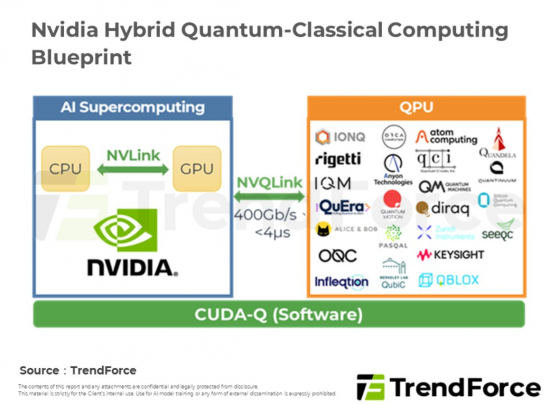
Table of Contents
1. The world is entering a quantum-driven "post-GPU era" as AI approaches physical limits
- Figure 1: Schematic of Quantum Superposition in a Quantum Computer
- Table 1: Classical Computers vs. Quantum Computers
2. Nvidia's Quantum Ambition: Not Building QPUs, but Transforming into the "Platform Ruler" of the Quantum Era
- Figure 2: Nvidia Hybrid Quantum-Classical Computing Blueprint
- Table 2: Nvidia's Strategic Positioning in Quantum Computing
3. Architectural Competition Amid Diverging Quantum Technologies: The Philosophies and Platform Directions of IonQ and Rigetti
- Table 3: Technological Differences Between IonQ and Rigetti
4. The Coming Quantum Era: Exponential Technological Leaps and the Countdown to a Quantum Crisis
5. The Global Quantum Race: Strategic Divergence and Infrastructure Paths Across the U.S., China, Europe, and Japan
- Table 4: Core Pillars of the Global Quantum Competition
6. The Quantum Crisis and Taiwan's Strategic Positioning: From Cryptographic Risk to an Industrial Inflection Point
- Table 5: Taiwan's Positioning in the Quantum Computing Ecosystem
7. TRI's View

