
PUBLISHER: Aviation & Defense Market Reports (A&D) | PRODUCT CODE: 2004315

PUBLISHER: Aviation & Defense Market Reports (A&D) | PRODUCT CODE: 2004315
Global Defense Head-Up Displays (HUD) Market 2026-2036
Global Defense Head-Up Displays (HUD) Market
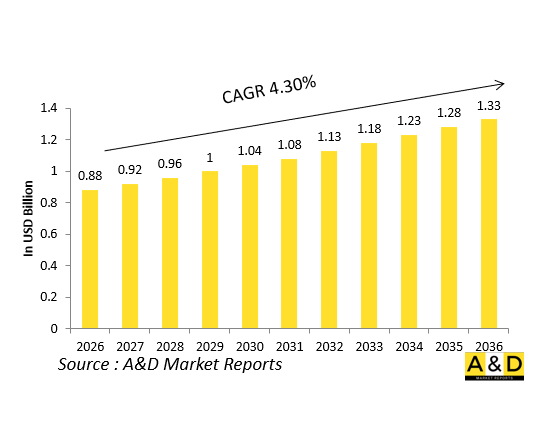
The Global Defense Head-Up Displays (HUD) Market is estimated at USD 0.88 billion in 2026, projected to grow to USD 1.33 billion by 2036 at a Compound Annual Growth Rate (CAGR) of 4.30% over the forecast period 2026-2036.
Introduction:
The global defense Head-Up Displays (HUD) market is a key segment within military avionics and pilot assistance systems, designed to project critical flight and mission data directly onto a transparent display in the pilot's line of sight. HUDs enable pilots to access essential information-such as speed, altitude, targeting data, and navigation cues-without looking down at cockpit instruments, thereby enhancing situational awareness and reaction time.
Between 2026 and 2036, the market is expected to witness strong growth, driven by increasing procurement of advanced fighter jets, helicopters, and military transport aircraft. HUD systems are becoming standard in modern combat aircraft due to their role in improving pilot performance and mission effectiveness. As defense forces emphasize precision, safety, and real-time decision-making, HUDs are evolving into advanced visualization systems integrated with targeting and sensor data, making them indispensable in next-generation military aviation.
Technology Impact in Global Defense HUD Market
Technological advancements are significantly transforming HUD systems, particularly through the integration of augmented reality (AR) and advanced optics. Modern HUDs utilize high-resolution digital displays, waveguide technology, and improved projection systems to provide clearer and more accurate visual information under various lighting conditions.
The integration of HUDs with advanced avionics, sensor fusion systems, and targeting pods allows real-time display of tactical data, enhancing combat effectiveness. Additionally, helmet-mounted displays (HMDs) are complementing traditional HUDs, providing pilots with 360-degree situational awareness.
Advancements in lightweight materials and compact designs are reducing system weight while improving reliability. Eye-tracking technologies and adaptive brightness control are also being incorporated to enhance usability and reduce pilot fatigue.
These innovations are transforming HUDs into intelligent, immersive systems that support complex mission environments and improve overall operational efficiency.
Key Drivers in Global Defense HUD Market
The primary driver of the market is the increasing demand for advanced military aircraft equipped with modern avionics systems. HUDs are essential for improving pilot situational awareness and reducing workload during high-intensity operations.
Another key driver is the growing emphasis on mission accuracy and safety. By providing real-time flight and targeting information within the pilot's field of view, HUDs enable faster decision-making and reduce the risk of human error.
Rising global defense spending and ongoing fleet modernization programs are also contributing to market growth. Older aircraft are being upgraded with advanced HUD systems to enhance operational capabilities.
Additionally, the increasing adoption of UAVs and advanced combat platforms is expanding the application scope of HUD technologies. The integration of augmented reality and sensor fusion further supports demand, as defense forces seek enhanced visualization and targeting capabilities.
Regional Trends in Global Defense HUD Market
North America dominates the global defense HUD market, supported by strong defense spending, advanced aerospace infrastructure, and the presence of leading avionics manufacturers. The region continues to lead in the development and deployment of advanced HUD technologies.
Europe holds a significant share, driven by collaborative defense programs and modernization initiatives among NATO countries. The region emphasizes innovation in avionics and pilot assistance systems.
The Asia-Pacific region is expected to witness the fastest growth during the forecast period, fueled by rising defense budgets and increasing indigenous aircraft development programs in countries such as India, China, and Japan. Expanding military aviation fleets are driving demand for advanced HUD systems.
The Middle East is also emerging as a key market due to ongoing procurement of advanced fighter aircraft and investments in military aviation infrastructure. These regional trends highlight a global focus on modernization and enhanced combat capabilities.
Key Global Defense HUD Market Program
Key defense aircraft programs are significantly driving the demand for advanced HUD systems. Next-generation fighter aircraft programs are incorporating high-performance HUDs integrated with sensor fusion and targeting systems to enhance combat effectiveness.
Modernization programs for existing aircraft fleets are also contributing to market growth, as legacy cockpit displays are replaced with advanced digital HUD systems. These upgrades improve pilot awareness, mission accuracy, and safety.
Additionally, the integration of HUDs with helmet-mounted display systems and advanced avionics is becoming a key focus in new aircraft development programs.
Collaborations between aerospace OEMs and avionics manufacturers such as BAE Systems, Elbit Systems, Collins Aerospace, and Thales are accelerating innovation in HUD technologies. These efforts focus on improving display quality, integrating augmented reality, and enhancing system reliability.
These programs highlight the strategic importance of HUD systems in improving pilot performance, enabling real-time decision-making, and supporting mission success in modern defense aviation.
Table of Contents
Defense Head-Up Displays (HUD) Market - Table of Contents
Defense Head-Up Displays (HUD) Market Report Definition
Defense Head-Up Displays (HUD) Market Segmentation
By Platform
By Technology
By Symbology Generation
Defense Head-Up Displays (HUD) Market Analysis for next 10 Years
The 10-year Defense Head-Up Displays (HUD) market analysis would give a detailed overview of Defense Head-Up Displays (HUD) market growth, changing dynamics, technology adoption overviews and the overall market attractiveness is covered in this chapter.
Market Technologies of Defense Head-Up Displays (HUD) Market
This segment covers the top 10 technologies that is expected to impact this market and the possible implications these technologies would have on the overall market.
Global Defense Head-Up Displays (HUD) Market Forecast
The 10-year Defense Head-Up Displays (HUD) market forecast of this market is covered in detailed across the segments which are mentioned above.
Regional Defense Head-Up Displays (HUD) Market Trends & Forecast
The regional counter drone market trends, drivers, restraints and Challenges of this market, the Political, Economic, Social and Technology aspects are covered in this segment. The market forecast and scenario analysis across regions are also covered in detailed in this segment. The last part of the regional analysis includes profiling of the key companies, supplier landscape and company benchmarking. The current market size is estimated based on the normal scenario.
North America
Drivers, Restraints and Challenges
PEST
Market Forecast & Scenario Analysis
Key Companies
Supplier Tier Landscape
Company Benchmarking
Europe
Middle East
APAC
South America
Country Analysis of Defense Head-Up Displays (HUD) Market
This chapter deals with the key defense programs in this market, it also covers the latest news and patents which have been filed in this market. Country level 10 year market forecast and scenario analysis are also covered in this chapter.
US
Defense Programs
Latest News
Patents
Current levels of technology maturation in this market
Market Forecast & Scenario Analysis
Canada
Italy
France
Germany
Netherlands
Belgium
Spain
Sweden
Greece
Australia
South Africa
India
China
Russia
South Korea
Japan
Malaysia
Singapore
Brazil
Opportunity Matrix for Defense Head-Up Displays (HUD) Market
The opportunity matrix helps the readers understand the high opportunity segments in this market.
Expert Opinions on Defense Head-Up Displays (HUD) Market Report
Hear from our experts their opinion of the possible analysis for this market.
Conclusions
About Aviation and Defense Market Reports
List of Tables
- Table 1: 10 Year Market Outlook, 2026-2036
- Table 2: Drivers, Impact Analysis, North America
- Table 3: Restraints, Impact Analysis, North America
- Table 4: Challenges, Impact Analysis, North America
- Table 5: Drivers, Impact Analysis, Europe
- Table 6: Restraints, Impact Analysis, Europe
- Table 7: Challenges, Impact Analysis, Europe
- Table 8: Drivers, Impact Analysis, Middle East
- Table 9: Restraints, Impact Analysis, Middle East
- Table 10: Challenges, Impact Analysis, Middle East
- Table 11: Drivers, Impact Analysis, APAC
- Table 12: Restraints, Impact Analysis, APAC
- Table 13: Challenges, Impact Analysis, APAC
- Table 14: Drivers, Impact Analysis, South America
- Table 15: Restraints, Impact Analysis, South America
- Table 16: Challenges, Impact Analysis, South America
- Table 17: Scenario Analysis, Scenario 1,By Technology, 2026-2036
- Table 18: Scenario Analysis, Scenario 1, By Platform, 2026-2036
- Table 19: Scenario Analysis, Scenario 1,By Symbology Generation, 2026-2036
- Table 20: Scenario Analysis, Scenario 2,By Technology, 2026-2036
- Table 21: Scenario Analysis, Scenario 2, By Platform, 2026-2036
- Table 22: Scenario Analysis, Scenario 2,By Symbology Generation, 2026-2036
List of Figures
- Figure 1: Global Defense Head-Up Displays (HUD) Market Forecast, 2026-2036
- Figure 2: Global Defense Head-Up Displays (HUD) Market Forecast, By Symbology Generation, 2026-2036
- Figure 3: Global Defense Head-Up Displays (HUD) Market Forecast, By Platform, 2026-2036
- Figure 4: Global Defense Head-Up Displays (HUD) Market Forecast, By Technology, 2026-2036
- Figure 5: North America, Defense Head-Up Displays (HUD) Market Forecast, 2026-2036
- Figure 6: Europe, Defense Head-Up Displays (HUD) Market Forecast, 2026-2036
- Figure 7: Middle East, Defense Head-Up Displays (HUD) Market Forecast, 2026-2036
- Figure 8: APAC, Defense Head-Up Displays (HUD) Market, Market Forecast, 2026-2036
- Figure 9: South America, Defense Head-Up Displays (HUD) Market Forecast, 2026-2036
- Figure 10: United States, Defense Head-Up Displays (HUD) Market, Region Maturation, 2026-2036
- Figure 11: United States, Defense Head-Up Displays (HUD) Market Forecast, 2026-2036
- Figure 12: Canada, Defense Head-Up Displays (HUD) Market, Region Maturation, 2026-2036
- Figure 13: Canada, Defense Head-Up Displays (HUD) Market Forecast, 2026-2036
- Figure 14: Italy, Defense Head-Up Displays (HUD) Market , Region Maturation, 2026-2036
- Figure 15: Italy, Defense Head-Up Displays (HUD) Market Forecast, 2026-2036
- Figure 16: France, Defense Head-Up Displays (HUD) Market , Region Maturation, 2026-2036
- Figure 17: France, Defense Head-Up Displays (HUD) Market Forecast, 2026-2036
- Figure 18: Germany, Defense Head-Up Displays (HUD) Market , Region Maturation, 2026-2036
- Figure 19: Germany, Defense Head-Up Displays (HUD) Market Forecast, 2026-2036
- Figure 20: Netherlands, Defense Head-Up Displays (HUD) Market , Region Maturation, 2026-2036
- Figure 21: Netherlands, Defense Head-Up Displays (HUD) Market Forecast, 2026-2036
- Figure 22: Belgium, Defense Head-Up Displays (HUD) Market , Region Maturation, 2026-2036
- Figure 23: Belgium, Defense Head-Up Displays (HUD) Market Forecast, 2026-2036
- Figure 24: Spain, Defense Head-Up Displays (HUD) Market , Region Maturation, 2026-2036
- Figure 25: Spain, Defense Head-Up Displays (HUD) Market Forecast, 2026-2036
- Figure 26: Sweden, Defense Head-Up Displays (HUD) Market , Region Maturation, 2026-2036
- Figure 27: Sweden, Defense Head-Up Displays (HUD) Market Forecast, 2026-2036
- Figure 28: Brazil, Defense Head-Up Displays (HUD) Market , Region Maturation, 2026-2036
- Figure 29: Brazil, Defense Head-Up Displays (HUD) Market Forecast, 2026-2036
- Figure 30: Australia, Defense Head-Up Displays (HUD) Market , Region Maturation, 2026-2036
- Figure 31: Australia, Defense Head-Up Displays (HUD) Market Forecast, 2026-2036
- Figure 32: India, Defense Head-Up Displays (HUD) Market , Region Maturation, 2026-2036
- Figure 33: India, Defense Head-Up Displays (HUD) Market Forecast, 2026-2036
- Figure 34: China, Defense Head-Up Displays (HUD) Market , Region Maturation, 2026-2036
- Figure 35: China, Defense Head-Up Displays (HUD) Market Forecast, 2026-2036
- Figure 36: Saudi Arabia, Defense Head-Up Displays (HUD) Market , Region Maturation, 2026-2036
- Figure 37: Saudi Arabia, Defense Head-Up Displays (HUD) Market Forecast, 2026-2036
- Figure 38: South Korea, Defense Head-Up Displays (HUD) Market , Region Maturation, 2026-2036
- Figure 39: South Korea, Defense Head-Up Displays (HUD) Market Forecast, 2026-2036
- Figure 40: Japan, Defense Head-Up Displays (HUD) Market , Region Maturation, 2026-2036
- Figure 41: Japan, Defense Head-Up Displays (HUD) Market Forecast, 2026-2036
- Figure 42: Malaysia, Defense Head-Up Displays (HUD) Market , Region Maturation, 2026-2036
- Figure 43: Malaysia, Defense Head-Up Displays (HUD) Market Forecast, 2026-2036
- Figure 44: Singapore, Defense Head-Up Displays (HUD) Market , Region Maturation, 2026-2036
- Figure 45: Singapore, Defense Head-Up Displays (HUD) Market Forecast, 2026-2036
- Figure 46: United Kingdom, Defense Head-Up Displays (HUD) Market , Region Maturation, 2026-2036
- Figure 47: United Kingdom, Defense Head-Up Displays (HUD) Market Forecast, 2026-2036
- Figure 48: Opportunity Analysis, Defense Head-Up Displays (HUD) Market , By Symbology Generation (Cumulative Market), 2026-2036
- Figure 49: Opportunity Analysis, Defense Head-Up Displays (HUD) Market , By Symbology Generation (CAGR), 2026-2036
- Figure 50: Opportunity Analysis, Defense Head-Up Displays (HUD) Market , By Platform (Cumulative Market), 2026-2036
- Figure 51: Opportunity Analysis, Defense Head-Up Displays (HUD) Market , By Platform (CAGR), 2026-2036
- Figure 52: Opportunity Analysis, Defense Head-Up Displays (HUD) Market ,By Technology(Cumulative Market), 2026-2036
- Figure 53: Opportunity Analysis, Defense Head-Up Displays (HUD) Market ,By Technology(CAGR), 2026-2036
- Figure 54: Scenario Analysis, Defense Head-Up Displays (HUD) Market , Cumulative Market, 2026-2036
- Figure 55: Scenario Analysis, Defense Head-Up Displays (HUD) Market , Global Market, 2026-2036
- Figure 56: Scenario 1, Defense Head-Up Displays (HUD) Market , Total Market, 2026-2036
- Figure 57: Scenario 1, Defense Head-Up Displays (HUD) Market , Region, 2026-2036
- Figure 58: Scenario 1, Defense Head-Up Displays (HUD) Market , By Platform, 2026-2036
- Figure 59: Scenario 1, Defense Head-Up Displays (HUD) Market ,By Technology, 2026-2036
- Figure 60: Scenario 2, Defense Head-Up Displays (HUD) Market , Total Market, 2026-2036
- Figure 61: Scenario 2, Defense Head-Up Displays (HUD) Market , By Symbology Generation, 2026-2036
- Figure 62: Scenario 2, Defense Head-Up Displays (HUD) Market , By Platform, 2026-2036
- Figure 63: Scenario 2, Defense Head-Up Displays (HUD) Market ,By Technology, 2026-2036
- Figure 64: Company Benchmark, Defense Head-Up Displays (HUD) Market , 2026-2036

