PUBLISHER: Global Market Insights Inc. | PRODUCT CODE: 1844323

PUBLISHER: Global Market Insights Inc. | PRODUCT CODE: 1844323
Liquid Adhesives Market Opportunity, Growth Drivers, Industry Trend Analysis, and Forecast 2025 - 2034
The Global Liquid Adhesives Market was valued at USD 42.2 billion in 2024 and is estimated to grow at a CAGR of 3.2% to reach USD 57.9 billion by 2034.
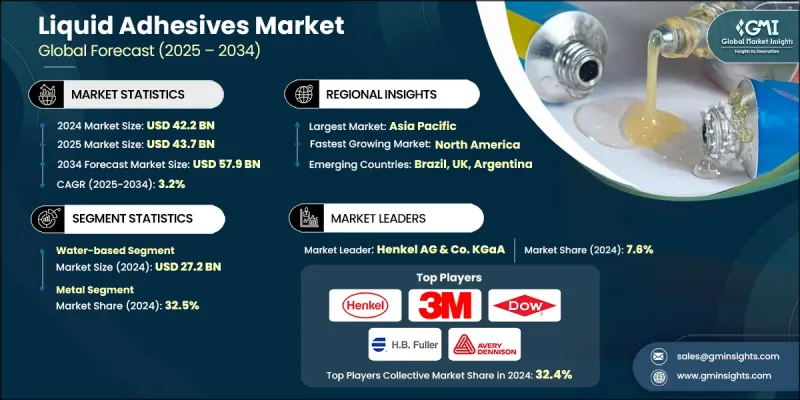
This market is fueled by rising demand across key industries such as automotive, aerospace, packaging, and construction. Liquid adhesives offer high durability, strong bonding, and reliability, which makes them essential in industrial operations and large-scale infrastructure projects. Their growing use in building materials contributes to faster construction timelines, enhanced structural integrity, and longer-lasting results. Government investments in infrastructure and technology are playing a critical role in market growth, particularly in regions like North America, where rapid construction activity and advancements in manufacturing are pushing demand upward. Meanwhile, the Asia Pacific region continues to dominate in terms of volume. Regulatory pressure around emissions and environmental safety is prompting manufacturers to redesign their formulations by reducing harmful chemicals and focusing on sustainable alternatives. As environmental concerns grow, companies are increasingly transitioning to low-VOC, eco-conscious adhesive technologies that align with both consumer expectations and legislative frameworks.
| Market Scope | |
|---|---|
| Start Year | 2024 |
| Forecast Year | 2025-2034 |
| Start Value | $42.2 Billion |
| Forecast Value | $57.9 Billion |
| CAGR | 3.2% |
The water-based liquid adhesives segment generated USD 27.2 billion in 2024, driven by increasing regulatory and consumer demand for sustainable and safer bonding solutions. These formulations are seeing rising adoption due to their lower emissions, reduced health risks, and suitability across various industries. Manufacturers are gradually shifting toward waterborne technologies as part of a broader strategy to meet sustainability targets and improve environmental compliance across production lines.
The metal substrate segment held 32.5% share in 2024, due to extensive use across sectors like construction, automotive, and heavy industry. Adhesives used on metal surfaces must deliver not just strong adhesion, but also withstand corrosion, humidity, and fluctuating temperatures. The rising popularity of lightweight metals in vehicle manufacturing and aviation is adding further momentum, as these applications demand adhesives that contribute to weight reduction while maintaining performance and safety.
North America Liquid Adhesives Market will grow at a CAGR of 3.8% in 2024, with significant growth across manufacturing, automotive assembly, packaging, and residential construction sectors. In automotive manufacturing, liquid adhesives are essential for bonding both interior and exterior components, ensuring structural strength and vibration resistance. In packaging, demand continues to grow due to the surge in online shopping, with adhesives being vital for sealing, labeling, and product protection throughout the supply chain.
Key players in the Global Liquid Adhesives Market include DIC Corporation, 3M Company, Pidilite Industries Ltd., H.B. Fuller Company, Dow Inc., Bostik SA, Avery Dennison Corporation, Huntsman Corporation, Jowat SE, Beardow Adams, Henkel AG & Co. KGaA, and Mapei S.p.A. To maintain competitiveness and reinforce their market position, companies in the liquid adhesives space are implementing several core strategies. Many are prioritizing R&D investments to develop eco-friendly adhesives with reduced VOC content and improved performance for demanding applications. Businesses are also expanding global production capabilities to reduce supply chain bottlenecks and meet growing demand across regions.
Table of Contents
Chapter 1 Methodology & Scope
- 1.1 Market scope and definition
- 1.2 Research design
- 1.2.1 Research approach
- 1.2.2 Data collection methods
- 1.3 Data mining sources
- 1.3.1 Global
- 1.3.2 Regional/Country
- 1.4 Base estimates and calculations
- 1.4.1 Base year calculation
- 1.4.2 Key trends for market estimation
- 1.5 Primary research and validation
- 1.5.1 Primary sources
- 1.6 Forecast model
- 1.7 Research assumptions and limitations
Chapter 2 Executive Summary
- 2.1 Industry 3600 synopsis
- 2.2 Key market trends
- 2.2.1 Formulation trends
- 2.2.2 Substrate trends
- 2.2.3 End use industry trends
- 2.2.4 Regional trends
- 2.3 TAM Analysis, 2025-2034
- 2.4 CXO perspectives: Strategic imperatives
- 2.4.1 Executive decision points
- 2.4.2 Critical success factors
- 2.5 Future Outlook and Strategic Recommendations
Chapter 3 Industry Insights
- 3.1 Industry ecosystem analysis
- 3.1.1 Supplier landscape
- 3.1.2 Profit margin
- 3.1.3 Value addition at each stage
- 3.1.4 Factor affecting the value chain
- 3.1.5 Disruptions
- 3.2 Industry impact forces
- 3.2.1 Growth drivers
- 3.2.2 Industry pitfalls and challenges
- 3.2.3 Market opportunities
- 3.3 Growth potential analysis
- 3.4 Regulatory landscape
- 3.4.1 North America
- 3.4.2 Europe
- 3.4.3 Asia Pacific
- 3.4.4 Latin America
- 3.4.5 Middle East & Africa
- 3.5 Porter’s analysis
- 3.6 PESTEL analysis
- 3.7 Technology and Innovation landscape
- 3.7.1 Current technological trends
- 3.7.2 Emerging technologies
- 3.8 Price trends
- 3.8.1 By region
- 3.8.2 By formulation
- 3.9 Future market trends
- 3.10 Technology and Innovation landscape
- 3.10.1 Current technological trends
- 3.10.2 Emerging technologies
- 3.11 Patent Landscape
- 3.12 Trade statistics (HS code) (Note: the trade statistics will be provided for key countries only)
- 3.12.1 Major importing countries
- 3.12.2 Major exporting countries
- 3.13 Sustainability and environmental aspects
- 3.13.1 Sustainable practices
- 3.13.2 Waste reduction strategies
- 3.13.3 Energy efficiency in production
- 3.13.4 Eco-friendly initiatives
- 3.14 Carbon footprint consideration
Chapter 4 Competitive Landscape, 2024
- 4.1 Introduction
- 4.2 Company market share analysis
- 4.2.1 By region
- 4.2.1.1 North America
- 4.2.1.2 Europe
- 4.2.1.3 Asia Pacific
- 4.2.1.4 LATAM
- 4.2.1.5 MEA
- 4.2.1 By region
- 4.3 Company matrix analysis
- 4.4 Competitive analysis of major market players
- 4.5 Competitive positioning matrix
- 4.6 Key developments
- 4.6.1 Mergers & acquisitions
- 4.6.2 Partnerships & collaborations
- 4.6.3 New product launches
- 4.6.4 Expansion plans
Chapter 5 Market Estimates and Forecast, By Formulation, 2021-2034 (USD Billion) (Kilo Tons)
- 5.1 Key trends
- 5.2 Water-based
- 5.3 Solvent-based
- 5.4 Others
Chapter 6 Market Estimates and Forecast, By Substrate, 2021-2034 (USD Billion) (Kilo Tons)
- 6.1 Key trends
- 6.2 Metal
- 6.3 Plastic
- 6.4 Glass
- 6.5 Wood
- 6.6 Others
Chapter 7 Market Estimates and Forecast, By End Use Industry, 2021-2034 (USD Billion) (Kilo Tons)
- 7.1 Key trends
- 7.2 Automotive & transportation
- 7.3 Building & construction
- 7.4 Electronics
- 7.5 Packaging
- 7.6 Healthcare & medical
- 7.7 Furniture
- 7.8 Others
Chapter 8 Market Estimates and Forecast, By Region, 2021-2034 (USD Billion) (Kilo Tons)
- 8.1 Key trends
- 8.2 North America
- 8.2.1 U.S.
- 8.2.2 Canada
- 8.3 Europe
- 8.3.1 Germany
- 8.3.2 UK
- 8.3.3 France
- 8.3.4 Spain
- 8.3.5 Italy
- 8.3.6 Rest of Europe
- 8.4 Asia Pacific
- 8.4.1 China
- 8.4.2 India
- 8.4.3 Japan
- 8.4.4 Australia
- 8.4.5 South Korea
- 8.4.6 Rest of Asia Pacific
- 8.5 Latin America
- 8.5.1 Brazil
- 8.5.2 Mexico
- 8.5.3 Argentina
- 8.5.4 Rest of Latin America
- 8.6 Middle East and Africa
- 8.6.1 Saudi Arabia
- 8.6.2 South Africa
- 8.6.3 UAE
- 8.6.4 Rest of Middle East and Africa
Chapter 9 Company Profiles
- 9.1 3M Company
- 9.2 Avery Dennison Corporation
- 9.3 Beardow Adams
- 9.4 Bostik SA
- 9.5 DIC Corporation
- 9.6 Dow Inc.
- 9.7 H.B. Fuller Company
- 9.8 Henkel AG & Co. KGaA
- 9.9 Huntsman Corporation
- 9.10 Jowat SE
- 9.11 Mapei S.p.A.
- 9.12 Pidilite Industries Ltd.

