
PUBLISHER: Global Market Insights Inc. | PRODUCT CODE: 1892721

PUBLISHER: Global Market Insights Inc. | PRODUCT CODE: 1892721
MEA Feminine Hygiene Wash Market Opportunity, Growth Drivers, Industry Trend Analysis, and Forecast 2025 - 2034
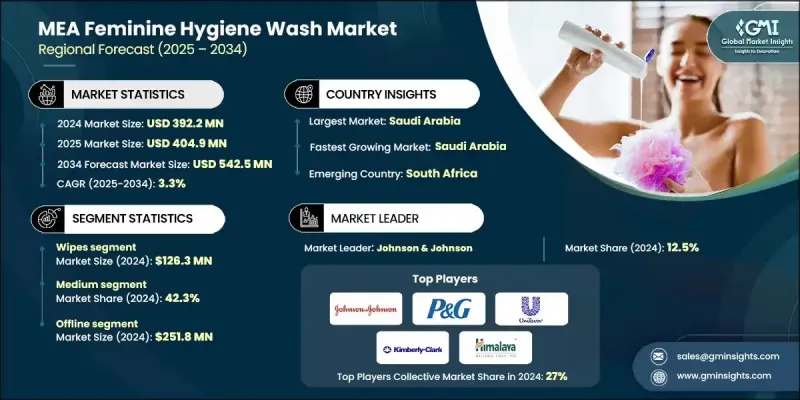
MEA Feminine Hygiene Wash Market was valued at USD 392.2 million in 2024 and is estimated to grow at a CAGR of 3.3% to reach USD 542.5 million by 2034.
Demand for feminine hygiene products across the region continues to grow as awareness campaigns and educational programs reshape consumer perceptions. Organizations across government, healthcare, and nonprofit sectors are actively encouraging women to view intimate hygiene as an essential element of overall wellness. These initiatives have played an important role in reducing stigma and encouraging open conversations about personal care. As more women learn about infection risks and the significance of maintaining proper pH levels, feminine hygiene washes are transitioning from optional purchases to widely adopted necessities, particularly in urban and semi-urban areas. Manufacturers are contributing to this shift by offering solutions tailored to local needs, which has helped accelerate product acceptance and broaden market reach. Public initiatives centered on women's health across multiple countries have also heightened awareness, reinforcing the importance of proper hygiene practices and supporting long-term market expansion throughout the MEA region.
| Market Scope | |
|---|---|
| Start Year | 2024 |
| Forecast Year | 2025-2034 |
| Start Value | $392.2 Million |
| Forecast Value | $542.5 Million |
| CAGR | 3.3% |
In 2024, the wipes category generated USD 126.3 million. This segment leads due to its ease of use, portability, and alignment with fast-paced lifestyles. Consumers increasingly rely on wipes as a convenient hygiene option, particularly when water is limited or when managing travel and work schedules.
The medium pricing tier segment held 42.3% share in 2024, maintaining its position as the dominant category. This segment performs strongly because it offers an appealing balance of cost and product reliability. In a region where shoppers remain conscious of pricing yet highly focused on safe and effective hygiene solutions, mid-range products deliver the essential features and dermatological assurance they expect, making them a preferred choice for a broad population.
Saudi Arabia MEA Feminine Hygiene Wash Market held a 40% share in 2024, generating approximately USD 188 million in revenue. The country's leadership in this sector stems from its strong economic environment, rising disposable income levels, and rapidly modernizing urban centers. A growing number of women participating in the workforce and increasing emphasis on health and wellness have both strengthened market demand. The preference for premium brands, combined with expanding retail channels and robust e-commerce activity, continues to support Saudi Arabia's leading market share.
Major companies active in the MEA Feminine Hygiene Wash Market include Unilever, Pigeon, Kimberly-Clark, Johnson & Johnson, Procter & Gamble, The Body Shop, Lactacyd (Part of Lactalis), New Avon, FemFresh (A brand under Levlad), Himalaya Herbal Healthcare, Himalaya Wellness, Sebapharma, Cottrell Pharmaceuticals, Beiersdorf, and VWash Plus (VWash). Companies in the MEA feminine hygiene wash market are enhancing their market position by localizing product development, expanding distribution networks, and increasing engagement through targeted awareness efforts. Many brands are focusing on formulations designed for regional skin sensitivities and climate conditions, helping build consumer trust. Firms are also investing in digital marketing, influencer outreach, and health-education initiatives that highlight the importance of intimate hygiene.
Table of Contents
Chapter 1 Methodology and Scope
- 1.1 Market scope and definition
- 1.2 Research design
- 1.2.1 Research approach
- 1.2.2 Data collection methods
- 1.3 Data mining sources
- 1.3.1 Global
- 1.3.2 Regional/Country
- 1.4 Base estimates and calculations
- 1.4.1 Base year calculation
- 1.4.2 Key trends for market estimation
- 1.5 Primary research and validation
- 1.5.1 Primary sources
- 1.6 Forecast model
- 1.7 Research assumptions and limitations
Chapter 2 Executive Summary
- 2.1 Industry 3600 synopsis
- 2.2 Key market trends
- 2.2.1 Regional
- 2.2.2 Product type
- 2.2.3 Price
- 2.2.4 End use
- 2.2.5 Distribution channel
- 2.3 CXO perspectives: Strategic imperatives
- 2.3.1 Key decision points for industry executives
- 2.3.2 Critical success factors for market players
- 2.4 Future outlook and strategic recommendations
Chapter 3 Industry Insights
- 3.1 Industry ecosystem analysis
- 3.1.1 Supplier landscape
- 3.1.2 Profit margin
- 3.1.3 Value addition at each stage
- 3.1.4 Factor affecting the value chain
- 3.2 Industry impact forces
- 3.2.1 Growth drivers
- 3.2.1.1 Rising awareness and education on intimate hygiene
- 3.2.1.2 Urbanization and lifestyle changes
- 3.2.1.3 Preference for natural and sustainable products
- 3.2.2 Industry pitfalls & challenges
- 3.2.2.1 Cultural and social taboos
- 3.2.2.2 High price sensitivity and limited accessibility
- 3.2.3 Opportunities
- 3.2.3.1 Expansion into untapped rural markets
- 3.2.3.2 Product diversification and innovation
- 3.2.1 Growth drivers
- 3.3 Growth potential analysis
- 3.4 Future market trends
- 3.5 Technology and innovation landscape
- 3.5.1 Current technological trends
- 3.5.2 Emerging technologies
- 3.6 Price trends
- 3.6.1 By country
- 3.6.2 By product type
- 3.7 Regulatory landscape
- 3.7.1 Standards and compliance requirements
- 3.7.2 Regional regulatory frameworks
- 3.7.3 Certification standards
- 3.8 Porter's analysis
- 3.9 PESTEL analysis
- 3.10 Consumer behaviour analysis
- 3.10.1 Purchasing patterns
- 3.10.2 Preference analysis
- 3.10.3 Regional variations in consumer behaviour
- 3.10.4 Impact of e-commerce on buying decisions
Chapter 4 Competitive Landscape, 2024
- 4.1 Introduction
- 4.2 Company market share analysis
- 4.2.1 By country
- 4.2.1.1 South Africa
- 4.2.1.2 Saudi Arabia
- 4.2.1.3 UAE
- 4.2.1 By country
- 4.3 Company matrix analysis
- 4.4 Competitive analysis of major market players
- 4.5 Competitive positioning matrix
- 4.6 Key developments
- 4.6.1 Mergers & acquisitions
- 4.6.2 Partnerships & collaborations
- 4.6.3 New product launches
- 4.6.4 Expansion plans
Chapter 5 Market Estimates and Forecast, By Product Type, 2021 - 2034 (USD Million) (Thousand Units)
- 5.1 Key trends
- 5.2 Creams
- 5.3 Wipes
- 5.4 Spray
- 5.5 Bar
- 5.6 Gel
- 5.7 Others
Chapter 6 Market Estimates and Forecast, By Price, 2021 - 2034 (USD Million) (Thousand Units)
- 6.1 Key trends
- 6.2 Low
- 6.3 Medium
- 6.4 High
Chapter 7 Market Estimates and Forecast, By End Use, 2021 - 2034 (USD Million) (Thousand Units)
- 7.1 Key trends
- 7.2 Female teenager
- 7.3 Female adult
Chapter 8 Market Estimates and Forecast, By Distribution Channel, 2021 - 2034 (USD Million) (Thousand Units)
- 8.1 Key trends
- 8.1.1 Online
- 8.1.2 E-commerce website
- 8.1.3 Company website
- 8.2 Offline
- 8.2.1 Hypermarket & supermarket
- 8.2.2 Specialty stores
- 8.2.3 Others
Chapter 9 Market Estimates and Forecast, By Country, 2021 - 2034 (USD Million) (Thousand Units)
- 9.1 Key trends
- 9.2 South Africa
- 9.3 Saudi Arabia
- 9.4 UAE
Chapter 10 Company Profiles
- 10.1 Beiersdorf
- 10.2 Cottrell Pharmaceuticals
- 10.3 FemFresh (A brand under Levlad)
- 10.4 Himalaya Herbal Healthcare
- 10.5 Himalaya Wellness
- 10.6 Johnson & Johnson
- 10.7 Kimberly-Clark
- 10.8 Lactacyd (Part of Lactalis)
- 10.9 New Avon
- 10.10 Pigeon
- 10.11 Procter & Gamble
- 10.12 Sebapharma
- 10.13 The Body Shop
- 10.14 Unilever
- 10.15 VWash Plus (VWash)

