PUBLISHER: Global Market Insights Inc. | PRODUCT CODE: 1913333

PUBLISHER: Global Market Insights Inc. | PRODUCT CODE: 1913333
Fleet Management Market Opportunity, Growth Drivers, Industry Trend Analysis, and Forecast 2026 - 2035
The Global Fleet Management Market was valued at USD 27 billion in 2025 and is estimated to grow at a CAGR of 16.9% to reach USD 122.3 billion by 2035.
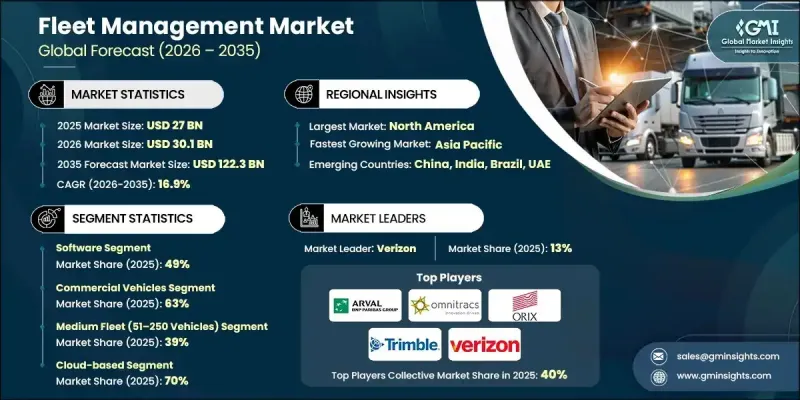
The market's strong growth is fueled by ongoing digital transformation, the rise of vehicle electrification, stringent regulatory compliance, and the booming e-commerce sector. This market spans a wide range of hardware, including GPS/GNSS trackers, telematics control units, dashcams, and IoT sensors, while also encompassing software platforms for fleet tracking, maintenance, fuel monitoring, and analytics. Professional services such as installation, consulting, managed services, and training further enhance the market ecosystem. Cloud-based solutions play a pivotal role, offering scalability, remote accessibility, automatic updates, and lower infrastructure costs compared to traditional on-premises systems. Small and medium-sized enterprises are particularly leveraging SaaS models to access advanced fleet management functionalities without heavy IT investment. North America leads this market, with the U.S. driving regional expansion due to high commercial vehicle activity, strict ELD mandates, advanced telematics integration, and a concentration of key solution providers.
| Market Scope | |
|---|---|
| Start Year | 2025 |
| Forecast Year | 2026-2035 |
| Start Value | $27 Billion |
| Forecast Value | $122.3 Billion |
| CAGR | 16.9% |
The software segment accounted for a 49% share in 2025 and is forecasted to grow at a CAGR of 17.1% from 2026 to 2035. The industry is increasingly shifting toward software-centric solutions with recurring revenue models, while hardware is becoming commoditized despite technological advancements. Software platforms now dominate by offering comprehensive capabilities for data aggregation, analytics, visualization, and actionable insights, which go far beyond simple data collection. The segment's growth is driven by advanced features that justify premium pricing, SaaS subscription models with high-margin recurring revenues, and the rising adoption of intelligent decision-making tools that deliver measurable operational ROI.
The commercial vehicles segment held a 63% share in 2025 and is expected to grow at a CAGR of 17% between 2026 and 2035. This segment includes light-duty vans, medium-duty trucks, and heavy-duty tractors, which travel between 30,000 and over 100,000 miles annually, consuming 5,000 to 20,000 gallons of fuel per year, with prices ranging from USD 3.00 to USD 4.50 per gallon depending on the region and fuel type. Light-duty commercial vehicles, such as small delivery trucks and service vans, are widely used in local deliveries and service fleets, benefiting from route optimization, productivity monitoring, and operational efficiency improvements.
U.S. Fleet Management Market generated USD 12.1 billion in 2025 and is expected to grow at a CAGR of 14.6% from 2026 to 2035. The growth is supported by a mature telematics ecosystem, strong digital infrastructure, and rapid adoption of connected vehicle technologies. Fleet operators across logistics, transportation, utilities, and public services are increasingly implementing advanced fleet solutions. This adoption is reinforced by software developers, telematics providers, and cloud platform companies aiming to improve operational efficiency, safety, and regulatory compliance.
Major players operating in the Global Fleet Management Industry include Geotab, Samsara, Omnitracs, Trimble, ARI Fleet Management, Wheels, Verizon Connect, Arval-Element, Donlen, and Teletrac Navman. Key strategies adopted by companies in the Global Fleet Management Market include expanding both hardware and software offerings to provide end-to-end solutions, developing cloud-based platforms for scalable and remote fleet management, and implementing SaaS subscription models that generate high-margin recurring revenues. Providers are integrating AI, predictive analytics, and real-time reporting features to enhance decision-making and operational efficiency. Partnerships with vehicle manufacturers, telematics vendors, and cloud service providers enable companies to broaden market reach and strengthen global presence.
Table of Contents
Chapter 1 Methodology
- 1.1 Market scope and definition
- 1.2 Research design
- 1.2.1 Research approach
- 1.2.2 Data collection methods
- 1.3 Data mining sources
- 1.3.1 Global
- 1.3.2 Regional/Country
- 1.4 Base estimates and calculations
- 1.4.1 Base year calculation
- 1.4.2 Key trends for market estimation
- 1.5 Primary research and validation
- 1.5.1 Primary sources
- 1.6 Forecast model
- 1.7 Research assumptions and limitations
Chapter 2 Executive Summary
- 2.1 Industry 3600 synopsis, 2022 - 2035
- 2.2 Key market trends
- 2.2.1 Regional
- 2.2.2 Component
- 2.2.3 Vehicle
- 2.2.4 Fleet Size
- 2.2.5 Connectivity Technology
- 2.2.6 Deployment Mode
- 2.2.7 End Use
- 2.3 TAM Analysis, 2026-2035
- 2.4 CXO perspectives: Strategic imperatives
- 2.4.1 Executive decision points
- 2.4.2 Critical success factors
- 2.5 Future outlook and strategic recommendations
Chapter 3 Industry Insights
- 3.1 Industry ecosystem analysis
- 3.1.1 Supplier landscape
- 3.1.2 Profit margin analysis
- 3.1.3 Cost structure
- 3.1.4 Value addition at each stage
- 3.1.5 Factor affecting the value chain
- 3.1.6 Disruptions
- 3.2 Industry impact forces
- 3.2.1.1 Growth drivers
- 3.2.1.2 Demand for efficiency and cost reduction
- 3.2.1.3 A growing number of regulations in vehicle maintenance
- 3.2.1.4 Rise of e-commerce and last-mile delivery
- 3.2.1.5 Integration of advanced technologies in telematics, the Internet of Things (IoT), and artificial intelligence
- 3.2.1.6 Increasing focus on sustainability
- 3.2.2 Industry pitfalls and challenges
- 3.2.2.1 Data overload and management concerns
- 3.2.2.2 Driver management and safety issues
- 3.2.3 Market opportunities
- 3.2.3.1 Integration of AI, IoT, and advanced analytics for smarter fleet operations.
- 3.2.3.2 Adoption of electric and hybrid vehicle fleets with specialized monitoring tools.
- 3.2.3.3 Autonomous vehicle fleet management solutions.
- 3.2.3.4 Expansion in emerging and regional markets.
- 3.2.3.5 Connected vehicles and 5G-enabled fleet management systems.
- 3.3 Growth potential analysis
- 3.4 Regulatory landscape
- 3.5 Porter's analysis
- 3.6 PESTEL analysis
- 3.7 Technology and innovation landscape
- 3.7.1 Current technological trends
- 3.7.2 Emerging technologies
- 3.8 Cost breakdown analysis
- 3.9 Patent analysis
- 3.10 Use cases & success stories
- 3.11 Sustainability and environmental aspects
- 3.11.1 Sustainable practices
- 3.11.2 Waste reduction strategies
- 3.11.3 Energy efficiency in production
- 3.11.4 Eco-friendly Initiatives
- 3.11.5 Carbon footprint considerations
- 3.12 Future outlook and opportunities
Chapter 4 Competitive Landscape, 2025
- 4.1 Introduction
- 4.2 Company market share analysis
- 4.2.1 North America
- 4.2.2 Europe
- 4.2.3 Asia Pacific
- 4.2.4 LATAM
- 4.2.5 MEA
- 4.3 Competitive analysis of major market players
- 4.4 Competitive positioning matrix
- 4.5 Strategic outlook matrix
- 4.6 Key developments
- 4.6.1 Mergers & acquisitions
- 4.6.2 Partnerships & collaborations
- 4.6.3 New product launches
- 4.6.4 Expansion plans and funding
Chapter 5 Market Estimates & Forecast, By Component, 2022 - 2035 ($Bn)
- 5.1 Key trends
- 5.2 Hardware
- 5.2.1 Vehicle tracking devices
- 5.2.2 Onboard diagnostics (OBD) devices
- 5.2.3 Telematics devices
- 5.2.4 Sensors
- 5.3 Software
- 5.3.1 Fleet management software (FMS)
- 5.3.2 Telematics platforms
- 5.3.3 Route optimization & scheduling software
- 5.3.4 Driver behavior monitoring software
- 5.3.5 Maintenance management software
- 5.4 Services
- 5.4.1 Installation & integration
- 5.4.2 Data analytics & reporting
- 5.4.3 Maintenance & support services
Chapter 6 Market Estimates & Forecast, By Vehicle, 2022 - 2035 ($Bn)
- 6.1 Key trends
- 6.2 Passenger vehicles
- 6.2.1 SUVs
- 6.2.2 Hatchback
- 6.2.3 Sedan
- 6.3 Commercial vehicles
- 6.3.1 Light duty
- 6.3.2 Medium-duty
- 6.3.3 Heavy-duty
- 6.4 Electric Vehicle
- 6.5 Specialty Fleets
- 6.5.1 Construction & mining equipment
- 6.5.2 Emergency vehicles
- 6.5.3 Utility service vehicles
Chapter 7 Market Estimates & Forecast, By Fleet Size, 2022 - 2035 ($Bn)
- 7.1 Key trends
- 7.2 Small fleet (1-50 vehicles)
- 7.3 Medium fleet (51-250 vehicles)
- 7.4 Large fleet (250+ vehicles)
Chapter 8 Market Estimates & Forecast, By Connectivity Technology, 2022 - 2035 ($Bn)
- 8.1 Key trends
- 8.2 GPS / GNSS
- 8.3 4G / LTE
- 8.4 5G
- 8.5 Bluetooth / Wi-Fi
- 8.6 Satellite communication
- 8.7 IoT sensors & CAN bus integration
Chapter 9 Market Estimates & Forecast, By Deployment Mode, 2022 - 2035 ($Bn)
- 9.1 Key trends
- 9.2 On-premises
- 9.3 Cloud-based
Chapter 10 Market Estimates & Forecast, By End Use, 2022 - 2035 ($Bn)
- 10.1 Key trends
- 10.2 Transportation
- 10.2.1 Operation management
- 10.2.2 Driver management
- 10.2.3 Vehicle tracking system
- 10.2.4 Compliance management
- 10.2.5 Maintenance management
- 10.2.6 Fuel management
- 10.2.7 Asset tracking
- 10.2.8 Others
- 10.3 Construction
- 10.3.1 Operation management
- 10.3.2 Driver management
- 10.3.3 Vehicle tracking system
- 10.3.4 Compliance management
- 10.3.5 Maintenance management
- 10.3.6 Fuel management
- 10.3.7 Asset tracking
- 10.3.8 Others
- 10.4 Manufacturing
- 10.4.1 Operation management
- 10.4.2 Driver management
- 10.4.3 Vehicle tracking system
- 10.4.4 Compliance management
- 10.4.5 Maintenance management
- 10.4.6 Fuel management
- 10.4.7 Asset tracking
- 10.4.8 Other
- 10.5 Utility
- 10.5.1 Operation management
- 10.5.2 Driver management
- 10.5.3 Vehicle tracking system
- 10.5.4 Compliance management
- 10.5.5 Maintenance management
- 10.5.6 Fuel management
- 10.5.7 Asset tracking
- 10.5.8 Others
- 10.6 Healthcare & pharmaceuticals
- 10.6.1 Operation management
- 10.6.2 Driver management
- 10.6.3 Vehicle tracking system
- 10.6.4 Compliance management
- 10.6.5 Maintenance management
- 10.6.6 Fuel management
- 10.6.7 Asset tracking
- 10.6.8 Others
- 10.7 Retail & E-commerce
- 10.7.1 Operation management
- 10.7.2 Driver management
- 10.7.3 Vehicle tracking system
- 10.7.4 Compliance management
- 10.7.5 Maintenance management
- 10.7.6 Fuel management
- 10.7.7 Asset tracking
- 10.7.8 Others
- 10.8 Food & beverage / cold Chain
- 10.8.1 Operation management
- 10.8.2 Driver management
- 10.8.3 Vehicle tracking system
- 10.8.4 Compliance management
- 10.8.5 Maintenance management
- 10.8.6 Fuel management
- 10.8.7 Asset tracking
- 10.8.8 Others
- 10.9 Others
- 10.9.1 Operation management
- 10.9.2 Driver management
- 10.9.3 Vehicle tracking system
- 10.9.4 Compliance management
- 10.9.5 Maintenance management
- 10.9.6 Fuel management
- 10.9.7 Asset tracking
- 10.9.8 Others
Chapter 11 Market Estimates & Forecast, By Region, 2022 - 2035 ($Bn)
- 11.1 Key trends
- 11.2 North America
- 11.2.1 US
- 11.2.2 Canada
- 11.3 Europe
- 11.3.1 Germany
- 11.3.2 UK
- 11.3.3 France
- 11.3.4 Italy
- 11.3.5 Spain
- 11.3.6 Russia
- 11.3.7 Nordics
- 11.3.8 Benelux
- 11.4 Asia Pacific
- 11.4.1 China
- 11.4.2 India
- 11.4.3 Japan
- 11.4.4 Australia
- 11.4.5 South Korea
- 11.4.6 Singapore
- 11.4.7 Thailand
- 11.4.8 Indonesia
- 11.4.9 Vietnam
- 11.5 Latin America
- 11.5.1 Brazil
- 11.5.2 Mexico
- 11.5.3 Argentina
- 11.5.4 Colombia
- 11.6 MEA
- 11.6.1 South Africa
- 11.6.2 Saudi Arabia
- 11.6.3 UAE
Chapter 12 Company Profiles
- 12.1 Global Players
- 12.1.1 ARI Fleet Management
- 12.1.2 Donlen
- 12.1.3 Element Fleet Management
- 12.1.4 Geotab
- 12.1.5 LeasePlan
- 12.1.6 Omnitracs
- 12.1.7 Orix
- 12.1.8 Trimble
- 12.1.9 Verizon Connect
- 12.1.10 Wheels
- 12.2 Regional Players
- 12.2.1 Azuga
- 12.2.2 Bestmile
- 12.2.3 ClearPath GPS
- 12.2.4 GPS Insights
- 12.2.5 Inseego
- 12.2.6 NexTraq
- 12.2.7 Onfleet
- 12.2.8 Teletrac Navman
- 12.2.9 ThingTech
- 12.2.10 TomTom Telematics
- 12.3 Emerging Technology Innovators
- 12.3.1 Automile
- 12.3.2 Fleet Complete
- 12.3.3 KeepTruckin (Motive)
- 12.3.4 Lytx
- 12.3.5 Samsara

