PUBLISHER: Global Market Insights Inc. | PRODUCT CODE: 1959278

PUBLISHER: Global Market Insights Inc. | PRODUCT CODE: 1959278
3D Chip Stacking Market Opportunity, Growth Drivers, Industry Trend Analysis, and Forecast 2026 - 2035
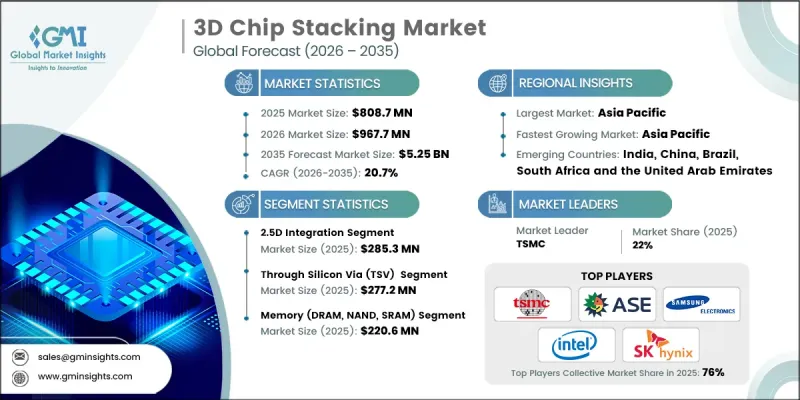
The Global 3D Chip Stacking Market was valued at USD 808.7 million in 2025 and is estimated to grow at a CAGR of 20.7% to reach USD 5.25 billion by 2035.
The market's expansion is fueled by rising demand for heterogeneous integration, cost optimization at advanced process nodes, AI and high-performance computing workload scaling, improved design flexibility, and ecosystem standardization through open interconnects. 3D chip stacking has become a cornerstone of modern semiconductor innovation, allowing multiple integrated circuit dies to be vertically stacked and interconnected within a single package. This approach reduces interconnect distances, accelerates signal transmission, enhances power efficiency, and enables a higher transistor density within compact footprints. Governments worldwide are actively supporting advanced packaging as part of industrial policies to strengthen domestic semiconductor capabilities and supply chain resilience. Technology is increasingly critical for AI accelerators, IoT devices, HPC platforms, and next-generation electronics that require high computational performance while maintaining low energy consumption and compact designs. As semiconductor ecosystems mature, 3D stacking is poised to be a key enabler of future electronics scalability and performance.
| Market Scope | |
|---|---|
| Start Year | 2025 |
| Forecast Year | 2026-2035 |
| Start Value | $808.7 Million |
| Forecast Value | $5.25 Billion |
| CAGR | 20.7% |
The 2.5D integration segment reached USD 285.3 million in 2025. 2.5D architectures place multiple dies side-by-side on an interposer, delivering high bandwidth, reduced latency, and enhanced interconnect density, which are essential for AI, HPC, networking, and graphics-intensive applications. The adoption of 2.5D integration is being reinforced by government-backed programs and R&D initiatives that accelerate interposer development and provide energy-efficient solutions for data centers and telecommunications infrastructure. Manufacturers are encouraged to invest in interposer-based 2.5D solutions to address high-bandwidth and low-latency requirements while leveraging policy support to advance next-generation semiconductor applications.
The through silicon via (TSV) segment generated USD 277.2 million in 2025. TSV technology enables vertical interconnects across stacked dies, reducing signal delay, improving power efficiency, and supporting thermal management, making it indispensable for AI accelerators, HPC systems, and data center memory stacks. Adoption of TSV is being reinforced by enterprise and government priorities to optimize chip density and performance while minimizing energy consumption and footprint. Manufacturers focusing on TSV-enabled high-performance memory and logic stacks are well-positioned to meet the increasing computational demands of AI and data-intensive applications while benefiting from government-sponsored R&D incentives.
North America 3D Chip Stacking Market accounted for 27.3% share in 2025. The region's rapid growth is supported by a mature technology ecosystem, strong R&D infrastructure, and rising demand from AI, automotive, and data center applications. Leading semiconductor companies, including Intel, NVIDIA, and AMD, are driving innovation in heterogeneous integration and high-density packaging. Government initiatives, such as funding programs for advanced packaging and 3D stacking, are enhancing domestic manufacturing capabilities and reducing dependence on overseas production. Companies in North America are scaling 3D stacking production lines in alignment with federal programs to capture high-performance computing, AI, and defense market opportunities.
Key players operating in the Global 3D Chip Stacking Market include TSMC, Intel Corporation, Samsung Electronics, Micron Technology, SK hynix, NVIDIA, Broadcom, Qualcomm, ASE Technology Holding, Amkor Technology, JCET Group, Powertech Technology Inc. (PTI), Sony Semiconductor Solutions, Toshiba (Kioxia Holdings), and Texas Instruments. Companies in the Global 3D Chip Stacking Market are strengthening their foothold by investing heavily in R&D for heterogeneous integration, high-density interposers, and TSV-enabled designs. Many firms are forming strategic alliances with foundries, memory suppliers, and AI platform developers to co-develop optimized chip architectures. Vertical integration strategies are being employed to enhance supply chain control and reduce production risks. Manufacturers are also focusing on government-backed initiatives to expand domestic manufacturing, improve thermal management solutions, and scale advanced packaging lines.
Table of Contents
Chapter 1 Methodology and Scope
- 1.1 Market scope and definition
- 1.2 Research design
- 1.2.1 Research approach
- 1.2.2 Data collection methods
- 1.3 Data mining sources
- 1.3.1 Global
- 1.3.2 Regional/Country
- 1.4 Base estimates and calculations
- 1.4.1 Base year calculation
- 1.4.2 Key trends for market estimation
- 1.5 Primary research and validation
- 1.5.1 Primary sources
- 1.6 Forecast model
- 1.7 Research assumptions and limitations
Chapter 2 Executive Summary
- 2.1 Industry 360° synopsis
- 2.2 Key market trends
- 2.2.1 Stacking architecture trends
- 2.2.2 Component trends
- 2.2.3 Technology trends
- 2.2.4 End-use industry trends
- 2.2.5 Application trends
- 2.2.6 Form factor trends
- 2.2.7 Regional trends
- 2.3 TAM Analysis, 2026 - 2035 (USD Million)
- 2.4 CXO perspectives: Strategic imperatives
Chapter 3 Industry Insights
- 3.1 Industry ecosystem analysis
- 3.1.1 Supplier landscape
- 3.1.2 Profit margin
- 3.1.3 Cost structure
- 3.1.4 Value addition at each stage
- 3.1.5 Factor affecting the value chain
- 3.1.6 Disruptions
- 3.2 Industry impact forces
- 3.2.1 Growth drivers
- 3.2.1.1 High demand for miniaturized and high-performance electronics
- 3.2.1.2 Increasing adoption of advanced packaging technologies
- 3.2.1.3 Rising use of 3D ICs in data centers and high-performance computing
- 3.2.1.4 Growth of AI, IoT, and automotive electronics applications
- 3.2.1.5 Expansion of semiconductor fabrication and foundry services
- 3.2.2 Pitfalls and challenges
- 3.2.2.1 High manufacturing complexity and cost
- 3.2.2.2 Thermal management and heat dissipation challenges
- 3.2.1 Growth drivers
- 3.3 Growth potential analysis
- 3.4 Regulatory landscape
- 3.4.1 North America
- 3.4.2 Europe
- 3.4.3 Asia Pacific
- 3.4.4 Latin America
- 3.4.5 Middle East & Africa
- 3.5 Porter’s analysis
- 3.6 PESTEL analysis
- 3.7 Technology and Innovation landscape
- 3.7.1 Current technological trends
- 3.7.2 Emerging technologies
- 3.8 Emerging Business Models
- 3.9 Compliance Requirements
Chapter 4 Competitive Landscape, 2025
- 4.1 Introduction
- 4.2 Company market share analysis
- 4.2.1 By region
- 4.2.1.1 North America
- 4.2.1.2 Europe
- 4.2.1.3 Asia Pacific
- 4.2.1.4 Latin America
- 4.2.1.5 Middle East & Africa
- 4.2.2 Market concentration analysis
- 4.2.1 By region
- 4.3 Competitive benchmarking of key players
- 4.3.1 Product portfolio comparison
- 4.3.1.1 Product range breadth
- 4.3.1.2 Technology
- 4.3.1.3 Innovation
- 4.3.2 Geographic presence comparison
- 4.3.2.1 Global footprint analysis
- 4.3.2.2 Service network coverage
- 4.3.2.3 Market penetration by region
- 4.3.3 Competitive positioning matrix
- 4.3.3.1 Leaders
- 4.3.3.2 Challengers
- 4.3.3.3 Followers
- 4.3.3.4 Niche players
- 4.3.1 Product portfolio comparison
- 4.4 Key developments, 2022-2025
- 4.4.1 Mergers and acquisitions
- 4.4.2 Partnerships and collaborations
- 4.4.3 Technological advancements
- 4.4.4 Expansion and investment strategies
- 4.4.5 Sustainability initiatives
- 4.4.6 Digital transformation initiatives
- 4.5 Emerging/ startup competitors landscape
Chapter 5 Market Estimates and Forecast, By Stacking Architecture, 2022 - 2035 (USD Million)
- 5.1 Key trends
- 5.2 Through-silicon via (TSV)
- 5.3 Micro-bump
- 5.4 Wafer-level packaging (WLP) based
- 5.5 Monolithic 3D
- 5.6 Hybrid
Chapter 6 Market Estimates and Forecast, By Component, 2022 - 2035 (USD Million)
- 6.1 Key trends
- 6.2 Memory (DRAM, NAND, SRAM)
- 6.3 Logic/processor
- 6.4 Interconnects
- 6.5 Thermal interface materials
- 6.6 Substrate & interposers
- 6.7 Others
Chapter 7 Market Estimates and Forecast, By Technology, 2022 - 2035 (USD Million)
- 7.1 Key Trends
- 7.2 2.5D integration
- 7.3 True 3D integration
- 7.4 Heterogeneous integration
- 7.5 Chiplet-based stacking
Chapter 8 Market Estimates and Forecast, By Form Factor, 2022 - 2035 (USD Million)
- 8.1 Key Trends
- 8.2 System-in-package (SiP)
- 8.3 Package-on-package (PoP)
- 8.4 3D die stack
- 8.5 Fan-out wafer level package (FOWLP)
- 8.6 Others
Chapter 9 Market Estimates and Forecast, By Application, 2022 - 2035 (USD Million)
- 9.1 Key Trends
- 9.2 High-performance computing (HPC)
- 9.3 Mobile & wearable devices
- 9.4 AI/ML accelerators
- 9.5 Storage systems
- 9.6 Baseband & RF systems
- 9.7 Sensors & MEMS
- 9.8 Others
Chapter 10 Market Estimates and Forecast, By End-use Industry, 2022 - 2035 (USD Million)
- 10.1 Key Trends
- 10.2 Consumer electronics
- 10.3 Telecommunications & networking
- 10.4 Automotive & transportation
- 10.5 Industrial & automation
- 10.6 Healthcare & medical devices
- 10.7 Aerospace & defense
- 10.8 Data centers & enterprise computing
- 10.9 Others
Chapter 11 Market Estimates and Forecast, By Region, 2022 - 2035 (USD Million)
- 11.1 Key trends
- 11.2 North America
- 11.2.1 U.S.
- 11.2.2 Canada
- 11.3 Europe
- 11.3.1 Germany
- 11.3.2 UK
- 11.3.3 France
- 11.3.4 Spain
- 11.3.5 Italy
- 11.3.6 Netherlands
- 11.4 Asia Pacific
- 11.4.1 China
- 11.4.2 India
- 11.4.3 Japan
- 11.4.4 Australia
- 11.4.5 South Korea
- 11.5 Latin America
- 11.5.1 Brazil
- 11.5.2 Mexico
- 11.5.3 Argentina
- 11.6 Middle East and Africa
- 11.6.1 Saudi Arabia
- 11.6.2 South Africa
- 11.6.3 UAE
Chapter 12 Company Profiles
- 12.1 Global Key Players
- 12.1.1 TSMC
- 12.1.2 Samsung Electronics
- 12.1.3 Intel Corporation
- 12.1.4 NVIDIA
- 12.1.5 Broadcom
- 12.2 Regional Key Players
- 12.2.1 North America
- 12.2.1.1 Micron Technology
- 12.2.1.2 Texas Instruments
- 12.2.1.3 Qualcomm
- 12.2.2 Asia Pacific
- 12.2.2.1 SK hynix
- 12.2.2.2 ASE Technology Holding
- 12.2.2.3 Amkor Technology
- 12.2.2.4 JCET Group
- 12.2.1 North America
- 12.3 Niche / Disruptors
- 12.3.1 Powertech Technology Inc. (PTI)
- 12.3.2 Sony Semiconductor Solutions
- 12.3.3 Toshiba (Kioxia Holdings)

