PUBLISHER: Global Market Insights Inc. | PRODUCT CODE: 1959285

PUBLISHER: Global Market Insights Inc. | PRODUCT CODE: 1959285
Asia Pacific Wet Wipes Market Opportunity, Growth Drivers, Industry Trend Analysis, and Forecast 2026 - 2035
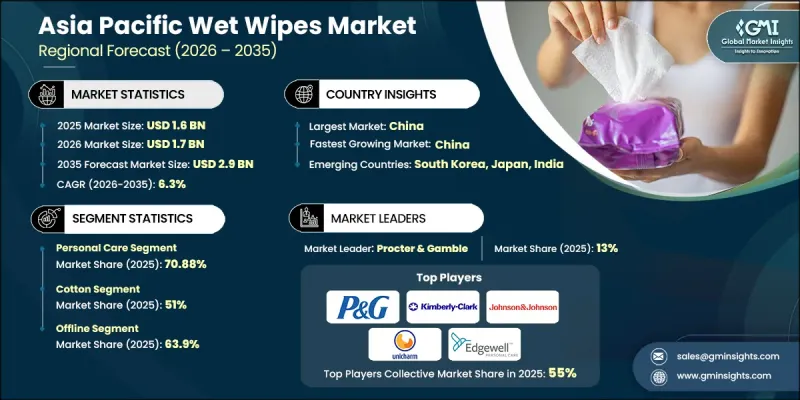
Asia Pacific Wet Wipes Market was valued at USD 1.6 billion in 2025 and is estimated to grow at a CAGR of 6.3% to reach USD 2.9 billion by 2035.
The expansion is driven by shifting consumer preferences toward safer skin formulations and heightened awareness around sustainability. Buyers are increasingly prioritizing products that are gentle on the skin while also reducing environmental impact, encouraging manufacturers to move away from conventional synthetic materials toward biodegradable alternatives. Although nonwoven materials still represent approximately 79.5% of the global market, producers in Asia Pacific are accelerating their transition to eco-conscious inputs to align with tightening regulations and retailer sustainability benchmarks. The region's vast and diverse consumer base demonstrates growing interest in hygiene solutions that combine dermatological comfort with responsible sourcing. These trends are reshaping product development strategies and influencing purchasing decisions, reinforcing Asia Pacific's role as a high-growth market for wet wipes.
| Market Scope | |
|---|---|
| Start Year | 2025 |
| Forecast Year | 2026-2035 |
| Start Value | $1.6 Billion |
| Forecast Value | $2.9 Billion |
| CAGR | 6.3% |
Demand growth is especially noticeable across baby care, personal hygiene, and household sanitation categories, supported by evolving lifestyles, higher workforce participation, and increased reliance on convenient hygiene formats. A strong focus on preventive hygiene practices continues to drive everyday usage across multiple settings. Brand familiarity, ease of use, and multipurpose functionality have positioned baby-focused and household disinfectant wipes as consistent revenue contributors across the region. Changing demographics and greater acceptance of portable hygiene solutions are further supporting volume growth and category expansion.
The personal care category accounted for 70.88% share in 2025. Products in this segment are closely linked to daily hygiene habits, which sustains repeat demand. Facial cleansing wipes remain widely adopted due to their ease of use and time-saving benefits, while body-focused wipes address the need for freshness in mobile and assisted-care situations. The segment's dominance reflects the growing importance of convenience-driven personal hygiene solutions in everyday routines.
In 2025, the cotton-based wipes segment held 51% share. Nonwoven materials remain the foundation of disposable wipe production due to their balance of durability, absorbency, and cost efficiency. These materials support large-scale manufacturing and continue to be favored for mass-market applications, enabling consistent product performance while maintaining competitive pricing across retail channels.
Asia Pacific Wet Wipes Market will grow at a CAGR of 6.3% through 2035. Growth momentum is fueled by rising hygiene awareness, rapid urban development, and expanding middle-income populations. Increasing demand for baby care, personal hygiene, and disinfectant wipes, combined with the expansion of organized retail and digital commerce platforms, continues to broaden market reach. Competitive intensity remains high as domestic and global brands emphasize affordability, skin compatibility, and environmentally responsible product design.
Key companies operating in the Asia Pacific Wet Wipes Market include Unicharm Corporation, Procter & Gamble, Johnson & Johnson, Kimberly-Clark Corporation, Unilever, The Honest Company, Natracare, Organyc, Veeda, Lola, Lil-Lets, Cora, Cottons, L. Organic, and Playtex. Companies active in the Asia Pacific wet wipes market focus on product innovation, brand differentiation, and supply chain optimization to strengthen their market position. Many manufacturers invest in research to improve formulation safety, material sustainability, and performance consistency. Portfolio diversification across personal care and household categories helps brands capture wider consumer segments. Strategic partnerships with retailers and e-commerce platforms enhance visibility and accessibility. Pricing strategies tailored to local purchasing power support volume growth, while localized manufacturing improves cost efficiency.
Table of Contents
Chapter 1 Methodology and Scope
- 1.1 Market scope and definition
- 1.2 Research design
- 1.2.1 Research approach
- 1.2.2 Data collection methods
- 1.3 Data mining sources
- 1.3.1 Country
- 1.4 Base estimates and calculations
- 1.4.1 Base year calculation
- 1.4.2 Key trends for market estimation
- 1.5 Primary research and validation
- 1.5.1 Primary sources
- 1.6 Forecast model
- 1.7 Research assumptions and limitations
Chapter 2 Executive Summary
- 2.1 Industry 360° synopsis
- 2.2 Key market trends
- 2.2.1 Regional
- 2.2.2 ProductType
- 2.2.3 Material
- 2.2.4 Price Range
- 2.2.5 Packaging Size
- 2.2.6 End User,
- 2.2.7 Distribution Channel
- 2.3 CXO perspectives: Strategic imperatives
- 2.3.1 Key decision points for industry executives
- 2.3.2 Critical success factors for market players
- 2.4 Future outlook and strategic recommendations
Chapter 3 Industry Insights
- 3.1 Industry ecosystem analysis
- 3.1.1 Supplier landscape
- 3.1.2 Profit margin
- 3.1.3 Value addition at each stage
- 3.1.4 Factor affecting the value chain
- 3.2 Industry impact forces
- 3.2.1 Growth drivers
- 3.2.1.1 Urbanization & rising hygiene awareness
- 3.2.1.2 Growth of baby & personal care wipes
- 3.2.1.3 Eco friendly non woven innovation
- 3.2.2 Industry pitfalls & challenges
- 3.2.2.1 Environmental waste & disposal issues
- 3.2.2.2 Price sensitivity in developing markets
- 3.2.3 Opportunities
- 3.2.3.1 Ecommerce & subscription growth
- 3.2.3.2 Travel-friendly & multi-functional wipes
- 3.2.1 Growth drivers
- 3.3 Growth potential analysis
- 3.4 Future market trends
- 3.5 Technology and innovation landscape
- 3.5.1 Current technological trends
- 3.5.2 Emerging technologies
- 3.6 Price trends
- 3.6.1 By region
- 3.6.2 By type
- 3.7 Regulatory landscape
- 3.7.1 Standards and compliance requirements
- 3.7.2 Regional regulatory frameworks
- 3.7.3 Certification standards
- 3.8 Porter’s analysis
- 3.9 PESTEL analysis
Chapter 4 Competitive Landscape, 2025
- 4.1 Introduction
- 4.2 Company market share analysis
- 4.2.1 By Country
- 4.2.1.1 China
- 4.2.1.2 Japan
- 4.2.1.3 India
- 4.2.1.4 Australia
- 4.2.1.5 South Korea
- 4.2.1 By Country
- 4.3 Company matrix analysis
- 4.4 Competitive analysis of major market players
- 4.5 Competitive positioning matrix
- 4.6 Key developments
- 4.6.1 Mergers & acquisitions
- 4.6.2 Partnerships & collaborations
- 4.6.3 New product launches
- 4.6.4 Expansion plans
Chapter 5 Market Estimates & Forecast, By Product Type, 2022 - 2035, (USD Billion)
- 5.1 Key trends
- 5.2 Personal care Asia Pacific wet wipes
- 5.2.1 Face wipes
- 5.2.2 Body wipes
- 5.2.3 Intimate wipes
- 5.2.4 Baby wipes
- 5.2.5 Others
- 5.3 Household Asia Pacific wet wipes
Chapter 6 Market Estimates & Forecast, By Material, 2022 - 2035, (USD Billion)
- 6.1 Key trends
- 6.2 Cotton
- 6.3 Non-woven fabrics
- 6.4 Woven fabrics
Chapter 7 Market Estimates & Forecast, By Price Range, 2022 - 2035, (USD Billion)
- 7.1 Key trends
- 7.2 Low
- 7.3 Medium
- 7.4 High
Chapter 8 Market Estimates & Forecast, By Packaging Size, 2022 - 2035, (USD Billion)
- 8.1 Key trends
- 8.2 Upto 50 wipes
- 8.3 50-100 wipes
- 8.4 More than 100 wipes
Chapter 9 Market Estimates & Forecast, By End User, 2022 - 2035, (USD Billion)
- 9.1 Key trends
- 9.2 Individual
- 9.3 Commercial
Chapter 10 Market Estimates & Forecast, By Distribution Channel, 2022 - 2035, (USD Billion)
- 10.1 Key trends
- 10.2 Online channels
- 10.2.1 E-commerce
- 10.2.2 Company websites
- 10.3 Offline channels
- 10.3.1 Mega Retail Store
- 10.3.2 Specialty stores
- 10.3.3 Others
Chapter 11 Market Estimates and Forecast, By Country, 2022 - 2035 (USD Billion)
- 11.1 Key trends
- 11.2 Asia Pacific
- 11.2.1 China
- 11.2.2 Japan
- 11.2.3 India
- 11.2.4 Australia
- 11.2.5 South Korea
Chapter 12 Company Profiles
- 12.1 Cora
- 12.2 Cottons
- 12.3 Johnson & Johnson
- 12.4 Kimberly-Clark Corporation
- 12.5 L. Organic
- 12.6 Lil-Lets
- 12.7 Lola
- 12.8 Natracare
- 12.9 Organyc
- 12.10 Playtex
- 12.11 Procter & Gamble
- 12.12 Unilever

