
PUBLISHER: Global Market Insights Inc. | PRODUCT CODE: 1959301

PUBLISHER: Global Market Insights Inc. | PRODUCT CODE: 1959301
Asia Pacific Acoustic Barrier Market Opportunity, Growth Drivers, Industry Trend Analysis, and Forecast 2026 - 2035
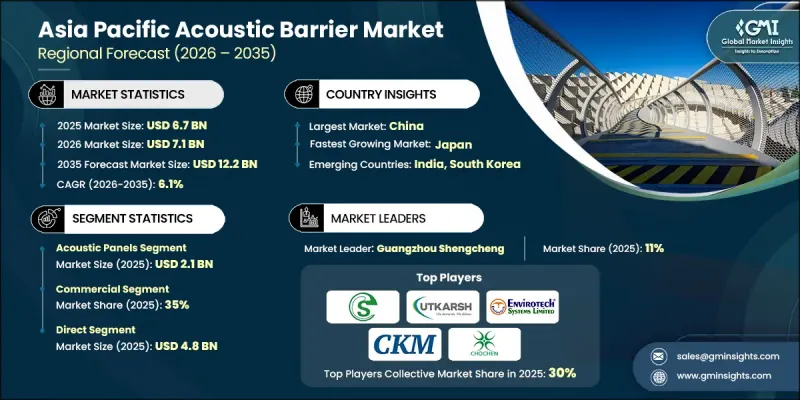
Asia Pacific Acoustic Barrier Market was valued at USD 6.7 billion in 2025 and is estimated to grow at a CAGR of 6.1% to reach USD 12.2 billion by 2035.
Rapid urbanization across the region is transforming city landscapes, driven by large-scale population migration from rural areas to urban centers and increased public investment in infrastructure projects such as highways, expressways, metro rail networks, airports, bridges, and industrial corridors. The expansion of urban infrastructure results in higher traffic density and increased operation of machinery, directly contributing to elevated noise levels. As cities expand, integrating acoustic barriers into urban planning has become essential to protect residential and commercial zones from environmental noise. Urban planners are now prioritizing noise mitigation strategies, ensuring infrastructure projects provide the minimum acoustic protection necessary to maintain livable and sustainable urban environments. Rising megacities and the proliferation of smart city initiatives further drive demand for effective noise control measures along busy urban corridors, ensuring community well-being and productivity.
| Market Scope | |
|---|---|
| Start Year | 2025 |
| Forecast Year | 2026-2035 |
| Start Value | $6.7 Billion |
| Forecast Value | $12.2 Billion |
| CAGR | 6.1% |
In 2025, the acoustic panels segment accounted for USD 2.1 billion. Acoustic panels are designed to absorb, diffuse, and control sound, improving acoustic clarity within spaces. They utilize materials such as porous foams, polyester fiber boards, fabric-wrapped fiberglass, and composite acoustic boards to reduce echo and dampen unwanted noise. By controlling sound propagation, acoustic panels are critical in enhancing sound quality in commercial, industrial, and public environments, making them indispensable in modern construction projects.
The commercial segment held 35% share in 2025. Commercial buildings, including offices, shopping centers, and service facilities, are designed to accommodate high user traffic and varied activities, which increases the need for effective noise management. Incorporating advanced acoustic materials and environmental control systems helps maintain comfort, productivity, and satisfaction among occupants, while supporting operational efficiency and user experience in commercial spaces.
China Acoustic Barrier Market held 35% share and reached USD 2.4 billion in 2025. The country's rapid industrialization, urban development, and expanding transportation systems result in elevated ambient noise levels that demand comprehensive noise mitigation solutions. Acoustic barrier adoption in China is further supported by regulatory standards and urban development policies that emphasize livable, sustainable city environments, encouraging widespread use of acoustic construction materials across infrastructure and commercial projects.
Key players operating in the Asia Pacific Acoustic Barrier Market include Knauf Insulation, Alfa PEB, Beijing New Building Material, CKM Applied Materials, Jiangsu Burgeree New Technology Materials, Echo Barrier, Envirotech Systems, Saint-Gobain, Guangzhou MQ Acoustic Materials, IAC Acoustics Thailand, Utkarsh India, Shengcheng Sieve, Guangzhou Shengcheng, Cho Chen Industry, and Hebei Doudou. Companies in the Asia Pacific acoustic barrier market are implementing several strategies to strengthen their market position. They are investing heavily in research and development to create innovative, high-performance noise reduction materials that meet the evolving urban infrastructure and commercial building requirements. Strategic partnerships with construction companies, architects, and urban planners are being leveraged to integrate acoustic solutions directly into large-scale projects. Manufacturers are expanding regional production capacities and distribution networks to improve accessibility and reduce lead times. They are also emphasizing sustainability by developing eco-friendly, recyclable acoustic materials that appeal to environmentally conscious clients.
Table of Contents
Chapter 1 Methodology and Scope
- 1.1 Market scope and definition
- 1.2 Research design
- 1.2.1 Research approach
- 1.2.2 Data collection methods
- 1.3 Data mining sources
- 1.3.1 Country
- 1.4 Base estimates and calculations
- 1.4.1 Base year calculation
- 1.4.2 Key trends for market estimation
- 1.5 Primary research and validation
- 1.5.1 Primary sources
- 1.6 Forecast model
- 1.7 Research assumptions and limitations
Chapter 2 Executive Summary
- 2.1 Industry 360° synopsis
- 2.2 Key market trends
- 2.2.1 Country
- 2.2.2 Barrier type
- 2.2.3 Material
- 2.2.4 End user industry
- 2.2.5 Distribution channel
- 2.3 CXO perspectives: Strategic imperatives
- 2.3.1 Key decision points for industry executives
- 2.3.2 Critical success factors for market players
- 2.4 Future outlook and strategic recommendations
Chapter 3 Industry Insights
- 3.1 Industry ecosystem analysis
- 3.1.1 Supplier landscape
- 3.1.2 Profit margin
- 3.1.3 Value addition at each stage
- 3.1.4 Factor affecting the value chain
- 3.2 Industry impact forces
- 3.2.1 Growth drivers
- 3.2.1.1 Rapid urbanization & infrastructure expansion
- 3.2.1.2 Increasing noise pollution awareness
- 3.2.1.3 Adoption of advanced materials and construction technologies
- 3.2.2 Industry pitfalls & challenges
- 3.2.2.1 High capital and installation costs
- 3.2.2.2 Harsh climatic conditions affecting durability
- 3.2.3 Opportunities
- 3.2.3.1 Sustainable and eco-friendly acoustic barriers
- 3.2.3.2 Smart acoustic barriers and IoT-integrated systems
- 3.2.1 Growth drivers
- 3.3 Growth potential analysis
- 3.4 Future market trends
- 3.5 Technology and innovation landscape
- 3.5.1 Current technological trends
- 3.5.2 Emerging technologies
- 3.6 Price trends
- 3.6.1 By country
- 3.6.2 By barrier type
- 3.7 Regulatory landscape
- 3.7.1 Standards and compliance requirements
- 3.7.2 Regional regulatory frameworks
- 3.7.3 Certification standards
- 3.8 Porter’s analysis
- 3.9 PESTEL analysis
Chapter 4 Competitive Landscape, 2025
- 4.1 Introduction
- 4.2 Company market share analysis
- 4.2.1 By country
- 4.2.1.1 China
- 4.2.1.2 India
- 4.2.1.3 Japan
- 4.2.1.4 South Korea
- 4.2.1.5 Australia
- 4.2.1 By country
- 4.3 Company matrix analysis
- 4.4 Competitive analysis of major market players
- 4.5 Competitive positioning matrix
- 4.6 Key developments
- 4.6.1 Mergers & acquisitions
- 4.6.2 Partnerships & collaborations
- 4.6.3 New product launches
- 4.6.4 Expansion plans
Chapter 5 Market Estimates and Forecast, By Barrier Type, 2022 - 2035 (USD Billion) (Thousand Square Meters)
- 5.1 Key trends
- 5.2 Noise barrier walls
- 5.3 Acoustic panels
- 5.3.1 Wall-mounted
- 5.3.2 Ceiling-mounted
- 5.3.3 Free-standing
- 5.4 Acoustic enclosures
- 5.5 Acoustic fencing
- 5.6 Partition walls/demountable systems
Chapter 6 Market Estimates and Forecast, By Material, 2022 - 2035 (USD Billion) (Thousand Square Meters)
- 6.1 Key trends
- 6.2 Concrete-based barriers
- 6.3 Metal-based barriers
- 6.4 Transparent/acrylic-based barriers
- 6.5 Wood-based barriers
- 6.6 Mineral wool-based
- 6.6.1 Rock wool
- 6.6.2 Glass wool
- 6.7 Foam/polymer-based barriers
- 6.8 Composite/multi-material barrier
Chapter 7 Market Estimates and Forecast, By End Use Industry, 2022 - 2035 (USD Billion) (Thousand Square Meters)
- 7.1 Key trends
- 7.2 Residential
- 7.3 Commercial
- 7.3.1 Office
- 7.3.2 Hospitality
- 7.3.3 Retail
- 7.3.4 Entertainment & recreation
- 7.4 Industrial
- 7.5 Transportation infrastructure
- 7.6 Institutional
Chapter 8 Market Estimates and Forecast, By Distribution Channel, 2022 - 2035 (USD Billion) (Thousand Square Meters)
- 8.1 Key trends
- 8.2 Direct
- 8.3 Indirect
Chapter 9 Market Estimates and Forecast, By Country, 2022 - 2035 (USD Billion) (Thousand Square Meters)
- 9.1 Key trends
- 9.2 China
- 9.3 India
- 9.4 Japan
- 9.5 South Korea
- 9.6 Australia
Chapter 10 Company Profiles
- 10.1 Alfa PEB
- 10.2 Beijing New Building Material
- 10.3 Cho Chen Industry
- 10.4 CKM Applied Materials
- 10.5 Echo Barrier
- 10.6 Envirotech Systems
- 10.7 Guangzhou MQ Acoustic Materials
- 10.8 Guangzhou Shengcheng
- 10.9 Hebei Doudou
- 10.10 IAC Acoustics Thailand
- 10.11 Jiangsu Burgeree New Technology Materials
- 10.12 Knauf Insulation
- 10.13 Saint-Gobain
- 10.14 Shengcheng Sieve
- 10.15 Utkarsh India

