
PUBLISHER: Global Market Insights Inc. | PRODUCT CODE: 1959310

PUBLISHER: Global Market Insights Inc. | PRODUCT CODE: 1959310
North America Acoustic Barrier Market Opportunity, Growth Drivers, Industry Trend Analysis, and Forecast 2026 - 2035
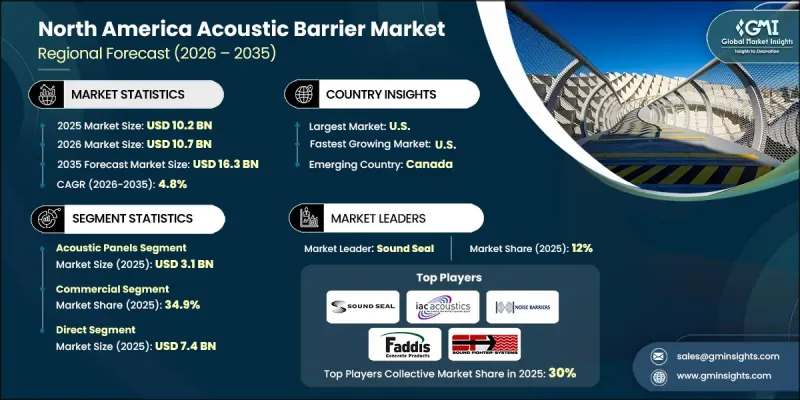
North America Acoustic Barrier Market was valued at USD 10.2 billion in 2025 and is estimated to grow at a CAGR of 4.8% to reach USD 16.3 billion by 2035.
Accelerated urban development across the region continues to intensify noise exposure linked to expanding transportation and industrial activity. As population density rises in metropolitan areas, excessive noise has become a critical concern for both residential and commercial developments. Acoustic barrier solutions are increasingly adopted to mitigate sound transmission, support compliance with environmental guidelines, and enhance overall living and working conditions. The rising focus on sustainable urban planning and community well-being is reinforcing long-term demand for advanced noise control solutions. Market growth is also supported by heightened awareness of the health and environmental implications of prolonged noise exposure, which continues to influence public policy and infrastructure planning decisions across North America.
| Market Scope | |
|---|---|
| Start Year | 2025 |
| Forecast Year | 2026-2035 |
| Start Value | $10.2 Billion |
| Forecast Value | $16.3 Billion |
| CAGR | 4.8% |
Ongoing investment in large-scale infrastructure initiatives by federal and state authorities is creating consistent demand for noise mitigation systems. Urban redevelopment programs and forward-looking city planning initiatives emphasize livability and environmental responsibility, driving the integration of acoustic barriers into project designs. These solutions are no longer viewed solely as functional installations but are increasingly aligned with modern architectural and aesthetic requirements. Stricter noise regulations across the region reflect a growing acknowledgment of the social and ecological impacts of uncontrolled sound levels, further strengthening market adoption.
In 2025, the acoustic panels segment generated USD 3.1 billion. These solutions are designed to absorb sound energy and manage reverberation, improving acoustic comfort within enclosed environments. By limiting sound reflections from structural surfaces, acoustic panels enhance sound clarity and reduce unwanted noise buildup. Their effectiveness in optimizing indoor sound quality has driven widespread adoption across diverse built environments, supporting their strong market position.
The commercial segment accounted for 34.9% share in 2025. Demand from this segment continues to rise as organizations prioritize occupant comfort and productivity. Commercial buildings often face complex noise challenges stemming from surrounding activity and internal mechanical systems. Acoustic barrier solutions address these challenges by limiting external noise intrusion and improving interior acoustic balance, contributing to better operational efficiency and improved user experiences.
U.S. Acoustic Barrier Market held 75.4% share, generating USD 7.7 billion in 2025. The country maintains one of the most developed acoustic solution markets globally, supported by extensive infrastructure networks and stringent regulatory frameworks. Continuous expansion of transportation corridors and dense urban development has elevated the need for sound attenuation solutions. Regulatory programs at both federal and state levels enforce strict noise control requirements, driving sustained installation volumes across residential and commercial zones.
Key companies operating in the North America Acoustic Barrier Market include Valmont Structures, IAC Acoustics, Sound Seal, Technicon Acoustics, Permacast Walls, Kinetics Noise Control, Acoustical Surfaces, Polymer Technologies, Tricon Precast, Echo Barrier USA, Sound Fighter Systems, Shaver Industries, Steel Guard Safety, Noise Barriers, and Faddis Concrete Products. Companies in the North America Acoustic Barrier Market focus on product innovation, regulatory alignment, and strategic partnerships to strengthen their market presence. Many manufacturers invest in advanced material technologies to improve sound absorption performance and durability while meeting evolving environmental standards. Customization capabilities allow suppliers to address diverse project requirements and architectural preferences. Collaboration with infrastructure developers and government agencies supports long-term contract opportunities.
Table of Contents
Chapter 1 Methodology and Scope
- 1.1 Market scope and definition
- 1.2 Research design
- 1.2.1 Research approach
- 1.2.2 Data collection methods
- 1.3 Data mining sources
- 1.3.1 Regional/Country
- 1.4 Base estimates and calculations
- 1.4.1 Base year calculation
- 1.4.2 Key trends for market estimation
- 1.5 Primary research and validation
- 1.5.1 Primary sources
- 1.6 Forecast model
- 1.7 Research assumptions and limitations
Chapter 2 Executive Summary
- 2.1 Industry 360° synopsis
- 2.2 Key market trends
- 2.2.1 Regional
- 2.2.2 Barrier type
- 2.2.3 Material
- 2.2.4 End use industry
- 2.2.5 Distribution channel
- 2.3 CXO perspectives: Strategic imperatives
- 2.3.1 Key decision points for industry executives
- 2.3.2 Critical success factors for market players
- 2.4 Future outlook and strategic recommendations
Chapter 3 Industry Insights
- 3.1 Industry ecosystem analysis
- 3.1.1 Supplier landscape
- 3.1.2 Profit margin
- 3.1.3 Value addition at each stage
- 3.1.4 Factor affecting the value chain
- 3.2 Industry impact forces
- 3.2.1 Growth drivers
- 3.2.1.1 Infrastructure & urbanization expansion
- 3.2.1.2 Stringent noise regulations
- 3.2.1.3 Technological advancements
- 3.2.2 Industry pitfalls & challenges
- 3.2.2.1 High initial cost
- 3.2.2.2 Maintenance & durability issues
- 3.2.3 Opportunities
- 3.2.3.1 Smart acoustic barriers
- 3.2.3.2 Eco-friendly materials
- 3.2.1 Growth drivers
- 3.3 Growth potential analysis
- 3.4 Future market trends
- 3.5 Technology and innovation landscape
- 3.5.1 Current technological trends
- 3.5.2 Emerging technologies
- 3.6 Price trends
- 3.6.1 By country
- 3.6.2 By barrier type
- 3.7 Regulatory landscape
- 3.7.1 Standards and compliance requirements
- 3.7.2 Regional regulatory frameworks
- 3.7.3 Certification standards
- 3.8 Porter’s analysis
- 3.9 PESTEL analysis
Chapter 4 Competitive Landscape, 2025
- 4.1 Introduction
- 4.2 Company market share analysis
- 4.2.1 By country
- 4.2.1.1 U.S.
- 4.2.1.2 Canada
- 4.2.1 By country
- 4.3 Company matrix analysis
- 4.4 Competitive analysis of major market players
- 4.5 Competitive positioning matrix
- 4.6 Key developments
- 4.6.1 Mergers & acquisitions
- 4.6.2 Partnerships & collaborations
- 4.6.3 New product launches
- 4.6.4 Expansion plans
Chapter 5 Market Estimates and Forecast, By Barrier Type, 2022 - 2035 (USD Billion) (Thousand Square Meters)
- 5.1 Key trends
- 5.2 Noise barrier walls
- 5.3 Acoustic panels
- 5.3.1 Wall-mounted
- 5.3.2 Ceiling-mounted
- 5.3.3 Free-standing
- 5.4 Acoustic enclosures
- 5.5 Acoustic fencing
- 5.6 Partition walls/demountable systems
Chapter 6 Market Estimates and Forecast, By Material, 2022 - 2035 (USD Billion) (Thousand Square Meters)
- 6.1 Key trends
- 6.2 Concrete-based barriers
- 6.3 Metal-based barriers
- 6.4 Transparent/acrylic-based barriers
- 6.5 Wood-based barriers
- 6.6 Mineral wool-based
- 6.6.1 Rock wool
- 6.6.2 Glass wool
- 6.7 Foam/polymer-based barriers
- 6.8 Composite/multi-material barrier
Chapter 7 Market Estimates and Forecast, By End Use Industry, 2022 - 2035 (USD Billion) (Thousand Square Meters)
- 7.1 Key trends
- 7.2 Residential
- 7.3 Commercial
- 7.3.1 Office
- 7.3.2 Hospitality
- 7.3.3 Retail
- 7.3.4 Entertainment & recreation
- 7.4 Industrial
- 7.5 Transportation infrastructure
- 7.6 Institutional
Chapter 8 Market Estimates and Forecast, By Distribution Channel, 2022 - 2035 (USD Billion) (Thousand Square Meters)
- 8.1 Key trends
- 8.2 Direct
- 8.3 Indirect
Chapter 9 Market Estimates and Forecast, By Country, 2022 - 2035 (USD Billion) (Thousand Square Meters)
- 9.1 Key trends
- 9.2 U.S.
- 9.3 Canada
Chapter 10 Company Profiles
- 10.1 Acoustical Surfaces
- 10.2 Echo Barrier USA
- 10.3 Faddis Concrete Products
- 10.4 IAC Acoustics
- 10.5 Kinetics Noise Control
- 10.6 Noise Barriers
- 10.7 Permacast Walls
- 10.8 Polymer Technologies
- 10.9 Shaver Industries
- 10.10 Sound Fighter Systems
- 10.11 Sound Seal
- 10.12 Steel Guard Safety
- 10.13 Technicon Acoustics
- 10.14 Tricon Precast
- 10.15 Valmont Structures

