PUBLISHER: Global Market Insights Inc. | PRODUCT CODE: 2019075

PUBLISHER: Global Market Insights Inc. | PRODUCT CODE: 2019075
Toluene Diisocyanate Market Opportunity, Growth Drivers, Industry Trend Analysis, and Forecast 2026 - 2035
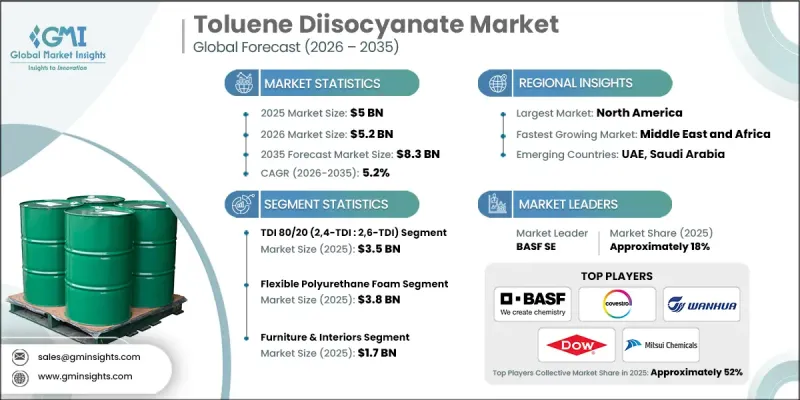
The Global Toluene Diisocyanate Market was valued at USD 5 billion in 2025 and is estimated to grow at a CAGR of 5.2% to reach USD 8.3 billion by 2035.
The market continues to gain momentum as the construction sector expands steadily across developed and emerging economies. Toluene diisocyanate plays a vital role as a raw material in the production of polyurethane foams and insulation systems, which are widely incorporated into modern building structures. The increasing focus on energy-efficient construction, improved thermal insulation, and long-lasting materials has accelerated the integration of polyurethane-based solutions into structural components and building envelopes. Growing urbanization, infrastructure development, and housing demand further support consistent consumption. In addition, the material is extensively used across manufacturing industries, particularly in furniture, bedding, and transportation applications. The shift toward lightweight and performance-enhancing materials in industrial production has strengthened its relevance. Rising population levels and expanding urban infrastructure continue to create long-term demand, while advancements in material science and processing technologies are further enhancing product adoption across multiple end-use sectors.
| Market Scope | |
|---|---|
| Start Year | 2025 |
| Forecast Year | 2026-2035 |
| Start Value | $5 Billion |
| Forecast Value | $8.3 Billion |
| CAGR | 5.2% |
The flexible polyurethane foam segment accounted for USD 3.8 billion in 2025, reflecting its strong presence across both consumer and industrial applications. This segment benefits from its widespread use in cushioning, comfort systems, and interior applications, particularly within the furniture and bedding industries. The material is also utilized in building applications for insulation and sealing purposes, supporting structural durability and improved thermal efficiency. In addition, its application in transportation systems contributes to enhanced comfort, reduced vibration, and improved product performance, making it an essential component across multiple industries.
The furniture and interiors segment reached USD 1.7 billion in 2025. This segment continues to expand as consumer demand rises for high-quality comfort products and interior solutions. Flexible polyurethane materials are widely used in the production of mattresses, seating systems, and cushioning applications, supporting both durability and comfort. Beyond interiors, the construction industry utilizes these materials for insulation and sealing systems, contributing to energy efficiency and structural longevity. Industrial applications further benefit from these materials due to their adaptability and performance-enhancing characteristics.
North America Toluene Diisocyanate Market captured USD 2.6 billion in 2025. The region maintains a solid position due to its established manufacturing ecosystem and diversified industrial demand. The United States continues to drive regional growth through its extensive use of polyurethane materials across construction, furniture, bedding, and industrial applications. Advanced production infrastructure, efficient supply chains, and access to raw materials support consistent market expansion. Ongoing industrial upgrades, coupled with the growing need for high-performance insulation and durable materials, are further strengthening regional demand and ensuring long-term market stability.
Key players operating in the Global Toluene Diisocyanate Market include BASF SE, Covestro AG, Wanhua Chemical Group Co. Ltd, Mitsui Chemicals Inc, DOW, OCI Company Ltd, Gujarat Narmada Valley Fertilizers & Chemicals Limited, KH Chemicals, Elchemy, PalviFZE, Penpet Petrochemicals, and Karoon Petrochemical Company. Companies in the Toluene Diisocyanate Market are focusing on expanding production capacities and strengthening supply chain networks to meet rising global demand. Strategic investments in advanced manufacturing technologies are enabling higher efficiency, improved product consistency, and reduced environmental impact. Market participants are also prioritizing research and development to enhance polyurethane performance characteristics and develop sustainable alternatives. Partnerships and long-term agreements with end-use industries are helping companies secure stable revenue streams and improve market reach. In addition, businesses are adopting environmentally responsible production practices and compliance strategies to align with evolving regulatory standards, while geographic expansion into high-growth regions is further supporting their competitive positioning and long-term growth.
Table of Contents
Chapter 1 Methodology & Scope
- 1.1 Market scope and definition
- 1.2 Research design
- 1.2.1 Research approach
- 1.2.2 Data collection methods
- 1.3 Data mining sources
- 1.3.1 Global
- 1.3.2 Regional/Country
- 1.4 Base estimates and calculations
- 1.4.1 Base year calculation
- 1.4.2 Key trends for market estimation
- 1.5 Primary research and validation
- 1.5.1 Primary sources
- 1.6 Forecast model
- 1.7 Research assumptions and limitations
Chapter 2 Executive Summary
- 2.1 Industry 360° synopsis
- 2.2 Key market trends
- 2.2.1 Regional
- 2.2.2 Product Type
- 2.2.3 Application
- 2.2.4 End Use
- 2.3 TAM Analysis, 2026-2035
- 2.4 CXO perspectives: Strategic imperatives
- 2.4.1 Executive decision points
- 2.4.2 Critical success factors
- 2.5 Future Outlook and Strategic Recommendations
Chapter 3 Industry Insights
- 3.1 Industry ecosystem analysis
- 3.1.1 Supplier Landscape
- 3.1.2 Profit Margin
- 3.1.3 Value addition at each stage
- 3.1.4 Factor affecting the value chain
- 3.1.5 Disruptions
- 3.2 Industry impact forces
- 3.2.1 Growth drivers
- 3.2.1.1 Booming construction industry
- 3.2.1.2 Automotive sector growth
- 3.2.1.3 Technological advancements
- 3.2.2 Industry pitfalls and challenges
- 3.2.2.1 Regulatory pressures
- 3.2.2.2 Volatile raw material prices
- 3.2.3 Market opportunities
- 3.2.3.1 Expansion of Specialized and High-Value Applications
- 3.2.3.2 Regional Supply Chain Localization and Service Integration
- 3.2.1 Growth drivers
- 3.3 Growth potential analysis
- 3.4 Regulatory landscape
- 3.4.1 North America
- 3.4.2 Europe
- 3.4.3 Asia Pacific
- 3.4.4 Latin America
- 3.4.5 Middle East & Africa
- 3.5 Porter's analysis
- 3.6 PESTEL analysis
- 3.7 Price trends
- 3.7.1 By region
- 3.7.2 Product type
- 3.8 Future market trends
- 3.9 Technology and Innovation Landscape
- 3.9.1 Current technological trends
- 3.9.2 Emerging technologies
- 3.10 Patent Landscape
- 3.11 Trade statistics (HS code) (Note: the trade statistics will be provided for key countries only)
- 3.11.1 Major importing countries
- 3.11.2 Major exporting countries
- 3.12 Sustainability and environmental aspects
- 3.12.1 Sustainable practices
- 3.12.2 Waste reduction strategies
- 3.12.3 Energy efficiency in production
- 3.12.4 Eco-friendly initiatives
- 3.13 Carbon footprint considerations
Chapter 4 Competitive Landscape, 2024
- 4.1 Introduction
- 4.2 Company market share analysis
- 4.2.1 By region
- 4.2.1.1 North America
- 4.2.1.2 Europe
- 4.2.1.3 Asia Pacific
- 4.2.1.4 LATAM
- 4.2.1.5 MEA
- 4.2.1 By region
- 4.3 Company matrix analysis
- 4.4 Competitive analysis of major market players
- 4.5 Competitive positioning matrix
- 4.6 Key developments
- 4.6.1 Mergers & acquisitions
- 4.6.2 Partnerships & collaborations
- 4.6.3 New product launches
- 4.6.4 Expansion plans
Chapter 5 Market Estimates and Forecast, By Product Type, 2022 - 2035 (USD billion) (Tons)
- 5.1 Key trends
- 5.2 TDI 80/20 (2,4-TDI : 2,6-TDI)
- 5.3 TDI 65/35 (2,4-TDI : 2,6-TDI)
- 5.4 Pure 2,4-TDI
- 5.5 Others
Chapter 6 Market Estimates and Forecast, By Application, 2022 - 2035 (USD billion) (Tons)
- 6.1 Key trends
- 6.2 Flexible polyurethane foam
- 6.2.1 Furniture
- 6.2.2 Bedding & mattresses
- 6.2.3 Automotive seating
- 6.3 Rigid polyurethane foam
- 6.4 Coatings
- 6.5 Adhesives and sealants
- 6.6 Elastomers
- 6.7 Others
Chapter 7 Market Estimates and Forecast, By End Use, 2022 - 2035 (USD billion) (Tons)
- 7.1 Key trends
- 7.2 Furniture & interiors
- 7.3 Construction
- 7.4 Automotive
- 7.5 Electronics
- 7.6 Packaging
- 7.7 Textiles
- 7.8 Others
Chapter 8 Market Estimates and Forecast, By Region, 2022 - 2035 (USD billion) (Tons)
- 8.1 Key trends
- 8.2 North America
- 8.2.1 U.S.
- 8.2.2 Canada
- 8.3 Europe
- 8.3.1 Germany
- 8.3.2 UK
- 8.3.3 France
- 8.3.4 Spain
- 8.3.5 Italy
- 8.3.6 Rest of Europe
- 8.4 Asia Pacific
- 8.4.1 China
- 8.4.2 India
- 8.4.3 Japan
- 8.4.4 Australia
- 8.4.5 South Korea
- 8.4.6 Rest of Asia Pacific
- 8.5 Latin America
- 8.5.1 Brazil
- 8.5.2 Mexico
- 8.5.3 Rest of Latin America
- 8.6 Middle East and Africa
- 8.6.1 Saudi Arabia
- 8.6.2 South Africa
- 8.6.3 UAE
- 8.6.4 Rest of Middle East and Africa
Chapter 9 Company Profiles
- 9.1 BASF SE
- 9.2 DOW
- 9.3 Covestro AG
- 9.4 Mitsui Chemicals, Inc.,
- 9.5 OCI Company Ltd
- 9.6 Wanhua Chemical Group Co. Ltd
- 9.7 Elchemy
- 9.8 PalviFZE
- 9.9 Penpet Petrochemicals
- 9.10 Gujarat Narmada Valley Fertilizers & Chemicals Limited
- 9.11 Karoon Petrochemical Company
- 9.12 KH Chemicals

