PUBLISHER: Global Market Insights Inc. | PRODUCT CODE: 2019195

PUBLISHER: Global Market Insights Inc. | PRODUCT CODE: 2019195
Chlorotoluene Market Opportunity, Growth Drivers, Industry Trend Analysis, and Forecast 2026 - 2035
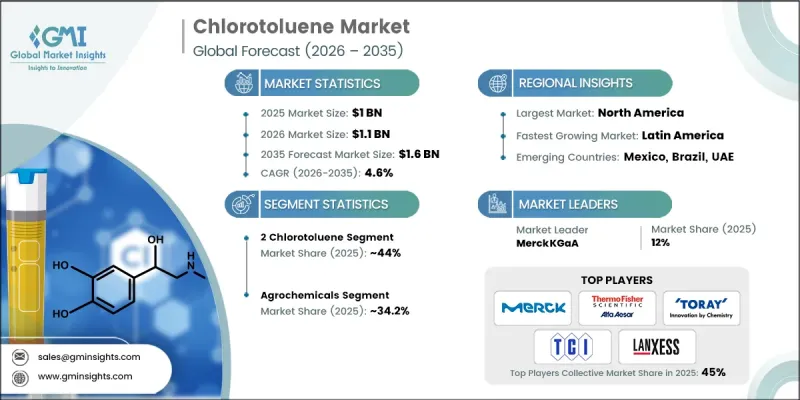
The Global Chlorotoluene Market was valued at USD 1 billion in 2025 and is estimated to grow at a CAGR of 4.6% to reach USD 1.6 billion by 2035.
The chlorotoluene market is benefiting from increasing production of intermediates used in multiple industrial applications, supported by strengthening trade activity across key regions. At the same time, rising costs associated with energy and raw materials are placing pressure on profitability, encouraging manufacturers to optimize operations and improve supply chain efficiency. The chlorotoluene market is also influenced by growing adoption in advanced chemical formulations, supported by stable industrial output trends. Increasing focus on process efficiency and digital monitoring technologies is enhancing production consistency while reducing energy consumption. Expanding domestic consumption in major manufacturing economies is helping balance global supply and demand dynamics. As production systems mature and sustainability initiatives gain traction, the chlorotoluene market is evolving toward more efficient, regionally balanced, and environmentally conscious operations, supporting long-term growth.
| Market Scope | |
|---|---|
| Start Year | 2025 |
| Forecast Year | 2026-2035 |
| Start Value | $1 Billion |
| Forecast Value | $1.6 Billion |
| CAGR | 4.6% |
The chlorotoluene market is also witnessing increasing diversification into specialized applications, which is strengthening its value proposition across industries. Manufacturers are focusing on developing high-performance derivatives that meet specific purity and application requirements. This shift toward specialized formulations is reducing dependence on commodity-driven demand while enabling access to higher-value segments. Continuous product innovation and targeted development strategies are supporting stable growth and improving competitive positioning across various end-use sectors.
The 2-chlorotoluene segment accounted for 44% share in 2025 and is expected to grow at a CAGR of 4.8% through 2035. This segment is expanding due to increasing utilization in intermediate chemical production processes. The chlorotoluene market is evolving toward integrated manufacturing approaches, where producers focus on flexible production systems that can adapt to varying demand patterns. Improvements in catalytic processes and recovery systems are enhancing efficiency, reducing waste, and maintaining consistent product quality.
The agrochemicals segment held 34.2% share in 2025 and is projected to grow at a CAGR of 5% by 2035. Growth in this segment is driven by rising demand for crop protection solutions and expanding formulation capabilities. The chlorotoluene market continues to benefit from its wide application scope across multiple industries, where it serves as a key intermediate in chemical synthesis. Ongoing advancements in formulation technologies are further supporting its adoption across diverse applications.
North America Chlorotoluene Market generated USD 407.4 million in 2025. The chlorotoluene market in the region is expanding due to strong demand for intermediate chemicals and growing production capacity. Advanced manufacturing technologies, efficient waste management systems, and strict regulatory standards are supporting sustainable growth while strengthening the region's competitive position.
Key players operating in the Global Chlorotoluene Market include INEOS, LANXESS Corporation, Merck KGaA, Tokyo Chemical Industry Co. Ltd, TORAY Industries Inc., Gujarat Alkalies & Chemicals, Changzhou Yuanfeng Chemical, Jiangsu Hongxing Chemical, Hunan Zhuzhou Chemical Industry Group, Shandong Exceris Chemical, Shimmer Chemicals, Sovika Group, Iharanikkei Chemical Industry, and Xiamen Kehua Hengsheng. Companies in the Global Chlorotoluene Market are reinforcing their market presence through strategic investments in process innovation and product diversification. Many players are focusing on developing high-purity and application-specific derivatives to cater to evolving industrial requirements. Expansion of production facilities and adoption of advanced manufacturing technologies are helping improve operational efficiency and reduce costs. Companies are also strengthening supply chain networks to ensure consistent availability and minimize disruptions. In addition, collaborations and long-term partnerships are supporting market expansion and technological advancement.
Table of Contents
Chapter 1 Methodology & Scope
- 1.1 Market scope and definition
- 1.2 Research design
- 1.2.1 Research approach
- 1.2.2 Data collection methods
- 1.3 Data mining sources
- 1.3.1 Global
- 1.3.2 Regional/Country
- 1.4 Base estimates and calculations
- 1.4.1 Base year calculation
- 1.4.2 Key trends for market estimation
- 1.5 Primary research and validation
- 1.5.1 Primary sources
- 1.6 Forecast model
- 1.7 Research assumptions and limitations
Chapter 2 Executive Summary
- 2.1 Industry 360° synopsis
- 2.2 Key market trends
- 2.2.1 Regional
- 2.2.2 Type
- 2.2.3 Application
- 2.3 TAM Analysis, 2026-2035
- 2.4 CXO perspectives: Strategic imperatives
- 2.4.1 Executive decision points
- 2.4.2 Critical success factors
- 2.5 Future Outlook and Strategic Recommendations
Chapter 3 Industry Insights
- 3.1 Industry ecosystem analysis
- 3.1.1 Supplier landscape
- 3.1.2 Profit margin
- 3.1.3 Value addition at each stage
- 3.1.4 Factor affecting the value chain
- 3.1.5 Disruptions
- 3.2 Industry impact forces
- 3.2.1 Growth drivers
- 3.2.1.1 Rising demand from agrochemical and dye industries
- 3.2.1.2 Adoption of greener synthesis technologies
- 3.2.1.3 Digital process automation in manufacturing plants
- 3.2.2 Industry pitfalls and challenges
- 3.2.2.1 Volatile feedstock availability and pricing trends
- 3.2.2.2 Stringent global regulatory and safety standards
- 3.2.3 Market opportunities
- 3.2.3.1 Growth in pharma intermediate applications
- 3.2.3.2 Rapid industrialization in emerging Asian economies
- 3.2.1 Growth drivers
- 3.3 Growth potential analysis
- 3.4 Regulatory landscape
- 3.4.1 North America
- 3.4.2 Europe
- 3.4.3 Asia Pacific
- 3.4.4 Latin America
- 3.4.5 Middle East & Africa
- 3.5 Porter's analysis
- 3.6 PESTEL analysis
- 3.7 Price trends
- 3.7.1 By region
- 3.7.2 By type
- 3.8 Future market trends
- 3.9 Technology and Innovation landscape
- 3.9.1 Current technological trends
- 3.9.2 Emerging technologies
- 3.10 Patent Landscape
- 3.11 Trade statistics (HS code)
- 3.11.1 Major importing countries
- 3.11.2 Major exporting countries
- 3.12 Sustainability and environmental aspects
- 3.12.1 Sustainable practices
- 3.12.2 Waste reduction strategies
- 3.12.3 Energy efficiency in production
- 3.12.4 Eco-friendly initiatives
- 3.13 Carbon footprint consideration
Chapter 4 Competitive Landscape, 2025
- 4.1 Introduction
- 4.2 Company market share analysis
- 4.2.1 By region
- 4.2.1.1 North America
- 4.2.1.2 Europe
- 4.2.1.3 Asia Pacific
- 4.2.1.4 LATAM
- 4.2.1.5 MEA
- 4.2.1 By region
- 4.3 Company matrix analysis
- 4.4 Competitive analysis of major market players
- 4.5 Competitive positioning matrix
- 4.6 Key developments
- 4.6.1 Mergers & acquisitions
- 4.6.2 Partnerships & collaborations
- 4.6.3 New Product Launches
- 4.6.4 Expansion Plans
Chapter 5 Market Estimates and Forecast, By Type, 2022-2035 (USD Billion) (Kilo Tons)
- 5.1 Key trends
- 5.2 2-Chlorotoluene
- 5.2.1 Technical/industrial grade
- 5.2.2 High-purity (≥99%)
- 5.2.3 Extra/ultra-pure (≥99.5%) / low moisture-low sulfur
- 5.2.4 Reagent/analytical grade
- 5.3 3-Chlorotoluene
- 5.3.1 Technical/industrial grade
- 5.3.2 High-purity (≥99%)
- 5.3.3 Extra/ultra-pure (≥99.5%) / low moisture-low sulfur
- 5.3.4 Reagent/analytical grade
- 5.4 Others
Chapter 6 Market Estimates and Forecast, By Application, 2022-2035 (USD Billion) (Kilo Tons)
- 6.1 Key trends
- 6.2 Agrochemicals
- 6.3 Pharmaceuticals
- 6.4 Dyes and Pigments
- 6.5 Specialty Chemicals
- 6.6 Polymers
- 6.7 Others
Chapter 7 Market Estimates and Forecast, By Region, 2022-2035 (USD Billion) (Kilo Tons)
- 7.1 Key trends
- 7.2 North America
- 7.2.1 U.S.
- 7.2.2 Canada
- 7.3 Europe
- 7.3.1 Germany
- 7.3.2 UK
- 7.3.3 France
- 7.3.4 Spain
- 7.3.5 Italy
- 7.3.6 Rest of Europe
- 7.4 Asia Pacific
- 7.4.1 China
- 7.4.2 India
- 7.4.3 Japan
- 7.4.4 Australia
- 7.4.5 South Korea
- 7.4.6 Rest of Asia Pacific
- 7.5 Latin America
- 7.5.1 Brazil
- 7.5.2 Mexico
- 7.5.3 Argentina
- 7.5.4 Rest of Latin America
- 7.6 Middle East and Africa
- 7.6.1 Saudi Arabia
- 7.6.2 South Africa
- 7.6.3 UAE
- 7.6.4 Rest of Middle East and Africa
Chapter 8 Company Profiles
- 8.1 Changzhou Yuanfeng Chemical
- 8.2 Gujarat Alkalies & Chemicals
- 8.3 Hunan Zhuzhou Chemical Industry Group
- 8.4 Iharanikkei Chemical Industry
- 8.5 INEOS
- 8.6 Jiangsu Hongxing Chemical
- 8.7 LANXESS Corporation
- 8.8 Merck KGaA
- 8.9 Shandong Exceris Chemical
- 8.10 Shimmer Chemicals
- 8.11 Sovika Group
- 8.12 Xiamen Kehua Hengsheng
- 8.13 Tokyo Chemical Industry Co.Ltd
- 8.14 TORAY Industries Inc.

