PUBLISHER: Mordor Intelligence | PRODUCT CODE: 2043882

PUBLISHER: Mordor Intelligence | PRODUCT CODE: 2043882
Toluene Diisocyanate - Market Share Analysis, Industry Trends & Statistics, Growth Forecasts (2026 - 2031)
The Toluene Diisocyanate Market size was valued at 2.5 Million tons in 2025 and estimated to grow from 2.55 Million tons in 2026 to reach 2.81 Million tons by 2031, at a CAGR of 1.96% during the forecast period (2026-2031).
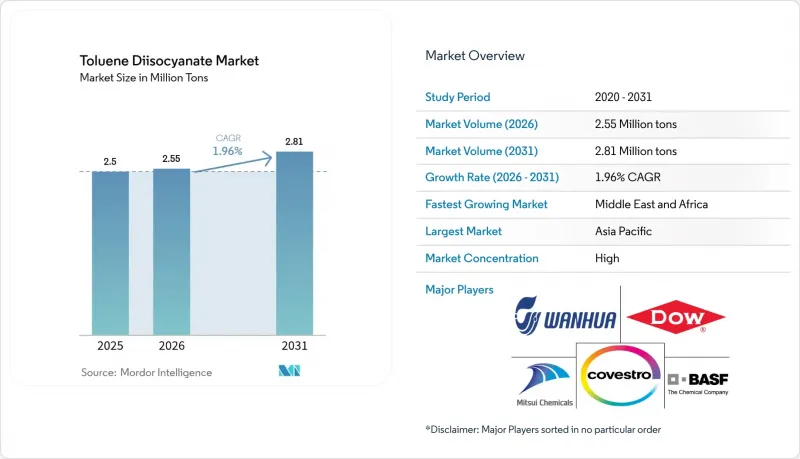
Current growth reflects a sector moving from rapid expansion toward steady maturity, shaped by stricter worker-safety rules, a shift toward phosgene-free routes, and sustained capital spending in Asia-Pacific's integrated petrochemical hubs. Producers are emphasizing low-viscosity, high-purity grades for flexible foams, while downstream users seek lighter, more energy-efficient materials for furniture, transportation, and construction applications. Regional price spikes in 2024-2025-such as Wanhua Chemical's USD 200/ton lift in ASEAN and BASF's USD 300/ton rise in South Asia-underscore persistent feedstock and logistics pressures. Investments like SABIC's USD 6.4 billion ethylene complex in Fujian illustrate long-term confidence in polyurethane demand. Phosgene-free pilot plants, inspired by UC San Diego's bio-based aromatic diisocyanate breakthrough, signal the next technology frontier.
Global Toluene Diisocyanate Market Trends and Insights
Flexible PU-Foam Demand in Furniture and Bedding
Household and commercial furniture makers consume large volumes of TDI because flexible polyurethane delivers soft-touch cushioning, high rebound, and long service life. U.S. furniture and bedding sales topped USD 106 billion in 2024, sustaining foam off-take that exceeded 1.5 billion lb annually. Memory-foam mattresses that blend TDI and MDI enhance pressure relief and command premium retail pricing, while thinner office-chair cushions reduce raw-material use without sacrificing comfort. In Asia-Pacific, urban housing growth, rising disposable incomes, and e-commerce furniture channels spur steady TDI uptake. China's GB 18584-2024 furniture standard, effective July 2025, limits hazardous substances including toluene, prompting local converters to adopt cleaner TDI grades. Collaborative R&D among diisocyanate, polyol, and additive suppliers now focuses on smaller-cell, lower-density foams that support lifetime warranties.
Automotive Seat and Interior Lightweighting
Vehicle makers rely on TDI-based foams for seat cushions, headliners, and acoustical pads because the material cuts weight and improves passenger comfort. Light-duty electrified models intensify weight-reduction targets, lifting TDI demand at a 2.54% CAGR to 2030. Optimal 70:30 TDI:MDI blends raise tensile strength and transparency, delivering consistent feel in hot-and-cold cycles. Automakers also apply TDI in two-component polyurethane coatings that withstand abrasion and chemicals. However, higher MDI ratios shorten pot life, so finishing shops fine-tune catalyst packages to keep processing windows open. Regional sourcing strategies limit supply risk: North American assemblers lean on BASF's expanding Louisiana capacity, while Chinese OEMs source from Wanhua and Covestro clusters.
Toxicity And Worker-Safety Regulations
TDI is a potent respiratory sensitizer classified as Group 2B by IARC, prompting regulators to enforce low exposure thresholds. OSHA sets an 8-hour TWA of 0.02 ppm, while ACGIH recommends 0.001 ppm TWA and 0.005 ppm STEL. Sensitized workers can react at 1-5 ppb, which pushes converters to improve enclosure, ventilation, and personal protective equipment. EPA's Toxic Substances Control Act requires significant-new-use notifications for certain TDI-bearing polymers, adding administrative cost. In the United Kingdom, the Health Security Agency advises complete avoidance of unreacted TDI for sensitized individuals, forcing companies to adopt closed-mix systems and rigorous leak detection.
Other drivers and restraints analyzed in the detailed report include:
- Building-Insulation Codes (Rigid/Flexible Foams)
- EV Battery Thermal-Management Foams
- Toluene/Crude-Oil Price Volatility
For complete list of drivers and restraints, kindly check the Table Of Contents.
Segment Analysis
Foams represented 68.10% of the Toluene diisocyanates market share in 2025, confirming the segment's long-standing position as the principal consumer of difunctional aromatic isocyanates. Within foams, flexible grades command the majority, backed by robust furniture and bedding demand in Asia-Pacific and North America. The Toluene diisocyanates market size for foams is projected to rise in line with downstream capacity additions in China and Southeast Asia. Memory-foam innovations, including viscoelastic and breathable outdoor variants, build on TDI's low viscosity and fast cure, offering lighter mattress cores without compromising rebound or durability.
Growth prospects outside foams continue to improve. Adhesives and sealants account for a modest volume today but are forecast at a 2.27% CAGR through 2031 thanks to stringent bonding requirements in modular construction and electric-vehicle assembly. In coatings, TDI affords high cross-link density for glossy, chemical-resistant finishes on automotive and wood substrates. Elastomers such as rollers and anti-vibration pads round out the portfolio, with niche grades featuring low acidity and narrow isomer ratios for superior mechanical performance.
The Toluene Diisocyanates (TDI) Market Report is Segmented by Application (Foams, Coatings, Adhesives and Sealants, Elastomers, and Other Applications), End-User Industry (Furniture and Interiors, Building and Construction, Automotive, Electronics, Packaging, and Others), and Geography (Asia-Pacific, North America, Europe, South America, and Middle East and Africa). The Market Forecasts are Provided in Terms of Volume (Tons).
Geography Analysis
Asia-Pacific's 47.62% share underscores its integrated supply chains and cost-advantaged feedstock slate. China hosts multiple TDI lines, including Covestro's Shanghai facility expanding from 310 000 tpa to 370 000 tpa by 2025 and Fujian Wanhua's 360 000 tpa project that cleared environmental review. The Toluene diisocyanates market size in the region benefits from export-oriented strategies, with average 2024 FOB prices of USD 1 700-1 800/ton supporting shipments across Southeast Asia. India's rising disposable income and furniture output add incremental demand, while Japan and South Korea emphasize high-purity grades for electronics and specialty elastomers.
North America shows stable consumption underpinned by furniture and automotive sectors. BASF's Geismar expansion will push regional MDI capacity to 600 000 tpa by 2026, indirectly bolstering aromatic diisocyanate value chains. TDI imports enter primarily through Gulf Coast ports, balancing domestic supply fluctuations. Canadian cold-storage retrofits and Mexican vehicle-assembly growth keep converters operating near capacity.
Europe confronts elevated energy costs and stringent decarbonization targets that pressure margins, yet the region retains technological leadership in low-monomer-residual grades. Covestro's chlorine-plant upgrade in Tarragona deploys oxygen-depolarized-cathode technology that trims power needs 25% and secures feedstock for local diisocyanate units. Regulatory initiatives such as EU Ecolabel criteria for mattresses could further limit TDI content, spurring adoption of lower-emission systems.
Middle East and Africa posts the fastest 2.18% CAGR on the back of GCC investments like the Sadara complex, which positions the region for downstream polyurethane diversification. South America remains a smaller but steady outlet, with Brazil's construction recovery and Argentina's auto-parts output supporting gradual volume gains.
- BASF SE
- BorsodChem
- Cangzhou Dahua Group Co., Ltd.
- Covestro AG
- Dow
- GNFC Ltd.
- Hanwha Solutions Chemical Division Corporation
- Karoon Petrochemical Company
- KH Chemicals
- Merck KGaA
- Mitsui Chemicals, Inc.
- OCI Company Ltd.
- Simel Chemical Industry Co., Ltd.
- Thermo Fisher Scientific Inc.
- Tokyo Chemical Industry (India) Pvt., Ltd.
- Wanhua
Additional Benefits:
- The market estimate (ME) sheet in Excel format
- 3 months of analyst support
TABLE OF CONTENTS
1 Introduction
- 1.1 Study Assumptions and Market Definition
- 1.2 Scope of the Study
2 Research Methodology
3 Executive Summary
4 Market Landscape
- 4.1 Market Overview
- 4.2 Market Drivers
- 4.2.1 Flexible PU-Foam Demand in Furniture and Bedding
- 4.2.2 Automotive Seat and Interior Lightweighting
- 4.2.3 Building-Insulation Codes (Rigid/Flexible Foams)
- 4.2.4 EV Battery Thermal-Management Foams
- 4.2.5 Phosgene-Free TDI Scale-Up
- 4.3 Market Restraints
- 4.3.1 Toxicity and Worker-Safety Regulations
- 4.3.2 Toluene/Crude-Oil Price Volatility
- 4.3.3 EU Ecolabel Limits for TDI in Mattresses
- 4.4 Value Chain Analysis
- 4.5 Porter's Five Forces
- 4.5.1 Bargaining Power of Suppliers
- 4.5.2 Bargaining Power of Buyers
- 4.5.3 Threat of New Entrants
- 4.5.4 Threat of Substitutes
- 4.5.5 Degree of Competition
5 Market Size and Growth Forecasts (Volume)
- 5.1 By Application
- 5.1.1 Foams
- 5.1.2 Coatings
- 5.1.3 Adhesives and Sealants
- 5.1.4 Elastomers
- 5.1.5 Other Applications
- 5.2 By End-user Industry
- 5.2.1 Furniture and Interiors
- 5.2.2 Building and Construction
- 5.2.3 Automotive
- 5.2.4 Electronics
- 5.2.5 Packaging
- 5.2.6 Others
- 5.3 By Geography
- 5.3.1 Asia-Pacific
- 5.3.1.1 China
- 5.3.1.2 India
- 5.3.1.3 Japan
- 5.3.1.4 South Korea
- 5.3.1.5 ASEAN Countries
- 5.3.1.6 Rest of Asia-Pacific
- 5.3.2 North America
- 5.3.2.1 United States
- 5.3.2.2 Canada
- 5.3.2.3 Mexico
- 5.3.3 Europe
- 5.3.3.1 Germany
- 5.3.3.2 United Kingdom
- 5.3.3.3 France
- 5.3.3.4 Italy
- 5.3.3.5 Russia
- 5.3.3.6 NORDIC Countries
- 5.3.3.7 Rest of Europe
- 5.3.4 South America
- 5.3.4.1 Brazil
- 5.3.4.2 Argentina
- 5.3.4.3 Rest of South America
- 5.3.5 Middle East and Africa
- 5.3.5.1 Saudi Arabia
- 5.3.5.2 South Africa
- 5.3.5.3 Rest of Middle East and Africa
- 5.3.1 Asia-Pacific
6 Competitive Landscape
- 6.1 Market Concentration
- 6.2 Strategic Moves
- 6.3 Market Share/Ranking Analysis
- 6.4 Company Profiles (includes Global level Overview, Market level overview, Core Segments, Financials as available, Strategic Information, Market Rank/Share, Products and Services, and Recent Developments)
- 6.4.1 BASF SE
- 6.4.2 BorsodChem
- 6.4.3 Cangzhou Dahua Group Co., Ltd.
- 6.4.4 Covestro AG
- 6.4.5 Dow
- 6.4.6 GNFC Ltd.
- 6.4.7 Hanwha Solutions Chemical Division Corporation
- 6.4.8 Karoon Petrochemical Company
- 6.4.9 KH Chemicals
- 6.4.10 Merck KGaA
- 6.4.11 Mitsui Chemicals, Inc.
- 6.4.12 OCI Company Ltd.
- 6.4.13 Simel Chemical Industry Co., Ltd.
- 6.4.14 Thermo Fisher Scientific Inc.
- 6.4.15 Tokyo Chemical Industry (India) Pvt., Ltd.
- 6.4.16 Wanhua
7 Market Opportunities and Future Outlook
- 7.1 White-space and Unmet-Need Assessment

