
PUBLISHER: Global Market Insights Inc. | PRODUCT CODE: 2038650

PUBLISHER: Global Market Insights Inc. | PRODUCT CODE: 2038650
Car Rental Market Opportunity, Growth Drivers, Industry Trend Analysis, and Forecast 2026 - 2035
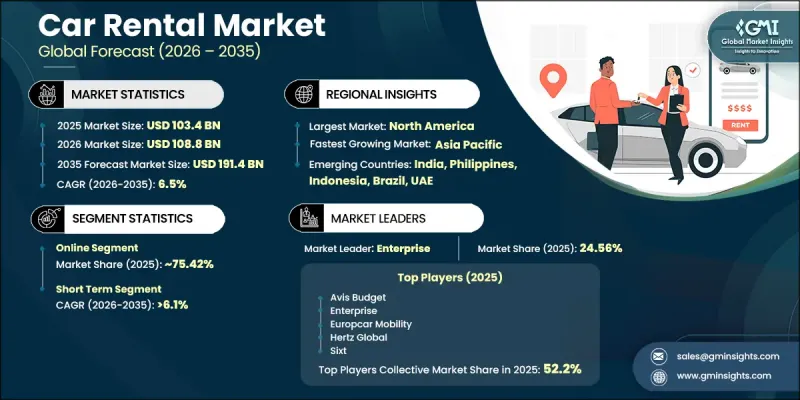
The Global Car Rental Market was valued at USD 103.4 billion in 2025 and is estimated to grow at a CAGR of 6.5% to reach USD 191.4 billion by 2035.
Market expansion is driven by rapid changes in urban mobility patterns, increasing digital adoption, and evolving consumer expectations in travel and transportation. The industry has shifted from traditional counter-based bookings and uniform fleet structures toward highly digital, customer-focused mobility solutions. Widespread use of mobile platforms, AI-enabled reservation systems, and real-time fleet coordination tools is improving booking convenience, enhancing fleet efficiency, and streamlining rental operations across both short-duration and extended rental services. Rising environmental awareness and tightening emission regulations are also reshaping industry direction, pushing rental operators to integrate low-emission and alternative fuel vehicles into their fleets. Companies are increasingly aligning with sustainability goals through investments in electric mobility, charging infrastructure partnerships, and carbon reduction initiatives. At the same time, operational efficiency has become a key focus area, with firms adopting data-driven fleet optimization, predictive maintenance systems, and dynamic pricing strategies. The expansion of telematics and IoT-based tracking solutions is further improving vehicle monitoring, reducing downtime, and enhancing utilization rates across global rental fleets.
| Market Scope | |
|---|---|
| Start Year | 2025 |
| Forecast Year | 2026-2035 |
| Start Value | $103.4 Billion |
| Forecast Value | $191.4 Billion |
| CAGR | 6.5% |
The online booking segment accounted for 75.42% share in 2025 and is projected to grow at a CAGR of 6.9% through 2035. This segment continues to lead due to the strong shift toward digital-first customer behavior. Consumers increasingly prefer web-based and mobile-based platforms for vehicle reservations due to ease of access, transparent pricing structures, and the ability to compare multiple options instantly. The rise of digital transactions, contactless services, and automated booking systems has further strengthened the dominance of online channels while reducing dependence on physical rental offices.
The short-term rental segment held a 75.2% share in 2025 and is expected to grow at a CAGR of 6.1% between 2026 and 2035. This segment remains dominant due to strong demand from travelers, corporate users, and urban commuters requiring temporary mobility solutions. Short-duration rentals provide flexibility for airport transfers, weekend travel, and daily usage needs without long-term commitments. High fleet turnover and frequent bookings also contribute to improved asset utilization and stable revenue generation for rental operators.
U.S. Car Rental Market held a 79% share, generating USD 38 million in 2025. Market growth is supported by the recovery of travel and tourism activities along with rising demand for domestic transportation solutions. Increasing leisure travel, road-based tourism, and corporate travel requirements are significantly boosting rental demand across airports and metropolitan regions. A growing preference for shared mobility over vehicle ownership is further reinforcing market expansion. In addition, advancements in digital platforms and automation technologies are improving service efficiency and customer experience.
Key companies operating in the Global Car Rental Industry include Hertz Global, Avis Budget, Sixt, Enterprise, Europcar Mobility, Nippon Rent-A-Car, CAR Inc., Ryder System, Movida, and Localiza + Movida. Companies in the Car Rental Market are focusing on digital transformation, fleet modernization, and sustainability integration to strengthen their competitive position. Many operators are investing in mobile applications and AI-based booking systems to improve customer experience and streamline operations. Expansion of electric and hybrid vehicle fleets is being prioritized to meet regulatory requirements and environmental goals. Strategic partnerships with mobility service providers and technology firms help enhance service efficiency and data capabilities. Firms are also leveraging telematics, IoT systems, and predictive analytics to optimize fleet performance and reduce maintenance costs. Additionally, dynamic pricing strategies, loyalty programs, and regional expansion initiatives are being used to improve customer retention and increase market penetration across diverse geographic regions.
Table of Contents
Chapter 1 Methodology
- 1.1 Research approach
- 1.2 Quality Commitments
- 1.2.1 GMI AI policy & data integrity commitment
- 1.2.1.1 Source consistency protocol
- 1.2.1 GMI AI policy & data integrity commitment
- 1.3 Research Trail & Confidence Scoring
- 1.3.1 Research Trail Components
- 1.3.2 Scoring Components
- 1.4 Data Collection
- 1.4.1 Partial list of primary sources
- 1.5 Data mining sources
- 1.5.1 Paid sources
- 1.5.1.1 Sources, by region
- 1.5.1 Paid sources
- 1.6 Base estimates and calculations
- 1.6.1 Base year calculation
- 1.7 Forecast Model
- 1.7.1 Quantified market impact analysis
- 1.7.1.1 Mathematical impact of growth parameters on forecast
- 1.7.1 Quantified market impact analysis
- 1.8 Research transparency addendum
- 1.8.1 Source attribution framework
- 1.8.2 Quality assurance metrics
- 1.8.3 Our commitment to trust
Chapter 2 Executive Summary
- 2.1 Industry 360° synopsis, 2022 - 2035
- 2.2 Key market trends
- 2.2.1 Regional
- 2.2.2 Booking
- 2.2.3 Rental Length
- 2.2.4 Vehicle
- 2.2.5 Application
- 2.2.6 End Use
- 2.3 TAM Analysis, 2026-2035
- 2.4 CXO perspectives: Strategic imperatives
Chapter 3 Industry Insights
- 3.1 Industry ecosystem analysis
- 3.1.1 Supplier landscape
- 3.1.2 Profit margin analysis
- 3.1.3 Cost structure
- 3.1.4 Value addition at each stage
- 3.1.5 Factor affecting the value chain
- 3.1.6 Disruptions
- 3.2 Industry impact forces
- 3.2.1 Growth drivers
- 3.2.1.1 Increase in global travel and tourism activities
- 3.2.1.2 Surge in adoption of app-based and contactless car rental platforms
- 3.2.1.3 Rise in preference for shared mobility over vehicle ownership
- 3.2.1.4 Increase in corporate leasing and long-term rental demand
- 3.2.2 Industry pitfalls and challenges
- 3.2.2.1 High Fleet Acquisition and Maintenance Costs
- 3.2.2.2 Regulatory and Insurance Complexities
- 3.2.3 Market opportunities
- 3.2.3.1 Increase in integration with Mobility-as-a-Service (MaaS) platforms
- 3.2.3.2 Surge in expansion across emerging economies
- 3.2.3.3 Rise in demand for subscription-based vehicle rental models
- 3.2.3.4 Increase in adoption of telematics and data-driven fleet management
- 3.2.1 Growth drivers
- 3.3 Growth potential analysis
- 3.4 Technology and Innovation landscape
- 3.4.1 Current technological trends
- 3.4.2 Emerging technologies
- 3.5 Pricing Analysis (Driven by Primary Research)
- 3.5.1 Historical Price Trend Analysis
- 3.5.2 Pricing Strategy by Player Type (Premium / Value / Cost-plus)
- 3.6 Regulatory guideline
- 3.6.1 North America
- 3.6.2 Europe
- 3.6.3 Asia Pacific
- 3.6.4 Latin America
- 3.6.5 MEA
- 3.7 Porter's analysis
- 3.8 PESTEL analysis
- 3.9 Impact of AI & Generative AI on the Market (Driven by Primary Research)
- 3.9.1 AI-Driven Disruption of Existing Business Models
- 3.9.2 GenAI Use Cases & Adoption Roadmap by Segment
- 3.9.3 Risks, Limitations & Regulatory Considerations
- 3.10 Patent Landscape (Driven by Primary Research)
- 3.11 Sustainability and environmental aspects
- 3.11.1 Sustainable practices
- 3.11.2 Waste reduction strategies
- 3.11.3 Energy efficiency in production
- 3.11.4 Eco-friendly initiatives
- 3.11.5 Carbon footprint considerations
- 3.12 Forecast assumptions & scenario analysis (Driven by Primary Research)
- 3.12.1 Base Case - key macro & industry variables driving CAGR
- 3.12.2 Optimistic Scenarios - Favorable Macro and Industry Tailwinds
- 3.12.3 Pessimistic Scenario - Macroeconomic slowdown or industry headwinds
Chapter 4 Competitive Landscape, 2025
- 4.1 Introduction
- 4.2 Company market share analysis
- 4.2.1 North America
- 4.2.2 Europe
- 4.2.3 Asia Pacific
- 4.2.4 Latin America
- 4.2.5 MEA
- 4.3 Competitive analysis of major market players
- 4.4 Competitive positioning matrix
- 4.5 Key developments
- 4.5.1 Mergers & acquisitions
- 4.5.2 Partnerships & collaborations
- 4.5.3 New Product Launches
- 4.5.4 Expansion Plans and funding
- 4.6 Company Tier Benchmarking
- 4.6.1 Tier Classification Criteria & Qualifying Thresholds
- 4.6.2 Tier Positioning Matrix by Revenue, Geography & Innovation
Chapter 5 Market Estimates & Forecast, By Booking, 2022 - 2035 ($Bn)
- 5.1 Key trends
- 5.2 Online
- 5.3 Offline
Chapter 6 Market Estimates & Forecast, By Rental Length, 2022 - 2035 ($Bn)
- 6.1 Key trends
- 6.2 Short term
- 6.3 Long term
Chapter 7 Market Estimates & Forecast, By Vehicle, 2022 - 2035 ($Bn)
- 7.1 Key trends
- 7.2 Luxury cars
- 7.3 Executive cars
- 7.4 Economy cars
- 7.5 SUVs
- 7.6 MUVs
Chapter 8 Market Estimates & Forecast, By Application, 2022 - 2035 ($Bn)
- 8.1 Key trends
- 8.2 Leisure/ Tourism
- 8.3 Business
Chapter 9 Market Estimates & Forecast, By End Use, 2022 - 2035 ($Bn)
- 9.1 Key trends
- 9.2 Self-driven
- 9.3 Chauffeur-driven
Chapter 10 Market Estimates & Forecast, By Region, 2022 - 2035 ($Bn)
- 10.1 Key trends
- 10.2 North America
- 10.2.1 US
- 10.2.2 Canada
- 10.3 Europe
- 10.3.1 Germany
- 10.3.2 UK
- 10.3.3 France
- 10.3.4 Italy
- 10.3.5 Spain
- 10.3.6 Russia
- 10.3.7 Netherlands
- 10.3.8 Belgium
- 10.4 Asia Pacific
- 10.4.1 China
- 10.4.2 India
- 10.4.3 Japan
- 10.4.4 Australia
- 10.4.5 South Korea
- 10.4.6 Philippines
- 10.4.7 Indonesia
- 10.5 Latin America
- 10.5.1 Brazil
- 10.5.2 Mexico
- 10.5.3 Argentina
- 10.6 MEA
- 10.6.1 South Africa
- 10.6.2 Saudi Arabia
- 10.6.3 UAE
Chapter 11 Company Profiles
- 11.1 Global Players
- 11.1.1 Avis Budget Group
- 11.1.2 Enterprise Holdings
- 11.1.3 Europcar Mobility Group
- 11.1.4 Hertz Global Holdings
- 11.1.5 Localiza
- 11.1.6 Movida
- 11.1.7 Penske Truck Rental
- 11.1.8 Ryder System
- 11.1.9 Sixt SE
- 11.1.10 U-Haul
- 11.2 Regional companies
- 11.2.1 AJ Rent a Car
- 11.2.2 CAR Inc.
- 11.2.3 eHi Car Services
- 11.2.4 Lotte Rent-A-Car
- 11.2.5 Nippon Rent-A-Car
- 11.2.6 Orix Rent a Car
- 11.2.7 Redspot Car Rentals
- 11.2.8 Theeb Rent a Car
- 11.2.9 Times Car Rental
- 11.2.10 Toyota Rent a Car
- 11.3 Emerging players
- 11.3.1 Evo Car Share
- 11.3.2 Kinto Share
- 11.3.3 SHARE NOW
- 11.3.4 Virtuo
- 11.3.5 Zipcar

