
PUBLISHER: Mordor Intelligence | PRODUCT CODE: 2097079

PUBLISHER: Mordor Intelligence | PRODUCT CODE: 2097079
Europe Vehicle Rental - Market Share Analysis, Industry Trends & Statistics, Growth Forecasts (2026 - 2031)
According to Mordor Intelligence, the European vehicle rental market size is projected to expand from USD 21.17 billion in 2025 and USD 22.37 billion in 2026 to USD 30.91 billion by 2031, registering a CAGR of 6.68% between 2026 and 2031.
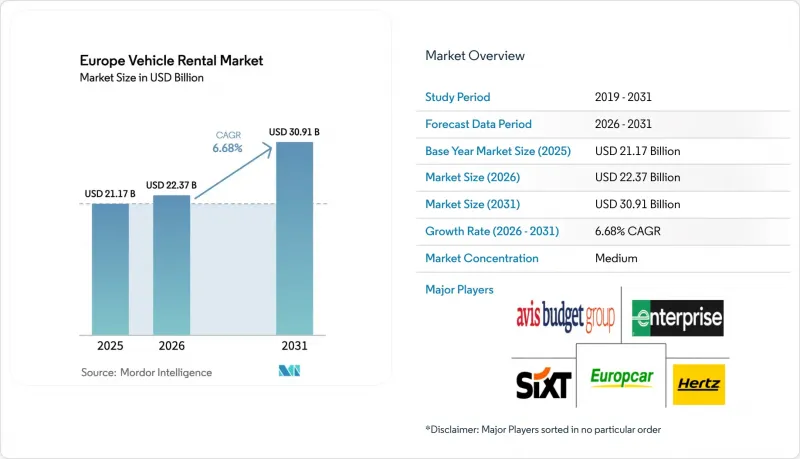
This report is Segmented by Booking Type (Offline and Online), Rental Channel (On-Airport and Off-Airport), Rental Duration (Short Term and Long Term), Application Type (Leisure/Tourism and More), Vehicle Type (Passenger Cars and More), Powertrain (ICE and More), Service Model (Traditional Car Rental and More), End-User, and Country. The Market Forecasts are Provided in Terms of Value (USD).
Europe Vehicle Rental Market Trends and Insights
EU Fit-for-55 Mandates Accelerating Fleet Electrification Among Rental Operators
The EU's European Climate Law sets a legally binding target to reduce net greenhouse-gas emissions by at least 55% by 2030 versus 1990; the Fit for 55 package implements measures (including transport-related rules) to meet that target.. Leading firms have placed multi-year orders for high-volume BEV and plug-in hybrid models, confident that price parity with ICE vehicles will widen customer acceptance. To support these assets, operators are installing high-power depot chargers that shorten turnaround times and preserve utilization. Early adopters are locking in OEM discounts and preferential allocation, creating a widening cost differential versus fast followers who face longer lead times and thinner rebates. Nonetheless, the higher ticket price of BEVs strains balance sheets, prompting joint-venture charging investments and green-bond issuances to fund fleet upgrades.
Mediterranean Tourism Rebound Inflating Leisure-Rental Volumes
In October 2025, Spain welcomed 9.2 million international tourists, marking a 3.2% increase from October 2024. Similar momentum in Italy and France is swelling leisure-rental demand, especially in coastal regions that rely on self-drive mobility. Operators are relocating fleet assets southward to capture peak-season utilization and are extending vehicle holding periods in summer to avoid repositioning costs. The rebound also inflates ancillary revenue from GPS, child-seat, and insurance add-ons, offsetting seasonal price competition. However, sharp winter slowdowns force dynamic pricing and cross-border reallocation to Central Europe to maintain acceptable load factors.
Volatile ICE Residual Values Amid Rapid EV Uptake Denting Fleet ROI
Accelerating BEV adoption is eroding resale demand for petrol and diesel models, depressing auction prices, and extending disposal lead times. An ICE compact that historically commanded over 50% residual value after a year now clears at a rate of nearly 45-48% in major auctions, forcing rental firms to raise depreciation charges. Meanwhile, the still-nascent used-BEV market suffers illiquidity due to battery-degradation concerns, delaying payback even for electrified assets. This twin squeeze compels operators to lengthen holding periods to ride out value troughs, but longer cycles lower average fleet age and heighten maintenance outlays. Financial pressure is already evident in tighter covenant ratios and higher funding spreads for mid-tier lessors.
Other drivers and restraints analyzed in the detailed report include:
- Surge in Digital-Native Travellers Boosting Online Bookings Across Western Europe
- Rise of Subscription-Based Car-as-a-Service Models in Urban Centers
- High EV Acquisition Costs and Charging Infrastructure Investments Straining Capital Allocation
For complete list of drivers and restraints, kindly check the Table Of Contents.
Segment Analysis
Online bookings delivered 61.75% of 2025 revenue, reflecting the Europe vehicle rental market share advantages of platforms that reduce check-in friction and integrate loyalty rewards. The European vehicle rental market size attributed to online channels is set to climb at a 10.23% CAGR by 2031. Price-comparison sites provide customers with transparency, keeping operators honest while encouraging ancillary bundling to maintain yields. Mobile apps now display real-time charger status for BEV reservations, easing range concerns and raising attachment rates for premium battery categories.
The offline channel still retains nearly 38% of market share and caters to corporate clients that prefer centralized account management and consolidated invoicing. Counter agents who upsell full-damage waiver and extended-roadside cover more effectively, through face-to-face support, achieve higher ancillary revenue per booking. Yet rising labor costs and airport concession fees erode the profitability of walk-in transactions, spurring branch automation investments. Hybrid models, such as self-service kiosks at major airports, blur the lines between channels by allowing online vouchers to be converted into physical keys without requiring staff interaction. As these kiosks roll out, offline share will slide while maintaining a strategic role for complex B2B billing needs.
Off-airport locations accounted for 55.68% of the 2025 market, buoyed by suburban and downtown branches that plug into subscription programs. Growth is projected at an 8.15% CAGR by 2031, solidifying the off-airport Europe vehicle rental market's leadership share. Convenience and lower facility rent permit operators to offer attractive weekend packages to locals seeking short leisure trips. Proximity to mass transit nodes also drives one-way rentals, which command higher day rates than round-trip bookings.
On-airport counters still dominate sun-destination leisure itineraries, capturing bookings immediately after arrivals. However, high concession fees increase the cost per booking, prompting operators to drive volume to city branches through loyalty discounts. Consolidated rental centers, complete with multi-brand bays and shared EV chargers, intensify rate competition as customers cross-shop within the same facility. The European vehicle rental market, represented by on-airport segments, will nonetheless continue to expand as inbound tourism grows.
Short-term rentals accounted for 78.96% of the 2025 market size, anchoring the day-rate backbone of the European vehicle rental market. Even so, the long-term category, which includes monthly subscriptions, will outpace at an 8.47% CAGR by 2031, nudging its share of the European vehicle rental market to over 20% by 2031. Subscriptions stabilize utilization by retaining assets with one customer for extended periods, thereby lowering turnaround expenses. They also smooth seasonal swings, reallocating fleet risk away from peak-tourism clusters.
Conversely, holding a vehicle longer raises residual-value exposure if secondary-market prices remain volatile, mainly for ICE models. Sophisticated lease-back structures and guaranteed repurchase agreements with OEMs are emerging to cap depreciation. In addition, telematics data gleaned from subscription fleets enhances predictive maintenance, reducing downtime and preserving resale value. Short-term rentals remain essential for capturing last-minute leisure demand and corporate trips, but their share will gradually erode as urban professionals adopt a subscription mindset.
Complete Report Scope:
- By Booking Type
- Offline
- Online
- By Rental Channel
- On-Airport
- Off-Airport
- By Rental Duration
- Short-Term (up to 30 days)
- Long-Term / Operating Lease (over 30 days)
- By Application
- Leisure / Tourism
- Business / Corporate
- By Vehicle Type
- Passenger Cars
- Light Commercial Vehicles
- Heavy Commercial Vehicles and Buses
- By Powertrain
- Internal Combustion Engine (ICE)
- Hybrid Electric Vehicle (HEV/PHEV)
- Battery Electric Vehicle (BEV)
- By Service Model
- Traditional Car Rental
- Vehicle Subscription
- Car Sharing
- By End-User
- Self-Driven
- Chauffeur-Driven
- Corporate Fleet Outsourcing
- By Country
- Germany
- United Kingdom
- France
- Spain
- Italy
- Netherlands
- Nordics (Sweden, Norway, Denmark, Finland)
- Rest of Europe
List of Companies Covered in this Report:
- Europcar Mobility Group
- Enterprise Holdings Inc.
- SIXT SE
- Avis Budget Group Inc.
- Hertz Global Holdings Inc.
- OK Mobility Group
- Goldcar Rental S.L.
- Auto Europe LLC
- Buchbinder Rent-a-Car
- BlaBlaCar
- Ayvens
- Finn Auto GmbH
- Leasys S.p.A.
- Ubeeqo Carsharing GmbH
- Green Motion International
- Share Now GmbH
- DRIVALIA Car Rental
Additional Benefits:
- The market estimate (ME) sheet in Excel format
- 3 months of analyst support
TABLE OF CONTENTS
1 Introduction
- 1.1 Study Assumptions and Market Definition
- 1.2 Scope of the Study
2 Research Methodology
3 Executive Summary
4 Market Landscape
- 4.1 Market Overview
- 4.2 Market Drivers
- 4.2.1 EU Fit-for-55 Mandates Accelerating Fleet Electrification Among Rental Operators
- 4.2.2 Mediterranean Tourism Rebound Inflating Leisure-Rental Volumes
- 4.2.3 Surge in Digital-Native Travellers Boosting Online Bookings Across Western Europe
- 4.2.4 Rise of Subscription-Based Car-as-a-Service Models in Urban Centres
- 4.2.5 Rapid Expansion of EV Charging Infrastructure Enabling Fleet Electrification
- 4.2.6 Corporate Sustainability Programmes Favouring Low-Carbon Rental Packages
- 4.3 Market Restraints
- 4.3.1 Volatile ICE Residual Values Amid Rapid EV Uptake Denting Fleet ROI
- 4.3.2 High EV Acquisition Costs and Charging Infrastructure Investments Straining Capital Allocation
- 4.3.3 Stricter EU Consumer-Protection and Pricing-Transparency Rules Inflating Compliance Costs
- 4.3.4 Urban Car-Sharing and Ride-Hailing Cannibalising Intra-City Rentals
- 4.4 Regulatory and Technological Outlook
- 4.5 Porter's Five Forces
- 4.5.1 Threat of New Entrants
- 4.5.2 Bargaining Power of Buyers
- 4.5.3 Bargaining Power of Suppliers
- 4.5.4 Threat of Substitutes
- 4.5.5 Intensity of Competitive Rivalry
5 Market Size and Growth Forecasts (Value)
- 5.1 By Booking Type
- 5.1.1 Offline
- 5.1.2 Online
- 5.2 By Rental Channel
- 5.2.1 On-Airport
- 5.2.2 Off-Airport
- 5.3 By Rental Duration
- 5.3.1 Short-Term (up to 30 days)
- 5.3.2 Long-Term / Operating Lease (over 30 days)
- 5.4 By Application
- 5.4.1 Leisure / Tourism
- 5.4.2 Business / Corporate
- 5.5 By Vehicle Type
- 5.5.1 Passenger Cars
- 5.5.2 Light Commercial Vehicles
- 5.5.3 Heavy Commercial Vehicles and Buses
- 5.6 By Powertrain
- 5.6.1 Internal Combustion Engine (ICE)
- 5.6.2 Hybrid Electric Vehicle (HEV/PHEV)
- 5.6.3 Battery Electric Vehicle (BEV)
- 5.7 By Service Model
- 5.7.1 Traditional Car Rental
- 5.7.2 Vehicle Subscription
- 5.7.3 Car Sharing
- 5.8 By End-User
- 5.8.1 Self-Driven
- 5.8.2 Chauffeur-Driven
- 5.8.3 Corporate Fleet Outsourcing
- 5.9 By Country
- 5.9.1 Germany
- 5.9.2 United Kingdom
- 5.9.3 France
- 5.9.4 Spain
- 5.9.5 Italy
- 5.9.6 Netherlands
- 5.9.7 Nordics (Sweden, Norway, Denmark, Finland)
- 5.9.8 Rest of Europe
6 Competitive Landscape
- 6.1 Market Concentration
- 6.2 Strategic Moves (M&A, Partnerships, Fleet Investments)
- 6.3 Market Share Analysis
- 6.4 Company Profiles (Includes Global-level Overview, Market-level Overview, Core Segments, Financials, Strategic Information, Market Rank/Share, Products and Services, Recent Developments)
- 6.4.1 Europcar Mobility Group
- 6.4.2 Enterprise Holdings Inc.
- 6.4.3 SIXT SE
- 6.4.4 Avis Budget Group Inc.
- 6.4.5 Hertz Global Holdings Inc.
- 6.4.6 OK Mobility Group
- 6.4.7 Goldcar Rental S.L.
- 6.4.8 Auto Europe LLC
- 6.4.9 Buchbinder Rent-a-Car
- 6.4.10 BlaBlaCar
- 6.4.11 Ayvens
- 6.4.12 Finn Auto GmbH
- 6.4.13 Leasys S.p.A.
- 6.4.14 Ubeeqo Carsharing GmbH
- 6.4.15 Green Motion International
- 6.4.16 Share Now GmbH
- 6.4.17 DRIVALIA Car Rental
7 Market Opportunities and Future Outlook
- 7.1 White-Space and Unmet-Need Assessment

