PUBLISHER: Global Market Insights Inc. | PRODUCT CODE: 2038728

PUBLISHER: Global Market Insights Inc. | PRODUCT CODE: 2038728
Intelligent Transportation System (ITS) Market Opportunity, Growth Drivers, Industry Trend Analysis, and Forecast 2026 - 2035
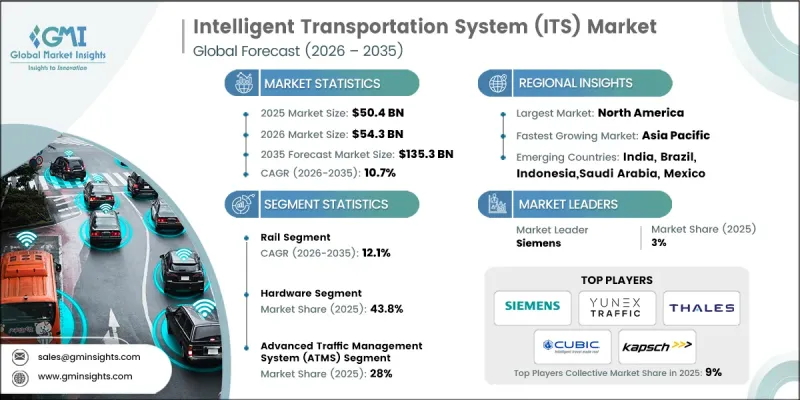
The Global Intelligent Transportation System Market was valued at USD 50.4 billion in 2025 and is estimated to grow at a CAGR of 10.7% to reach USD 135.3 billion by 2035.
The intelligent transportation system market is witnessing strong momentum as urban areas prioritize smarter mobility solutions and digital infrastructure upgrades. Increasing financial support through collaborative funding models between public and private entities is accelerating large-scale deployment while reducing implementation risks. Rising demand for seamless and contactless travel experiences is encouraging the adoption of digital fare systems and flexible payment solutions. Governments are actively introducing regulatory frameworks to enhance traffic efficiency, reduce congestion, and improve road safety through advanced transportation technologies. Investments in modernizing transportation networks are further driving adoption, supported by the integration of intelligent monitoring and communication systems. The emergence of artificial intelligence is transforming traffic management through predictive analytics and real-time optimization, enabling cities to manage congestion more effectively. Additionally, evolving tolling frameworks are shifting toward dynamic pricing models designed to regulate traffic flow and enhance revenue generation. These developments collectively position the intelligent transportation system market for sustained long-term growth.
| Market Scope | |
|---|---|
| Start Year | 2025 |
| Forecast Year | 2026-2035 |
| Start Value | $50.4 Billion |
| Forecast Value | $135.3 Billion |
| CAGR | 10.7% |
The rail segment accounted for 41% share in 2025 and is expected to grow at a CAGR of 12.1% through 2035. The segment continues to expand as electrification initiatives and network enhancements gain traction globally. Ongoing investments in rail infrastructure are supporting efficiency improvements and capacity expansion. The adoption of advanced monitoring systems and predictive maintenance technologies is enabling better asset utilization and operational performance, contributing to overall system reliability.
The hardware segment held a share of 43.8% in 2025 and is anticipated to grow at a CAGR of 10.5% from 2026 to 2035. Growth in this segment is driven by increasing deployment of high-performance computing components, energy-efficient processors, and connected devices. Advancements in edge computing and sensor integration are strengthening real-time data processing capabilities, while expanding digital infrastructure is supporting scalable and efficient transportation networks.
U.S. Intelligent Transportation System Market reached USD 16.1 billion in 2025. The market is expanding as cities implement advanced traffic management solutions powered by artificial intelligence and data analytics. Municipal initiatives focused on improving mobility efficiency and reducing congestion are driving adoption. The development of connected transportation ecosystems, supported by enhanced communication technologies, is enabling better coordination between vehicles, infrastructure, and urban systems.
Key companies operating in the Global Intelligent Transportation System Market include Kapsch TrafficCom, Siemens Mobility, Conduent, Cubic Transportation Systems, Indra Sistemas, Iteris, SWARCO, Thales, TomTom, and Yunex Traffic. Companies in the intelligent transportation system market are focusing on innovation, partnerships, and digital transformation to strengthen their market position. Investments in artificial intelligence, data analytics, and cloud-based platforms are enabling more advanced and scalable solutions. Strategic collaborations with government agencies and infrastructure developers are helping companies secure long-term projects and expand their global footprint. Firms are also prioritizing the development of integrated mobility platforms that enhance user experience and operational efficiency. Continuous advancements in hardware and software capabilities, along with the adoption of smart city initiatives, are supporting product differentiation.
Table of Contents
Chapter 1 Methodology
- 1.1 Research approach
- 1.2 Quality commitments
- 1.3 GMI AI policy & data integrity commitment
- 1.4 Research trail & confidence scoring
- 1.4.1 Research trail components
- 1.4.2 Scoring components
- 1.5 Data collection
- 1.5.1 Partial list of primary sources
- 1.6 Data mining sources
- 1.6.1 Paid sources
- 1.7 Base estimates and calculations
- 1.7.1 Base year calculation
- 1.8 Forecast model
- 1.9 Research transparency addendum
Chapter 2 Executive Summary
- 2.1 Industry 360° synopsis
- 2.2 Key market trends
- 2.2.1 Regional
- 2.2.2 Mode of transport
- 2.2.3 Component
- 2.2.4 System
- 2.2.5 Application
- 2.3 TAM analysis, 2026-2035
- 2.4 CXO perspectives: Strategic imperatives
Chapter 3 Industry Insights
- 3.1 Industry ecosystem analysis
- 3.1.1 Supplier landscape
- 3.1.2 Profit margin
- 3.1.3 Cost structure
- 3.1.4 Value addition at each stage
- 3.1.5 Factor affecting the value chain
- 3.1.6 Disruptions
- 3.2 Industry impact forces
- 3.2.1 Growth drivers
- 3.2.1.1 Government funding and PPP models
- 3.2.1.2 Demand for Pay-as-you-go ticketing service among commuters in Europe and North America
- 3.2.1.3 Rise in favorable government initiatives for effective traffic management in North America and Asia Pacific
- 3.2.1.4 Growing investment in railway infrastructure in Europe
- 3.2.2 Industry pitfalls and challenges
- 3.2.2.1 Integration complexities with legacy systems
- 3.2.2.2 High cost of maritime equipment
- 3.2.3 Market opportunities
- 3.2.3.1 Smart city expansion
- 3.2.3.2 Ai & predictive analytics integration
- 3.2.3.3 Connected & autonomous vehicle ecosystem
- 3.2.3.4 Public-private partnerships (PPP) & infrastructure funding
- 3.2.1 Growth drivers
- 3.3 Growth potential analysis
- 3.4 Technology and innovation landscape
- 3.4.1 Current technological trends
- 3.4.2 Emerging technologies
- 3.5 Pricing analysis (Driven by Primary Research)
- 3.5.1 Historical price trend analysis
- 3.5.2 Pricing strategy by player type (premium / value / cost-plus)
- 3.6 Regulatory landscape
- 3.6.1 North America
- 3.6.1.1 Federal Communications Commission (FCC)
- 3.6.1.2 Innovation, Science and Economic Development Canada (ISED)
- 3.6.2 Europe
- 3.6.2.1 European Commission - DG CONNECT
- 3.6.2.2 Body of European Regulators for Electronic Communications (BEREC)
- 3.6.3 Asia Pacific
- 3.6.3.1 Ministry of Industry and Information Technology (MIIT), China
- 3.6.3.2 Telecom Regulatory Authority of India (TRAI)
- 3.6.4 Latin America
- 3.6.4.1 Agencia Nacional de Telecomunicacoes (ANATEL), Brazil
- 3.6.4.2 Instituto Federal de Telecomunicaciones (IFT), Mexico
- 3.6.5 Middle East & Africa
- 3.6.5.1 Communications and Information Technology Commission (CITC), Saudi Arabia
- 3.6.5.2 Independent Communications Authority of South Africa (ICASA)
- 3.6.1 North America
- 3.7 Porter's analysis
- 3.8 PESTEL analysis
- 3.9 Cost breakdown analysis
- 3.10 Patent analysis (Driven by Primary Research)
- 3.11 Trade data analysis (Driven by paid database)
- 3.11.1 Import/export volume & value trends
- 3.11.2 Key trade corridors & tariff impact
- 3.12 Impact of AI & Generative AI on the Market
- 3.12.1 AI-driven disruption of existing business models
- 3.12.2 Gen AI use cases & adoption roadmap by segment
- 3.12.3 Risks, limitations & regulatory considerations
- 3.13 Sustainability and environmental aspects
- 3.13.1 Sustainable practices
- 3.13.2 Waste reduction strategies
- 3.13.3 Energy efficiency in production
- 3.13.4 Eco-friendly initiatives
- 3.13.5 Carbon footprint considerations
- 3.14 Forecast assumptions & scenario analysis (Driven by primary research)
- 3.14.1 Base Case - key macro & industry variables driving CAGR
- 3.14.2 Optimistic Scenarios - Favorable macro and industry tailwinds
- 3.14.3 Pessimistic Scenario - Macroeconomic slowdown or industry headwinds
Chapter 4 Competitive Landscape, 2025
- 4.1 Introduction
- 4.2 Company market share analysis
- 4.2.1 North America
- 4.2.2 Europe
- 4.2.3 Asia Pacific
- 4.2.4 LATAM
- 4.2.5 MEA
- 4.3 Competitive analysis of major market players
- 4.4 Competitive positioning matrix
- 4.5 Key developments
- 4.5.1 Mergers & acquisitions
- 4.5.2 Partnerships & collaborations
- 4.5.3 New product launches
- 4.5.4 Expansion plans and funding
Chapter 5 Market Estimates & Forecast, By Mode of Transport, 2022 - 2035 ($Mn)
- 5.1 Key trends
- 5.2 Rail
- 5.3 Road
- 5.4 Air
- 5.5 Marine
Chapter 6 Market Estimates & Forecast, By Component, 2022 - 2035 ($Mn)
- 6.1 Key trends
- 6.2 Hardware
- 6.2.1 Telecommunication networks
- 6.2.2 Interface boards
- 6.2.3 Sensors
- 6.2.4 Monitoring & detection systems
- 6.2.5 Surveillance cameras
- 6.2.6 Others
- 6.3 Software
- 6.3.1 Visualization software
- 6.3.2 Video detection management software
- 6.3.3 Transit management system
- 6.3.4 Traffic analytics & AI platforms
- 6.3.5 Others
- 6.4 Services
- 6.4.1 Professional services
- 6.4.2 Managed services
Chapter 7 Market Estimates & Forecast, By System, 2022 - 2035 ($Mn)
- 7.1 Key trends
- 7.2 Advanced Traffic Management System (ATMS)
- 7.3 Advanced Traveler Information System (ATIS)
- 7.4 Advanced Transportation Pricing System (ATPS)
- 7.5 Advanced Public Transport System (APTS)
- 7.6 Advanced Rural Transportation System (ARTS)
- 7.7 Commercial Vehicle Operation (CVO)
Chapter 8 Market Estimates & Forecast, By Application, 2022 - 2035 ($Mn)
- 8.1 Key trends
- 8.2 Traffic management
- 8.3 Fleet management & asset monitoring
- 8.4 Smart ticketing
- 8.5 Public transport & passenger information
- 8.6 Road safety & security
- 8.7 Smart parking & guidance
- 8.8 Tolling & congestion pricing
- 8.9 Environmental & emission monitoring
- 8.10 Connected & autonomous vehicle (CAV) support
- 8.11 Others
Chapter 9 Market Estimates & Forecast, By Region, 2022 - 2035 ($Mn)
- 9.1 Key trends
- 9.2 North America
- 9.2.1 U.S.
- 9.2.2 Canada
- 9.3 Europe
- 9.3.1 Germany
- 9.3.2 UK
- 9.3.3 France
- 9.3.4 Italy
- 9.3.5 Spain
- 9.3.6 Nordics
- 9.3.7 Russia
- 9.3.8 Poland
- 9.3.9 Romania
- 9.4 Asia Pacific
- 9.4.1 China
- 9.4.2 India
- 9.4.3 Japan
- 9.4.4 South Korea
- 9.4.5 ANZ
- 9.4.6 Vietnam
- 9.4.7 Indonesia
- 9.4.8 Philippines
- 9.5 Latin America
- 9.5.1 Brazil
- 9.5.2 Mexico
- 9.5.3 Argentina
- 9.6 MEA
- 9.6.1 South Africa
- 9.6.2 Saudi Arabia
- 9.6.3 UAE
Chapter 10 Company Profiles
- 10.1 Global players
- 10.1.1 Cisco Systems
- 10.1.2 Conduent
- 10.1.3 Cubic Transportation Systems
- 10.1.4 Hitachi
- 10.1.5 IBM
- 10.1.6 Indra Sistemas
- 10.1.7 Kapsch TrafficCom
- 10.1.8 NEC Corporation
- 10.1.9 Siemens Mobility
- 10.1.10 Thales
- 10.2 Regional players
- 10.2.1 Econolite
- 10.2.2 Iteris
- 10.2.3 Q-Free ASA
- 10.2.4 Sumitomo Electric Industries
- 10.2.5 SWARCO
- 10.2.6 TomTom
- 10.2.7 TransCore
- 10.2.8 Yunex Traffic
- 10.3 Emerging players
- 10.3.1 Applied Information
- 10.3.2 Jenoptik Mobility Solutions
- 10.3.3 Miovision
- 10.3.4 Rekor Systems

