
PUBLISHER: Global Market Insights Inc. | PRODUCT CODE: 2061287

PUBLISHER: Global Market Insights Inc. | PRODUCT CODE: 2061287
Asia Pacific Coffee Machines Market Opportunity, Growth Drivers, Industry Trend Analysis, and Forecast 2026 - 2035
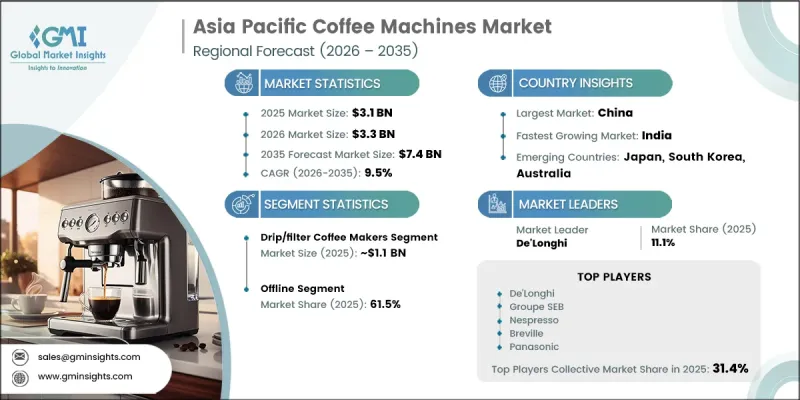
Asia Pacific Coffee Machines Market was valued at USD 3.1 billion in 2025 and is estimated to grow at a CAGR of 9.5% to reach USD 7.4 billion by 2035.
The market is experiencing strong growth due to rapid urbanization and the expansion of middle-income consumer groups across the region. As urban populations continue to increase and disposable incomes rise, consumers are showing greater interest in modern kitchen appliances that support convenience-focused lifestyles. Changing consumption habits and the growing influence of global cafe culture are significantly accelerating coffee adoption across several Asia Pacific countries. Coffee consumption is increasingly associated with modern living, premium lifestyles, and productivity-oriented routines, driving rising demand for home and commercial coffee machines. The entry of international coffee chains and expanding cafe networks has also increased consumer exposure to premium coffee experiences, further encouraging investment in home brewing solutions. Technological advancements in automation, connectivity, and energy-efficient systems are strengthening product adoption, while smart coffee machines integrated with connected home ecosystems are gaining popularity among tech-oriented consumers. Increased product accessibility and competitive pricing are further supporting market expansion across residential and commercial sectors.
| Market Scope | |
|---|---|
| Start Year | 2025 |
| Forecast Year | 2026-2035 |
| Start Value | $3.1 Billion |
| Forecast Value | $7.4 Billion |
| CAGR | 9.5% |
The drip and filter coffee makers segment generated USD 1.1 billion in 2025 and is expected to reach USD 2.8 billion by 2035. Demand for these machines is being supported by increasing consumer preference for sustainable and multifunctional brewing solutions. Younger consumers are increasingly prioritizing energy-efficient products made with recyclable components and environmentally responsible materials. At the same time, the growing home brewing trend is encouraging demand for versatile coffee machines capable of preparing multiple beverage styles through a single appliance, enhancing convenience and customization for users.
The offline distribution channel accounted for 61.5% share in 2025. Physical retail stores continue to dominate sales due to the experiential advantages they provide during the purchasing process. Consumers often prefer evaluating machine design, build quality, operational functionality, and brewing performance in person before making purchasing decisions, particularly for premium coffee machines. Commercial buyers also rely heavily on offline retail channels for customized installation services, bulk purchasing negotiations, and local after-sales support, which remain critical factors influencing buying behavior.
China Coffee Machines Market held a 37.7% share in 2025. The country's market leadership is supported by rapid urban development, rising disposable incomes, and the fast expansion of coffee consumption culture across metropolitan areas. The growing popularity of home brewing, increased adoption of premium lifestyle products, and the expansion of digital retail platforms are all contributing to stronger coffee machine demand. Consumers are increasingly investing in automatic and capsule-based coffee machines that offer convenience, consistency, and modern functionality suited to evolving lifestyle preferences.
Major companies operating in the Asia Pacific Coffee Machines Market include De'Longhi, Breville, Nespresso, Philips, Panasonic, Groupe SEB, Electrolux, JURA, Keurig Dr Pepper, Franke, Cimbali, Nuova Simonelli, Rancilio, Rocket Espresso, Thermoplan, Bezzera, Tiger, Zojirushi, Dr. Coffee, Sunbeam, and CAYE. Companies operating in the Asia Pacific coffee machines market are implementing multiple strategies to strengthen their market position and increase customer engagement. Product innovation remains a major focus area, with manufacturers introducing smart coffee machines featuring automation, app connectivity, customizable brewing settings, and energy-efficient technologies. Companies are also emphasizing sustainability by incorporating recyclable materials, reducing energy consumption, and developing environmentally friendly product designs to align with changing consumer preferences. Expansion through e-commerce platforms and omnichannel retail strategies is helping brands improve accessibility and reach a broader customer base across urban and emerging markets. In addition, businesses are investing in premium product portfolios and multifunctional brewing systems to cater to rising home barista trends and evolving lifestyle demands. Strategic collaborations with cafes, hospitality providers, and retail distributors are further enhancing brand visibility and market penetration.
Table of Contents
Chapter 1 Methodology & Scope
- 1.1 Research approach
- 1.2 Quality Commitments
- 1.2.1 GMI AI policy & data integrity commitment
- 1.2.1.1 Source consistency protocol
- 1.2.1 GMI AI policy & data integrity commitment
- 1.3 Research Trail & Confidence Scoring
- 1.3.1 Research Trail Components
- 1.3.2 Scoring Components
- 1.4 Data Collection
- 1.4.1 Partial list of primary sources
- 1.5 Data mining sources
- 1.5.1 Paid sources
- 1.5.1.1 Sources, by region
- 1.5.1 Paid sources
- 1.6 Base estimates and calculations
- 1.6.1 Base year calculation for any one approach
- 1.7 Forecast model
- 1.7.1 Quantified market impact analysis
- 1.7.1.1 Mathematical impact of growth parameters on forecast
- 1.7.1 Quantified market impact analysis
- 1.8 Research transparency addendum
- 1.8.1 Source attribution framework
- 1.8.2 Quality assurance metrics
- 1.9 Our commitment to trust
Chapter 2 Executive Summary
- 2.1 Industry 360° synopsis, 2022 - 2035
- 2.2 Key market trends
- 2.2.1 Country
- 2.2.2 Product type trends
- 2.2.3 Technology trends
- 2.2.4 Price range trends
- 2.2.5 End use trends
- 2.2.6 Distribution channel trends
Chapter 3 Industry Insights
- 3.1 Industry ecosystem analysis
- 3.1.1 Supplier landscape
- 3.1.2 Profit margin
- 3.1.3 Value addition at each stage
- 3.1.4 Factor affecting the value chain
- 3.2 Industry impact forces
- 3.2.1 Growth drivers
- 3.2.1.1 Growing home coffee culture
- 3.2.1.2 Rising demand from offices and hospitality spaces
- 3.2.1.3 Preference for convenience and customization
- 3.2.2 Industry pitfalls & challenges
- 3.2.2.1 High competition and brand differentiation
- 3.2.2.2 Maintenance and after-sales concerns
- 3.2.3 Opportunities
- 3.2.3.1 Untapped rural & tier 2/3 city markets
- 3.2.3.2 Commercial segment expansion (offices, co-working spaces)
- 3.2.1 Growth drivers
- 3.3 Growth potential analysis
- 3.4 Regulatory framework
- 3.4.1 Product Safety & Certification Standards by Country
- 3.4.2 Energy Efficiency Regulations (China GB Standards, India BEE)
- 3.4.3 Environmental Compliance (RoHS, WEEE Directives)
- 3.4.4 Import/Export Regulations & Tariff Structures
- 3.5 Major market trends and disruptions
- 3.6 Technology/innovation landscape
- 3.6.1 Current trends
- 3.6.2 Emerging trends
- 3.7 Pricing Analysis (driven by primary research)
- 3.7.1 Historical price trend analysis (driven by primary research)
- 3.7.2 Pricing strategy by player type (premium / value / cost-plus) (driven by primary research)
- 3.8 Future market trends
- 3.9 Trade data analysis (driven by paid database) (HS Code-85167100)
- 3.9.1 Import/export volume & value trends (driven by primary research)
- 3.9.2 Key trade corridors & tariff impact (driven by primary research)
- 3.10 Impact of AI & Generative AI on the Market
- 3.10.1 AI-driven disruption of existing business models
- 3.10.2 Gen-AI use cases & adoption roadmap by segment
- 3.10.3 Risks, limitations & regulatory considerations
- 3.11 Porter's analysis
- 3.12 PESTEL analysis
- 3.13 Distribution Infrastructure & Channel Penetration Landscape (Driven by Primary Research)
- 3.13.1 Channel Coverage by Region & Format (Modern vs. Traditional Trade) (Driven by Primary Research)
- 3.13.2 Last-Mile Infrastructure Gaps & Emerging Channel Shifts (Driven by Primary Research)
- 3.13.3 E-Commerce Penetration in Asia-Pacific Markets
Chapter 4 Competitive Landscape, 2025
- 4.1 Introduction
- 4.2 Company market share analysis
- 4.2.1 By Country
- 4.2.1.1 China
- 4.2.1.2 India
- 4.2.1.3 Japan
- 4.2.1.4 South Korea
- 4.2.1.5 Australia
- 4.2.1.6 Rest of Asia Pacific
- 4.2.1 By Country
- 4.3 Company matrix analysis
- 4.4 Competitive analysis of major market players
- 4.5 Competitive positioning matrix
- 4.6 Key developments
- 4.6.1 Mergers & acquisitions
- 4.6.2 Partnerships & collaborations
- 4.6.3 New product launches
- 4.6.4 Expansion plans
Chapter 5 Market Estimates & Forecast, By Product Type, 2022 - 2035, (USD Billion) (Thousand Units)
- 5.1 Key trends
- 5.2 Espresso machines
- 5.3 Drip coffee makers
- 5.4 Single-serve coffee machines
- 5.5 Others (bean to cup, etc.)
Chapter 6 Market Estimates & Forecast, By Technology, 2022 - 2035, (USD Billion) (Thousand Units)
- 6.1 Key trends
- 6.2 Manual
- 6.3 Semi- Automatic
- 6.4 Automatic
Chapter 7 Market Estimates & Forecast, By Price range, 2022 - 2035, (USD Billion) (Thousand Units)
- 7.1 Key trends
- 7.2 Low
- 7.3 Medium
- 7.4 High
Chapter 8 Market Estimates & Forecast, By End use, 2022 - 2035, (USD Billion) (Thousand Units)
- 8.1 Key trends
- 8.2 Residential
- 8.3 Commercial
Chapter 9 Market Estimates & Forecast, By Distribution Channel, 2022 - 2035, (USD Billion) (Thousand Units)
- 9.1 Key trends
- 9.2 Online
- 9.2.1 E-commerce
- 9.2.2 Company website
- 9.3 Offline
- 9.3.1 Specialty stores
- 9.3.2 Mega retail stores
- 9.3.3 Others (individual stores, etc.)
Chapter 10 Market Estimates & Forecast, By Country, 2022 - 2035, (USD Billion) (Thousand Units)
- 10.1 Key trends
- 10.2 China
- 10.3 India
- 10.4 Japan
- 10.5 South Korea
- 10.6 Australia
- 10.7 Rest of Asia Pacific
Chapter 11 Company Profiles
- 11.1 Global Companies
- 11.1.1 De'Longhi
- 11.1.2 Electrolux
- 11.1.3 Groupe SEB
- 11.1.4 Keurig Dr Pepper
- 11.1.5 Nespresso
- 11.1.6 Panasonic
- 11.1.7 Philips
- 11.2 Regional Companies
- 11.2.1 Breville
- 11.2.2 Cimbali
- 11.2.3 JURA
- 11.2.4 Nuova Simonelli
- 11.2.5 Rancilio
- 11.2.6 Tiger
- 11.2.7 Zojirushi
- 11.3 Emerging Companies
- 11.3.1 Bezzera
- 11.3.2 CAYE
- 11.3.3 Dr. Coffee
- 11.3.4 Franke
- 11.3.5 Rocket Espresso
- 11.3.6 Sunbeam
- 11.3.7 Thermoplan

