PUBLISHER: Global Market Insights Inc. | PRODUCT CODE: 2045810

PUBLISHER: Global Market Insights Inc. | PRODUCT CODE: 2045810
Coffee Machines Market Opportunity, Growth Drivers, Industry Trend Analysis, and Forecast 2026 - 2035
The Global Coffee Machines Market was valued at USD 11.6 billion in 2025 and is estimated to grow at a CAGR of 6.3% to reach USD 21.2 billion by 2035.
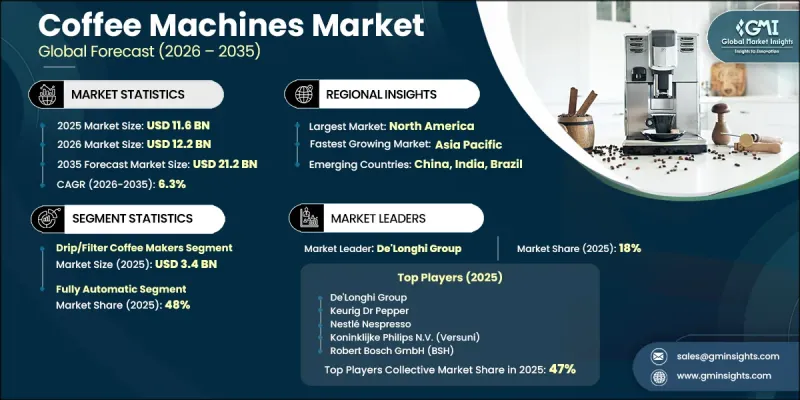
The coffee machines industry is evolving steadily as changing consumer lifestyles, growing cafe culture, and increasing preference for premium coffee experiences continue to reshape purchasing behavior worldwide. Coffee consumption is no longer limited to a routine activity, as consumers now associate coffee preparation with comfort, convenience, personalization, and lifestyle enhancement. This shift has increased demand for technologically advanced coffee machines that can deliver professional-quality beverages across residential and commercial environments. Rising urbanization, fast-paced schedules, and increasing disposable income levels are further supporting the adoption of compact, automated, and energy-efficient coffee machines. In commercial spaces including offices, restaurants, cafes, and hotels, coffee machines are increasingly viewed as essential customer service and employee convenience solutions. Manufacturers are also focusing on sustainability initiatives by developing machines with recyclable components, lower energy consumption, and reduced waste generation. In addition, increasing consumer preference for customizable brewing settings, milk frothing options, and smart connectivity features continues to accelerate innovation across the global coffee machines market.
| Market Scope | |
|---|---|
| Start Year | 2025 |
| Forecast Year | 2026-2035 |
| Start Value | $11.6 Billion |
| Forecast Value | $21.2 Billion |
| CAGR | 6.3% |
The drip and filter coffee maker segment accounted for USD 3.4 billion in 2025. Demand for these machines remains strong because consumers continue to favor practical, reliable, and easy-to-operate brewing systems suitable for everyday use. Their popularity is supported by straightforward functionality, cost efficiency, and the ability to prepare multiple servings in a single cycle. Residential consumers, workplaces, and hospitality establishments continue to prefer drip coffee systems due to their operational simplicity and consistent brewing performance. Manufacturers are also enhancing these machines with programmable features, compact designs, temperature control systems, and energy-saving capabilities to align with modern consumer expectations. The growing preference for convenient coffee preparation solutions across households and commercial establishments is expected to further strengthen demand for drip and filter coffee machines over the forecast period.
The fully automatic segment held a share of 48% in 2025. Fully automatic coffee machines continue to gain substantial traction as consumers increasingly prioritize convenience, speed, precision, and consistent beverage quality. These systems simplify the entire brewing process by automating grinding, brewing, milk frothing, and cleaning functions with minimal manual involvement. The growing demand for premium coffee experiences at home, combined with the expansion of commercial foodservice operations, has significantly accelerated the adoption of fully automatic systems. Businesses are increasingly investing in these machines to improve operational efficiency, maintain beverage consistency, and enhance customer satisfaction. Continuous product advancements, including touch-screen interfaces, personalized brewing profiles, app-based controls, and intelligent maintenance alerts, are further elevating product demand. In addition, the rising preference for sophisticated coffee solutions in offices, hotels, and retail establishments is expected to support long-term segment growth.
North America Coffee Machines Market held a 74% share, generating USD 2.6 billion in 2025. The strong coffee culture across the region continues to drive consistent demand for advanced brewing equipment in both residential and commercial settings. Consumers across North America increasingly prefer coffee machines that combine convenience, durability, ease of maintenance, and premium beverage quality. Growing adoption of specialty coffee beverages, increasing work-from-home trends, and rising investments in hospitality infrastructure are contributing to market expansion. Commercial establishments are also prioritizing high-performance coffee systems to improve customer experiences and operational productivity. Additionally, technological innovation, growing awareness regarding sustainable appliances, and the increasing availability of smart coffee machines are further supporting industry growth across the U.S. and the broader North American region.
Key participants operating in the Global Coffee Machines Market include De'Longhi Group, Panasonic Corporation, Groupe SEB, BUNN, Nuova Simonelli, Breville Group, Nestle Nespresso S.A., Robert Bosch GmbH, Thermoplan AG, WMF Group, Rocket Espresso Milano, Rancilio Group, Hamilton Beach Brands, Inc., Franke Coffee Systems, Victoria Arduino, Keurig Dr Pepper, Koninklijke Philips N.V., JURA Elektroapparate AG, Bezzera S.r.l., La Cimbali, and Eversys S.A. Companies operating in the coffee machines market are adopting multiple strategies to strengthen their market position and expand their customer base globally. Manufacturers are heavily investing in product innovation focused on automation, smart connectivity, energy efficiency, and personalized brewing technologies to enhance user experience and differentiate their offerings. Strategic partnerships with hospitality chains, offices, cafes, and retail distributors are helping companies increase product visibility and strengthen distribution networks. Many brands are also introducing sustainable coffee machines featuring recyclable materials, low-energy operations, and reduced waste systems to align with environmental goals and changing consumer preferences.
Table of Contents
Chapter 1 Methodology & Scope
- 1.1 Research approach
- 1.2 Quality Commitments
- 1.2.1 GMI AI policy & data integrity commitment
- 1.2.1.1 Source consistency protocol
- 1.2.1 GMI AI policy & data integrity commitment
- 1.3 Research Trail & Confidence Scoring
- 1.3.1 Research Trail Components
- 1.3.2 Scoring Components
- 1.4 Data Collection
- 1.4.1 Partial list of primary sources
- 1.5 Data mining sources
- 1.5.1 Paid sources
- 1.5.1.1 Sources, by region
- 1.5.1 Paid sources
- 1.6 Base estimates and calculations
- 1.6.1 Base year calculation for any one approach
- 1.7 Forecast model
- 1.7.1 Quantified market impact analysis
- 1.7.1.1 Mathematical impact of growth parameters on forecast
- 1.7.1 Quantified market impact analysis
- 1.8 Research transparency addendum
- 1.8.1 Source attribution framework
- 1.8.2 Quality assurance metrics
- 1.8.3 Our commitment to trust
Chapter 2 Executive Summary
- 2.1 Industry 360° synopsis
- 2.2 Key market trends
- 2.2.1 Regional
- 2.2.2 Product type trends
- 2.2.3 Technology trends
- 2.2.4 Price range trends
- 2.2.5 End use trends
- 2.2.6 Distribution channel trends
Chapter 3 Industry Insights
- 3.1 Industry ecosystem analysis
- 3.1.1 Supplier landscape
- 3.1.2 Profit margin analysis
- 3.1.3 Value addition at each stage
- 3.1.4 Factor affecting the value chain
- 3.1.5 Disruptions
- 3.2 Industry impact forces
- 3.2.1 Growth drivers
- 3.2.2 Industry pitfalls & challenges
- 3.3 Growth potential analysis
- 3.3.1 By End Use
- 3.3.1.1 Residential
- 3.3.1.2 Commercial
- 3.3.1 By End Use
- 3.4 Future market trends
- 3.5 Technology and innovation landscape
- 3.5.1 Current technological trends
- 3.5.2 Emerging technologies
- 3.6 Pricing analysis (driven by primary research)
- 3.6.1 Historical price trend analysis (driven by primary research)
- 3.6.2 Pricing strategy by player type
- 3.7 Regulatory landscape
- 3.7.1 Standards and compliance requirements
- 3.7.2 Regional regulatory frameworks
- 3.7.3 Certification standards
- 3.8 Impact of AI and generative AI on the market
- 3.8.1 AI driven disruption of existing business models
- 3.8.2 Generative AI use cases and adoption roadmap by segment
- 3.8.3 Risks, limitations, and regulatory considerations
- 3.9 Trade analysis (driven by paid database) (HS Code: 85167100)
- 3.9.1 Top 10 export countries
- 3.9.2 Top 10 import countries
- 3.9.3 Key trade corridors and tariff impact
- 3.10 Capacity and production landscape (driven by primary research)
- 3.10.1 Installed manufacturing capacity by region and key producer (driven by primary research)
- 3.10.2 Capacity utilization rates and expansion pipelines (driven by primary research)
- 3.11 Porter's analysis
- 3.12 PESTEL analysis
- 3.13 Consumer behavior analysis
- 3.13.1 Purchasing patterns
- 3.13.2 Preference analysis
- 3.13.3 Regional variations in consumer behavior
- 3.13.4 Impact of e-commerce on buying decisions
- 3.14 Segment-Specific Market Dynamics
- 3.14.1 Professional & Traditional Espresso Market Outlook
- 3.14.2 Prosumer Market Dynamics
- 3.14.3 Commercial Segment Growth Trajectory
- 3.14.4 Residential vs. Commercial Demand Comparison
- 3.15 Manufacturer Performance & Sales Trends
- 3.15.1 Global Producer Revenue Trends
- 3.15.2 Sales Growth by Manufacturer Tier
- 3.15.3 Market Share Shifts & Consolidation Trends
- 3.15.4 Production Volume Trends by Region
Chapter 4 Competitive Landscape, 2025
- 4.1 Introduction
- 4.2 Company market share analysis
- 4.2.1 By Region
- 4.2.1.1 North America
- 4.2.1.2 Europe
- 4.2.1.3 Asia Pacific
- 4.2.1.4 Latin America
- 4.2.1.5 Middle East & Africa
- 4.2.1 By Region
- 4.3 Company matrix analysis
- 4.4 Competitive analysis of major market players
- 4.5 Competitive positioning matrix
- 4.6 Key developments
- 4.6.1 Mergers & acquisitions
- 4.6.2 Partnerships & collaborations
- 4.6.3 New product launches
- 4.6.4 Expansion plans
Chapter 5 Market Estimates & Forecast, By Product Type, 2022 - 2035, (USD Billion) (Thousand Units)
- 5.1 Key trends
- 5.2 Espresso Machines
- 5.2.1 Traditional/Manual Espresso
- 5.2.2 Semi-Automatic Espresso
- 5.2.3 Super-Automatic Espresso
- 5.2.4 Prosumer Espresso
- 5.3 Drip/Filter Coffee Makers
- 5.4 Single-Serve/Capsule Machines
- 5.5 Bean-to-Cup Machines
- 5.6 Others (French press, Moka pot, percolators, pour-over systems)
Chapter 6 Market Estimates & Forecast, By Technology, 2022 - 2035, (USD Billion) (Thousand Units)
- 6.1 Key trends
- 6.2 Manual
- 6.3 Semi-Automatic
- 6.4 Fully Automatic/Super-Automatic
- 6.5 Smart/Connected
Chapter 7 Market Estimates & Forecast, By End Use, 2022 - 2035, (USD Billion) (Thousand Units)
- 7.1 Key trends
- 7.2 Manual
- 7.2.1 Residential
- 7.2.1.1 Entry-Level/Mainstream Home Users
- 7.2.1.2 Prosumer/Enthusiast
- 7.2.2 Commercial
- 7.2.2.1 Specialty Coffee & Hospitality
- 7.2.2.2 Institutional & General Foodservice
- 7.2.1 Residential
- 7.3 Semi-Automatic
- 7.3.1 Residential
- 7.3.1.1 Entry-Level/Mainstream Home Users
- 7.3.1.2 Prosumer/Enthusiast
- 7.3.2 Commercial
- 7.3.2.1 Specialty Coffee & Hospitality
- 7.3.2.2 Institutional & General Foodservice
- 7.3.1 Residential
- 7.4 Fully Automatic/Super-Automatic
- 7.4.1 Residential
- 7.4.1.1 Entry-Level/Mainstream Home Users
- 7.4.1.2 Prosumer/Enthusiast
- 7.4.2 Commercial
- 7.4.2.1 Specialty Coffee & Hospitality
- 7.4.2.2 Institutional & General Foodservice
- 7.4.1 Residential
- 7.5 Smart/Connected
- 7.5.1 Residential
- 7.5.1.1 Entry-Level/Mainstream Home Users
- 7.5.1.2 Prosumer/Enthusiast
- 7.5.2 Commercial
- 7.5.2.1 Specialty Coffee & Hospitality
- 7.5.2.2 Institutional & General Foodservice
- 7.5.1 Residential
Chapter 8 Market Estimates & Forecast, By Price range, 2022 - 2035, (USD Billion) (Thousand Units)
- 8.1 Key trends
- 8.2 Low (<$200)
- 8.3 Medium ($200-$1,000)
- 8.4 High (>$1,000)
Chapter 9 Market Estimates & Forecast, By End use, 2022 - 2035, (USD Billion) (Thousand Units)
- 9.1 Key trends
- 9.2 Residential
- 9.2.1 Entry-Level/Mainstream Home Users
- 9.2.2 Prosumer/Enthusiast
- 9.3 Commercial
- 9.3.1 Specialty Coffee & Hospitality
- 9.3.2 Institutional & General Foodservice
Chapter 10 Market Estimates & Forecast, By Distribution Channel, 2022 - 2035, (USD Billion) (Thousand Units)
- 10.1 Key trends
- 10.2 Online
- 10.2.1 E-commerce
- 10.2.2 Company website
- 10.3 Offline
- 10.3.1 Specialty coffee equipment stores
- 10.3.2 Retail/Mega stores
- 10.3.3 Direct B2B (manufacturer to commercial buyers)
- 10.3.4 Others (independent retailers)
Chapter 11 Market Estimates & Forecast, By Region, 2022 - 2035, (USD Billion) (Thousand Units)
- 11.1 Key trends
- 11.2 North America
- 11.2.1 U.S.
- 11.2.2 Canada
- 11.3 Europe
- 11.3.1 Germany
- 11.3.2 UK
- 11.3.3 France
- 11.3.4 Italy
- 11.3.5 Spain
- 11.4 Asia Pacific
- 11.4.1 China
- 11.4.2 India
- 11.4.3 Japan
- 11.4.4 South Korea
- 11.4.5 Australia
- 11.4.6 Indonesia
- 11.4.7 Malaysia
- 11.5 Latin America
- 11.5.1 Brazil
- 11.5.2 Mexico
- 11.5.3 Argentina
- 11.6 MEA
- 11.6.1 Saudi Arabia
- 11.6.2 UAE
- 11.6.3 South Africa
Chapter 12 Company Profiles
- 12.1 Top Global Players
- 12.1.1 De'Longhi Group
- 12.1.2 Keurig Dr Pepper
- 12.1.3 Nestle Nespresso S.A.
- 12.1.4 Koninklijke Philips N.V.
- 12.1.5 Robert Bosch GmbH
- 12.1.6 Groupe SEB
- 12.1.7 Panasonic Corporation
- 12.2 Regional Champions
- 12.2.1 La Cimbali (Gruppo Cimbali S.p.A.)
- 12.2.2 Nuova Simonelli
- 12.2.3 Rancilio Group
- 12.2.4 JURA Elektroapparate AG
- 12.2.5 WMF Group
- 12.2.6 Hamilton Beach Brands, Inc.
- 12.2.7 BUNN (Bunn-O-Matic Corporation)
- 12.3 Niche / Specialist Players
- 12.3.1 Rocket Espresso Milano
- 12.3.2 Victoria Arduino
- 12.3.3 Bezzera S.r.l.
- 12.3.4 Eversys S.A.
- 12.3.5 Thermoplan AG
- 12.3.6 Franke Coffee Systems
- 12.3.7 Breville Group

